
Abu Dhabi T10 2026: Dates, Six Teams and Pakistan Time Guide
Check Abu Dhabi T10 2026 dates, six teams and the official venue. Learn to convert fixtures to Pakistan time and read ten-over scorecards.
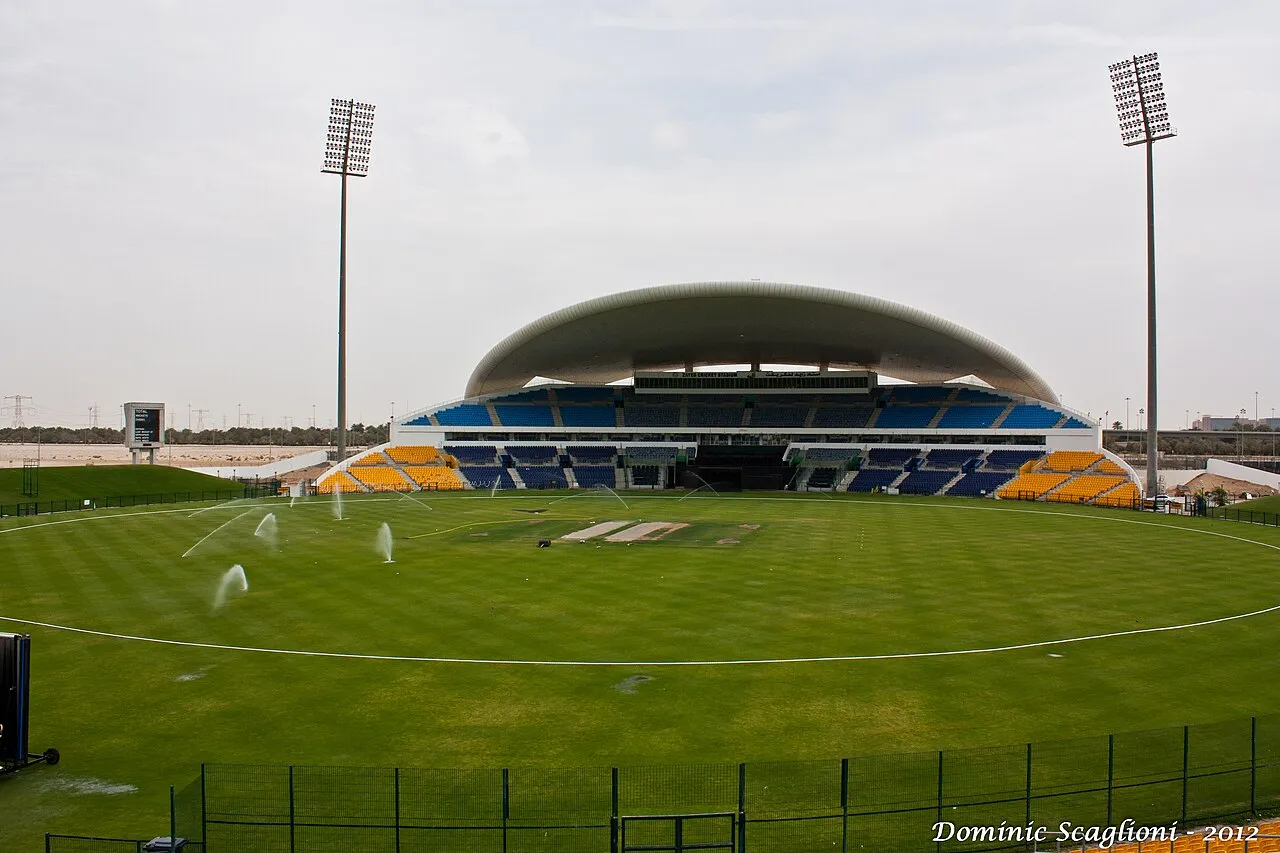
Abu Dhabi T10 returns from 7 to 20 November 2026 at Zayed Cricket Stadium, according to the competition's official website checked on 7 November. The site presents six teams for its tenth season. For Pakistan readers, the practical questions are straightforward: which season is this, where is it played, what does ten-over cricket mean, and how should a fixture time be converted?
This guide answers those questions without pretending to be a live score feed. Match results, last-minute replacements and broadcasting rights can change after publication. The dated tournament window below comes from the organiser; the arithmetic examples are original teaching examples, not predictions or reported performances from the opening matches.
When and where is Abu Dhabi T10 2026?
The organiser lists 7–20 November 2026 and Zayed Cricket Stadium in Abu Dhabi. Keep the year attached when saving a fixture, because older seasons remain visible in search results. A page advertising last year's team names or final is not a reliable substitute for the current season's match centre.
Tournament dates versus individual fixtures
A tournament window tells you the span within which the event takes place. It does not say that every team plays on every day, or that every match begins at the same time. To make a useful personal calendar, copy the individual pairing, date, venue and displayed timezone from the official schedule. Record when you checked it so that a later revision can be spotted.
Follow the organiser's match centre
The official homepage links to a dedicated matches section. That is the sensible starting point for checking a pairing rather than relying on a screenshot with no year. If a schedule is presented through an embedded interface and a particular browser fails to display it, try the organiser's normal page in an updated browser. An empty panel is not evidence that a fixture has been cancelled.
Which teams appear on the official website?
The six names displayed are Arabian Aces, UAE Bulls, Emirates Eagles, Royal Desert Champions, United Tigers and Yas Lions. These are the organiser's 2026 labels, not a reconstruction from old franchise lists. Save team names as text rather than identifying them only by shirt colours, which may look different under lights or in promotional graphics.
A team label is not a confirmed eleven
Knowing which franchise is involved does not establish its final playing eleven. A contracted player, a drafted player, an available player and someone named at the toss are different statuses. Before describing a favourite batter as playing today, look for the official match lineup. A promotional poster can show someone who is not available for that particular game.
Similar names need careful handling
Many short-format competitions use words such as Tigers, Bulls or Lions. A search result containing one of those words is not enough to identify Abu Dhabi's competition. Match the full franchise name with the tournament and season. In a spreadsheet, separate columns for competition, year and team prevent unrelated statistics being combined simply because two teams share a mascot.
What does T10 mean in cricket?
T10 is the short-format label associated with innings scheduled for ten overs per side. An over normally contains six legal deliveries. That gives 60 legal balls in an uninterrupted ten-over innings, although wides and no-balls can add deliveries. A match's specific playing conditions still determine interruptions, shortened innings and other event procedures.
Ten overs create a small opportunity budget
In a fictional innings, losing twelve legal balls to quiet periods uses one fifth of the scheduled 60-ball allocation. This is why a short spell can appear decisive. It does not mean every batter must attempt a boundary on every delivery: wickets, bowling quality, field placement and the current target all affect sensible choices. Speed of format should not be confused with absence of strategy.
Overs are not decimal fractions
A score shown after 6.4 overs means six completed overs and four legal balls, or 40 legal deliveries. It does not mean 6.4 multiplied by six. If you calculate run rate from that notation, first convert it to balls and then divide by six. This small conversion error can make an otherwise convincing match analysis numerically wrong.
How do run rate and required rate work?
Run rate is runs divided by overs expressed as an actual fraction of six-ball overs. Required rate uses the runs still needed divided by the overs remaining. Both measures help describe an innings, but neither guarantees how the remaining balls will unfold. Always label whether you are discussing scoring so far or the pace needed next.
A fictional run-rate example
Suppose a side has 72 after 6.4 overs. Forty balls have been used, equivalent to 6⅔ overs. Its rate is 72 divided by 6⅔, or 10.8 runs per over. Dividing 72 by the written number 6.4 would produce 11.25, which is wrong for cricket notation. The example is invented for learning and is not a 2026 league score.
A fictional chase example
Imagine a target of 121, with the chasing side on 73 after seven overs. It needs 48 more runs from 18 legal balls, so the required rate is 16 per over. Reaching 120 would only equal the first innings' total in this example. Describing the target and remaining requirement separately prevents the familiar mistake of treating a tie as a completed successful chase.
How should Pakistan viewers read the start time?
Pakistan Standard Time is one hour ahead of Gulf Standard Time used in Abu Dhabi. If an organiser explicitly lists a start at 15:30 GST, that corresponds to 16:30 PKT. This is a conversion example, not a promise that a particular match starts then. Some sports sites already adjust schedules to the visitor's device timezone.
Avoid converting an already localised time
Before adding an hour, inspect the timezone label near the schedule. A display saying PKT or Asia/Karachi is already local for Pakistan. A display saying UTC needs five hours added, whereas GST needs one. If the page provides no label, check its timezone selector rather than guessing from the website's country or the language of the article.
Save the date together with the time
Time conversions can cross midnight. An invented example of 23:30 in Abu Dhabi becomes 00:30 the following day in Pakistan. Saving only the hour would send a viewer to the correct clock time on the wrong date. A useful calendar entry includes the local date, local time, original timezone and a link back to the fixture.
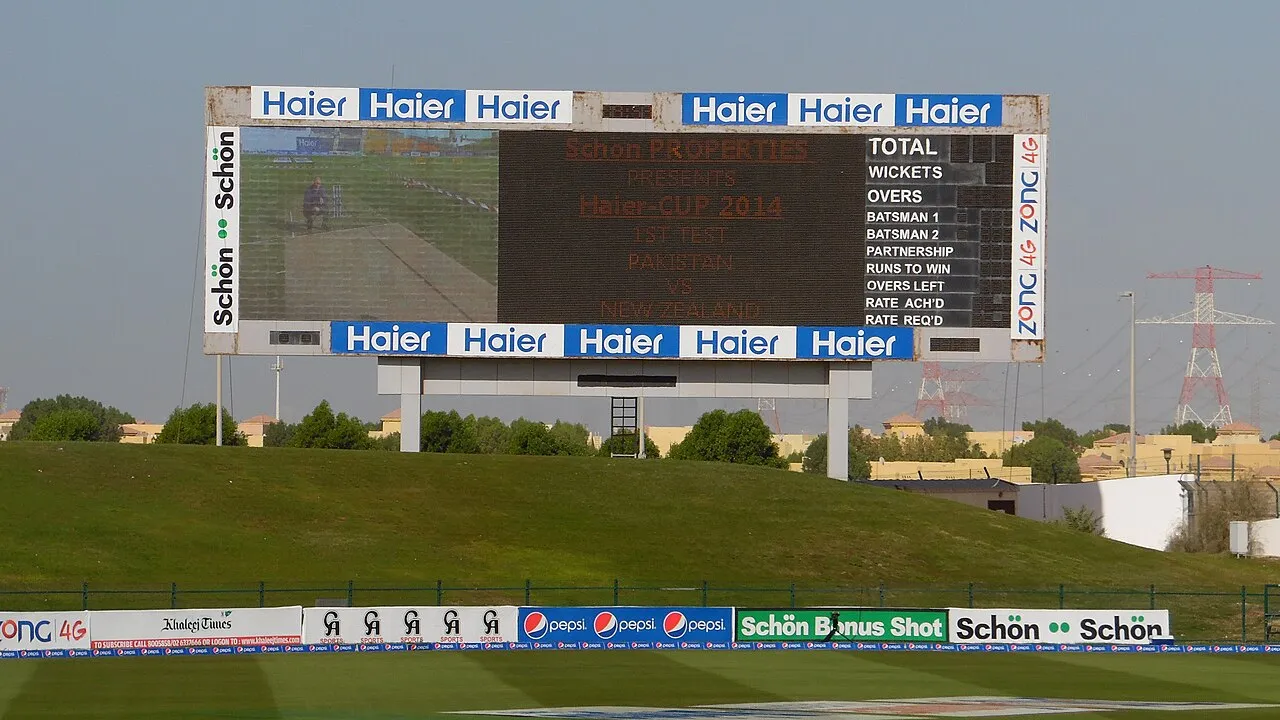
A different view of Sheikh Zayed Cricket Stadium from 2014, shown for venue context rather than as a 2026 match photograph.
What can a scorecard tell you?
A scorecard connects the total to batting, bowling and extras. It can help explain how a chase developed without relying on a dramatic headline. Start with the innings totals and result line, then inspect contributions. Do not assume that the highest individual score belongs to the winning side, or that the bowler with most wickets necessarily conceded the fewest runs.
Separate boundaries from total runs
If a fictional batter hits four fours and three sixes, those shots contribute 34 runs. If the batter finishes on 45, the remaining eleven runs came through other credited scoring. The boundary contribution is 34 divided by 45, approximately 75.6 percent. That describes the scoring mix; it does not prove the batter's shots were all equally risky or equally well timed.
Extras are part of the team story
The team's total includes extras as well as batter runs. A wide can add to the score and require another legal delivery, so a loose spell can cost both runs and additional scoring opportunities. To reconcile a fictional total, add all batter scores and all extras. Do not force the sum of individual batters alone to equal the innings total.
How should you compare players in a short league?
Compare like with like: the same format, a clearly stated season and a meaningful opportunity count. A fast 18 from six balls and a 52 from 30 balls describe different contributions. Neither innings should be declared universally better without the match situation. A finisher facing a few deliveries has a different job from an opener using half the available balls.
Small samples move quickly
A fictional player with 30 runs from ten balls has a strike rate of 300. Add a later innings of ten from ten and the combined rate becomes 200, calculated from 40 runs in 20 balls. The change does not require an extraordinary collapse; it reflects the small original sample. Always show the aggregate runs and balls alongside a striking percentage.
Do not average rates carelessly
Taking the simple average of two innings strike rates can be misleading when the innings contain different numbers of balls. Combine total runs and total balls, then calculate the rate. This weights the opportunities correctly. The same principle applies to many classroom datasets: percentages with unequal denominators cannot usually be combined by averaging the displayed percentages alone.
Where can fans follow safely and legally?
Use official competition and broadcaster channels to check territorial availability. An overseas broadcaster's rights do not automatically include Pakistan, and a free clip does not establish a legal full-match stream. This guide does not name an unverified Pakistan rights holder. Avoid pages demanding account passwords or payment-card details merely to show a public score.
Tickets and streams are different products
A stadium ticket buys admission under the ticket's terms; it normally does not prove a right to online viewing. Likewise, a streaming subscription does not provide stadium entry. Confirm the date, seller, refund terms and geographic restrictions before paying. For a young viewer, a trusted adult can check the transaction rather than using an unfamiliar link circulating in a group chat.
Keep study and viewing plans realistic
A short cricket format can still involve several matches in an evening. Pick the match you actually want to follow instead of repeatedly refreshing every score during study time. Write down one useful observation, such as how the required rate changed in the last two overs. That makes viewing more thoughtful without turning every recreational moment into a complicated statistics project.
A practical match-reading exercise
Create a small table with six fields: fixture, timezone, target, runs scored, legal balls used and result status. Use a fictional dataset first. Check each row manually before attempting a formula. The goal is to learn how an innings is represented, not to scrape private feeds or publish an automated score service without permission.
Test the edge cases
Include a completed over, an incomplete over and a score with extras. Add a row where the target is reached before ten overs, and another labelled interrupted rather than finished. These cases reveal why a program must not assume every innings lasts 60 legal balls. If a field is unknown, leave it explicitly unknown rather than treating a blank as zero.
Turn the exercise into a small coding task
In Python or JavaScript, write a function that accepts completed overs and extra legal balls as separate integers. Reject values of six or more for the second input, then return the legal-ball count. Test 6 overs and 4 balls against the expected answer of 40. More learning material is available through programming courses and class resources.
Quick answers before you watch
The event window is 7–20 November 2026, the venue named by the organiser is Zayed Cricket Stadium, and the website presents six franchises. For a live pairing or result, reopen the official matches page. For PKT conversion, establish the original timezone first. For statistical comparisons, preserve the season, format, legal-ball denominator and match context.
What this guide deliberately leaves open
It does not manufacture today's score, a toss result, an injured player's availability or a Pakistan streaming deal. Those details require their own current confirmation. Treating uncertainty honestly is more useful than filling a page with plausible names and times. Keep the official match link with your notes, and update the particular field that changed rather than rewriting history around a new headline.
How to read a shortened match
If a scorecard shows fewer scheduled overs, check the match note before recalculating the chase. A revised target is a published condition of that particular game. Do not estimate it by scaling the original target in proportion to the remaining overs, because that would omit the competition's method and the batting resources already used.
Sources
Image credits: cover: Dominic Scaglioni, source, CC BY 2.0. Resized and converted to WebP. inline: Rizwan Ullah Wazir, source, CC BY 3.0. Resized and converted to WebP.
Found an error or an outdated detail? Report a correction with the article URL and original source.