
Adam Milne: Fast Bowling, Career Context and Scorecards
Explore Adam Milne with clear explanations, worked examples, source checks and practical questions for independent student learning.
Adam Milne is a New Zealand right-arm fast bowler whose international career began in 2010. A useful profile should distinguish his dated achievements from changing squad lists and career totals. New Zealand Cricket's 2023 contract announcement records his 5/26 against Sri Lanka that year. This guide uses that historical reference to explain fast-bowling records without presenting invented statistics as his results.
Checked on 2 November 2026, the article focuses on roles, measurements and scorecard skills. It is not a live injury bulletin, selection prediction or personal training programme. Original calculations below are labelled as fictional unless they explicitly refer to a sourced historical figure.
Who is Adam Milne?
The ICC identifies Milne as a right-handed batter and right-arm fast bowler for New Zealand, with an international debut in 2010. A player profile published by Mumbai Indians identifies Palmerston North as his birthplace and 13 April 1992 as his birth date. These biographical anchors are different from a claim about his present contract or next appearance.
The distinction is useful when an older franchise page remains online. A historical team profile can establish that the team introduced or profiled a player; it does not, by itself, establish that he currently belongs to that squad. Read its purpose and date before turning a page's existence into a current selection claim.
For a learner, the central cricket question is what a fast bowler contributes. That can include new-ball pressure, a particular phase of an innings or the ability to change a batter's timing. A role description is a starting point, not proof that every spell followed the same plan or achieved the same outcome.
What does right-arm fast mean?
Right-arm identifies the bowling arm, while fast places the bowler in a broad pace category. The label does not supply a measured speed for every delivery. A precise speed claim needs a recorded delivery and a source that explains the measurement. Avoid treating an enthusiastic description as a verified maximum or an all-time record.
Imagine an original classroom comparison between two deliveries. One travels faster but is easy for the batter to reach; the other is slower but changes the batter's expected timing. Speed is one variable, not a complete evaluation. The field, match state and intended outcome also help explain whether a delivery was effective.
A public profile cannot prescribe how a young reader should bowl. Elite actions and workloads depend on individual circumstances. Keep learning activities centred on observation and arithmetic, and use appropriate supervised coaching for physical practice. Admiring a player does not mean copying every visible movement or chasing a broadcast speed number.
What happened in the 2023 five-wicket performance?
New Zealand Cricket's 2023 contract announcement cites Milne's 5/26 in the second T20I against Sri Lanka as a career-best performance at that time. It also describes a productive preceding international season. The wording is historical: it records what was known and reported then, rather than automatically certifying his current best across every competition.
Five wickets for twenty-six runs is a strong return, but the notation should be read carefully. It gives wickets credited and runs conceded. It does not mean that the opposing team scored only twenty-six in total, that all five dismissals were identical or that the bowler took every wicket in the innings.
To understand the entire match, a full dated scorecard is needed. It supplies other bowlers, innings totals, overs and the chase. This article does not manufacture those missing details from a short profile paragraph. A precise introduction can acknowledge a landmark performance while keeping unsupported match narration out of the story.
Why do wickets belong to different kinds of records?
A bowler's figures can appear under T20I, ODI, domestic T20 or other headings. Those categories have different meanings. T20I refers to international Twenty20 cricket, while a domestic or franchise T20 competition has its own identity. Similar match length does not make the records interchangeable, and a best figure in one category is not automatically a best in all categories.
Create a fictional table with three rows: an ODI return of 4/40, a T20I return of 3/18 and a domestic T20 return of 5/22. None of those is a Milne statistic. The table shows why a headline saying only “best figures” is incomplete unless it identifies the category and the period considered.
When a statistic changes, update the label with the number. A new performance might change a current best while leaving a historical statement true. “His best at the time of the 2023 announcement” and “his current best” are different claims. Preserve that distinction instead of silently rewriting the past.
How is a bowling spell recorded?
A standard scorecard commonly lists overs, maidens, runs and wickets in separate columns. Read the headings rather than assuming the order from an isolated line. A compact return such as 4-0-24-2 means something different from a batting score. Correct labels prevent plausible numbers from being interpreted in the wrong way.
For an original exercise, take four complete overs, no maidens, twenty-four runs and two wickets. The bowler has delivered twenty-four legal balls. The economy rate is six runs per over, the bowling average is twelve runs per wicket and the strike rate is twelve balls per wicket. Write the units alongside the answers.
Now imagine the same runs and wickets in three overs. Economy changes to eight, while average stays twelve. Strike rate becomes nine balls per wicket. Changing one field affects different measures differently. That is why “better statistics” should not be reduced to one unlabeled number.

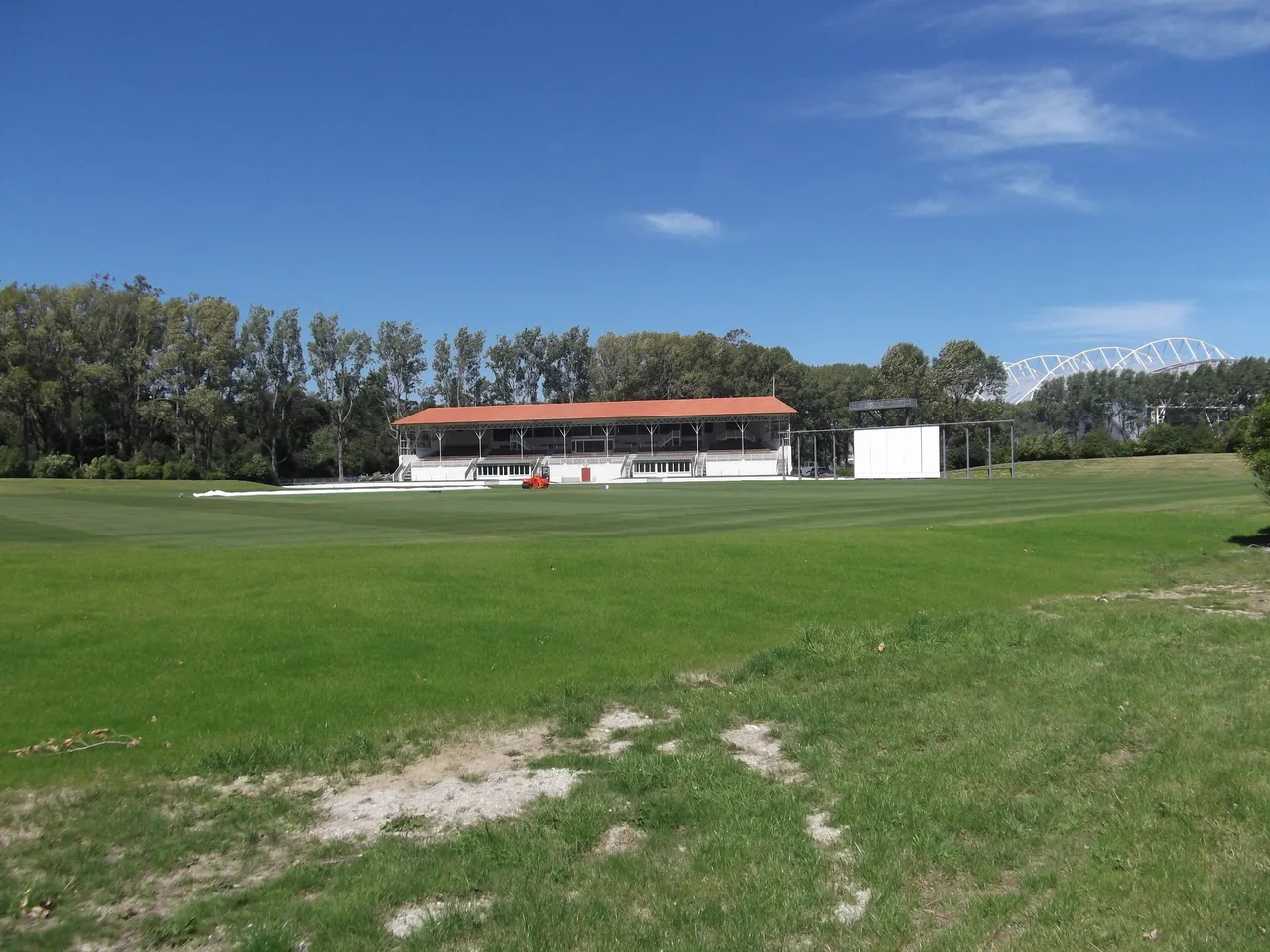
Historical ground illustration, not evidence of any specific Milne delivery.
Why is over notation not a decimal?
In conventional six-ball cricket, 2.5 overs means two complete overs plus five legal deliveries, or seventeen legal balls. It does not mean two and a half overs. The digit after the point is a ball count, not tenths of an over. Calculate with balls first and convert to an over-based measure only when needed.
Suppose an imaginary spell ends after 2.5 overs with seventeen runs conceded. Seventeen divided by seventeen legal balls, multiplied by six, gives an economy of six. Dividing by the decimal 2.5 would produce 6.8, which answers the wrong calculation. The error can look reasonable unless the representation is checked first.
An educational calculator should reject invalid values rather than hiding them. For six-ball overs, a ball component greater than five needs correction or normalisation. A blank field should not silently become zero. Clear validation makes the tool trustworthy for beginners who may not yet recognise an impossible input.
Does the quickest bowler always have the best spell?
No single physical measurement establishes the quality of an entire spell. A delivery's outcome depends on its location, movement, timing, the batter's response and the field. Measured pace can be informative, but it is not a substitute for a scorecard or a description of the match situation.
Consider a fictional final over in which the batting side needs twelve runs. A well-placed slower delivery and a fast delivery in a convenient hitting area create different opportunities. To discuss the decision, record what was attempted and what happened. Do not assume the result alone proves that the intention was good or bad.
The same caution applies to highlights. A compilation may show only wickets and omit deliveries that conceded runs. It can illustrate particular moments, but it is not a complete sample of every ball. A fair description states whether it comes from a full match, a scorecard or a selected clip.
What is the difference between a contract and selection?
A central contract, a tour squad and a playing eleven describe different relationships. New Zealand Cricket's 2023 announcement concerns an offer for that contract period. It does not mean a player was guaranteed to appear in every subsequent fixture, and it does not establish his current contractual status years later.
Imagine an original school-team example: twenty students join a training group, fifteen travel and eleven play. Membership, selection and appearance are all real events, but they are not the same event. A sports profile should preserve the equivalent distinctions when describing a professional career.
A player can also be listed as cover, named in a squad or withdrawn before a match. Do not count an appearance from those statements alone. Use the actual match record for appearances, and use dated announcements for the selection or contract decisions they genuinely establish.
How should readers handle fitness updates?
Fitness reports are time-sensitive and should be attributed to an identified, dated source. An old withdrawal does not prove a player is currently unavailable, while a later return does not guarantee future availability. This article deliberately does not infer Milne's current medical condition from historical stories or a missing name in one list.
For a fictional timeline, mark an announcement on Monday, a revised squad on Thursday and a playing eleven on Saturday. Each item has a date and a limited scope. A later update may supersede part of an earlier story without making the earlier report dishonest at the time it was published.
Avoid private medical speculation. A public match profile can discuss officially reported availability when relevant, but it should not diagnose an athlete or invent a cause. For a learner, the transferable skill is tracking a changing record carefully rather than treating the first search result as permanently current.
Can you build a better comparison chart?
Yes. Begin with a clearly defined question, such as comparing economy in a fictional set of equal-length spells. Use the same format, units and date range. Record missing values explicitly. A chart becomes misleading when one player's current international total is placed beside another's old domestic total without explanation.
Try three invented spells of four overs: 1/20, 2/28 and 3/36. Their economies are five, seven and nine. Their wicket totals move in the opposite direction. Ask what additional context would help choose a bowler for a particular role. The exercise demonstrates a trade-off in the sample, not a universal rule about bowling.
Do not turn a small made-up table into a ranking of real players. It is a way to understand measures. If you later use real data, keep a source link and a retrieval date for every row, then explain the limits of the sample before drawing a broader conclusion.
A final scorecard challenge
An imaginary bowler concedes thirty runs in 3.4 overs and takes three wickets. Convert the spell to twenty-two legal balls. The economy is approximately 8.18 runs per over, the average is ten runs per wicket and the strike rate is approximately 7.33 balls per wicket. Keep the unrounded inputs for calculation, then round only the displayed result.
Next remove the wicket count entirely. The correct response is not to guess three, zero or the player's usual figure. Mark the missing field and calculate only what the available inputs support. This small discipline is useful in programming, spreadsheet work and sports analysis alike.
Explore more cricket and numerical learning guides when you are ready. Milne's profile provides a recognisable starting point, but the lasting lesson is how to read a bowling record: identify its format and date, preserve its units, distinguish a historical achievement from a current total and avoid explaining more than the evidence supports.
A useful final exercise is to explain one calculation to another learner without showing the formula first. Name the quantity, its unit and the record category, then describe why each input is needed. If you cannot explain why a denominator belongs in the calculation, pause before publishing the answer. Good numerical communication makes the method understandable as well as producing a plausible result.
A well-labelled answer is easier for another reader to verify independently.
Compare these record-reading habits with the Blair Tickner profile and bowling guide.
Sources
- ICC: Adam Milne profile, for bowling style and international-debut context.
- Mumbai Indians: Adam Milne profile, for the published biographical introduction, not a current squad claim.
- New Zealand Cricket: 2023 contract announcement, for the dated 5/26 reference and historical contract context. All other numerical spells above are original teaching examples.
Image credits: cover: uglybob nz, source, CC BY-SA 2.0. Resized and converted to WebP. inline: Grutness at English Wikipedia, source, CC BY-SA 3.0. Resized and converted to WebP.
Found an error or an outdated detail? Report a correction with the article URL and original source.