
Alex de Minaur: Career Milestones, Movement and Return Decisions
Explore Alex de Minaur’s career, Acapulco titles and court coverage. Learn return depth, recovery positioning and how to read tennis statistics.

Alex de Minaur makes tennis movement worth watching closely. A sprint can keep a rally alive, but the next decision determines whether the player remains under pressure or earns a chance to attack. His career provides a useful starting point for understanding that difference, from his first major singles quarter-final at the 2020 US Open to his Acapulco successes in 2023 and 2024.
This is a career and tennis-learning guide, not a live score service. Historical milestones are separated from exercises using invented numbers. For today's draw, ranking or result, consult the dated tournament record. A profile can explain what to look for without pretending that an old achievement describes the current match situation.
Who is Alex de Minaur?
Alex de Minaur is an Australian professional tennis player. ATP records identify Sydney as his birthplace and 17 February 1999 as his birth date. His career includes a first Grand Slam singles quarter-final in New York in 2020, followed by further progress at major events and ATP tournaments. Those achievements should retain their event names and years.
Read the development as a sequence
A junior appearance, a tour title and a major quarter-final describe different stages of competition. They should not be compressed into one vague claim that someone became successful overnight. The useful questions are what event the player entered, which round he reached and how that result fitted into the broader season. Dates make the sequence understandable.
Australia is not an event category
De Minaur's national representation is separate from the tournament location. Playing in Mexico does not make an Acapulco title an Australian domestic championship. Likewise, representing Australia in a team event is not the same statistical category as entering a regular individual tournament. Keep nationality, competition and format in separate columns when organising career information.
What happened at the 2020 US Open?
De Minaur reached his first Grand Slam singles quarter-final at the 2020 US Open. The Australian Olympic Committee's profile records that Dominic Thiem, who went on to win the title, ended that run. A quarter-final appearance means reaching the last eight in that draw; it does not mean reaching the championship match or winning the event.
Why the round label matters
In a standard knockout bracket, each completed round reduces the remaining field. However, a draw can contain byes, qualifiers and other entry arrangements. Use the actual tournament record when counting matches won. It is safer to say quarter-finalist when that is the verified result than to infer an exact victory count from a generic bracket diagram.
A loss can still mark progress
A career milestone need not be a trophy. Reaching a new stage can show that a player sustained performance across several opponents and conditions. That observation does not mean every later tournament must improve on it. Development is uneven, and a profile should leave room for different draws and surfaces instead of treating a career as a steadily rising line.
Why are the Acapulco titles important?
ATP's biography records De Minaur's ATP 500 titles at Acapulco in 2023 and 2024. Winning at the same venue in consecutive editions is a specific achievement, not evidence of winning every match there throughout his career. The ATP 500 designation identifies the event category; it is not the number of matches played or a description of a player's ranking.
Separate a title from a ranking position
A trophy records a result at one tournament. A ranking combines eligible results under a defined system over a relevant period. Winning an event can contribute to a ranking change, but the two records answer different questions. An article describing the Acapulco titles should not silently turn an older ranking position into today's standing.
Read a retrospective in its own date
A preview written before a title defence may discuss the previous edition as last year. That phrase changes meaning when someone reads the page later. Translating the relative phrase into the actual event year prevents confusion. It also helps distinguish a report of the 2023 title from a later discussion of the 2024 tournament.
What makes court coverage effective?
Good court coverage is more than reaching the ball. Players must anticipate, move, balance, strike and recover. A late contact can return the ball but leave an opponent an easy attacking opportunity. When studying a De Minaur rally, observe the quality of the recovery and next shot rather than using running distance as a complete measure of performance.
The split step prepares a decision
A small readiness movement around the opponent's contact can help a player respond in either direction. Its value depends on timing and balance, not on how dramatic it looks. For a viewing exercise, pause just before the opponent strikes and notice whether the receiver is ready to move. Do not diagnose technique from one blurred still image.
The shortest route is not always the best recovery
After a wide shot, returning to the exact centre mark may not be the only sensible option. The opponent's position and available angles influence where the player needs to cover. A recovery position should answer the likely next shot. This is why movement analysis needs the whole court, not merely a close-up of a player running.
Balance affects the next contact
Reaching a ball while falling away can reduce control even when the racket makes contact. A player may choose a higher, safer response to gain time rather than attempt a low-percentage winner. That choice can be intelligent defence. Evaluate whether the shot helps reset the rally before calling every nonaggressive response a missed opportunity.
How can return position change a rally?
Standing farther back can provide more time to react to a serve, while standing closer can reduce the time available for the server's next shot. Neither position is automatically correct for every serve. The speed, angle, bounce and receiver's intentions all matter. Observe where the return lands as well as where the receiver initially stands.
Deep does not mean fast
A return can travel slowly yet land near the baseline and limit the server's attack. Another can be struck hard but land short and invite pressure. Depth, height and direction are separate properties. A useful match note records at least two of them instead of describing every strong-looking swing as a good return.
First and second serves create different problems
A receiver may prepare differently when the server has another opportunity available or is protecting against a double fault. Still, a second serve is not automatically weak, and the receiver must judge the actual ball. Separate the first-serve and second-serve return samples when comparing outcomes. Combining them can hide an important change in the pattern.
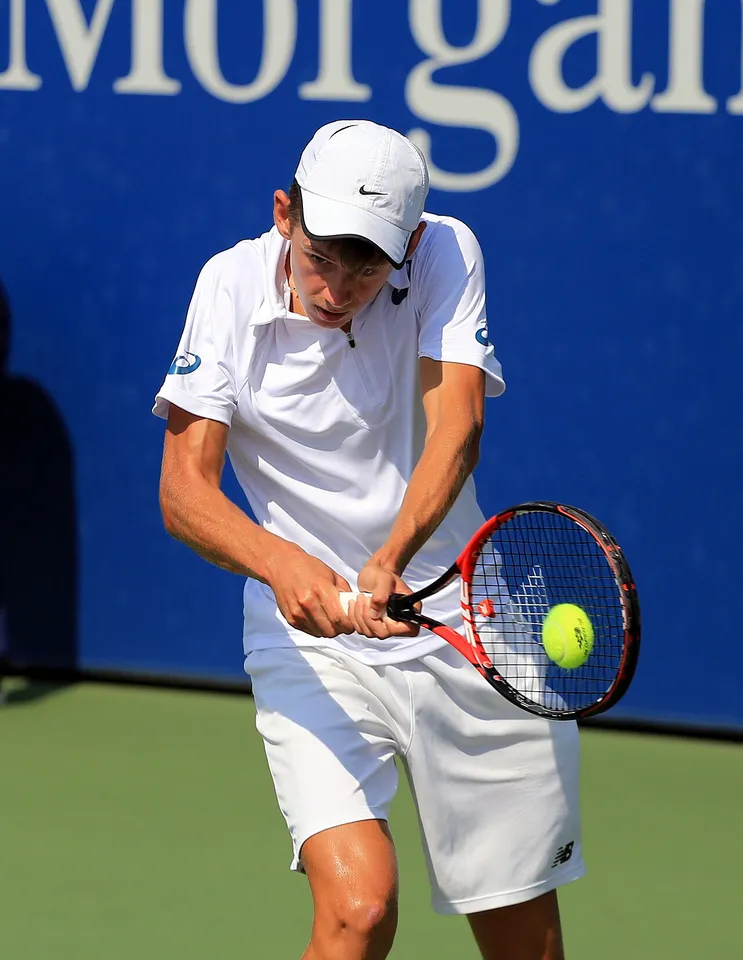
Alex de Minaur at the 2015 US Junior Open, shown as an early career image rather than a recent senior result.
What is defence-to-attack transition?
A defensive rally can become neutral, and a neutral rally can become attacking. Those are stages rather than permanent player identities. A high response that pushes an opponent back may create time for a better court position. The next shorter ball can then offer an attacking chance. Watch the sequence rather than assigning one label to the entire point.
Identify the turning shot
Choose a rally and mark the contact after which the player under pressure no longer needs to scramble. Was it a deeper ball, a change of direction or an opponent's weaker shot? There may be more than one contributing action. Explain what changed in the court geometry instead of assuming that the eventual winner alone created the point.
An attack needs a realistic target
A short ball does not remove the net or sidelines. A player still balances pace and placement against risk. Aiming well inside the court can preserve an advantage without producing an instant winner. For beginners watching professional tennis, this is an important lesson: taking control and finishing the point are connected but separate tasks.
How do you calculate return points won?
Return points won is a proportion of the points played while receiving, not a proportion of all games in the match. In a fictional sample, winning 18 of 45 receiving points gives 40 percent. That calculation does not reveal whether those points occurred together in a few games or were spread evenly across the set.
A percentage needs its denominator
Winning two of four receiving points and 20 of 40 both produces 50 percent. The larger sample usually provides a more substantial description of what happened, but context still matters. Always show the counts alongside the percentage when possible. A visually impressive percentage based on a tiny sample can create more confidence than the evidence supports.
Break points are not all receiving points
A break point is an opportunity to win the opponent's service game on that point. Return points also include many other score situations. A player can win numerous receiving points without converting many break chances. Keep the categories distinct when explaining why a set felt close even though the final game score appeared comfortable.
A rally observation worksheet
Use five columns: starting position, opponent's shot, contact balance, reply depth and recovery position. Review only a few rallies at first. The aim is not to produce a professional scouting report from a short clip. It is to replace vague praise such as great speed with observations another viewer can recognise and discuss.
Add context without inventing motives
If the camera shows a player moving back, record the visible action. Do not automatically state that he was frightened, exhausted or following a private coaching instruction. Those explanations require further evidence. An honest note might say the player adopted a deeper position and gained contact time, while leaving the reason for the change open.
Compare similar situations
A return against a wide serve on one side is not directly comparable with a return against a body serve on the other. Group observations sensibly before drawing a conclusion. Different surfaces, opponents and camera angles can also affect what you see. A small, clearly defined comparison is more useful than collecting unrelated highlights into one sweeping judgement.
What can young players learn safely?
The transferable idea is purposeful movement, not copying a professional's running load or diving for every ball. Beginners need appropriate instruction, a suitable playing area and practice that matches their level. This guide is a viewing and reasoning resource, not a personal training prescription. Technique and physical preparation should be adapted with qualified support where needed.
Practise describing a point first
Before trying to imitate a pattern, explain it in plain words. For example: the return landed deep, the server replied shorter, and the receiver moved forward. That sentence reveals a cause-and-effect sequence without pretending every point follows it. Clear description helps a learner notice when a pattern fails and why a different response might be necessary.
Use arithmetic to challenge an impression
If a player seems to win every long rally, count a defined sample instead of relying on memory. Specify what counts as long and whether serve contacts are included. Your result may support or challenge the impression. Either outcome is useful because the purpose is to understand the evidence, not to force the numbers to praise a favourite player.
Questions about Alex de Minaur
Is a career-high ranking the current ranking?
No. A career high is the best position reached at a particular time, while the current ranking is attached to a specific release. An older biography can contain a valid historical high without showing today's table. Read the date and category, and avoid treating the number on an undated social image as a live ranking update.
Does reaching every ball guarantee a win?
No. Contact quality, placement, serving, returning and decision-making still determine the outcome. A retrieved ball can prolong a rally without removing the opponent's advantage. Movement is valuable because it creates options; it does not replace the need to choose a useful shot. That is why analysing recovery and reply depth gives a fuller picture than counting sprints.
Where can students explore the numbers?
Use the class resources for supporting mathematics and the programming courses to build a simple tennis-statistics worksheet. Store receiving points played and won separately, reject impossible inputs and display both counts and percentages. Begin with fictional data, then add a source and match date before using real records. Reproducible calculations make sports discussion more precise.
Sources
- ATP Tour: Alex de Minaur biography and historical milestones
- Australian Olympic Committee: Alex de Minaur career profile
- ATP Tour: context for the Acapulco breakthrough
Image credits: cover: Barcex, source, CC BY-SA 4.0. Resized and converted to WebP. inline: robbiesaurus from Smithtown, NY, USA, source, CC BY-SA 2.0. Resized and converted to WebP.
Found an error or an outdated detail? Report a correction with the article URL and original source.