
Amish Shah Wins Arizona District 1: US House Result and Public-Record Guide
Read Shah’s reported Arizona congressional win over Jay Feely, distinguish state and federal roles and understand race calls, margins and public records.
Amish Shah has won Arizona's First Congressional District, according to the Associated Press race call reported on 5 November 2026. Local public-radio coverage identifies Republican Jay Feely as his opponent. Shah is the representative-elect for a federal US House seat; an older Arizona state-legislature profile describes a different stage of his career.
The distinction is useful for readers finding his name through a trending search. This guide explains the reported result, the difference between a state House and the United States House, and how to follow an incoming member's work without treating an election call as a completed legislative record.
What has been reported about Arizona District 1?
The post-election report says AP called the congressional race for Shah on 5 November. This article records that winner as checked on 6 November 2026. It does not reproduce a final certified percentage, because an interim count and an official completed canvass are different records. No unverified final margin is being supplied.
| Field | Meaning in this report |
|---|---|
| Person | Amish Shah |
| Reported winning race | Arizona's First Congressional District |
| Incoming office | United States House of Representatives |
| Reported opponent | Jay Feely |
| Earlier public service | Arizona state House |
| Current transition description | Representative-elect |
| Not established here | Final certification or a completed oath |
The full office name belongs with the district number. Arizona has state legislative districts as well as federal congressional districts. A number alone cannot tell a reader which office is involved. That is why a reliable profile should state US House rather than simply saying that a candidate won the House.
Why an Arizona House profile still appears online
The Arizona Legislature maintains pages tied to particular legislatures and sessions. Those records can document earlier state service. Their continued availability does not mean the person is currently serving in every office described across search results. A session identifier and date should be read before treating a page as a current directory entry.
That historical record is still useful. It can help establish earlier legislative experience and locate bills or proceedings from the relevant period. The error would be to transplant that material into an incoming federal biography without changing the institution or timeframe. Historical information should be preserved with its original scope.
For a student researcher, make a career table with columns for office, institution, term and source. A state House row and a US House election row can sit next to each other without conflict. The table makes a change of role visible instead of forcing all records into one current title.
What does the United States House do?
The US House is one chamber of Congress and participates in making federal law. Members represent congressional districts, work through committees and take part in legislative proceedings. A House seat is not an executive appointment, a Senate seat or a role in Arizona's own state legislature.
The House's official explainer describes representatives as serving two-year terms and identifies a chamber with 435 voting representatives. Those institutional facts help readers understand the scale and type of office. They do not establish which committee an incoming member will join or what bills that member will eventually introduce.
An election victory therefore provides an opportunity to participate in a collective institution. It does not grant the ability to enact a proposal alone. When assessing a future record, look for the precise action and the other steps required. A bill introduced, a committee vote and an enacted law are not interchangeable milestones.
Representative-elect and sitting representative are different stages
Representative-elect identifies the period after an election result and before service in the incoming role begins. The constitutional start of the new congressional term is in January. The oath and official membership record provide the appropriate evidence for describing service once it starts.
This explains why a November search can show an outgoing officeholder alongside a newly reported winner. The sources may describe different terms. A correction should identify that timing instead of assuming that one page must be fraudulent or that the winner has already taken every power of the office.
It also matters for voting records. Do not attribute a roll-call vote from the current Congress to someone who has only won a future seat. A professional background, campaign pledge or victory speech cannot substitute for an actual recorded vote. Future actions should be added when the relevant record exists.
How a race call differs from certification
A news race call is a journalistic determination based on the available evidence. Certification is part of the official election process. They can occur at different times, and a reported winner does not make every interim percentage a final certified figure. The wording of an article should preserve that distinction.
Suppose an invented race has a candidate leading by 5,000 votes while some ballots remain to be counted. A news organisation may assess the likely outcome using information beyond that single lead. A reader cannot reproduce the organisation's conclusion merely by subtracting two totals, nor should the reader label the snapshot certified without the authority's record.
This example is not a reconstruction of Shah's race. It explains why the article can report AP's call without inventing a completed margin. Readers who need official totals should use the relevant election authority's published results and check the stage of the record rather than remove the word unofficial from an early table.
Why percentage points and percent are not the same
Election reporting often compares vote shares, and the wording can change the meaning. In a fictional race with shares of 52 percent and 46 percent, the gap is six percentage points. Saying six percent more is a different mathematical statement, because a relative percentage requires a denominator.
To calculate a relative difference against 46, divide six by 46 and multiply by 100, giving roughly 13 percent. Neither expression should replace the other without explanation. The first describes the difference between two shares; the second describes that difference relative to a chosen baseline. A precise article states which calculation it is making.
Those figures are not being used as Shah's result. They are a teaching example for interpreting any election table. If a live count changes, calculate again from the correct snapshot rather than retain an old margin beside a new percentage. Keep the timestamp, vote shares and calculation together.

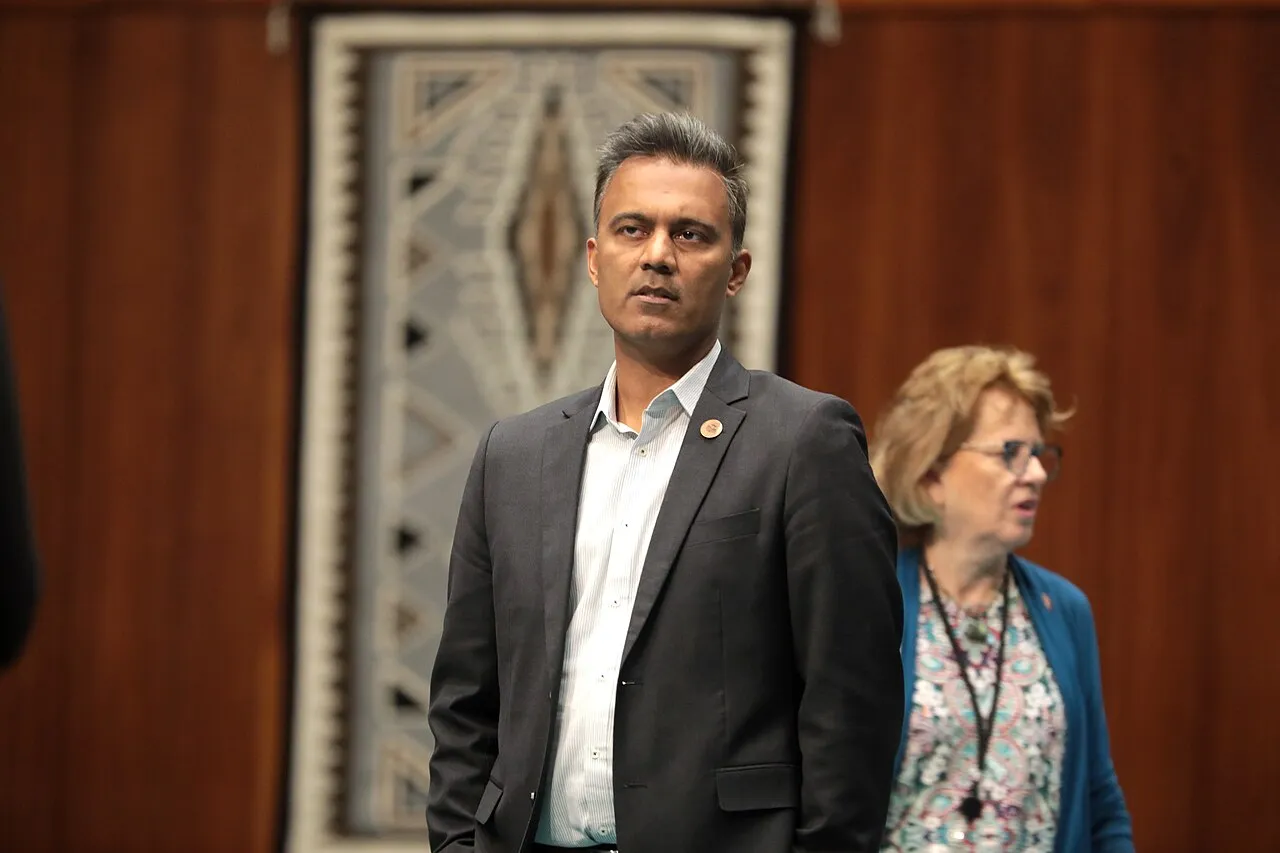
A January 2019 photograph of Amish Shah, shown as an earlier public-career image rather than a November 2026 election or US House oath.
District numbers and maps require their own evidence
A congressional district is a defined electoral area, but its name alone does not provide every boundary. A reader should use an official map or representative lookup for an address-based question. A profile cannot establish representation simply because a town name appears in a candidate's campaign coverage.
Historical maps need dates as well. A district number can persist while boundaries or the relevant election context change. If comparing results across years, confirm that the comparison is geographically meaningful. Otherwise a change attributed to voter preference might partly reflect a change in the population included in the district.
For classroom work, label a map with the election year and source. Do not colour in an area from memory or assume that a state legislative district matches a congressional one. Geographic accuracy is part of political literacy, not a decorative extra added after the numbers have been written.
A medical background is relevant experience, not a policy outcome
Coverage describes Shah as a physician. That professional background can help explain an interest in health-related public questions, but it does not tell us what every future bill will contain. Nor does it mean a member of Congress personally administers every health service affecting constituents.
The important analytical question is how experience informs a specific proposal. What problem is identified, what mechanism is offered and what evidence supports the expected effect? Credentials can be relevant while the proposal still needs scrutiny. A profile should not treat either professional experience or political affiliation as an automatic answer to those questions.
This article is not personal medical advice. Discussion of healthcare policy concerns institutions and public choices, not an individual reader's diagnosis or treatment. Keep those levels separate. A political officeholder's biography should not be used as a reason to change medical care or trust an unverified health claim.
How to evaluate a future healthcare proposal
First identify the level of the proposed change. It might concern a federal programme, a state implementation decision, a regulator, an insurer or a provider. Those are not all controlled through the same route. A proposal is easier to assess when it names the responsible institution rather than describing a desired outcome in general terms.
Next look at eligibility and cost. Who would qualify, what would be paid and how would the funding work? A lower advertised price does not automatically mean every person's total expenditure falls. The proposal might change one component while other costs remain. Read the defined scope before treating a headline as a universal guarantee.
Finally distinguish authorisation from implementation. A measure can be proposed, approved or in operation at different times. Each stage needs its own evidence. These questions are a general framework for future scrutiny, not a claim that Shah has introduced a particular proposal or that an unannounced programme already exists.
Bills, amendments and laws form a sequence
A bill number identifies a proposal within a legislative context. The text can change as amendments are considered. A vote on one version does not automatically establish support for every later provision. When discussing an incoming member's future record, preserve the bill number, version and date alongside the action.
A committee action and a floor action are also different. A measure may advance through one stage without becoming law. Saying a representative passed a reform can be misleading if the record only shows introduction or committee approval. Use the verb that matches the documented event and explain what remained to happen.
This sequence is a useful lesson in evaluating public claims. A campaign can promise an outcome, a legislator can propose a mechanism and an institution can later decide on it. The reader should be able to follow those steps without finding that the article has silently merged intention, activity and result.
What constituency service can and cannot imply
An elected representative's public office may provide official routes for constituents to seek information or assistance within its remit. That should not be confused with a private agent promising guaranteed approval of a benefit, document or immigration decision. The responsible agency's process remains distinct from a politician's office.
Use published government channels and be cautious about impersonation. A congratulatory social page is not necessarily an official casework portal. Do not send sensitive documents to an account merely because it uses a politician's photograph. Verify the website and the purpose of the request before supplying personal information.
For an incoming office, wait for verified contact arrangements rather than inventing a helpdesk address. A profile can link to institutional directories when service begins. It should not manufacture a constituent service or imply that contacting a campaign account guarantees an official action.
How to keep the profile accurate after January
Update the status from the official membership record when the new service begins. Add committee assignments only after they are announced, and record legislative actions from the relevant proceedings. Preserve the election date so that readers can distinguish the result from the start of the term.
Do not rewrite historical photographs as current events. An image from earlier state service can illustrate that stage of the career when captioned accurately. It should not be labelled as a federal swearing-in or an election-night scene simply because the person is the same. Images have dates and contexts just as text does.
A useful maintenance checklist asks whether the office, term, links and captions still match the article's scope. It does not require deleting older information. It requires making the timeline clear. Readers can then understand both the earlier Arizona House role and the reported incoming US House seat without confusion.
Questions about Amish Shah's result
Is Arizona District 1 a state House seat here?
No. The result covered by this article is the First Congressional District seat in the United States House. Shah's earlier Arizona state House service is a separate record. The complete institution name is essential when comparing the election with an archived legislative biography.
Has this article confirmed a final certified percentage?
No. It reports the winner identified by AP and local coverage while leaving final certification figures to the official record. The numerical examples above are deliberately fictional lessons in interpreting margins, not substitutes for the actual completed vote totals.
What should readers watch next?
Look for official membership, the oath record, committee announcements and actual legislative actions. Those will establish the next stage of service. Browse news explainers and class study resources for more practice distinguishing a proposal, a public record and a completed outcome.
Sources
- Source: AP congressional election call
- Source: KJZZ local report on the District 1 result
- Source: Arizona Legislature archived member record
- Source: United States House institutional explainer
- Source: National Archives, constitutional amendments
Image credits: cover: Gage Skidmore from Surprise, AZ, United States of America, source, CC BY-SA 2.0. Resized and converted to WebP. inline: Gage Skidmore, source, CC BY-SA 3.0. Resized and converted to WebP.
Found an error or an outdated detail? Report a correction with the article URL and original source.