
Asitha Fernando: Career Milestones and Bowling Figures Explained
Follow Asitha Fernando's youth, A-team and senior milestones, then learn how wickets, bowling average, economy and strike rate differ.
Asitha Fernando's career offers a useful way to learn what bowling numbers actually mean. A five-wicket innings, seven wickets in a match and a tournament's leading wicket total sound similar when reduced to a short headline. They describe different achievements. Understanding that difference helps you read his record without confusing separate competitions or stages of his career.
This guide introduces the Sri Lankan right-arm pace bowler through verified career milestones, then builds practical exercises around bowling figures. Checked on 2 November 2026, it is not a live ranking, injury bulletin or selection announcement. All learner scenarios below are invented and clearly separate from Fernando's documented performances.
Who is Asitha Fernando?
Asitha Fernando is a Sri Lankan international pace bowler whose progression included Under-19 cricket, Sri Lanka A and the senior national side. He made his ODI debut against Zimbabwe in July 2017 and his Test debut against South Africa in January 2021. Different formats have separate debut dates; one should not replace the other.
The county archive records his full name as Asitha Madushanka Fernando and his birthplace as Katuneriya, with a birth date of 31 July 1997. Do not confuse him with Dilshan Madushanka, another Sri Lankan bowler. A shared name component is not evidence that two player profiles describe the same person.
For a classroom record, create separate fields for displayed name, full name, bowling arm and country. Keeping those labels distinct is more reliable than joining information whenever two names look alike. It also makes your record easier to check later, when a source uses initials rather than the familiar playing name.
The same approach helps with news reports. “Fernando” alone may be insufficient to identify a player in a Sri Lankan scorecard. Look at the complete team list and the source's player link before assigning figures. Correct identification comes before analysis, because a precise calculation attached to the wrong person is still wrong.
What did his Under-19 performances show?
At the 2016 Under-19 World Cup, Fernando took 11 wickets in six matches and was Sri Lanka's leading wicket-taker. The ICC's retrospective gives an average of 16.45 and best figures of 4/43. These numbers describe that youth tournament, not his senior career total or a current international ranking.
Notice that the source provides three different views of performance: total wickets, a rate and one best innings. The total tells you the amount of wicket-taking across the event. The average relates runs conceded to wickets taken. The best figures identify a standout bowling return, rather than describing every appearance.
No single one of those numbers answers every question. A tournament total does not tell you how the wickets were distributed between matches. An average does not identify which batters were dismissed. A best innings cannot establish consistency on its own. Read the measures together, with the competition and time period attached.
An Under-19 tournament is also a specific level of cricket. It can reveal promise without guaranteeing future senior success. The sensible interpretation is that Fernando produced a documented performance at that stage of his development. Avoid turning an early achievement into a prediction that a player must dominate every later format.
How did Sri Lanka A and senior cricket differ?
The ICC records Fernando's first-class debut for Sri Lanka A against Pakistan A at Leicester in 2016. He took seven wickets in the match, including 5/33 in the second innings. An A-team match is not automatically a senior international, even when recognised international players appear in the opposing team.
Think of three labels that answer separate questions: the team selected, the match's statistical status and the competition involved. “Sri Lanka A” identifies a team. “First-class” identifies a category of match. A senior Test cap identifies participation at another level. These terms can be related without being interchangeable.
Fernando's Test debut came in January 2021, when he received Sri Lanka men's Test cap number 153. That cap number is a historical sequence marker. It is not his shirt number, bowling ranking, age or tally of appearances. Understanding the label stops a memorable number becoming a misleading statistic.
The gap between ODI and Test debuts illustrates another useful point: a player can enter one format before another. Selection pathways are not a single straight ladder where every category changes at once. Record each milestone with its own date and format instead of forcing them into one universal “debut” field.
What does a bowling return such as 5/33 mean?
When clearly labelled as bowling figures, 5/33 means five wickets credited to the bowler for 33 runs conceded. It is not the team's innings total. The surrounding label matters because a similar slash notation elsewhere on a scorecard can describe a batting side's runs and wickets instead.
Start with a fictional example: Learner A finishes with 3/24. Read it aloud as “three wickets for twenty-four runs.” Do not add overs that have not been supplied. The figures alone do not tell you whether the spell lasted four overs, eight overs or longer, so they cannot support an economy calculation by themselves.
Now compare two invented returns, 3/24 and 1/10. The first contains more wickets, while the second contains fewer conceded runs. Deciding which performance better served a team needs context, including overs, conditions and match situation. A two-number display is useful precisely because it preserves both quantities rather than pretending one replaces the other.
A scorecard's conventional description of best bowling should also be kept separate from a broad personal judgement. Calling a return a player's best recorded innings is a statistical claim. Calling it their most skilful spell is an interpretation requiring more evidence. You can explain the figures without claiming to have watched every delivery.

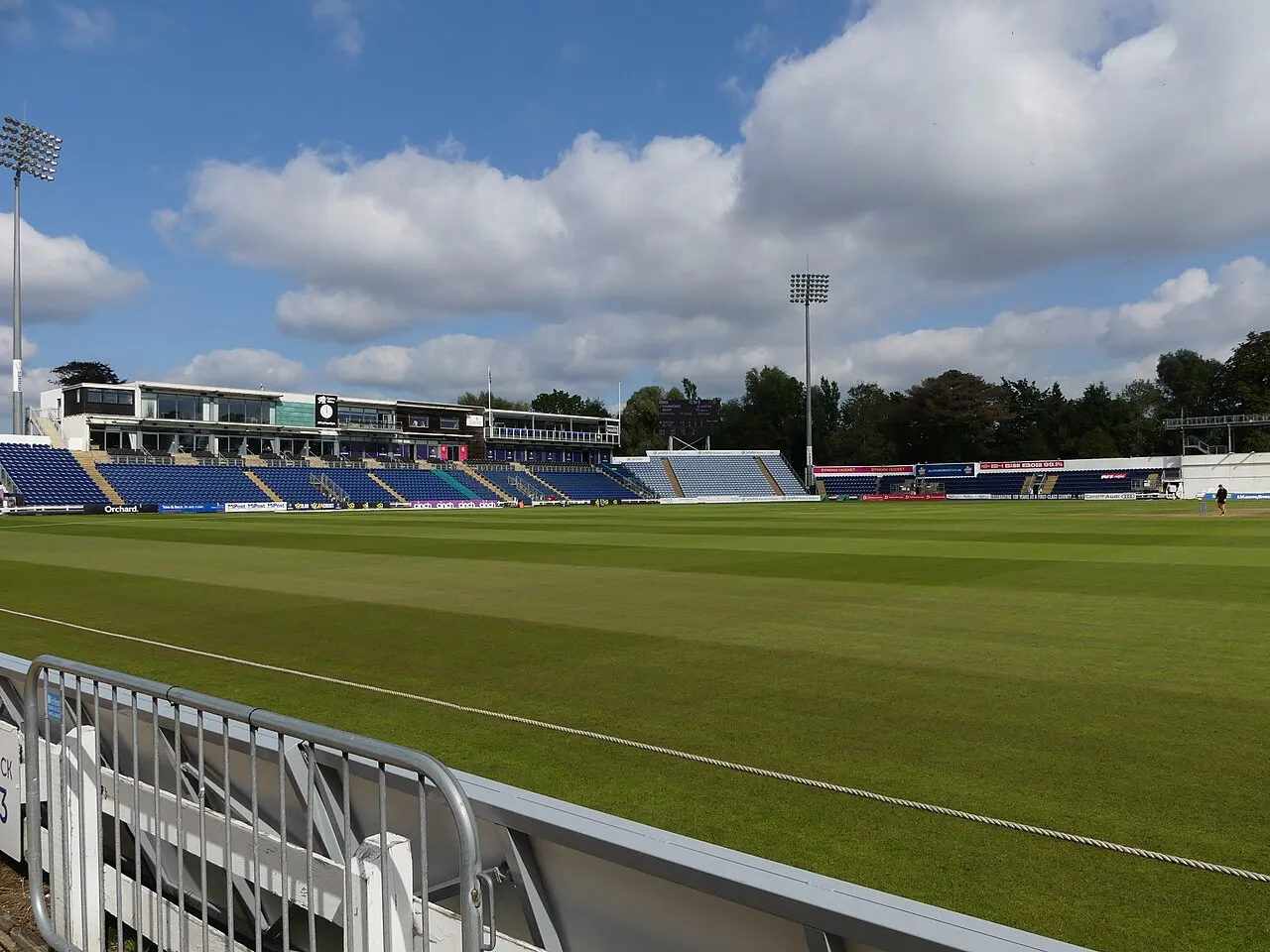
Grace Road Cricket Ground in Leicester, shown as historical city and cricket context. Not a photograph of Fernando's 2016 Sri Lanka A performance.
How are innings wickets different from match wickets?
In a multi-innings match, a bowler's match wicket total can combine wickets taken across the opponent's separate innings. Five wickets in one innings and seven in the match are therefore compatible. The five is a component of the seven, not an additional seven-wicket achievement to add on top.
Use a simple invented ledger. In the first innings, Learner B takes two wickets; in the second, five. The match total is seven. If your table already has a column called “match wickets,” do not calculate a career total by adding that seven to both innings columns. That would count the same dismissals twice.
This is why data tables need a clear level of detail. A row may represent a delivery, a bowling innings or a complete match. Combining rows from those different levels without labelling them is a common route to inflated totals. Choose the level first, then aggregate only the fields that belong to it.
For Fernando's 2016 A-team performance, the reported 5/33 belongs to the second innings and the seven belongs to the match. Keeping those labels alongside the numbers preserves the story. Removing them leaves readers with impressive-looking quantities that they may combine incorrectly, even when every individual number was copied accurately.
What is the difference between average, economy and strike rate?
Bowling average divides runs conceded by wickets taken. Bowling economy expresses runs conceded per over, conventionally using six-ball overs in these exercises. Bowling strike rate divides legal balls bowled by wickets taken. The three measures share some inputs but answer different questions about cost, containment and frequency.
Take one fictional spell: 60 legal balls, 40 runs conceded and two wickets. The average is 40 divided by two, giving 20 runs per wicket. The strike rate is 60 divided by two, giving 30 balls per wicket. The economy is 40 divided by ten six-ball overs, giving four runs per over.
Do not report those three answers without their units. “Twenty, thirty and four” means little to a beginner. Write “20 runs per wicket,” “30 balls per wicket” and “4 runs per over.” Units make the denominators visible and help you notice when a formula has used overs where it should have used balls.
The zero-wicket case needs special care. If another invented spell contains no wickets, dividing by zero does not produce an ordinary average or strike rate. Mark the measure as unavailable under your worksheet's rules rather than inventing zero. Zero would incorrectly imply an exceptionally favourable rate, hiding what actually happened.
Why does an old county record need its date?
Glamorgan's archive describes Fernando's involvement during the 2025 season and labels its statistical tables with a 13 October 2025 cutoff. Those figures belong to that county record at that point in time. They should not be copied into a November 2026 article as his complete, current international statistics.
A county career and an international career use different sets of matches. Even if both tables contain a column called “wickets,” the populations differ. A reader needs to know which matches qualify for inclusion. The correct first question is therefore “wickets in what?” rather than simply “how many wickets?”
Dates also protect against a subtler mistake: treating an age printed at the time of a signing as the player's permanent age. Historical articles often retain their original wording. Use a verified birth date if an age calculation is necessary, or leave age out when it adds nothing to the explanation.
The same caution applies to availability. A county appearance in 2025 does not establish selection for the next national fixture. An old injury report cannot prove a present absence or recovery. If the question concerns today's squad, look for a dated selection announcement rather than stretching an archive beyond the question it can answer.
Can you judge swing or pace from a photograph?
A still image can show a pose or a venue, but it cannot by itself measure delivery speed or establish how a particular ball moved through the air. Distinguish visual illustration from match evidence. Historical ground photographs in this guide provide setting; they are not pictures of the specific performances discussed.
Imagine pausing a bowling video just before release. The frame does not contain the complete ball path. To discuss movement responsibly, you would need the sequence and relevant context. To quote a speed, you would need a reliable measurement. Avoid converting a dramatic action photograph into a claim about an unrecorded delivery.
That principle makes cricket analysis stronger rather than less interesting. You can ask useful questions without pretending to know the answer: where did the ball pitch, what was the batter trying to do, and what happened after contact? Separate observation, measurement and interpretation in your notes so that each claim has an appropriate basis.
Try a bowling-record challenge
Create three fictional innings records containing legal balls, conceded runs and credited wickets. Calculate average, strike rate and economy only when the required inputs are present. Then add a fourth record with zero wickets and decide how your worksheet should display undefined rates. Explain that choice in a short note beside the table.
Next, combine two innings into one match without counting them twice. Check the total wickets against the sum of the two innings wicket columns. Keep the match summary on a separate display rather than adding it back into the source rows. This is a small exercise in both cricket knowledge and reliable data handling.
You can extend it in our programming courses by representing each innings as a named record. For the legal-ball conversion behind economy, see our Australia scoreboard guide. The aim is to explain a performance accurately, not to collect disconnected numbers that look convincing but describe different things.
Before finishing, give the worksheet to another learner without explaining it aloud. Ask them to identify the competition, date cutoff and units from the page itself. If they need to guess, improve the labels. Good presentation is not just a colourful heading: it lets another person reconstruct what the calculation means and which records it includes. That is the habit worth taking from a player profile into your next statistics exercise, whether the subject is cricket, classroom results or a small programming project.
Sources
- ICC: Fernando and Bhanuka's Test debuts, dated 3 January 2021, for Fernando's youth, A-team and early international milestones.
- Glamorgan Cricket Archives: Asitha Fernando, for biographical details and the explicitly historical 2025 county context. Fictional learner records and explanatory calculations are original exercises, not Fernando's match statistics.
Image credits: cover: Ruth Sharville, source, CC BY-SA 2.0. Resized and converted to WebP. inline: Mat Fascione, source, CC BY-SA 2.0. Resized and converted to WebP.
Found an error or an outdated detail? Report a correction with the article URL and original source.