
Australia–England ODI Series: Perth Start, Schedule and Viewing Context
Check the official 13 November Perth ODI date, Adelaide and Hobart fixtures, format distinctions and careful time-zone guidance for Pakistan readers.
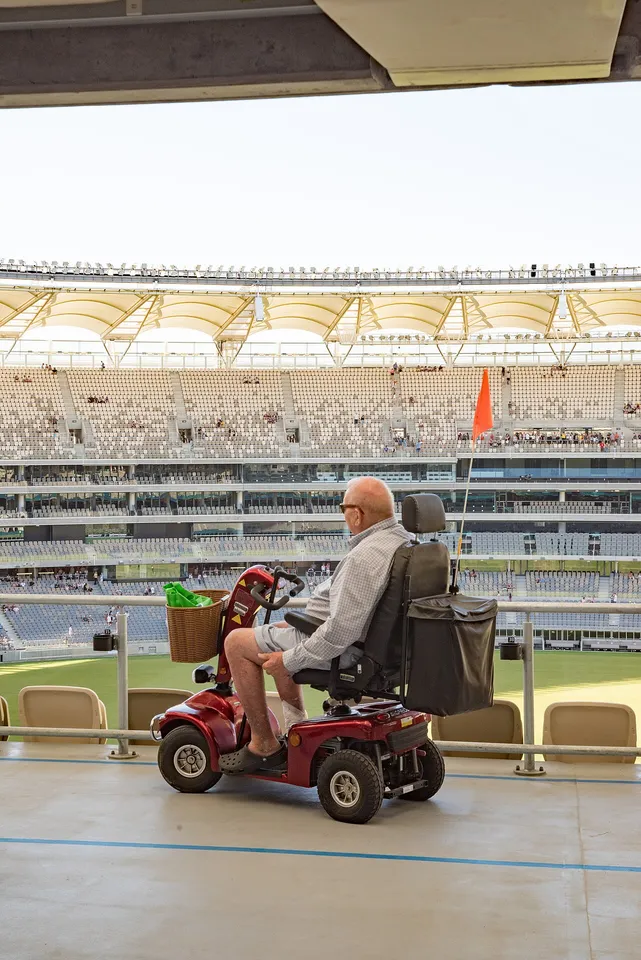
Australia versus England begins in Perth on 13 November
England's men's white-ball tour of Australia opens with an ODI at Perth Stadium on Friday, 13 November 2026. The ECB's official schedule and Western Australian Cricket's preview both confirm that date. Some searchable fixture pages show 12 November, so readers should prioritise the boards' current information rather than assume every cached listing agrees.
This is a preview and schedule guide, checked on 12 November. It does not contain an invented result for a match that the official schedule places on the following day. It also distinguishes this limited-overs tour from an Ashes Test series and from women's fixtures involving the same countries.
The tour includes three ODIs followed by five T20 internationals. Those formats ask different questions about pacing, selection and bowling allocation, which makes the programme more than a repetition of the same match eight times.
The ODI sequence
| Match | Date | City and ground |
|---|---|---|
| First ODI | 13 November 2026 | Perth Stadium, Perth |
| Second ODI | 15 November 2026 | Adelaide Oval, Adelaide |
| Third ODI | 18 November 2026 | Bellerive Oval, Hobart |
Check the official fixture page again before arranging attendance or a viewing session. Start times can require careful time-zone conversion, and an old screenshot may omit a later operational change. This article does not sell tickets or guarantee availability at a particular price.
For someone in Pakistan, the city is an important part of a time conversion. Australia has multiple time zones, and daylight-saving arrangements are not identical across them. Do not reuse a Perth conversion automatically for Adelaide, Hobart or a later eastern-state T20.
Why an ODI preview differs from a T20 preview
In an uninterrupted ODI, each side has up to 50 overs. That creates room for rebuilding after early wickets and for several distinct phases of a batting innings. A team can begin cautiously and still have considerable time to accelerate, although the match situation determines whether that approach is sensible.
A T20 innings has a much shorter horizon. An expensive over or a brief wicket cluster can change the task sharply, while a batter has less time to recover the scoring rate. Players may therefore be selected or used differently even when the opposition remains the same.
These are format principles, not predictions that either side will follow a fixed script in Perth. The surface, toss, weather and selected teams still matter. A useful preview identifies the questions to watch rather than pretending that the answers are known before the first ball.
What to look for when the teams are announced
Start by separating the squad from the playing eleven. A tour selection gives a group of available players; it does not prove that every member appears in the opening game. The final team announcement is the relevant evidence for a particular match.
Then look at the balance of batting and bowling roles. Who can operate with the new ball, who offers an option through the middle and who may be trusted near the finish? An all-rounder changes the available combinations, but the label alone does not reveal how many overs that player will bowl.
Western Australian Cricket's preview discusses the possibility of several local players appearing in Perth. The word “could” is important: a potential selection story should not be rewritten as confirmation of the final eleven. Keep the original degree of certainty when summarising it for another reader.
How to follow the contest without a misleading live claim
Use the board or official competition match centre for the current score. A static preview can explain the fixture and its context, but it should not display a stale number under a permanent “live” label. If a result is added later, it should be clearly dated and checked against the completed record.
Be cautious about video channels that use a match title without owning the broadcast. A scoreboard animation or a fan discussion is not necessarily live match footage. Check the authorised broadcaster for your location rather than entering payment details on an unfamiliar stream page.
If you are keeping notes, record the match number and format alongside the score. Australia and England meet in several settings, so country names alone are an unreliable identifier. The date and ground make it much easier to distinguish this Perth ODI from an older meeting.
A useful way to watch the opening ten overs
Instead of predicting a final total immediately, observe how the first pair of batters responds to the new ball. Note the scoring opportunities, dismissals and changes of bowling. A low score after a few overs may reflect challenging conditions, cautious choices or effective bowling; the number alone does not explain which.
Compare that opening period with the corresponding phase of the chase. Keep differences in target and conditions in mind. The second team is solving a known scoring task, which can change its risk choices even on the same surface.
This kind of observation is more informative than declaring a team beaten after one over. It also gives younger followers a practical introduction to why a 50-over match can develop through several contrasting phases.
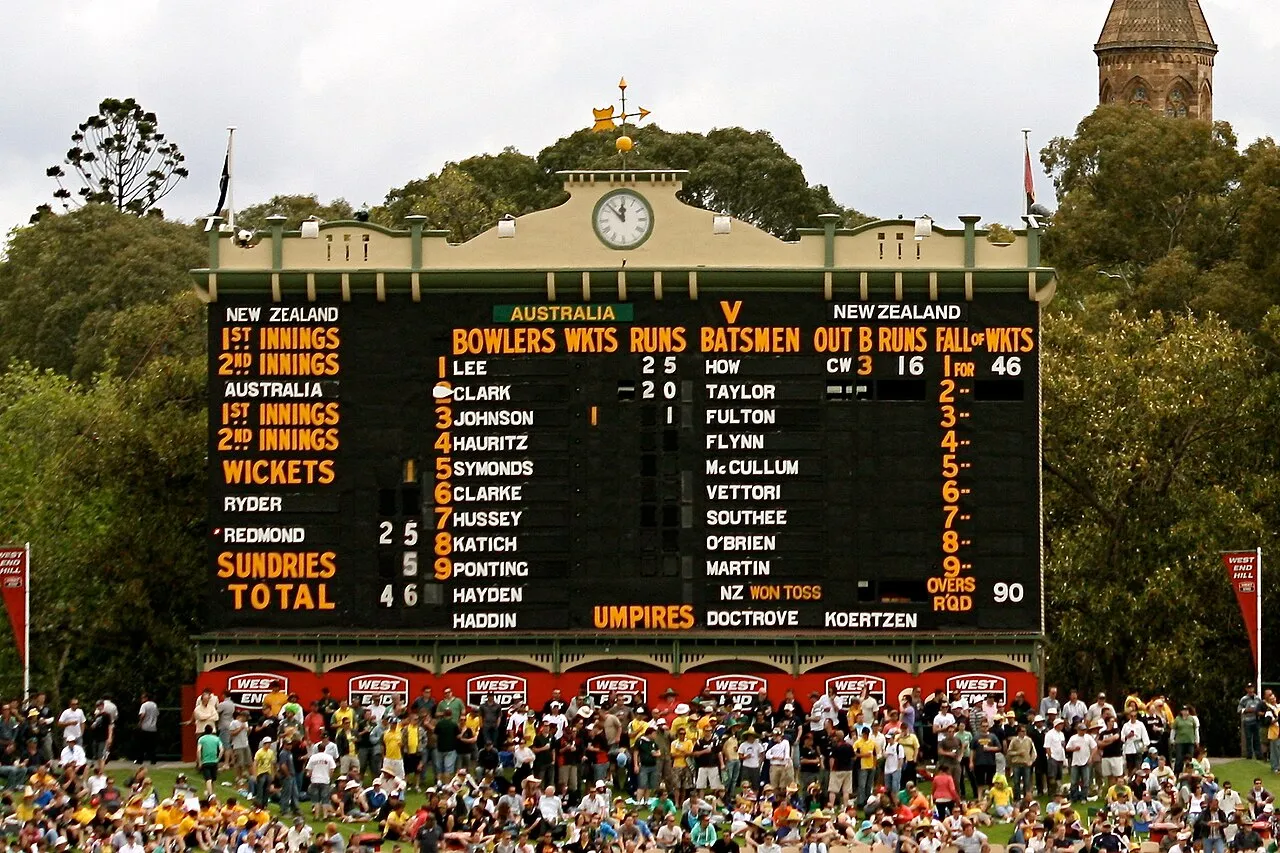
Archive Adelaide venue photograph. Visible scores are not current series results.
Questions about the tour
Is the opening ODI on 12 or 13 November?
The official ECB fixture information and WA Cricket preview identify Friday, 13 November 2026. Some third-party pages differ. This guide uses the official date and advises checking the current match centre before travel or viewing arrangements.
Is this the Ashes?
No. This programme consists of ODIs and T20 internationals. The Ashes refers to the Test rivalry. The teams' names do not make the formats interchangeable, and a short-format result should not be added to an Ashes series score.
Does the preview confirm a winner or final eleven?
No. Those details require subsequent match evidence. The purpose here is to establish the correct fixture and explain what to watch, not to invent a result or promote a prediction as certainty.
Find further cricket explainers in the RayTech article collection, and use the official sources below for the current schedule.
Why an ODI asks a different question from a T20
Both formats are limited-overs cricket, but the available time changes how an innings can develop. In an ODI, a side can move through several phases of accumulation, recovery and acceleration. In a T20, each over occupies a larger share of the innings, so a quiet passage can require a quicker adjustment.
That does not mean an ODI is simply slow or that a T20 involves no planning. The relevant difference is the number of opportunities and the cost of using them. A batter's decision has to be understood in relation to the target, wickets and remaining legal deliveries rather than judged from one shot alone.
As a teaching example, 30 runs from five overs represents six per over. In a 50-over innings, those five overs are one tenth of the scheduled allocation. In a 20-over innings, they are one quarter. The same numerical rate occupies a different proportion of the contest.
This tour's ODI-to-T20 sequence therefore offers a useful way to observe adaptation. The preview does not predict how either side will play. It identifies the different problems viewers can look for when the actual matches begin.
Read a score update with the format attached
A total of 150 means little without knowing the format, wickets and stage of the innings. It might describe a completed T20 effort, a developing ODI innings or a target in a shortened match. A useful update retains those identifiers rather than treating the total as self-explanatory.
Likewise, a batter's strike rate and a bowler's economy rate measure different relationships. Strike rate relates runs to balls faced; economy relates conceded runs to overs bowled. Both need the relevant sample and context before they can support a comparison.
If a feed displays overs with a dot, remember that the part after the dot represents legal balls within the current over. Twelve overs and four balls is 76 legal balls. Treating 12.4 as an ordinary decimal would distort a rate calculation.
These basic checks are especially helpful when international fixtures overlap. Confirm the teams, gender, format and date before assigning a score to the men's tour described here. Similar country names do not make another competition's result part of this series.
Perth is the opening venue, not a prediction of conditions
A venue name identifies where the fixture is scheduled. It does not by itself establish the pitch behaviour, weather, crowd size or winning strategy on the day. Historical descriptions can provide background, but they should not be presented as a direct observation of a match that has not begun.
When following the opening ODI, look for current information from the ground and the official match record. If discussing a toss decision, distinguish what the captain says from your own interpretation of the conditions. A score alone cannot prove every reason a team chose to bat or bowl.
The tour then moves to Adelaide and Hobart for the remaining ODIs in the reviewed schedule. That travel sequence matters for identifying fixtures, but it does not justify an invented claim about fatigue, injuries or selection changes. Such developments need current confirmation.
An archive ground photograph should also be treated as context. It can show a venue's appearance at an earlier time without proving the conditions for the November fixture. The image caption should not quietly claim to depict the current match.
A viewing plan for Pakistan readers
Check the official start time and the named Australian time zone before making a local reminder. Different Australian locations can use different offsets, and daylight-saving arrangements are relevant to some places and dates. Do not apply one memorised difference to every fixture on the tour.
Keep the original time alongside your conversion. If a friend questions the reminder, the source value makes the calculation easier to check. A countdown without a zone is less useful than a plain note that identifies the fixture and both calendar contexts.
Broadcast access is a separate issue. A fixture page confirming the match does not guarantee that a particular platform has rights in Pakistan. Use the current authorised regional listing, and do not treat a live-labelled thumbnail as proof that an uploader is carrying licensed match footage.
If you cannot watch, the official scorecard can still support a useful summary. Read the innings status and timestamp, then separate recorded figures from commentary about how the match felt. There is no need to pretend that you saw every delivery to explain a completed result accurately.
Compare the series through roles rather than slogans
As matches are played, ask which roles each side is trying to fill. Opening the batting, managing the middle overs and finishing a chase involve different tasks. Bowling with a new ball and controlling the closing overs likewise create different demands.
A player's contribution should be considered against the assignment actually performed. A modest-looking innings can be valuable in a difficult chase, while an attractive run total can still require context about the situation. Avoid settling every debate with one isolated number.
For a simple notebook, record the fixture, completed result and one clearly supported observation. The observation might concern a partnership, a bowling spell or a change in innings tempo. If you do not have the evidence to explain its cause, leave the cause open.
Over the tour, this record can show how the teams adjust between formats. It also protects against treating an ODI result as a prediction that the same team must win the T20 programme. The opponents remain the same, but the format and immediate match problems change.
Questions to revisit after the first ODI
Did the official final score match the earlier live snapshots you encountered? Were the leading contributions described with the correct names and units? Did your pre-match expectation concern something the match record can actually demonstrate? These questions turn a preview into a useful learning exercise rather than an abandoned prediction.
Keep any later result update clearly dated. The present article's fixture information was checked before the scheduled opening ODI. A later completed score should not be inserted without changing the relevant description from preview to result and checking the primary record.
That distinction makes the page useful to someone arriving after the match as well as someone planning ahead. The reader can identify what was known at publication, which facts concern the schedule and where to find the current official result without being misled by an old headline.
Sources
- Source: ECB tour announcement
- Source: ECB England men's fixtures
- Source: WA Cricket opening-ODI preview
Image credits: cover: Photographs by Gnangarra...commons.wikimedia.org, source, CC BY 2.5 au. Resized and converted to WebP. inline: Richard Woods from Adelaide; cropped by Blackcat, source, CC BY-SA 2.0. Resized and converted to WebP.
Found an error or an outdated detail? Report a correction with the article URL and original source.