
Boeing 787-9: Dreamliner Specifications and the PIA Lease Explained
Understand the Boeing 787-9, PIA’s dated lease and arrival context, aircraft specifications and why model figures differ from an airline configuration.

The Boeing 787-9 is the middle-length member of the 787 Dreamliner family, a twin-engine widebody designed for long-haul passenger services. Interest in Pakistan increased as PIA introduced a leased example on its UK services. The aircraft type, the airline selling the ticket, the operating arrangement and the specifications of an individual airframe are related but different facts.
This guide was reviewed on 2 November 2026. It explains the aircraft and the PIA-Norse context without promising a particular aircraft on a future flight. Manufacturer figures describe a model under stated assumptions; they do not guarantee the seating, range or onboard facilities of every aircraft carrying the same type designation.
What does 787-9 mean?
The 787 name identifies Boeing’s Dreamliner family, while the suffix distinguishes a variant. Boeing’s family table lists the 787-8, 787-9 and 787-10 separately. The suffix is not a count of engines, seats or years of age. It should be read as part of the aircraft model name rather than converted into an unrelated numerical claim.
The 787-9 is longer than the 787-8 and shorter than the 787-10. A family resemblance does not mean every specification is identical. When checking an aircraft description, match the variant to the relevant column instead of copying the first number found beside the general word “Dreamliner.”
For a student exercise, create three fictional product variants with shared features and different dimensions. Ask which fields belong to the family and which belong to a specific model. This is a useful introduction to classification: a general category helps organise information, but it does not replace the details of each member.
What happened with PIA’s Dreamliner introduction?
Reporting published on 1 and 2 November 2026 described PIA’s first leased 787-9 arriving in Islamabad from London as flight PK786 on 1 November. The reported arrangement involved Norse Atlantic rather than a newly purchased aircraft delivered directly from Boeing. Keep arrival, ownership and commercial service as separate fields when summarising the news.
Norse’s own 9 October announcement identified an ACMI agreement for two 787-9s, with operations expected from the beginning of November. Under that stated arrangement, Norse provides the aircraft, crew, maintenance and insurance. An earlier plan and a later arrival report answer different questions; the announcement alone would not prove that a flight had already taken place.
This article does not extend that information into an unverified claim about every future PIA route or a separate purchase programme. Travellers should check their current booking and airline information for a specific service. A fleet announcement can explain an airline’s plans without guaranteeing that an individual departure will use the same aircraft.
What is an ACMI arrangement?
ACMI stands for aircraft, crew, maintenance and insurance. In the agreement described by Norse, those elements are supplied as part of the arrangement. That is different from simply buying an aircraft and operating it entirely with an airline’s own resources. The commercial brand on a ticket does not, by itself, explain every operational responsibility.
Imagine a fictional school hiring a coach together with a driver and maintenance support for a trip. That differs from buying a vehicle and employing its own driver. The analogy is limited: airline contracts and aviation oversight involve their own detailed requirements. It only helps learners see why “using” and “owning” an asset are not identical.
Create a comparison sheet with asset, personnel, maintenance responsibility and duration. Fill it using a clearly stated fictional contract. Avoid assuming that an aircraft’s paint scheme settles each field. A visible logo is useful for identification but is not a complete legal or operational description of an aviation arrangement.
Which dimensions does Boeing list?
The Boeing family page checked for this guide lists the 787-9 at 62.8 metres long with a 60.1-metre wingspan. Those are different dimensions. Length runs along the aircraft’s body; wingspan measures across the wings. A diagram should identify its orientation so that the numbers are not swapped.
For an original scale exercise, use one centimetre to represent two metres. The listed length becomes 31.4 centimetres and the wingspan 30.05 centimetres. These are drawing dimensions, not dimensions of a physical model sold by an airline. Keep the scale visible so that someone else can reproduce the calculation.
Ask learners why the drawing’s area does not change in the same proportion as one length when the scale changes. A simple rectangle exercise can explore that relationship without pretending the aircraft is a rectangle. The point is understanding a representation, not calculating aerodynamic performance from a classroom sketch.
Why do seat counts differ between airlines?
Boeing’s current table gives a two-class seating range of 250-325 for the 787-9. An airline’s actual configuration can differ from a manufacturer’s typical presentation. Cabin classes, seat spacing and layout choices affect the number installed. Do not treat a generic model figure as the confirmed seat map for a particular leased aircraft.
Use a fictional cabin with two sections. Give the front section fewer, larger seats and the rear section more, smaller seats. Change one row and see how the total changes. The example illustrates a layout trade-off; it does not specify a real aircraft’s emergency-exit limits, certification or approved configuration.
When researching a flight, use the airline’s current seat map for the relevant service and remember that equipment can change. This guide does not recommend a seat or promise a cabin feature. It explains why a family-level specification and a booking-level layout may both be accurate while showing different totals.
What does an advertised range mean?
The Boeing page checked on 2 November lists the 787-9 range as up to 8,300 nautical miles, or 15,370 kilometres. Preserve “up to” and the source date. This is a model-level published figure, not a promise that every individual aircraft can carry every possible load over that distance under all conditions.
A route’s practical operation involves factors beyond the straight-line distance between airports. The payload, required reserves, weather and actual routing can matter. This guide does not calculate an operational flight plan. A map showing two cities within a published range circle is not sufficient evidence that a particular service is approved or commercially available.
For a fictional exercise, give a transport system a maximum distance under specified assumptions. Then change the load or add a required reserve. Ask why the original headline number no longer answers the whole question. The lesson is to read the conditions attached to a specification rather than treating the largest number as unconditional.
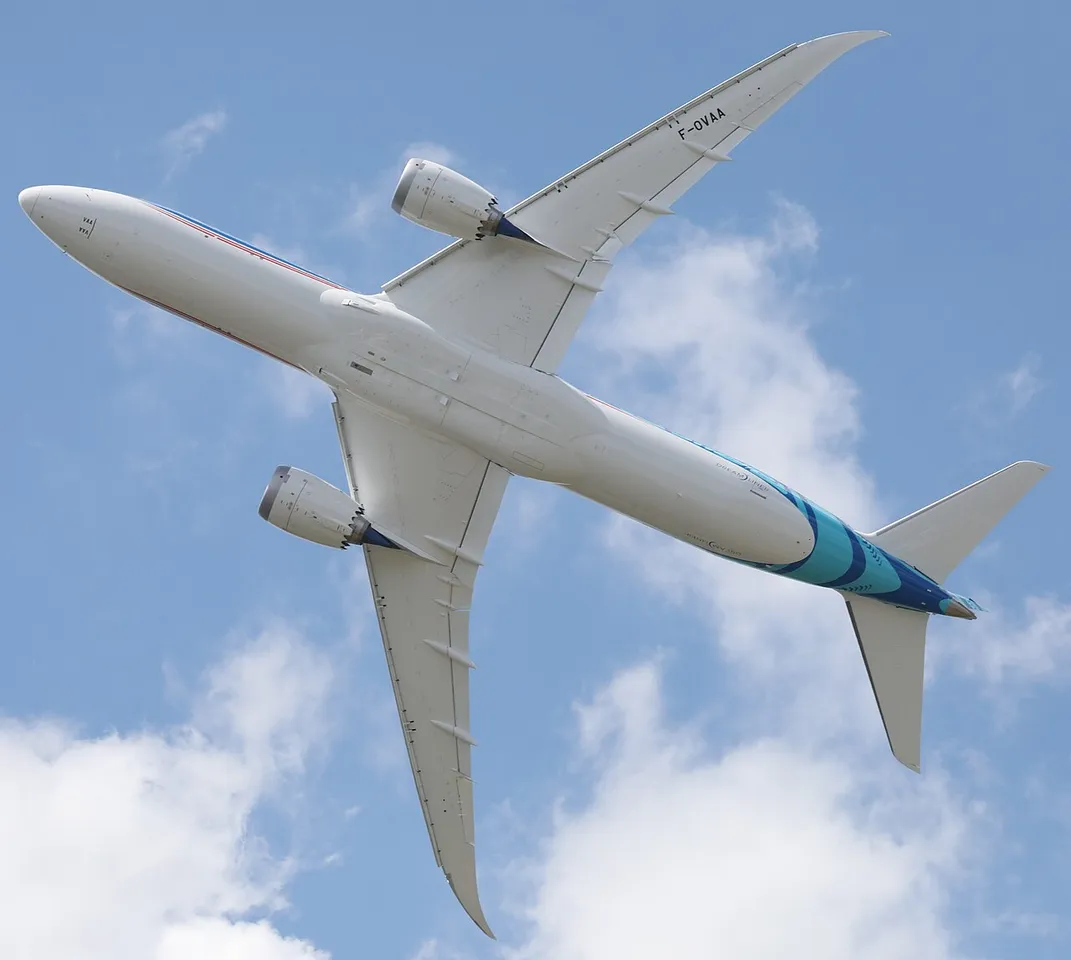
Historical aircraft-type context from a different airline, not a PIA delivery photograph.
Nautical miles and kilometres are different units
A nautical mile equals 1.852 kilometres. To convert an exact nautical-mile quantity, multiply by that factor. Published specifications may round their displayed conversions, so small differences between your calculation and a rounded manufacturer figure do not automatically identify an error. Match the precision of the source rather than adding unnecessary digits.
Use an original example of 1,000 nautical miles. Multiplication gives 1,852 kilometres. Then reverse the calculation by dividing. Ask students to label each value with its unit. A bare number such as “1,852” is ambiguous without context, especially when several units appear in the same aircraft table.
The same care applies to speed and distance. A distance value does not tell you flight time without further information, and a simple distance-divided-by-speed classroom calculation is not an airline schedule. Keep an educational model visibly separate from practical flight planning or promises about an actual arrival time.
What does composite construction mean?
Boeing’s design explanation describes the 787 airframe as about 50 percent composites by weight. “By weight” is an important condition: it is not a statement that half of every visible surface is the same material or that every component has identical properties. A material summary should preserve the basis of the percentage.
For a classroom demonstration, make a fictional object from several materials and compare the proportion by mass with the proportion of visible area. The two measures can differ. This helps explain why percentages need a defined denominator. It does not test the strength, repair process or safety of an aircraft structure.
Avoid turning a material description into an unsupported guarantee that a design can never fail or never require inspection. Engineering performance depends on design, manufacturing, maintenance and operating conditions. A general educational article should explain the vocabulary without replacing certification documents or qualified technical assessment.
Aircraft identity needs more than a photograph
A family name, variant, registration and operator identify different levels of information. A photograph can sometimes show a registration or livery, but the caption and date still matter. An image of a 787-9 from another airline is not evidence of the specific aircraft that arrived for PIA in November.
Historical photographs can illustrate the type if labelled honestly. Do not relabel a 787-8 as a 787-9 because both are Dreamliners. Similarly, an airline name painted on an aircraft does not establish ownership, contract terms or its current route. Those claims require the relevant records.
Create a fictional aircraft card with model, registration, operator, photograph date and source. Ask which fields a cropped image actually confirms. If the registration is hidden, mark it unknown. A good identification exercise rewards recognising a limit rather than guessing a detail to make the card appear complete.
Build a specification-comparison tool
Start with a small table containing variant, length, wingspan and source date. Store numbers separately from their units and display the units clearly. Do not mix metres and feet in one comparison column. If you offer conversion, keep the original value available so that the result can be checked.
Learners can build a version in our programming courses. Test that changing the selected variant updates the correct fields. Then test an unknown variant. The tool should show that data is unavailable rather than reusing the previous model’s specifications without warning.
Add a short note distinguishing published model specifications from a particular airline’s configuration. This is a meaningful feature because it prevents a common interpretation error. A polished interface is not only attractive; it makes the scope of the data easier to understand and avoids implying that a general number answers a booking-specific question.
Questions to ask before sharing an aircraft claim
Does the claim identify the exact variant? Is it about an agreement, a delivery, an arrival or a scheduled flight? Does a seat count come from a manufacturer table or a current airline configuration? Is a range figure conditional and dated? These questions help turn excitement about a new aircraft into accurate information.
For the PIA story, preserve the distinction between the October ACMI announcement and the reported November arrival. For the engineering story, preserve units, variants and conditions. Neither needs to be exaggerated to be interesting. The combination offers a useful introduction to aviation, contracts, measurement and the careful interpretation of technical specifications.
Keep a specification history
Manufacturer tables can change as a product develops or the presentation assumptions change. Save the source date alongside a quoted figure rather than treating an older brochure as automatically false when a newer page differs. First check whether both concern the same variant, configuration and basis of measurement. Only then describe the difference. This guide uses the table visible during its stated review, not a claim that every earlier 787-9 has identical capabilities.
For a small classroom database, keep two fictional editions of a specification sheet. Let a learner select the edition before comparing values. The interface should never silently combine the range from one edition with the weight assumptions from another. This makes versioning tangible: the record is not just a number, but a number attached to an identified product and source context. It is a useful habit for technical research, software documentation and any project where information evolves.
Sources
- Boeing: 787 Dreamliner family, for the model table checked on 2 November 2026, including the then-published range, dimensions and typical seating range.
- Boeing: 787 by design, for composite construction context.
- Norse Atlantic announcement, 9 October 2026, for the two-aircraft ACMI agreement and stated responsibilities.
- PIA arrival report, 1 November 2026, for the dated Islamabad arrival account. All scale drawings, fictional contracts and calculations above are educational examples, not operational aviation instructions.
Image credits: cover: Hawkeye UK, source, CC BY-SA 2.0. Resized and converted to WebP. inline: New York-air, source, CC BY-SA 4.0. Resized and converted to WebP.
Found an error or an outdated detail? Report a correction with the article URL and original source.