
Bruno Fernandes: United Timeline, Creative Midfield and Passing Risk
Explore Bruno Fernandes’s United transfer and captaincy timeline. Learn creative passing, chance creation, off-ball support and football data.

Bruno Fernandes is easiest to understand when creative responsibility is separated from a simple count of goals and assists. A midfielder can attempt a difficult pass that creates a chance, choose a safer option to retain possession or move without touching the ball to open a route for someone else. Those decisions make his role a useful subject for learning how football attacks are organised.
This guide anchors the career outline to Manchester United's January 2020 signing announcement and the documented captaincy change before the 2023/24 season. It then explains how to assess passing risk, chance creation and attacking positioning. It does not invent a current transfer, injury, season total or private tactical instruction. Numerical examples below are fictional unless explicitly attributed to an official record.
Who is Bruno Fernandes?
Bruno Fernandes is a Portuguese professional footballer who joined Manchester United from Sporting Clube de Portugal in January 2020. He later became club captain ahead of the 2023/24 campaign. Those are separate milestones: joining the squad and receiving a leadership role happened at different times. A profile should preserve the distinction instead of describing every later responsibility as part of the original transfer.
A club timeline needs exact institutions
Sporting and Manchester United are distinct clubs, while Portugal is the national team association. Club and international appearances belong to different competitions and reporting systems. When collecting information, place each record in its proper category. Adding a national-team appearance total to a club season without explanation produces a number that does not describe either category clearly.
A signing announcement is not a permanent status update
A January 2020 announcement establishes what happened then. It does not by itself prove the terms of every later contract or future transfer window. This guide uses the record as historical career evidence. Claims about a new agreement require their own dated confirmation rather than an old article presented with a recent social-media timestamp.
What does an attacking midfielder contribute?
An attacking midfielder can connect deeper possession with the forwards, receive in crowded areas and create options near the penalty area. The exact responsibilities depend on the team's structure and match situation. Position names are useful starting labels, but they do not explain every movement. Study where Fernandes receives and what options surround him before reducing his role to a single number.
Receiving between lines is a spatial idea
The phrase between the lines describes space between opposing units, such as midfield and defence. It is not a fixed strip painted on the pitch. As the opponents move, the available space changes. A player may need to adjust his position repeatedly to remain accessible without standing directly behind a defender who blocks the passing route.
Body orientation changes the next action
A receiver facing his own goal has different immediate options from one who can see forward. A half-turned position may help a player recognise pressure and available teammates, but it is not always possible. The arriving pass and opponent's distance matter. Judge the action in context rather than assuming a particular body shape guarantees a successful attack.
A useful movement may produce no touch
An attacking midfielder can draw attention and create space for another player without receiving the ball. That contribution may not appear in an ordinary goals-and-assists summary. To identify it, follow the defenders' reactions and the next passing lane. Do not award invisible credit automatically; explain the visible movement that supports the interpretation.
How should you evaluate a creative pass?
A pass should be assessed in relation to its target, difficulty and intended benefit. A short sideways pass and a ball through a crowded defensive line do not carry the same problem. Completion percentage alone therefore cannot describe creative responsibility. At the same time, a difficult intention does not excuse every loss of possession without examining the alternatives.
Risk has a location
Losing the ball near the opposition penalty area can create a different immediate danger from losing it in front of one's own defence. Teammate positioning and available cover also matter. A useful analysis identifies where the pass was attempted and what happened next. The same incomplete-pass count can contain very different tactical consequences.
An available option is not always a visible option
A television viewer may see a passing lane from an elevated camera angle that the player cannot see through bodies at ground level. This does not make every decision correct, but it should make criticism more careful. Distinguish a clear missed option from an imagined perfect pass that ignores the receiver's actual view and contact situation.
Completion is not the only useful outcome
A completed pass can put a teammate under immediate pressure, while another can move the whole attack into a better area. Ask what the receiver could do next. Describing the result only as completed or failed removes the quality of the situation created. Football data becomes more informative when the event is connected to the surrounding sequence.
What is chance creation?
Chance creation concerns actions that help produce shooting opportunities, but data providers define particular categories differently. An assist, a key pass and an expected-assist measure are not interchangeable labels. Before quoting a statistic, read what the provider counts. A number can be correct within one definition and misleading when casually described using another.
An assist depends on the scoring sequence
A teammate must finish the chance for a pass to become an assist under the applicable definition. A creative action can therefore be useful without producing a goal. Conversely, a simple final pass can receive an assist after a difficult individual finish. Neither point makes the statistic worthless; it explains why the final label is not the entire creative contribution.
A shot is not automatically a strong chance
A hopeful attempt from distance and a close-range opportunity after a clear pass both count as shots, but their quality can differ substantially. If discussing chance creation, describe the type of opportunity rather than equating every resulting attempt. An expected-goals model can offer context, but its output depends on its data and assumptions, not certainty about what should happen.
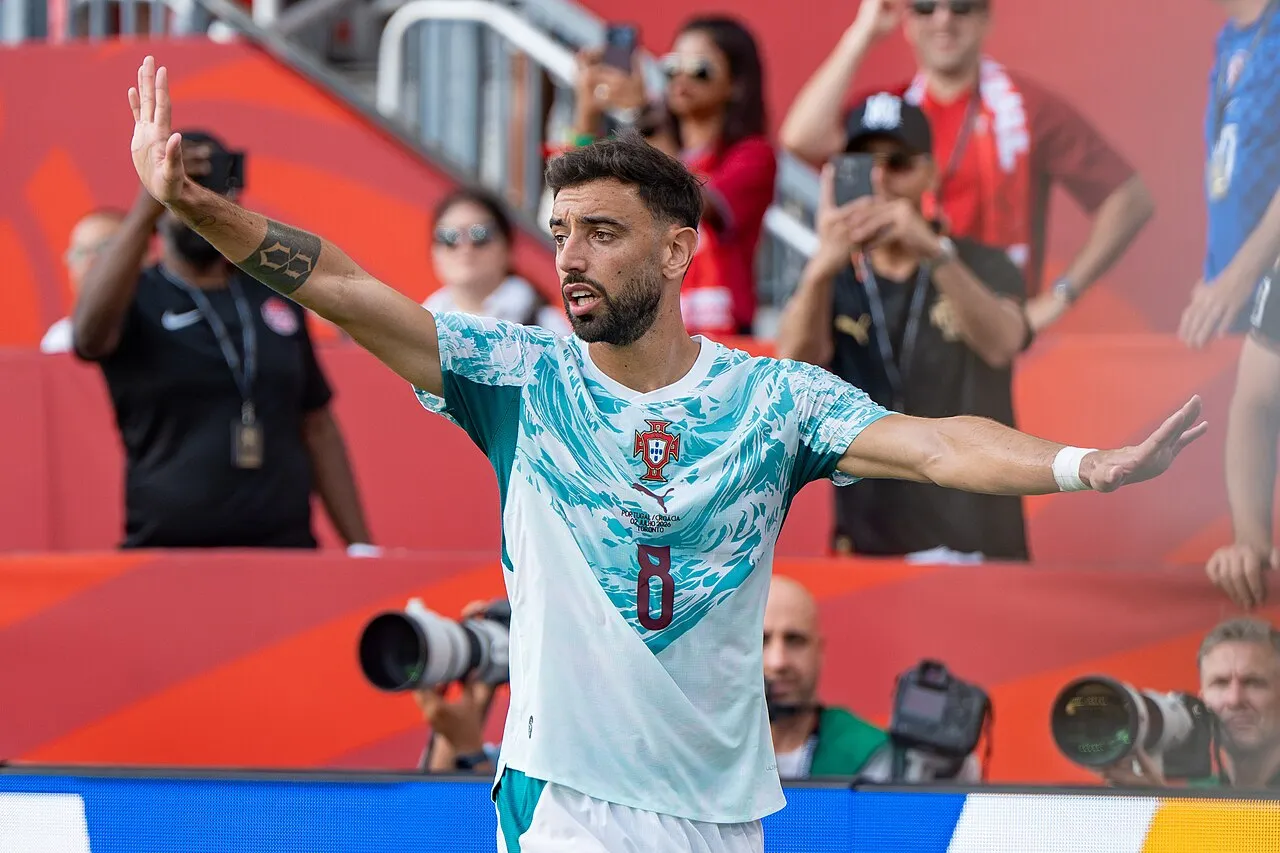
Bruno Fernandes during Croatia against Portugal on 2 July 2026; dated international football context, not a club-transfer announcement.
What does captaincy tell a reader?
Captaincy is a documented team responsibility, not a statistic that measures every leadership quality. The Premier League's captaincy record places Fernandes's appointment ahead of the 2023/24 season. That date establishes the role change. It does not reveal private dressing-room discussions or prove that every on-field decision was personally directed by the captain.
Leadership claims need evidence
A visible conversation, a club announcement and a teammate's attributed statement offer different kinds of evidence. Do not turn a short clip into a claim about an entire relationship. A careful account can describe a captain communicating during a match while leaving motives and private conversations unasserted. This keeps reporting engaging without inventing access to the team.
Responsibility does not remove the team context
A captain still plays within a collective structure involving coaches and teammates. An attacking move can depend on a defender's pass, a forward's run and a supporting midfielder's cover. Giving one player all credit or all blame makes the sequence less understandable. Identify each visible contribution when explaining how a chance or turnover developed.
How can students compare passing records?
Start with attempted passes, completed passes, minutes and competition scope. Then ask whether the two players had similar responsibilities. A defender circulating possession and an attacking midfielder seeking difficult entries may have different completion rates for understandable reasons. The aim is not to avoid comparison but to define a fair question that the available numbers can actually answer.
Work through a fictional sample
Imagine one player completes 45 of 60 passes and another completes 54 of 60. Their completion rates are 75 and 90 percent. These invented figures do not establish who created better chances or protected possession more effectively. To answer those questions, you would need additional information about locations, targets, pressure and the situations following the passes.
Per-90 values need minutes
Suppose a fictional midfielder creates four labelled chances across 180 minutes. That is two per 90 minutes. If another creates three in 90 minutes, the rate is three per 90. The rate helps account for time played, but small samples can still mislead. It does not convert substitute appearances into identical match conditions or remove differences in opposition.
Do not mix totals and rates in one ranking
A season total rewards accumulated contribution, while a per-90 rate describes output relative to time. Each answers a legitimate but different question. An infographic should label which one it uses. Switching between the two depending on which makes a preferred player look better is not a sound comparison, even if every individual number was copied accurately.
Why do off-ball decisions matter?
The player without the ball can influence the next pass by moving, holding position or occupying a defender. When studying Fernandes, follow a complete attacking sequence rather than only the instant of contact. The purpose is to see how passing options are created. Do not assume that a run was useful merely because it looked energetic; identify what changed around it.
Support angles create choices
A teammate positioned directly behind an opponent may be difficult to reach. A small adjustment can open a passing lane and make the next action simpler. This is a useful concept for beginners because it shows how effective football can depend on modest movements. The player need not sprint dramatically for the movement to have a clear purpose.
Cover matters after an attacking risk
When a midfielder advances or attempts a difficult pass, teammates may need to protect space behind the attack. If possession changes, that arrangement influences the transition. Evaluate the team shape instead of judging the attacker in isolation. A turnover can expose a collective spacing problem as well as an individual decision, and the footage may support more than one contributing factor.
A practical football observation project
Choose ten consecutive possessions involving the player in one documented historical match. Record receiving position, pressure, passing direction and the next team action. Include routine moments rather than selecting only assists or errors. Write your definitions before counting so that another student can understand how you decided whether a pass advanced the attack or maintained possession.
Separate a description from an explanation
The description might say that a forward pass was intercepted. The explanation requires more evidence: was the lane blocked, the timing late or the receiver's movement different? A broadcast replay may not resolve every possibility. Record what can be observed and identify the remaining uncertainty instead of turning the first plausible explanation into a confident fact.
Build a source-aware analysis tool
The programming courses can help students create a small match-log application, while the class resources support percentage calculations. Give each entry a match date and source. Validate that completed passes do not exceed attempts, and handle missing statistics as unavailable rather than zero. Useful software preserves the meaning of the data it displays.
Record possession outcomes consistently
Decide whether the next action means the receiver's first contact or the end of the team's possession. Those definitions can produce different findings from the same footage. State the choice before collecting data and keep it unchanged throughout the sample. A transparent rule makes later comparisons more useful and prevents the analysis from quietly changing its question.
Questions about Bruno Fernandes
Did Fernandes join United as captain in January 2020?
No. The transfer from Sporting occurred in January 2020, while the captaincy appointment belongs to the period before the 2023/24 season. Those are separate events in the career timeline. Keeping them distinct prevents a later responsibility from being incorrectly attached to the original signing announcement or used to invent details about the transfer agreement.
Is a lower passing percentage proof of poor creativity?
No single passing rate settles the question. Difficulty, location and purpose matter, as do the consequences of incomplete attempts. A creative role can involve risk without making every risk justified. The strongest analysis considers both the opportunity created and the possession cost, supported by examples rather than a statistic used without its denominator or context.
Sources
- Manchester United: January 2020 signing confirmation
- Manchester United: Bruno Fernandes player profile
- Premier League: club captaincy timeline
Image credits: cover: Александр Вепрёв, source, CC BY-SA 4.0. Resized and converted to WebP. inline: Bryan Berlin / WikiPortraits, source, CC BY-SA 4.0. Resized and converted to WebP.
Found an error or an outdated detail? Report a correction with the article URL and original source.