
Charles Leclerc: Career Milestones and Understanding Formula 1 Race Results
Explore Charles Leclerc’s career, Ferrari move and 2024 Monaco win. Learn qualifying, lap times, tyres, pit stops and official race classifications.

Charles Leclerc is a Monegasque Formula 1 driver whose career offers more to understand than a list of wins. Qualifying pace, race management, engineering decisions and the difference between a good lap and a complete weekend all shape a driver's performance. Reading those details makes motorsport more interesting and prevents a dramatic headline from becoming an inaccurate summary.
This guide follows established career milestones and explains the measurements behind a race report. It does not present an old photograph as a new result or publish an undated championship total. Numerical examples below are classroom exercises unless a particular historical event is explicitly identified. Current results should always be checked against the relevant official event classification.
Who is Charles Leclerc?
Charles Leclerc was born in Monte Carlo, Monaco, on 16 October 1997. He entered Formula 1 with Sauber in 2018 and joined Ferrari for the 2019 season. His earlier development included successive GP3 and Formula 2 titles. These milestones describe a progression through racing categories rather than a sudden arrival without preparation.
Nationality and team are separate identities
Leclerc represents Monaco as a driver, while Ferrari is his Formula 1 team. A team's national association does not replace a driver's nationality. Likewise, a race held in a particular country does not change the competitors' identities. Keep the driver, entrant, venue and championship separate when creating a profile or reading a timing sheet.
Junior success is not a Formula 1 title
Winning in a junior category demonstrates achievement within that championship's field, cars and rules. It does not count as winning the Formula 1 drivers' championship. A profile should name the category and season rather than combining different titles into a misleading total. Career development is more informative when each stage retains its own context.
What changed when Leclerc joined Ferrari?
The move from Sauber to Ferrari in 2019 placed Leclerc in a different team environment and competitive context. Formula 1's official biography records his first Grand Prix victory at Spa and another at Monza the following week. These are historical milestones, not claims about the latest season or a prediction of future results.
A first victory and a home-team celebration
Spa is the circuit associated with the Belgian Grand Prix, while Monza hosts the Italian Grand Prix. Ferrari's connection with Italian supporters helps explain the attention surrounding a Monza victory. That is different from Leclerc's own home Grand Prix in Monaco. Calling both events simply his home race removes an important distinction between driver and team.
A team move changes more than car colour
A driver works with engineers, operational procedures and a car whose behaviour may differ from the previous season. Setup choices affect how the car responds through corners and over a race distance. Results should therefore be read with the competitive environment in mind. Comparing positions alone cannot isolate how much improvement came from the driver or equipment.
Why was the 2024 Monaco victory significant?
Leclerc won the Monaco Grand Prix on 26 May 2024. The official Formula 1 event report identifies him as the first Monegasque winner of the race during the world championship era. The wider historical comparison includes Louis Chiron's 1931 victory, before that championship era. Both the achievement and the historical boundary deserve clear wording.
A precise record is better than a bigger claim
Saying first Monegasque winner ever would erase the earlier history. Saying first in the world championship era preserves what made the 2024 result distinctive. Sports records often depend on these boundaries: a particular competition, era, venue or nationality. Before repeating a first-ever headline, identify the exact set of events being counted.
A historical win is not this week's classification
An article published recently can discuss a race from 2024. Its publication date does not move the event into the current season. When sharing a result, include the event year and distinguish a retrospective from live reporting. This is particularly important when an emotional celebration photograph circulates again without its original caption or date.
How do qualifying and the race differ?
Qualifying establishes a competitive order under the event's applicable format, while the race determines its own finishing classification. Pole position refers to the first starting position; it is not another name for a victory. A driver can be exceptionally fast over one lap without finishing first after the longer demands of the race.
Why one fast lap cannot explain everything
A qualifying attempt concentrates performance into a short opportunity. A race adds repeated laps, changing fuel load, tyre behaviour, traffic and operational decisions. A quick car over a single lap might not maintain the same advantage throughout a longer run. Understanding those different tasks is more useful than assuming the quickest qualifier must always win.
Qualifying position and starting position can differ
Always consult the final starting grid for the particular event rather than assuming it is identical to a qualifying screenshot. Applicable penalties or other official decisions can change the grid. This guide does not substitute a general description for a season's sporting regulations. The relevant official documents determine what happened at a specific race.
How do you read a lap time correctly?
A lap time commonly combines minutes, seconds and thousandths of a second. The colon separates minutes from seconds; it does not express a decimal minute. Converting both times into seconds makes comparisons much easier. Small-looking differences can matter in racing, but their interpretation still depends on the session and conditions.
Work through a fictional comparison
Imagine one lap recorded as 1:20.350 and another as 1:20.675. The first is 80.350 seconds and the second 80.675 seconds. Subtracting gives 0.325 seconds. These are invented examples, not Leclerc's lap times. Showing the conversion avoids accidentally subtracting the numbers as if the minute field were already part of a decimal measurement.
Average pace needs comparable laps
Suppose a classroom dataset includes a slow pit-entry lap alongside uninterrupted laps. Taking an unlabelled average can make a driver's normal pace look worse. Decide what the calculation is intended to measure, then state which laps it includes. Excluding data silently is misleading, but combining different kinds of laps without explanation can also obscure the question.
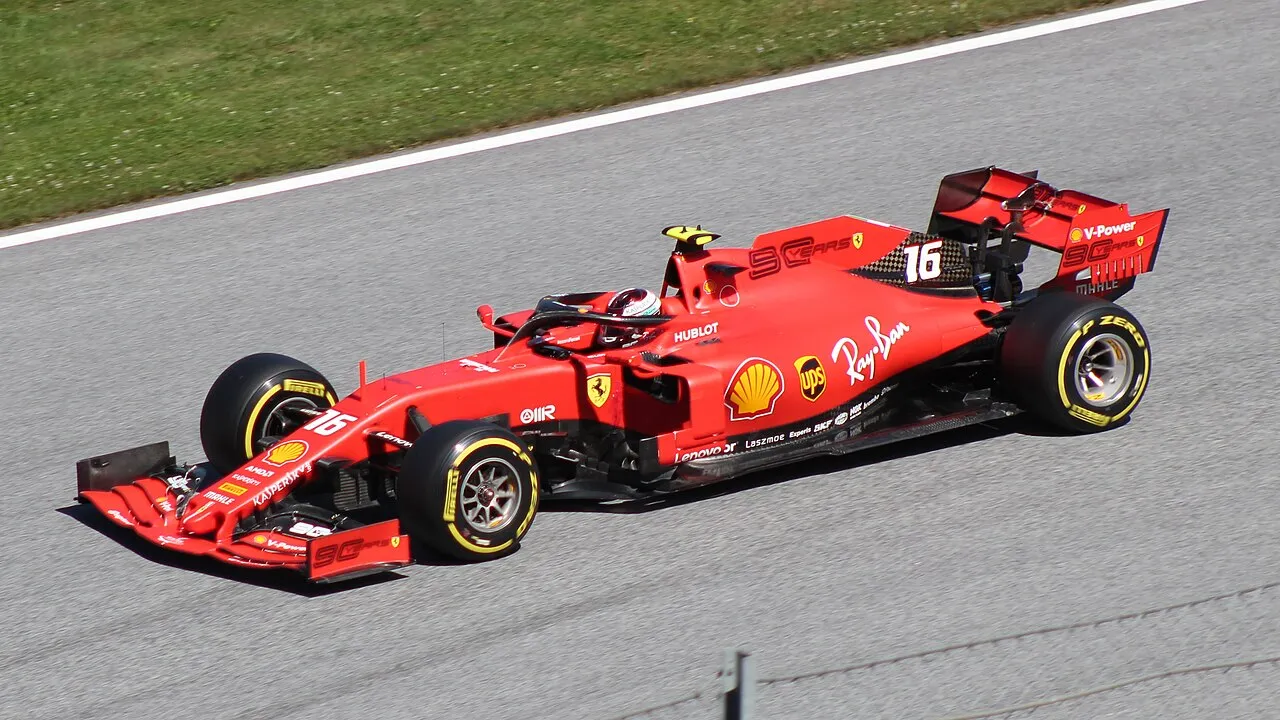
Charles Leclerc’s number 16 Ferrari during the Austrian Grand Prix weekend in June 2019; historical on-track context.
What do sectors reveal about a lap?
Timing sectors divide the circuit into smaller measured portions. They can show where a driver gained or lost time relative to another lap. A strong first sector does not guarantee the quickest complete lap, because the remaining sectors still count. Analyse the full sequence rather than turning one favourable split into a claim about the entire session.
Add the parts before judging the whole
In a fictional example, three sectors of 25.100, 30.200 and 24.900 seconds total 80.200 seconds. Another driver might gain two tenths in the first sector and lose three tenths later. The second driver then finishes the full lap one tenth slower. This demonstrates why a partial timing advantage and a final ranking can tell different stories.
A best-sector combination may be hypothetical
A graphic can combine a driver's strongest sectors from different laps to illustrate potential. That assembled number is not necessarily a lap the driver actually completed. Check whether a display shows a recorded time or a theoretical best. The distinction matters whenever an analysis claims that a driver could have qualified higher by combining separate moments.
Why are tyres central to a race explanation?
Tyres influence grip and how performance changes during a stint. Their behaviour depends on temperature, wear, loading, track conditions and setup. A fresh tyre can offer a different performance profile from an older one, but there is no universal rule that one label guarantees the best outcome in every situation or for every circuit.
Read compound names with event context
The labels used during a race weekend should be interpreted with that event's tyre selection and regulations. A colour or a simple soft-medium-hard description is not enough for an unrestricted comparison across years. A student can describe what a team used in one documented race without assuming that an identically named tyre had exactly the same characteristics elsewhere.
Strategy balances competing costs
Stopping for different tyres may improve subsequent pace, but reaching and leaving the pit lane costs time. Staying out avoids an immediate stop while potentially losing performance later. Traffic also matters because rejoining behind another car can change the intended benefit. Strategy is therefore a comparison of scenarios, not a simple instruction to choose the newest tyres whenever possible.
What is the difference between pit-stop time and pit-lane loss?
The stationary service time measures only one part of a stop. A car must also enter, travel through and leave the pit lane. The overall time lost relative to continuing on the circuit is a different measurement. A very fast tyre change does not mean the entire pit-lane visit took only that many seconds.
Label a stop calculation carefully
Imagine a hypothetical service lasting three seconds, with additional travel and speed-limited movement around it. Reporting only those three seconds as the total race-time cost ignores the rest of the sequence. When comparing strategies, specify the measurement used. Different broadcasts and timing graphics may emphasise different parts of the process without being directly interchangeable.
Interruptions change the comparison
A safety-car period or another interruption can change the relative cost of stopping because cars on the circuit are no longer travelling under normal racing conditions. That does not make every stop automatically advantageous. Position, tyre condition, track access and the event's applicable rules still matter. Read the official race sequence before judging a decision from a short replay.
How do driver and constructor results differ?
The drivers' championship concerns individual competitors, while the constructors' competition concerns teams under the applicable scoring rules. A team result can therefore depend on more than one car. A strong personal finish and a disappointing team outcome can coexist. Use the season's official standings instead of calculating a championship from one isolated finishing order.
Keep race and sprint records separate
Some weekends include sessions with their own competitive results in addition to the Grand Prix. A database may show race and sprint statistics in separate fields. Combining them without a label can create a total that answers neither question clearly. Identify whether a number describes Grand Prix victories, sprint victories, points or all event participation.
A podium is not always a win
In ordinary race-result reporting, the podium includes the leading three finishers. A victory describes first place. If a profile lists podium appearances and wins, the wins are part of the podium record rather than an entirely separate collection to add again. Carefully naming the category prevents double counting and exaggerated career summaries.
How can students analyse Leclerc without guessing?
Choose one historical event and collect the official entry list, grid and final classification. Record the date, team and session for every statistic. Then ask a narrow question, such as how the starting position compared with the final result. A modest conclusion supported by those records is stronger than a sweeping judgement built from an edited highlight.
Separate observation from explanation
An observation might be that a car lost positions during a particular phase. Explaining why requires evidence such as timing, an official decision or a documented team account. Do not automatically assign blame to a driver, engineer or component. Where the evidence does not establish the cause, describe the uncertainty rather than disguising speculation as inside knowledge.
Use photographs as dated context
A portrait identifies the subject, while an on-track photograph can illustrate a particular car and event. Neither proves a later result or contract status. Preserve the photographer's credit and the image's date where available. Historical images remain useful when their captions are honest about what the reader is actually seeing.
Questions about Charles Leclerc
Is Leclerc Italian because he drives for Ferrari?
No. His driver nationality is Monegasque, and he was born in Monte Carlo. The team identity is a separate part of the entry. Keeping those two facts distinct helps readers understand national flags in classifications and why the Monaco Grand Prix has a different personal significance from Ferrari's association with the Italian Grand Prix.
Does pole position guarantee a race win?
No. It provides a starting position, not a completed result. Race pace, tyre choices, reliability, incidents and operational decisions can change the outcome. To evaluate a specific weekend, compare the final qualifying record, actual grid and official race classification. Each document describes a different stage of the competition rather than competing versions of the same statistic.
Where can students practise these calculations?
The class study resources provide supporting learning material, while the programming courses offer a place to practise data handling. Build a function that converts a lap time into seconds, validates its format and compares two fictional laps. Add clear units and a source field before extending it to real historical records. Accurate small tools make sports analysis easier to understand.
Sources
- Formula 1: Charles Leclerc's official driver profile and career biography
- Formula 1: historical context for Leclerc's 2024 Monaco victory
- FIA: official entry list for the 2024 Monaco Grand Prix
Image credits: cover: Gil Zetbase, source, CC BY-SA 4.0. Resized and converted to WebP. inline: Lukas Raich, source, CC BY-SA 4.0. Resized and converted to WebP.
Found an error or an outdated detail? Report a correction with the article URL and original source.