
Chinese Yuan Explained: RMB, CNY, CNH and Reading CNY-to-PKR Quotes
Understand yuan, RMB, CNY and CNH, compare buying and selling quotes, calculate conversions and fees, and find official exchange-rate information.

The Chinese yuan is the unit of China's renminbi currency. CNY is the currency code commonly used in exchange-rate tables, while RMB is a familiar abbreviation for renminbi. For someone comparing yuan with Pakistani rupees, the important next question is not simply “what is the rate?” It is which rate, for which transaction, at what time and with what charges.
This guide was checked on 13 November 2026. It explains currency labels, CNY versus CNH, buying and selling quotes, conversion arithmetic and the difference between a reference figure and a provider's actual offer. It does not publish an unverified live yuan-to-rupee quote or recommend a currency trade.
The examples below use deliberately hypothetical numbers. They are learning exercises, not rates offered by a bank, exchange company or this website. Keeping that distinction visible lets readers learn the calculation without mistaking a worked example for a promise about today's transaction.
Yuan, renminbi, RMB and CNY
Think of renminbi as the currency name and yuan as its main unit. The terms often appear together because a price is expressed in units while a currency discussion uses the broader name. A figure such as 100 yuan describes an amount; RMB and CNY help identify which currency the amount belongs to.
Do not rely on the currency symbol alone when comparing international prices. Symbols can be used in more than one context, and a copied price may lose the country label surrounding it. A currency code attached to the amount reduces ambiguity, especially in spreadsheets, invoices and travel budgets.
For a simple personal record, write both the number and the code: “100 CNY,” not just “100.” Then write the currency you want to compare it with. This habit prevents a surprisingly common error: performing correct arithmetic on numbers that describe different currencies or different units.
What CNY and CNH describe
Central-bank research distinguishes the onshore renminbi market, commonly labelled CNY, from the offshore market, commonly labelled CNH. The labels identify different market contexts for the renminbi. They should not be treated as two unrelated national currencies merely because a screen uses different final letters.
Those market contexts can produce different quotations. A chart labelled USD/CNH therefore should not silently be substituted for a provider's CNY-to-PKR transaction quote. Read the full pair and the market description before deciding that two screens contradict one another.
For an ordinary learning exercise, begin with the pair shown on the relevant official or provider document and avoid introducing an offshore quote unnecessarily. Understanding the terminology is useful; trying to exploit a difference between markets is a separate, much more complex activity that this guide does not recommend.
Read the direction of the exchange rate
Suppose an imaginary example says one CNY equals 40 PKR. The number 40 represents rupees per yuan. To estimate the rupee value of 25 CNY at that hypothetical rate, multiply 25 by 40. The result is 1,000 PKR before any separate charges.
Now reverse the direction. At that same invented rate, one PKR equals 0.025 CNY because one divided by 40 is 0.025. Both statements describe the same hypothetical relationship. They look different because the base unit has changed, not because someone necessarily changed the underlying price.
Write the units through the calculation if you are unsure. CNY multiplied by PKR per CNY leaves PKR. PKR divided by PKR per CNY leaves CNY. This method is more dependable than memorising “always multiply,” which fails as soon as the question is reversed.
A buying rate is written from someone's perspective
An exchange provider's buying rate generally concerns the provider buying the foreign currency from the customer. Its selling rate concerns the provider selling that currency to the customer. The customer's action is therefore the opposite side of the provider's label, which can be confusing at first.
If you hold yuan and want rupees, ask what you will receive when the provider buys your yuan. If you hold rupees and want yuan, ask the full amount you must pay to buy the required yuan. State the intended transaction rather than asking for an unexplained single number.
Always check the provider's own labels and terms for the actual service. Cash, account transfers and other arrangements may not use one identical quotation. This guide explains the reading method; it cannot establish the rate or availability of a transaction with a particular institution.
A worked buying-and-selling example
Imagine a provider displays a hypothetical buying rate of 39 PKR and selling rate of 41 PKR for one CNY. Selling 100 CNY to that provider would produce a gross amount of 3,900 PKR at the example buying rate. Buying 100 CNY would require 4,100 PKR at the example selling rate.
The gap is called a spread in this example. It explains why changing currency and immediately changing it back does not normally return the original amount even before a separately stated fee. The two directions use different prices rather than a single reversible classroom conversion.
These invented numbers are intentionally simple. They do not describe an institution's current spread, and the exercise is not a recommendation to transact. Its purpose is to make the direction and unit clear enough that you can read a real quote more carefully.
Include fees in the total comparison
Now suppose the fictional 100 CNY purchase also carries a separately stated 200 PKR charge. The total example cost becomes 4,300 PKR rather than 4,100. Dividing that total by 100 produces an effective cost of 43 PKR per CNY for this particular example transaction.
Compare that with a second imaginary provider offering the same 100 CNY for 4,250 PKR with no additional charge in the example. The second offer is cheaper for this stated amount, even if an isolated advertised rate initially looked less attractive. The full payable total answers the practical comparison.
For a real service, ask which fees are included, which are separate and whether a recipient receives the exact requested amount. Do not assume that every provider uses the same charging structure. A clear written quote is more useful than an attractive number detached from its conditions.
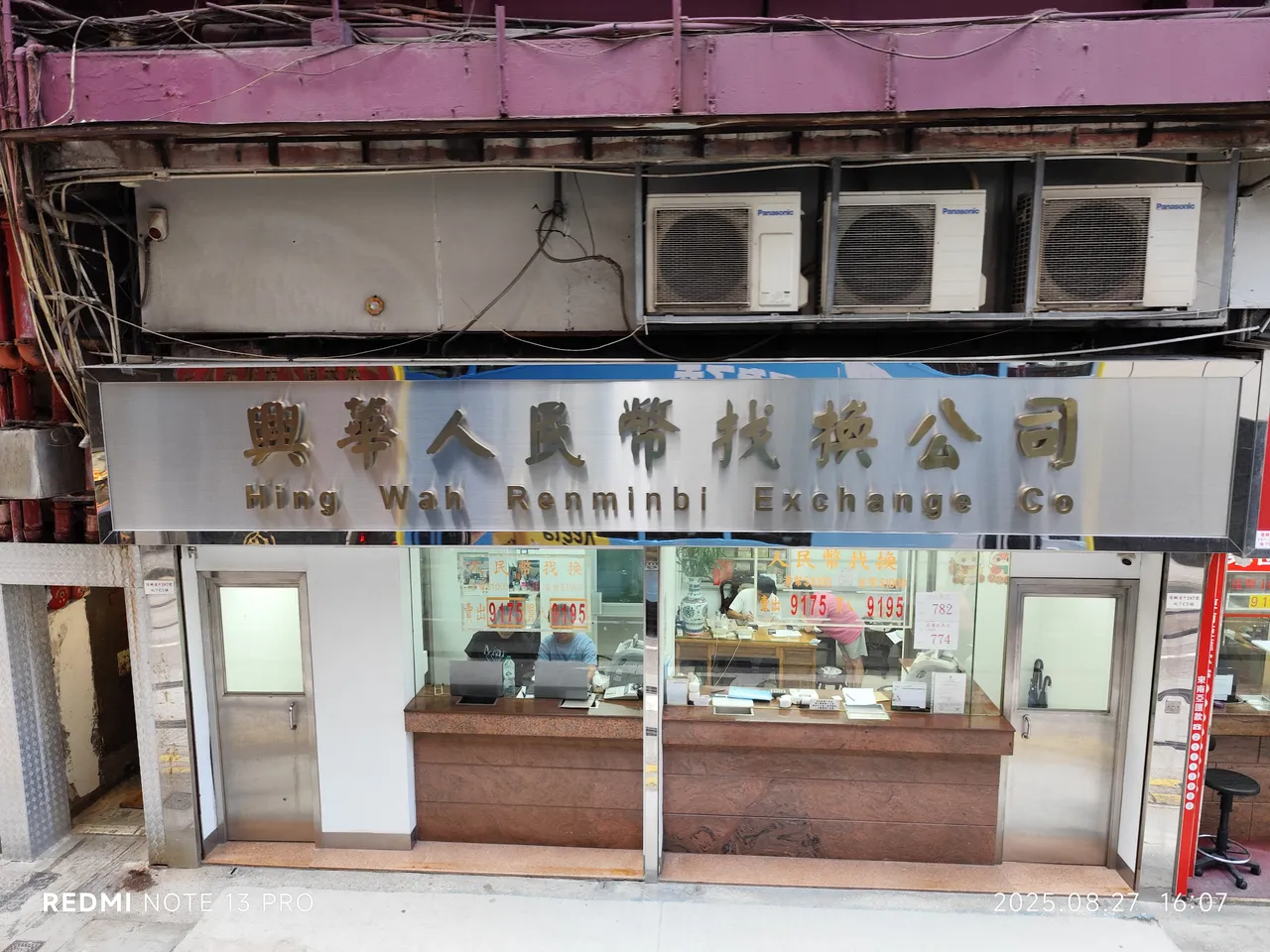
Archive: a Hong Kong exchange storefront in August 2025. Any visible figures are historical and are not current CNY-to-PKR offers.
Reference tables are not automatically retail offers
The State Bank of Pakistan publishes economic and exchange-rate information. Its website distinguishes concepts such as mark-to-market revaluation and weighted-average rates. Those labels matter because a published reference has a defined purpose; it is not automatically an offer for a small cash exchange at any counter.
Check the date printed on the relevant publication and the description of the table. A value from the previous working day may still appear on a page viewed today. The date you opened the browser and the date of the underlying observation are different pieces of information.
This article links to the official economic-data starting point instead of asserting a current CNY figure that was not verified from the appropriate sheet. If a saved link moves or redirects, return to the official site's current data navigation rather than treating an unrelated number as a substitute.
Why two websites can show different yuan figures
First check whether both figures concern the same pair, date and direction. One page may show a reference rate, another a customer selling quote and another an older cached amount. Those differences must be investigated before concluding that one of the pages has necessarily calculated the conversion incorrectly.
Next inspect the unit. A bank table may express selected currencies per a stated number of units rather than one. A screenshot cropped above the column heading can remove the detail needed to interpret the figure. Never copy a number without the heading that defines it.
Finally, compare the source and timestamp. A search snippet is a summary of a page at a particular point, not a binding transaction quote. Open the relevant source and read the current explanation. A precise-looking decimal is not enough to establish freshness or applicability.
Calculate an invoice estimate without confusing it with payment
Suppose a fictional course-material invoice is 250 CNY and your planning assumption is 40 PKR per CNY. The initial estimate is 10,000 PKR. If the assumption changes to 42, the estimate becomes 10,500 PKR. The difference is 500 PKR before any separate costs.
This kind of calculation is useful for understanding sensitivity, but it does not prove that a payment method will process the invoice at either rate. The actual method, availability, charges and settlement terms require confirmation from the relevant provider. Keep the estimate labelled as an estimate.
In a spreadsheet, separate the foreign-currency amount, assumed rate and additional charges into different cells. Put the rate's date and source alongside them. That structure makes it easier to update one input and see the effect without rewriting the invoice amount or hiding a fee inside a formula.
Percentage changes depend on the quotation
Consider another purely hypothetical movement: a yuan quotation rises from 40 to 42 PKR per CNY. The change is two divided by 40, multiplied by 100, which equals five percent. In that quotation, purchasing one yuan requires more rupees than before.
The reciprocal quotation changes from 0.025 to approximately 0.02381 CNY per PKR. Its percentage change is approximately minus 4.76 percent, not exactly minus five. Reciprocal exchange rates do not produce equal percentage movements in opposite directions because their starting denominators differ.
This is a mathematical explanation, not a prediction about either currency. Before repeating that something has strengthened or weakened by a certain percentage, check which currency is the base, which is the quote and what starting value was used. The wording should match the actual calculation.
Keep transaction records and private details separate
A useful comparison note contains the amount, currency pair, direction, date, quoted total and relevant fee explanation. It does not need to become a public collection of account numbers, identity documents or payment screenshots. Share sensitive material only through an appropriate authorised process when required.
If a person promises a special rate through a private message, verify the service independently instead of sending funds because the advertised number looks favourable. A currency lesson cannot validate an unknown business or confirm that a payment destination belongs to the organisation it claims to represent.
For classroom practice, fictional quotes are enough. Students can compare multiplication, division, spread and fees without using real account data or attempting a financial transaction. The purpose is confidence in reading numbers, not pressure to buy currency as part of an exercise.
A five-question checklist before comparing quotes
Ask which currency you are giving and which you are receiving. Check whether the rate is buying, selling or a reference figure. Read its date and unit. Identify all stated charges. Then compare the full amount payable or receivable for the same transaction size and service type.
If any of those answers is missing, request clarification from the provider before relying on the comparison. Do not fill an unknown fee or unit with an assumption just to complete a spreadsheet. A clearly marked unknown is better than a neat total that answers the wrong question.
More educational and economy explainers are available on this website. The skill to take away is a repeatable reading method: identify the unit, preserve the direction, separate reference information from an offer and keep assumptions visible. That method remains useful even when the actual rate changes.
Common questions
Are yuan and renminbi different currencies?
Renminbi is the currency name and yuan its main unit. RMB is a common abbreviation, while CNY identifies the currency in many rate tables. Read the code and context together rather than assuming that different familiar labels always describe different money.
Can I use the examples as today's CNY-to-PKR rate?
No. Every numerical conversion example in this article is hypothetical. Check the relevant current official information and the provider's actual offer for your intended transaction. Include fees and quote direction when making a comparison.
Why not publish one live yuan rate here?
A single figure can conceal its date, direction, market and purpose. This static educational guide does not claim a real-time feed. It explains how to read the relevant source so that a reference rate is not mistaken for a guaranteed retail transaction.
Sources
- State Bank of Pakistan: official economic data
- State Bank of Pakistan: official website and exchange-rate categories
- Reserve Bank of Australia: developments in RMB internationalisation, August 2026
- Government of Canada terminology service: yuan and currency terminology
- CME Group: educational background on yuan, renminbi and offshore markets
Image credits: cover: User:CatOnMars, source, CC BY 4.0. Resized and converted to WebP. inline: HDISMMSY POON YAU, source, CC0. Resized and converted to WebP.
Found an error or an outdated detail? Report a correction with the article URL and original source.