
CISF Explained: Full Form, Public Responsibilities and Recruitment Notices
Learn CISF's full form, public role and how to read official recruitment notices, eligibility dates, selection stages and application updates.

CISF stands for Central Industrial Security Force. Its public Citizen's Charter identifies it as a force under India's Ministry of Home Affairs, established in 1969, with responsibilities that include industrial and other infrastructure security. A search for CISF can concern its public role, a recruitment notice, an application stage or a result. These are related subjects, but they require different evidence.
The official CISF website links its recruitment information and recruitment portal. This guide explains how to use those routes and read a notice carefully. It does not announce an unverified vacancy, supply a universal age limit or promise selection. Any dates, eligibility conditions and stages for an actual application must come from the relevant current official notice.
What the full name tells a student
An abbreviation can become familiar before its meaning is understood. Expanding CISF to Central Industrial Security Force gives a useful starting point, but the name alone does not describe every present public responsibility. The Citizen's Charter provides the broader institutional context.
For a civics notebook, record the full name, responsible ministry and official source separately. Those fields help distinguish an institution from a coaching centre, a private service or an unrelated organisation using similar letters. A copied logo is not enough to establish that a website is official.
| Search purpose | Appropriate official evidence |
|---|---|
| Public responsibilities | Citizen's Charter and official information |
| A particular vacancy | Identified recruitment notification |
| Application requirements | Notice and linked official application route |
| Examination update | Applicable official notice or candidate record |
| Selection outcome | Relevant official result and instructions |
The public role is broader than one familiar location
The Charter describes industrial security alongside roles involving airports, government buildings and other critical infrastructure. Seeing the force at one public location does not establish that its entire work is limited to that place. The official description is the appropriate source for its general mandate.
This article stays at the institutional and educational level. It does not describe deployment patterns, inspection weaknesses or sensitive operating arrangements. Students can understand the relationship between a public force, infrastructure and public service without needing tactical details about a particular site.
When writing an assignment, distinguish a broad responsibility from a specific current deployment claim. The latter needs its own dated evidence. A historical photograph is useful visual context, but it cannot establish present personnel numbers or operational arrangements at a location.
A recruitment overview is not a vacancy announcement
An official overview can describe posts and recruitment routes without establishing that applications for every listed post are currently open. A vacancy announcement identifies a particular exercise, usually with its own reference and dates. The two should not be treated as interchangeable.
For a fictional example, a website explains five job categories but opens applications for only one named exercise. The overview remains useful background, yet it does not create four additional open application windows. The actual notice answers which opportunity is available.
Start with the official recruitment information, then locate the specific notification. Keep its title, reference, publication date and relevant application dates together. A generic search snippet or a coaching headline should not replace the actual document when making an application decision.
Identify the recruiting authority for the actual post
The official recruitment page describes different routes and authorities for different posts. A familiar force name does not mean every application is conducted through one identical form or examination. The current notification should identify the responsible body and process.
For a fictional public-sector exercise, an institution supplies the eventual role while a named examination authority conducts an earlier stage. Applying through an unrelated form because the institution's name appears in the advertisement would not follow the identified process.
Read the notice's application instructions and follow the official link it provides. This guide does not assume that every CISF-related recruitment uses the same agency, portal or sequence. The correct route is the one specified for the particular exercise and date.
Post title and recruitment year belong together
Similar post names can appear in different years, categories or recruitment exercises. A result or admit-card update from one exercise should not be attached to another merely because part of the title matches. The reference information helps prevent that mistake.
Create a fictional comparison with two notices bearing the same broad post label but different years. Their deadlines and candidate lists are not interchangeable. A person searching only the short title could easily land on an older record and misunderstand its relevance.
Record the full notice identity before checking an update. When an article links to a document, verify that the document's own heading matches the intended exercise. The page's upload date and the recruitment year can also describe different things.
Eligibility must be read for the specific exercise
Age, education, nationality, category conditions and other requirements can differ by post and notification. A broad overview should not be turned into a universal rule for all applicants. The applicable notice and any official amendments are the relevant records.
For a fictional application, one qualification is required by a stated cutoff date. Completing it later may be a different situation under that exercise's wording. The example explains why the date matters; it is not an eligibility decision for any reader.
Build a checklist directly from the actual notification, preserving its conditions. If a clause is unclear, use the responsible official contact or clarification route. Do not rely on a comment that removes an exception or adds a relaxation absent from the governing document.
A cutoff date differs from the last date to apply
An application deadline and an eligibility reference date can serve different purposes. One concerns submitting the form; another may define how a condition is assessed. Reading them as the same date can lead to an incorrect conclusion even when both were copied accurately.
In an invented notice, applications close on the 20th while an age condition is assessed on the first day of another specified month. A calculation based only on the closing date would not follow that fictional notice's rule. The document must supply the actual basis.
When making notes, keep a separate row for every date and its purpose. Add a source reference beside each. This is a practical information-reading skill and avoids turning a calendar reminder into an unsupported eligibility interpretation.
Physical and medical stages need official requirements
Some recruitment routes can include physical, skill or medical stages under their applicable rules. Requirements and exemptions must be read from the relevant notice. A short social-media summary can omit important conditions or describe another post entirely.
This article does not provide a training programme, medical assessment or personal prediction about passing. A general recruitment guide cannot determine an individual's health or suitability from a few details. The responsible official process establishes the applicable assessment and outcome.
For study purposes, distinguish the name of a stage from its exact criteria. Write down where the official requirements are located and which exercise they belong to. Do not merge standards from several posts into a single invented test for everyone.
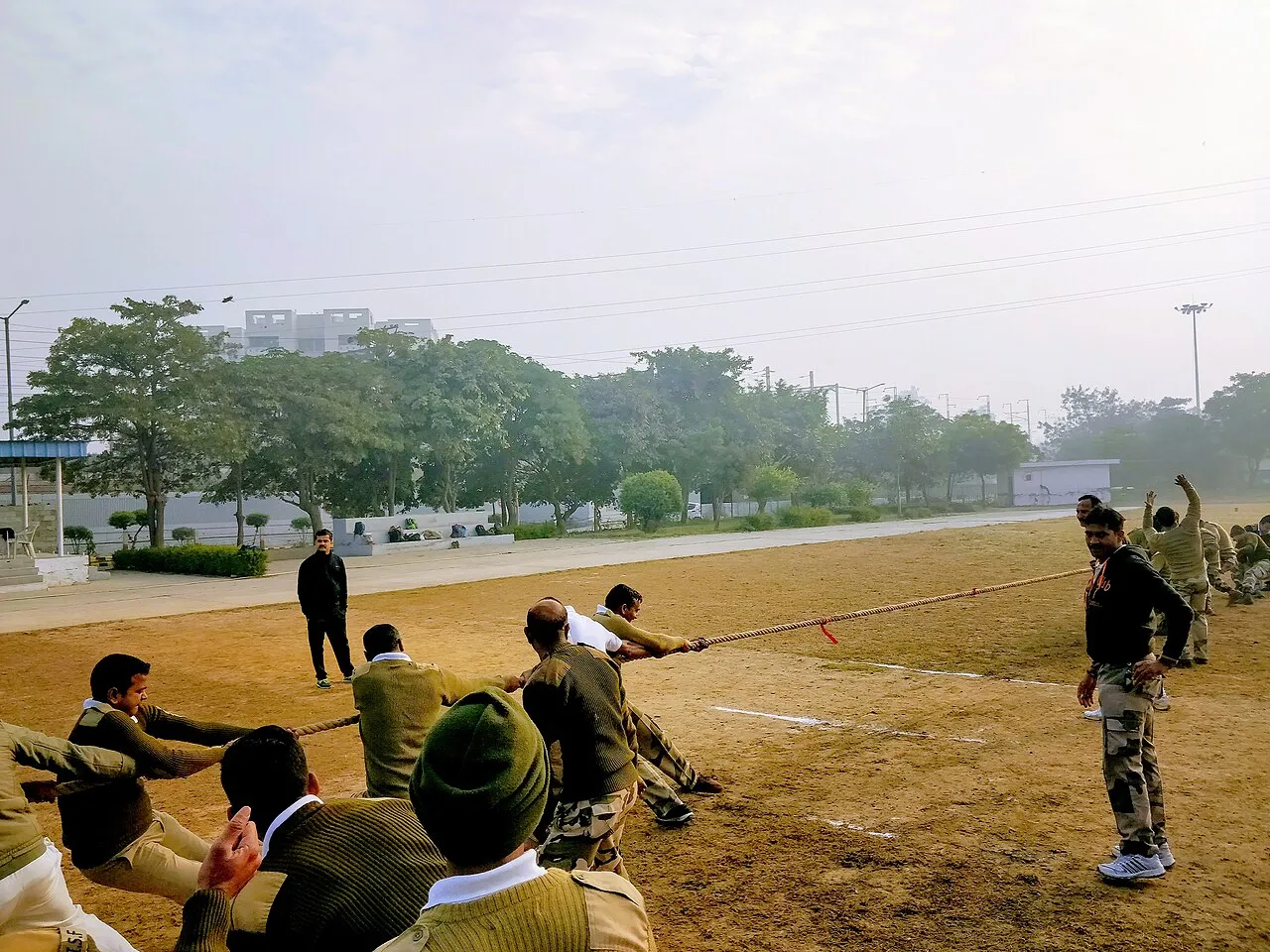
CISF personnel playing tug of war in January 2019, shown as historical team-activity context rather than a recruitment test or selection standard.
Qualifying a stage is not final appointment
A process can contain several stages, and passing one does not automatically establish completion of the whole exercise. The notice should explain what the stage means and what follows. An admit card, provisional shortlist and appointment instruction are different records.
Imagine a fictional process with a written examination, verification and a final outcome. A candidate moving past the first stage still needs the later applicable decisions. Describing that first result as a guaranteed job would overstate the evidence.
Use the actual update's language and preserve any provisional conditions. This also helps readers understand why a later document may request additional information. A stage result answers a particular question rather than every question about the final selection outcome.
Marks, percentages and cutoffs need their definitions
An examination score, percentage, qualifying condition and category-specific cutoff may describe different measures. The relevant notice and result document determine how they are used. A number copied without its exam, category or scale can be misleading.
For a fictional test, 60 marks out of 100 represent 60 percent, while 60 out of 120 represent 50 percent. The same raw score has a different percentage because the denominator differs. The exercise does not announce an actual CISF cutoff.
If comparing two published results, establish that the scoring basis and exercise match. Do not convert one year's figure into a promise for another year. A previous result can be historical context without determining the outcome of a future competition.
Document preparation is different from public sharing
An application can require documents through its official process, but that does not mean those documents should be posted publicly. Identity details, application references and login credentials belong in the appropriate private channel. A study website does not need them to explain a notice.
Keep personal copies organised under clear filenames and use the actual upload requirements from the official instructions. A fictional document checklist can illustrate organisation without collecting anyone's certificates, identification numbers or account access.
When sharing a question about a notice, quote the public clause and reference rather than publishing the entire personal application. This helps another person understand the issue while preserving the boundary between publicly available rules and a candidate's private information.
Read an application status by its actual label
Registration, submission, payment status, acceptance for a stage and final selection can represent separate events. A user should not infer the last event from the first. The official portal or notice supplies the relevant confirmation for each stage.
For an invented form, a saved draft is not yet a submitted application. Similarly, a payment attempt is not necessarily the final application outcome. The example explains why a process label matters without asserting the rules of a current CISF exercise.
Check the actual instructions for what counts as completion. Keep the official acknowledgement where the process provides one, and use the responsible support route for account-specific problems. A generic article cannot inspect or decide an individual's application state.
Amendments and corrections can change the reading
An official amendment may update a deadline, instruction or other part of an earlier notification. The earlier document remains part of the history, but the applicable current reading must account for the correction. A screenshot may omit that later context.
Build a fictional notice register with columns for original reference, amendment reference, issue date and affected clause. This makes it possible to see what changed without rewriting the entire process from memory. It is a useful document-control exercise for students.
Use the actual official records when a real application is involved. Do not treat a rumoured extension as an amendment or assume an older saved PDF includes later changes. The authority's published correction is the relevant evidence.
Prepare from the announced syllabus
A study plan should follow the syllabus and stage described for the actual exercise. A general question bank can help practise skills, but it does not independently establish the examination's subject list, marking scheme or current pattern.
For a fictional plan, divide the announced subjects into small revision sessions and keep an error notebook after practice. Record why an answer was wrong, not only the option letter. This builds understanding without promising that memorising one set of questions guarantees selection.
Use class resources for structured study and programming courses for general digital skills. Match any specialised preparation to the official notice rather than assuming that every computer, typing or written stage has identical requirements across posts.
Build an official-notice reading worksheet
Create fields for the full post name, recruitment reference, responsible authority, eligibility date, application deadline, stages and official source. Keep a separate section for amendments. Every important date should have a purpose label rather than appearing as an unexplained calendar entry.
Next, mark what is established, what needs checking and what is not stated. Do not fill an empty requirement field using a different year's notice simply to make the worksheet look complete. A visible uncertainty is safer and more useful than a confident but unsupported rule.
This method is useful beyond CISF. Students can apply the same reading discipline to scholarships, admissions and other official processes: identify the authority, preserve the document reference, separate stages and keep personal information out of public discussion.
Questions about CISF
What does CISF stand for?
It stands for Central Industrial Security Force. Its official Citizen's Charter identifies its institutional context and public responsibilities under the Ministry of Home Affairs. Use that source for a general overview rather than assuming that one familiar public location describes the whole force.
Does the recruitment overview mean applications are open?
No. An overview can describe posts and processes without announcing an active application window for each one. Locate the specific current notification and its official application instructions. A generic page or an old search result does not establish a new vacancy.
Can one age limit or cutoff be used for every post?
No. The relevant exercise, post, category conditions and reference date matter. Read the actual notification and any official amendments. This article explains how to identify those fields and does not make a personal eligibility decision or publish a universal selection threshold.
Where should official application information be found?
Start from the CISF website's recruitment section and follow the responsible authority or portal linked for the particular exercise. Use its current notices for dates and status. Keep credentials and identity documents private; they are not needed in public comments to discuss a published rule.
Sources
- CISF official Citizen's Charter
- CISF official recruitment information
- CISF official recruitment portal linked by the force
Image credits: cover: Deepak G Goswami, source, CC BY-SA 3.0. Resized and converted to WebP. inline: Deepak G Goswami, source, CC BY-SA 3.0. Resized and converted to WebP.
Result dates, fees and eligibility must be checked against the issuing authority's current notice. Report a correction with the article URL and original source.