
Cricket Fixtures and Live Scores: Read the Right Match
Learn to identify cricket fixtures, read scorecards and targets, convert overs and time zones, and distinguish live updates from stale or completed data.
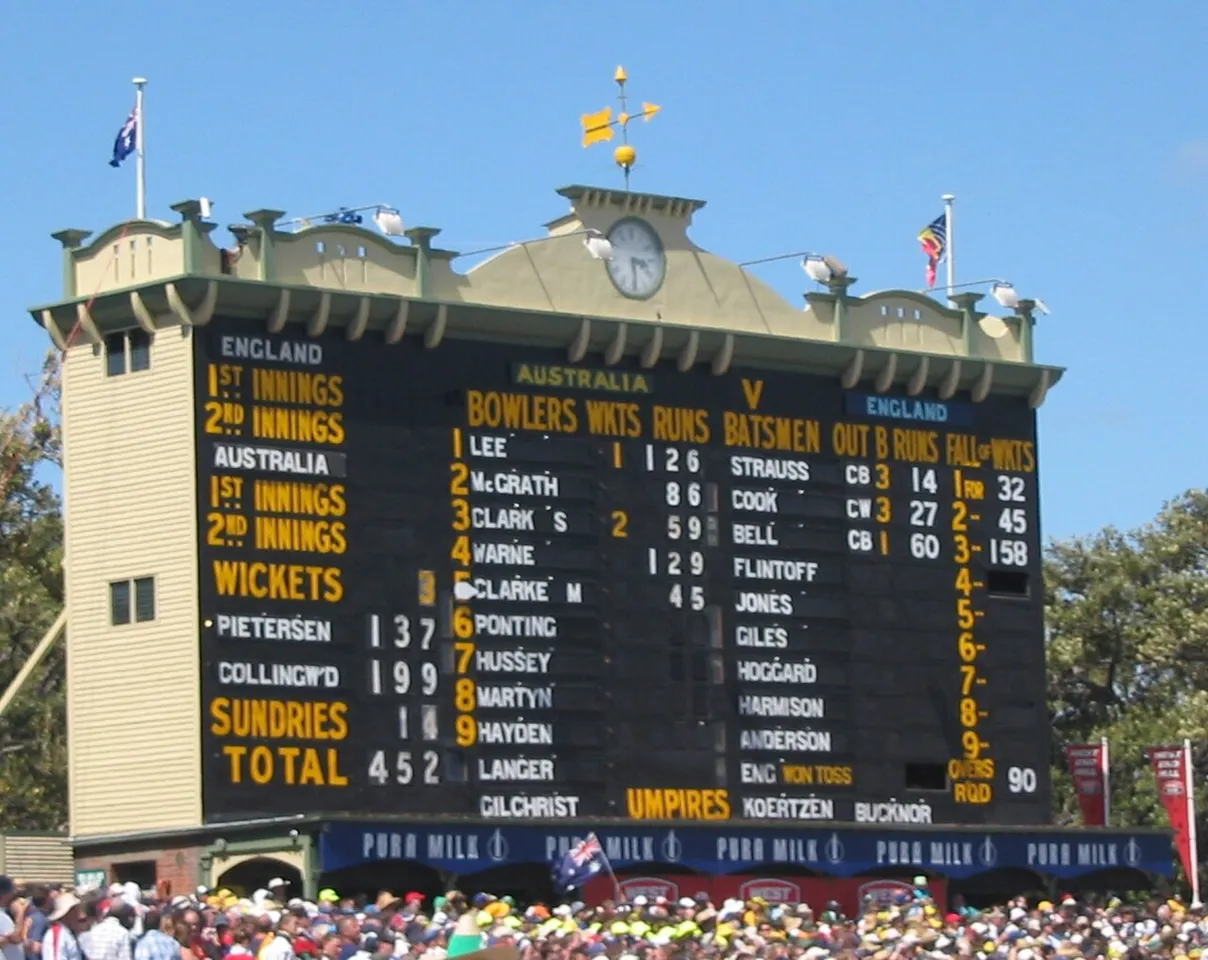
To follow cricket accurately, identify the fixture before reading the score. The teams, date, competition, format and team level determine which match you are looking at. A senior ODI, an Under-19 game and a six-a-side tournament can involve familiar country names while using different structures and producing records that should never be merged.
This guide was checked on 2 November 2026. It explains how fixture lists and scorecards work rather than publishing an automatically updated live feed. The examples are original fictional scenarios unless a dated source is explicitly identified. No link on this page promises a live stream, a current result or a complete schedule for every competition.
What is the difference between a fixture and a scorecard?
A fixture identifies an arranged match, usually with participants, date, competition and venue. A scorecard records play and outcomes when available. A completed report explains the result in prose. These pages can refer to the same event while showing different information and updating at different times.
Think of a school examination. The timetable tells you when and where it is scheduled; the marks sheet records what happened afterwards. Both are useful, but the timetable is not evidence of a student's score. Cricket's fixture list and scorecard have a similar relationship: the planned event and its recorded play should be linked without being confused.
A fixture page can remain online after the match ends. If its display still says upcoming, look for a dated completed record rather than assuming the result does not exist. Conversely, an old completed scorecard does not confirm the time of the teams' next meeting. Each page answers a particular question.
For your own notebook, keep separate fields for scheduled start, match state and final result. That structure allows a postponement or completed score to be recorded without overwriting the event's identity. It also makes uncertainty visible: an unknown result is different from a result of zero.
How do you identify the correct cricket match?
Check five things together: teams, date, competition, format and level. A country name by itself is insufficient. Senior men, senior women, A teams and age-group sides can have fixtures involving the same countries. If those labels disappear, a perfectly accurate score can be attached to the wrong match.
Add the venue when it helps distinguish repeated meetings. A bilateral series can contain several games between the same sides over a short period. Match number and season make the identification stronger. Do not use a search result's display date as a substitute for the event date without opening the record.
For an original exercise, create two fictional cards: Team A versus Team B in an ODI and the same countries in an Under-19 match on another date. Give both an invented first-innings total of 250. The shared number does not make them the same event. Their identifiers keep the records separate even when the scores happen to match.
Now remove the format and age label from the cards. Ask another learner which event a bare screenshot represents. If the answer requires guessing, the screenshot needs better context before being shared. A small amount of identifying text can make a result dramatically more useful than a larger but ambiguous image.
What does live actually mean?
A live-score service receives updates during play, but its display can still be delayed by collection, transmission, caching or device connectivity. The word live should describe an actual update process, not merely an attractive badge. A static article discussing a match is not a live feed because it contains a scoreboard-shaped design.
Look for a last-updated time and a match-state label when available. A page showing the same score after losing connection may be preserving an earlier state rather than claiming play has stopped. Refresh behaviour and error messages should distinguish stale information from a confirmed interval or result.
For a fictional interface exercise, use three states: current update received, connection unavailable and match completed. Make the difference visible in words as well as colour. A user should not have to infer that a grey number means the network failed. Good status labels are part of reliable sports information.
Do not confuse an automatically refreshing webpage with guaranteed immediate data. A browser can refresh repeatedly while the upstream record remains unchanged. What matters is the source and timestamp of the information, not the frequency of an animation. A moving indicator should never substitute for evidence that new match data arrived.
How should you read an innings score?
Read runs and wickets as separate quantities, using the provider's labels. In common runs-first notation, 180/4 means 180 runs with four wickets down. Some Australian presentations reverse the order. Before copying a score, establish which convention is in use instead of assuming the first number always means runs.
The score also needs an innings label. In a multi-innings match, a total cannot be interpreted without knowing whether it is a first innings, a second innings or the current chase. A screenshot omitting those details may be accurate as far as it goes while still encouraging an incorrect conclusion about who is ahead.
Create a fictional record with fields called runs, wickets and innings number. Display a full sentence before showing the compact notation. This helps a beginner learn what the symbols compress. Once the meaning is clear, the short scoreboard becomes convenient rather than a puzzle solved by remembering a visual pattern.
Keep extras separate from individual batting totals when the scorecard does. A team total is not simply the sum of the most prominent batters visible in a short summary. If you are checking a full scorecard, reconcile all listed contributions and extras according to its definitions rather than assuming missing runs are an error.

A historical umpire photograph illustrating recorded match events. Not an incident from a fixture listed as live here.
Why do overs need special handling?
In conventional six-ball over notation, 8.3 means eight completed overs and three additional legal balls, or fifty-one legal deliveries. It is not the decimal number 8.3 overs. Converting to legal balls before calculating rates prevents a common mistake that ordinary calculators will not warn you about.
Use a fictional innings of 68 runs after 8.3 overs. Fifty-one legal balls equal 8.5 six-ball overs. Dividing 68 by 8.5 gives eight runs per over. Dividing by the displayed string as a decimal produces a different answer because it assigns the notation the wrong mathematical meaning.
Wides and no-balls mean a delivery log can contain more events than the legal-ball count. A basic teaching exercise can begin with an explicit legal-ball number, then introduce extras later. Do not assume that counting every row in an event feed reproduces completed overs unless the feed's definitions support that method.
For more practice, our Australia scoreboard guide works through another conversion. The transferable skill is identifying the unit before calculating. A score display is a representation designed for cricket readers; it is not automatically ready for decimal arithmetic in a spreadsheet.
What is the difference between a total and a target?
In a straightforward completed single-innings exercise without an adjusted target, a reply to 150 needs 151 to win. The earlier total and winning target are different values. Rain-affected limited-overs matches can use an officially revised target, so the current match record must take precedence over a simple calculation from an incomplete screenshot.
Use an invented chase at 100 with a target of 151. The remaining requirement is 51, not 50. A one-run mistake can change whether a result has been reached, even though the arithmetic looks minor. Label the target explicitly instead of making a beginner infer it from the opposing total.
A Test target requires the complete innings context. Do not subtract only the opponent's latest total while ignoring the earlier innings. Declarations and aggregate scores can matter. If you do not have the complete position, use the official target rather than reconstructing one from fragments that happen to be visible.
This also shows why a scorecard and a headline serve different functions. A headline can report a successful chase; the scorecard supplies the structure needed to inspect it. Read the detailed record when a numerical question matters. A short summary may omit a condition without being wrong, but it cannot answer every follow-up.
How should Pakistan readers handle time zones?
Keep the original zone attached to any scheduled start before converting it. A venue's local time, UTC and a website's automatically localised clock may all differ. A time without a zone is incomplete for an international reader. Check whether the page already converted the display before adding an offset yourself.
For a fictional example, an event explicitly listed at 09:00 UTC becomes 14:00 in Pakistan at UTC+5. This is a conversion exercise, not a newly verified fixture time. Keep that distinction visible so a reader scanning quickly does not mistake an example for an appointment they can rely on.
Some locations change offsets seasonally, so use the date as well as the place when converting their local times. A remembered difference from summer may not apply in another season. If a conversion crosses midnight, update the date too. An hour-only correction can place a viewer on the wrong calendar day.
Write the final calendar entry with teams, format, date and zone. A clear line such as “Pakistan time” is more useful than a decorative countdown with an unclear reference clock. Countdown displays must also respond properly to rescheduling; a confident timer attached to an old appointment is still wrong.
What should you do when two sources disagree?
First check whether they describe the same event and the same state of play. A live update and a completed result can differ because one is older. A target and a final score can differ because a winning boundary carries the total beyond the minimum requirement. Not every difference is a contradiction.
Then identify which record has the appropriate authority for the question. A competition schedule is useful for fixtures; an official completed scorecard is useful for the result. Preserve the source and check time in your notes. Do not silently combine the most convenient fields from several providers into a new record that none actually published.
If an unresolved numerical inconsistency remains, state it or leave out the disputed calculation. You can still report a well-supported winner without pretending every detail has been settled. Our Hong Kong Sixes final guide illustrates why a board summary and a detailed organiser account should be compared carefully.
Build a fixture card that tells the truth
Use a unique match identifier behind the interface and visible labels for competition, format and date. Keep scheduled, live, interrupted and completed states separate. Store source timestamps rather than relying on the page animation to suggest freshness. A user should be able to understand the status without learning how the data pipeline works.
Test the card with a postponed fixture, an unavailable connection and a completed match. Make sure missing data does not appear as a zero score or a final result. These are meaningful beginner checks because the expected behaviour can be explained in ordinary language before a line of code is written.
Our programming courses offer a place to practise the model using invented data. A demonstration should remain labelled as a demonstration until a verified live source and suitable access arrangements exist. Clear boundaries make the project more professional: readers know whether they are learning a concept or relying on current match information.
Before sharing a score, ask a friend to identify the match from your card alone. They should find the teams, level, date and state without following another link. If they cannot tell whether the example is fictional or an actual result, improve that label first. Clear context matters more than another decorative number or a faster flashing update indicator.
Sources
- ICC: cricket formats, for the distinction between international formats.
- Hong Kong Sixes: official fixtures, as an example of a named competition schedule rather than a universal live-score feed. All numerical exercises and interface scenarios in this guide are original fictional examples.
Image credits: cover: Stephen Parnell at English Wikipedia, source, Public domain. Resized and converted to WebP. inline: http://picasaweb.com/kroome111, source, CC BY 3.0. Resized and converted to WebP.
Found an error or an outdated detail? Report a correction with the article URL and original source.