
Daniil Medvedev: The 2021 US Open, No. 1 Milestone and Baseline Geometry
Understand Daniil Medvedev’s 2021 US Open title and 2022 No. 1 milestone, with lessons on return position, rally geometry and tennis statistics.
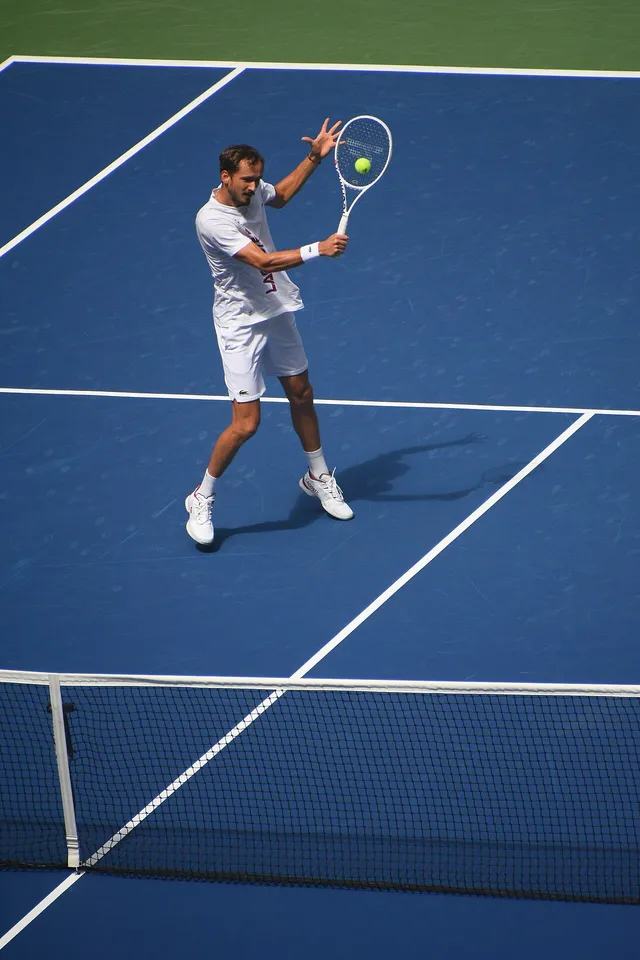
Daniil Medvedev's career is a good introduction to tennis played with space, time and patience. A player can stand well behind the baseline and still influence an opponent's decisions. A rally can look defensive while gradually changing direction and pressure. Understanding those possibilities gives more meaning to a score than simply labelling every long exchange cautious tennis.
This guide centres on two established milestones: Medvedev's 2021 US Open title and his first rise to world No. 1 on 28 February 2022. It then explains the geometry and statistics a viewer can use to study a match. It does not replace a current ranking table, injury update or tournament draw, and all invented numerical exercises are labelled accordingly.
Who is Daniil Medvedev?
Daniil Medvedev is a professional tennis player who won his first major singles title at the 2021 US Open. He later reached the top of the ATP singles rankings in February 2022. A major title and a No. 1 ranking are distinct achievements: one records a tournament victory, while the other reflects a broader eligible-results system.
A milestone needs its date
The phrase world No. 1 can describe a historical achievement or the current leader. Those meanings should never be mixed. Saying Medvedev first reached No. 1 on 28 February 2022 preserves a verifiable career event. Saying he is No. 1 today requires the current dated ranking, which is a different piece of evidence.
Major success and consistency are different questions
A tournament title involves completing that event's path through the draw. A ranking considers results over its applicable period and rules. A player can have an outstanding fortnight without leading the rankings, or lead the rankings without winning the most recently completed major. Both measures are useful when their scope is stated clearly.
What happened in the 2021 US Open final?
Medvedev defeated Novak Djokovic 6-4, 6-4, 6-4 to win the 2021 US Open men's singles title. ATP's official final report confirms the score. Djokovic had been pursuing a calendar-year Grand Slam, so the result carried significance beyond the individual trophy. The event and year belong alongside the achievement whenever the final is discussed.
Read three sets without adding them into one game
The score lists each set separately. Medvedev won six games to four in the first, second and third sets. Adding those figures produces a total of games, not a different official match score. A three-set victory also does not mean that the entire match consisted of three service games or only a handful of points.
A calendar-year Grand Slam has a specific meaning
The expression refers to winning all four major singles titles within one calendar year in the relevant discipline. It is different from holding major titles at other points across a career. Medvedev's final victory stopped Djokovic's 2021 attempt at that calendar-year sequence. It did not erase any titles Djokovic had already won earlier in the season.
What changed in February 2022?
On 28 February 2022, Medvedev first became the ATP singles world No. 1. ATP's historical feature identifies him as the 27th player to reach that position and records 16 weeks at the top during 2022. Those are dated historical records, not an assertion about his ranking when a reader opens this page.
A ranking release is a snapshot
Ranking positions can change when results enter or leave the relevant calculation. A player need not lose a match on the same day that a ranking changes. The table reflects the system's update, not simply a race decided by yesterday's result. Understanding that distinction makes ranking news less mysterious and avoids claims that a position changed for no reason.
Ranking points are not match points
The word points appears in both scoring and ranking discussions. A point played on court can move a game score, while ranking points contribute to a separate table. Winning a rally does not directly add the same number to the ranking total. A clear explanation names which kind of point it means before comparing players or tournaments.
Why can a deep return position be useful?
Moving farther from the server can increase the time between the serve and the receiver's contact. That additional time may help the receiver make a controlled return. However, the position also changes angles and the distance to shorter balls. It is a tactical trade-off rather than proof that one location is universally superior.
Time and distance work together
Imagine a ball travelling through an additional three metres before contact. The extra reaction interval depends on the ball's changing speed and path; it is not a fixed bonus for every serve. A simplified classroom model can illustrate the relationship, but real tennis includes bounce, spin and deceleration. Do not present a rough calculation as a measured reaction time for Medvedev.
The server can respond to the position
A receiver standing deeper may face serves placed at wider angles or a following shot directed into open space. The receiver then needs to manage court coverage and return quality. Watch how both players adapt. A still image showing one starting position cannot explain whether the strategy worked across a complete game or match.
How does baseline geometry affect a rally?
The net, sidelines and opponent's position create different risks for different targets. Cross-court shots generally travel along a different path from shots down the line. Changing direction can open space but may require greater control. A player's decision should be read in relation to contact position, available time and the ball arriving from the opponent.
Depth can reduce attacking opportunities
A ball landing closer to the opponent's baseline can make stepping forward more difficult. Depth alone does not guarantee quality: a ball can be deep but easy to attack if its height and pace suit the opponent. Combine the variables when describing a rally. The purpose is to identify a useful pattern, not to assign a perfect score to one characteristic.
Direction changes can reverse pressure
Suppose an opponent repeatedly moves to cover one side. A controlled change toward the other side can create a longer recovery route. Yet attempting that change while off balance may cause an error. Distinguish an available opportunity from an obligation to attack. Good analysis considers the shot the player could realistically control from that contact point.
Rally tolerance is not passive waiting
Keeping the ball in play can involve purposeful depth, variation and recovery. It should not automatically be described as hoping for an error. Conversely, a long rally is not necessarily tactically excellent merely because it lasted many shots. Ask which player improved position, which targets were available and how the eventual mistake or winner developed.
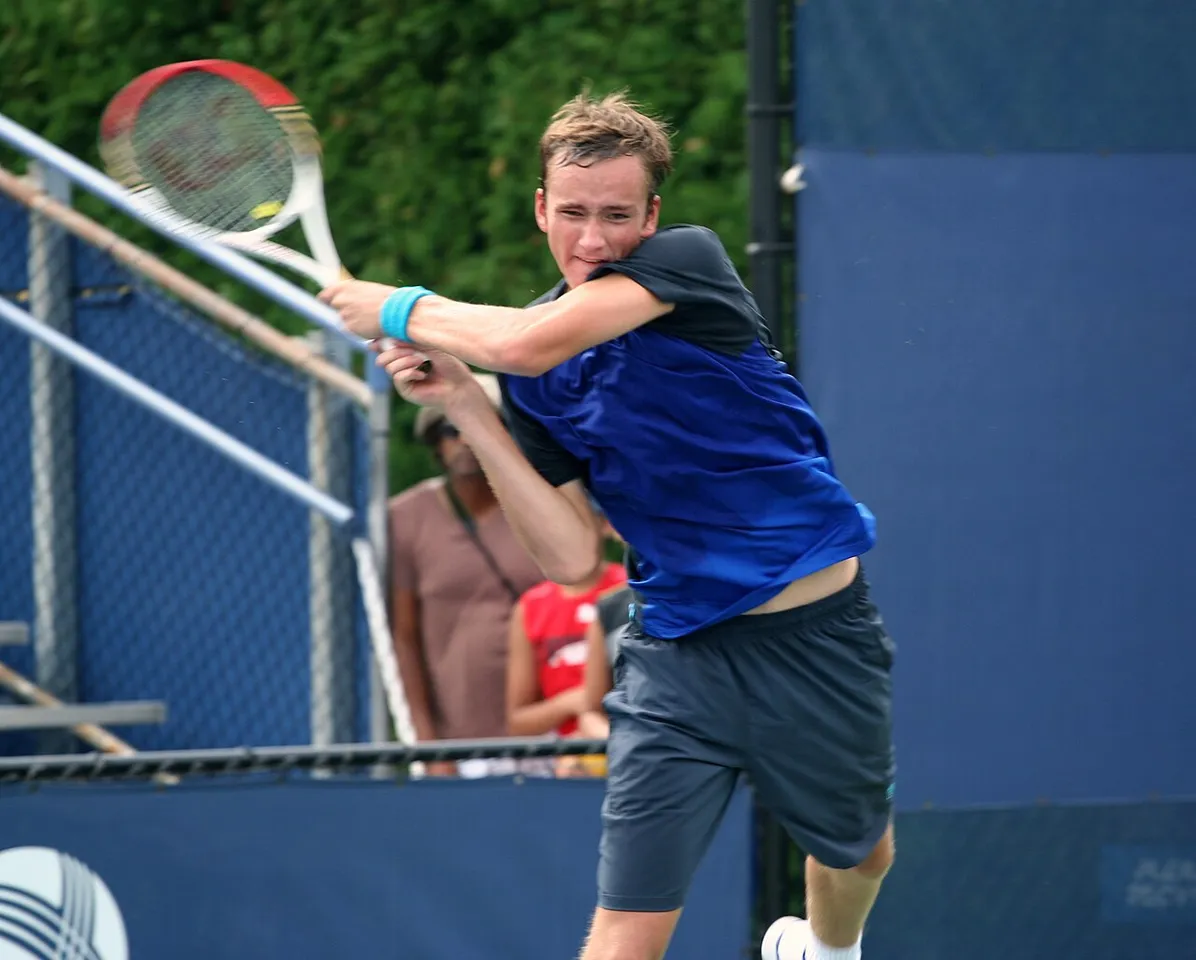
Daniil Medvedev photographed in September 2013, shown as an earlier career reference.
What do serve statistics tell you?
First-serve percentage tells you how often the first serve landed in, while points won behind that serve describes a different outcome. A high first-serve percentage can coexist with weak results if the opponent returns effectively. A player may also win many points after a second serve. The categories should be examined together rather than treated as interchangeable measures.
Work through a fictional service sample
Imagine a player serves 50 points and lands 30 first serves. The first-serve percentage is 60 percent. If the player wins 21 of those 30 points, first-serve points won is 70 percent. These invented numbers use different denominators. Reporting 21 divided by 50 as the first-serve success rate would answer another question and mislabel the statistic.
Aces explain only part of serving
A serve can produce an advantage without being an ace. The receiver may touch the ball but return it weakly, allowing the server to control the next shot. Ace totals therefore do not capture every effective serve. Observe the serve-and-next-ball pattern before assuming that the player with fewer aces necessarily served less effectively overall.
How should a viewer evaluate a long rally?
Start by identifying the rally's stages: serve or return, neutral exchange, emerging pressure and final outcome. Then decide which contact changed the situation. This method avoids giving all credit to the finishing stroke or all blame to the final error. A rally can be decided by the opportunity created several shots before it ends.
Use a consistent counting method
Decide whether the serve counts as the first shot and apply that rule throughout the sample. Different counting conventions can create different rally-length totals without anyone changing the footage. Write the convention beside the data. A small table with a clear method is more informative than a large total whose meaning cannot be reproduced.
Separate forced and unforced descriptions carefully
An error made while stretching under pressure differs from a miss on a comfortable ball, but classification can involve judgement. Different statistics providers may not label every situation identically. If you are making your own observation, describe the visible pressure rather than claiming your informal label is the official event statistic. Evidence and interpretation should remain distinguishable.
What does a head-to-head record leave out?
A head-to-head total summarises previous meetings, but it does not show every condition behind them. Surface, date, format and stage of each player's development can differ. Past results can provide context without guaranteeing the next outcome. A preview should not convert a favourable historical record into a certain prediction or a claim that the opponent has no chance.
Compare a relevant subset
For a classroom project, group past matches by surface and record the event date. You may discover that the overall total hides different patterns in smaller categories. However, smaller groups also contain fewer observations. Explain both the pattern and the limited sample instead of choosing whichever grouping makes the preferred player look strongest.
A final is not an entire career
The 2021 US Open final is a major historical example, not proof that all later encounters must follow the same score. Players adapt, conditions change and individual matches contain different challenges. Keeping that perspective allows readers to appreciate the achievement without turning one memorable performance into an unsupported law about future tennis.
A student analysis project
Build a one-page report around a clearly identified historical match. Include the event, year, final score and two carefully defined statistics. Add one paragraph describing a rally pattern you can actually observe. End with a limitation, such as a small sample or missing point-by-point data. This produces a more credible project than assembling unrelated superlatives.
Make the calculations inspectable
Show the raw counts before the percentage, round consistently and avoid treating tiny differences as decisive. If one player wins 19 of 30 points in a category and another wins 20 of 30, the one-point difference should remain visible. The percentage is a compact description of the evidence, not permission to exaggerate its importance.
Keep the source date with the data
Use the class resources for supporting mathematics and the programming courses to create a simple calculator. Give every real dataset an event date and source link. The calculator should reject a won-points value greater than played points and handle an empty sample without dividing by zero. Reliable small checks prevent misleading conclusions.
Questions about Daniil Medvedev
Did the 2021 US Open title make him No. 1 immediately?
No. His first major title came in September 2021, while his first week at world No. 1 began on 28 February 2022. The milestones belong to different dates and different systems. A tournament result can contribute to a later ranking achievement without being the same event. Keeping the dates separate makes the career timeline accurate.
Is a deep baseline position always defensive?
Not necessarily. The position can provide time and support a particular return or rally strategy, but its effectiveness depends on the ball and opponent. Analyse the resulting shot quality and court coverage rather than attaching one permanent label. Tactical descriptions should explain how space is being used, not merely how far a player stands from a painted line.
Sources
- ATP Tour: Medvedev's first No. 1 ranking and historical context
- ATP Tour: the 2021 US Open final report
- US Open: the February 2022 ranking milestone
Image credits: cover: Amaury Laporte, source, CC BY 2.0. Resized and converted to WebP. inline: robbiesaurus from Smithtown, NY, USA, source, CC BY-SA 2.0. Resized and converted to WebP.
Found an error or an outdated detail? Report a correction with the article URL and original source.