
Detangle Electric Comb Study: Mouse Results, Human Evidence and Limits
Understand the Detangle electric-comb mouse study, its combined delivery method and why the result does not prove a human hair-loss cure.
Does the electric comb study prove a cure for hair loss?
No. The new Detangle research describes an experimental comb-shaped system tested in a mouse model of androgenetic alopecia. It is interesting early research, but it does not establish that an ordinary electric comb restores human hair or that the experimental device is an approved treatment available for people to buy.
The paper, published in Nature Communications on 3 November 2026, combines an electrical-delivery approach with molecular cargo. That combination is important. Describing it only as “a comb that regrows hair” leaves out the experimental treatment being delivered and makes the result sound closer to a familiar consumer product than the evidence supports.
This guide explains how to read the finding, what remains unknown and why the distinction between an animal experiment and a human treatment matters. It does not provide instructions for electrical self-treatment, a drug regimen or a recommendation to stop an existing treatment prescribed by a qualified clinician.
What the researchers actually built
The paper names the system Detangle and describes differentiated electrodes and integrated drug-loading components. Its reported mechanism combines stimulation with delivery of material intended to influence follicular biology. The abstract reports improved regrowth in the experimental mouse model relative to the topical minoxidil comparison used in that experiment.
That is a narrower claim than the viral interpretation. The study is not simply a test of running electricity through an ordinary hairbrush. Nor is it evidence that every product advertised with words such as “ionic,” “electric” or “scalp stimulation” shares the same mechanism, ingredients or results.
The correct question is therefore not “Which cheap comb looks like this?” It is “What exactly was tested, in which model, against which comparison and with what outcome?” Those questions keep the discussion attached to the actual research rather than the marketing language that may appear around it.
A device and its treatment cargo form one experiment
In biomedical engineering, a delivery device and the substance it delivers can both matter to the outcome. If an experiment combines them, it is not safe to assume that either component would produce the same effect alone. The design of appropriate control groups is what allows researchers to investigate their separate and combined contributions.
Imagine a teaching example involving a watering tool and a particular plant nutrient. If plants improve after receiving both, the observation does not automatically tell you that the shape of the watering tool caused the result. You would need comparisons. This analogy explains experimental reasoning; it is not a claim that human biology behaves like a garden.
For Detangle, that principle prevents a misleading leap from a complex experimental system to a generic retail comb. Similar appearance is not equivalent function. A photograph of a consumer device cannot establish that it reproduces the research team's delivery method or has been evaluated under comparable conditions.
Why mouse findings do not settle human treatment
Animal models can help researchers investigate mechanisms and test ideas before human studies. They cannot reproduce every aspect of a person's condition, medical history or long-term response. A controlled experiment may answer a useful research question while leaving major clinical questions unresolved.
For a human treatment, readers would want evidence about safety, appropriate use, meaningful benefits and durability in people. They would also want to know who was included in the studies and which types of hair loss were being treated. None of those questions is settled merely because an animal photograph shows a visible difference.
This does not make the research worthless. It locates the finding at the correct stage. Early work can justify further investigation without being ready for self-treatment or commercial claims. Confusing those stages harms both public understanding and the researchers, whose work can be advertised as proving something they have not yet tested.
Reading the percentage in a headline
The abstract compares an approximately 70% outcome with one approaching 100% in the mouse model. Such percentages need a defined endpoint. They are not automatically the percentage of human patients cured, the percentage increase in every hair follicle or a guarantee that a person's scalp will return to an earlier appearance.
Whenever a headline contains a dramatic percentage, ask what was counted and over what period. A proportion of an experimental area, a change from baseline and the proportion of participants responding are different measures. Removing the denominator can make a correct numerical result sound like a much broader promise.
This guide deliberately does not turn the experimental comparison into a consumer success rate. A reader should be able to repeat the study's scope in ordinary language: the result concerns the specified experimental system and animal model, not every person searching for a hair-loss solution.
What a useful next-stage study would need to address
Without predicting the research programme, several general questions matter whenever an experimental skin treatment moves toward clinical use. Is the intervention tolerated? Does the effect persist? How is the outcome measured? Does the method work consistently across an appropriate group rather than only in a selected example?
The comparison also matters. A study should make clear what each group receives so that a reader can understand which factor is being tested. Photographs can support an explanation, but they should not replace transparent measurements and methods. A dramatic before-and-after image is easier to share than a careful table, yet both need context.
These are questions for evaluating future evidence, not a claim that a human trial has already been registered or completed. If a company later advertises a related product, its own evidence and regulatory status would require separate checking. A research paper does not automatically validate every subsequent commercial adaptation.
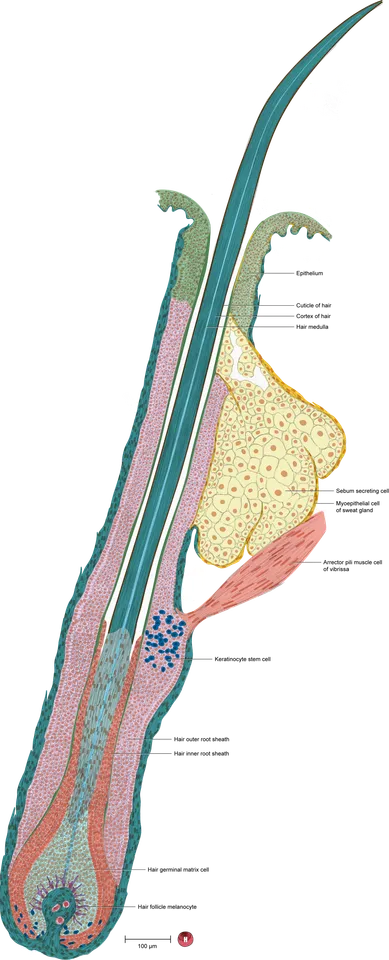
Hair-follicle anatomy illustration. It is not an experimental result or evidence of human regrowth.
Hair loss has more than one possible cause
Androgenetic alopecia is the condition named in this paper. A person experiencing hair shedding should not assume that the study applies to them simply because the symptom sounds similar. The American Academy of Dermatology's patient guidance emphasises diagnosis as part of deciding on treatment; the cause and circumstances matter.
This is especially important when online marketing uses “hair loss” as though it describes one uniform problem. A research result about a specified mechanism cannot safely be extended to every cause of thinning, shedding or scalp change. An appropriate clinical assessment is more useful than choosing a product from a headline alone.
If you have concerns about your own hair or scalp, seek qualified care rather than experimenting with electrical equipment or unfamiliar substances. This article is a research-literacy guide. It cannot identify your condition, assess contraindications or decide whether a treatment is suitable for you.
How to evaluate a product claiming to use the discovery
Start by asking whether the product is actually the one studied. Compare the name, manufacturer, mechanism and evidence rather than relying on visual resemblance. A seller may cite a genuine paper while selling something that was never part of the experiment. The presence of a DOI on a sales page is not enough to connect the product to the result.
Next, ask whether the claim concerns humans and whether the advertised outcome matches the measured outcome. “Inspired by research” is not equivalent to “shown effective in a suitable human trial.” Those phrases should not be treated as interchangeable even when they appear beside the same before-and-after photograph.
Finally, examine practical promises. Guaranteed regrowth, an unexplained success rate or pressure to buy before asking questions should prompt closer scrutiny. This guide does not assess any particular retailer or accuse one of misconduct. It offers a way to separate a study from claims that may go beyond it.
A research-reading worksheet for students
Create a page with six headings: research question, experimental model, intervention, comparison, outcome and unanswered questions. Fill each heading only with information that the paper actually provides. If a detail is absent from the accessible abstract, write “requires full-methods review” rather than guessing.
Then write a one-sentence summary that includes the model. Compare “A comb cures baldness” with “An experimental delivery system improved a measured regrowth outcome in a mouse model.” The second sentence is less dramatic, but it preserves the feature that determines how far the conclusion can be applied.
As an extension, identify the difference between a research author's conclusion and a journalist's headline. Ask which words were added during summarisation. Terms such as “cure,” “available” or “human” can radically change a claim if they were not established in the underlying evidence. This exercise develops the same checking habits used in responsible science reporting.
Why ordinary photographs need honest captions
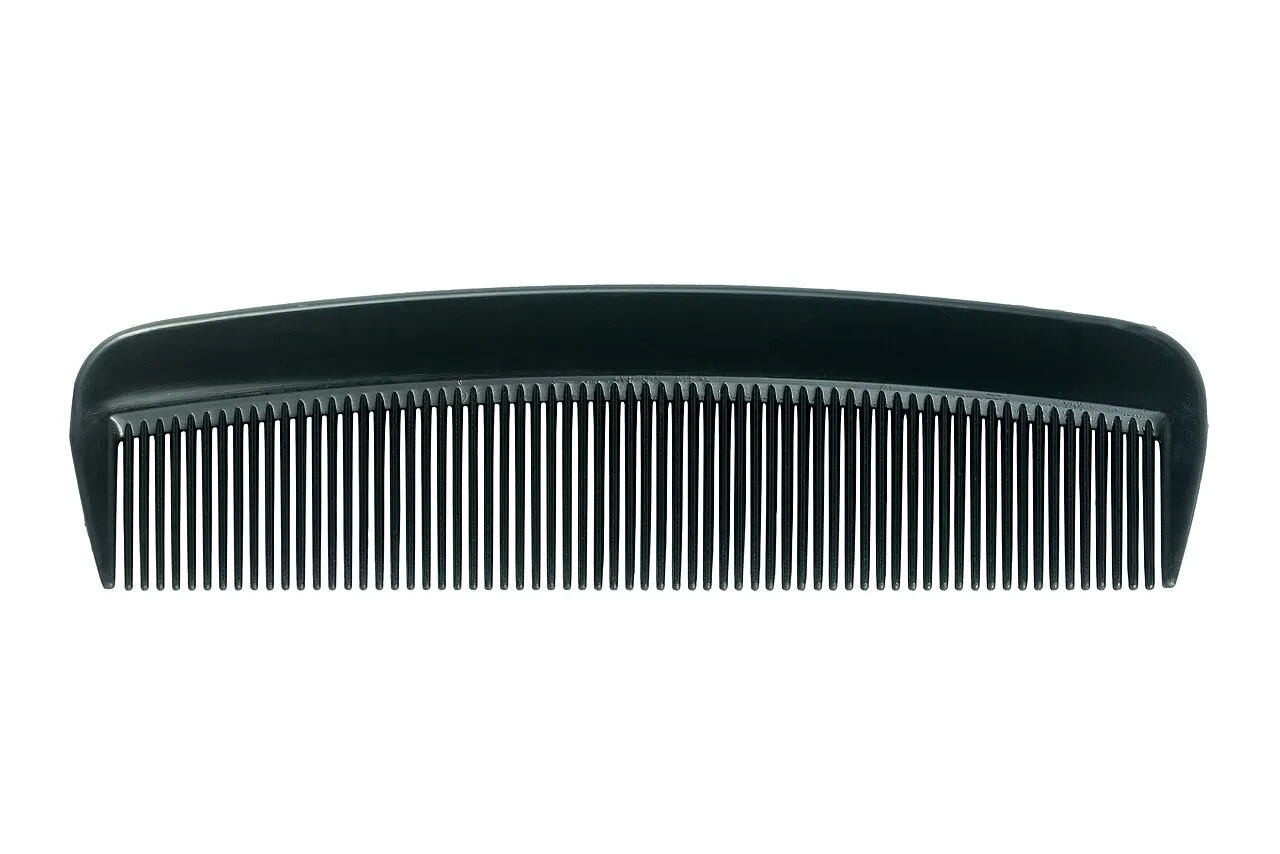
A conventional comb photograph can illustrate the subject, but it is not a photograph of Detangle. A hair-follicle diagram can explain anatomy, but it does not display the outcome of this experiment. Captions should make those distinctions explicit rather than allowing a reader to infer a connection that has not been established.
The same principle applies to scientific images shared on social media. A historical illustration, a commercial product photo and a laboratory figure serve different purposes. Using one in place of another can make the article appear more specific while actually making it less accurate.
When viewing any health story, read the caption as well as the headline. Ask whether the photograph shows the intervention, the condition or merely a related object. Clear visual labelling is part of research accuracy, not an optional decoration added after the writing is finished.
Frequently asked questions
Was Detangle tested on people?
The finding discussed here concerns an androgenetic-alopecia mouse model. This review does not establish a completed human trial or an approved human treatment. Do not translate an animal-study result into a personal success probability or assume that a similarly named retail product has the same evidence.
Is it just electrical scalp massage?
No. The paper describes a combined experimental delivery system with molecular cargo as well as electrical components. Reducing the intervention to massage or an ordinary powered comb leaves out a central part of what was studied. Consumer products need their own relevant evidence rather than borrowing the result by resemblance.
Does the near-100% figure mean everyone is cured?
No. The percentage belongs to the outcome measured in the experimental model. It is not a rate of successful human treatment. A percentage cannot be interpreted correctly without its denominator, measurement definition, comparison and study population, all of which matter when moving from a headline to a clinical claim.
Should someone stop an existing treatment to try this?
This article provides no basis for doing so. Decisions about an individual's treatment should be discussed with an appropriately qualified clinician. The experimental finding does not establish a safe home procedure, a suitable replacement therapy or instructions for applying electricity or research substances to a person's scalp.
The finding worth following
The interesting part of Detangle is the engineering question: can a purpose-built system improve delivery and biological response in the model being studied? That is a legitimate research direction. It can be followed with interest without turning an early result into a promise of a purchasable cure.
Future reports should be checked for genuinely new evidence rather than a recycled image and a stronger adjective. Look for the model, study design, endpoint and limitations. If human evidence becomes available, evaluate that evidence directly instead of assuming that the earlier mouse result already answered the clinical question.
For more research and technology explanations, browse the RayTech article collection. The useful response to this story is informed curiosity: recognise what was tested, respect what remains unknown and keep a clear boundary between a promising experiment and a treatment decision for a real person.
Availability is another independent question. A published paper, a prototype photograph and a retail listing do not establish the same thing. Before calling a device available for patients, a report would need to identify the actual product, intended use and appropriate authorisation in the relevant jurisdiction. None of those facts should be inferred from the word “comb” in a headline. Research can be important well before any consumer product is ready, and acknowledging that stage gives a more accurate picture of scientific progress.
Sources
- Source: Nature Communications research abstract and publication record
- Source: Medical Xpress report on the experimental study
- Source: AAD patient information on hair-loss diagnosis and treatment
Image credits: cover: Crisco 1492, source, CC BY-SA 4.0. Resized and converted to WebP. inline: NIH NIAID, source, CC BY 4.0. Resized and converted to WebP.
Found an error or an outdated detail? Report a correction with the article URL and original source.