
Ebenezer Scrooge: The 2026 Film and a Christmas Carol Reading Guide
Check the confirmed Ebenezer film date and explore Scrooge, the three spirits and character change in Dickens, with practical reading and essay exercises.
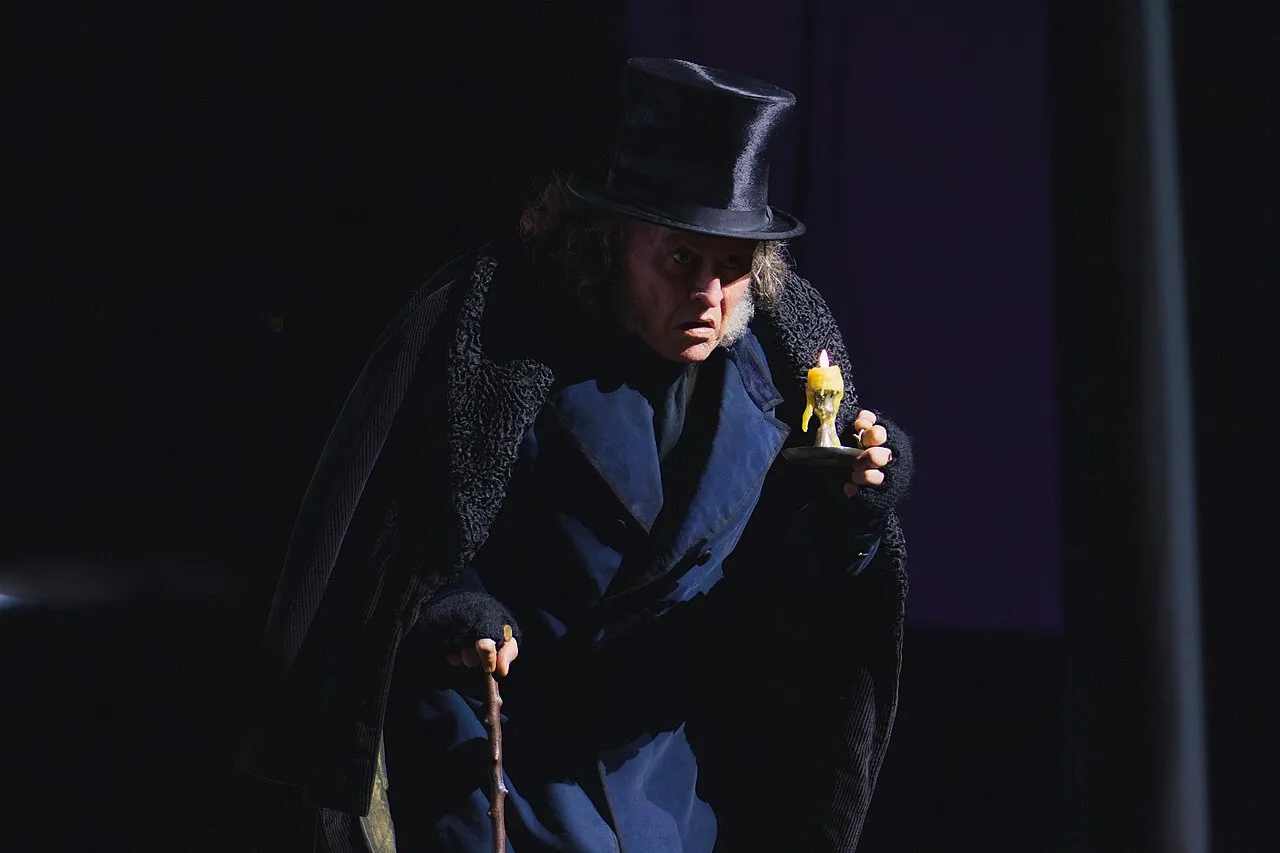
Ebenezer Scrooge returns to cinemas: what is confirmed for 2026?
Johnny Depp plays Ebenezer Scrooge in Ebenezer, the film directed by Ti West that Paramount lists for theatrical release on 13 November 2026. The familiar character comes from Charles Dickens's A Christmas Carol. Understanding that distinction helps separate confirmed information about the new production from the much older story behind it.
Checked on 11 November 2026, this guide covers the studio announcement and offers a reading companion to Dickens's original novella. It is not a review of the film. No Pakistan cinema booking, local ticket price or streaming date has been verified for this article. A release listed for one market should not be treated as a worldwide appointment.
The literary sections contain spoilers for the original book, including its ending. They do not claim that the film follows every scene, character detail or line of dialogue. For students, that separation is useful: an adaptation can become a starting point for reading without replacing the text you are studying.
The new film and the original book are different sources
The studio's film page names Depp in the title role and lists an ensemble including Rupert Grint, Andrea Riseborough, Sam Claflin, Daisy Ridley, Arthur Conti, Ellie Bamber, Henry Lloyd-Hughes, Charlie Murphy, Tramell Tillman and Ian McKellen. Its distribution catalogue describes a supernatural journey through the protagonist's past, present and future.
Those details establish the production's announced identity, not an assessment of its quality. A trailer, cast announcement or distributor synopsis cannot establish whether a performance is convincing, whether a particular scene survives the edit, or how an audience will respond. Those are different questions requiring different evidence.
If you are making a school presentation, create two columns. Label one “original novella” and the other “2026 film announcement.” Put the author and events from the book in the first column. Put the director, announced cast and listed release date in the second. Leave anything unverified outside both columns.
This simple arrangement prevents a common mistake in adaptation essays: describing something remembered from a previous film as though Dickens wrote it. Before using a scene as evidence, identify which version actually contains it. The distinction matters even when the broad outline of the story seems familiar.
Who is Ebenezer Scrooge in Dickens's story?
Scrooge is a businessman whose approach to life is dominated by money, calculation and withdrawal from other people. The opening presents his coldness through his behaviour toward his employee Bob Cratchit, his nephew Fred and visitors seeking charitable help. His problem is not merely that he dislikes a celebration; he treats human connection as an inconvenience.
As a reading exercise, notice the difference between a character trait and evidence for that trait. “Scrooge is selfish” is a conclusion. A stronger paragraph identifies a particular response or decision, explains what it reveals, and considers its effect on someone else. This turns a label into an argument.
Make a small character chart with three headings: action, affected person and what the action suggests. Add an entry when you encounter a meaningful choice. At the end, return to the same headings and record what has changed. The comparison helps you explain development without retelling every event.
Do not assume that money itself is the story's only subject. The important question is how Scrooge uses his position and what he refuses to recognise. A person can understand a financial calculation while misunderstanding an obligation to another human being. That tension drives the reading beyond a simple description of wealth.
Why does Marley's ghost appear first?
Jacob Marley, Scrooge's dead business partner, arrives before the three spirits. His chains connect his present suffering with the priorities of his former life. He warns Scrooge that another course is still possible. The scene establishes a relationship between repeated choices, accumulated consequences and the possibility of change.
Read the chain as an image rather than simply a frightening prop. Ask what it makes visible that an ordinary conversation might leave abstract. In an essay, you could argue that an invisible pattern of decisions becomes a physical burden. Support that interpretation with details from the scene rather than claiming there is only one acceptable symbolic meaning.
Marley's appearance also changes the scale of the problem. Scrooge cannot dismiss the warning as a stranger's ignorance of business, because the visitor shared his professional world. This creates a useful discussion question: why might a warning from someone similar to the listener be harder to ignore?
For a short written response, explain what the opening would lose if Marley were removed. Consider the connection between the two men, the explanation of the coming visits and the warning about responsibility. This exercise asks you to analyse a scene's function, not just identify the ghost by name.
The past: memory explains without excusing
The Ghost of Christmas Past shows Scrooge earlier experiences, including loneliness, companionship, the generosity of his former employer Fezziwig and the loss of Belle. These scenes complicate the first impression of an entirely unfeeling man. The present personality has a history, and the visits make him confront it.
Explanation and excuse are not the same thing. A reader can recognise pain in a character's earlier life without deciding that later cruelty is harmless. Keep those two judgments separate when writing about motivation. “This experience helps explain his behaviour” is more precise than “therefore he could not act differently.”
Fezziwig is particularly useful for comparison because he offers an alternative model of authority. Instead of asking only how much a celebration costs, consider the effect of an employer's attitude on the people around him. A workplace relationship can be shaped by treatment and recognition as well as by the money changing hands.
Try a paired paragraph: first describe one early influence on Scrooge, then explain how the memory challenges something he currently believes. Finish with the question the scene raises about his present choices. This approach connects past and present instead of treating the memory sequence as a separate miniature biography.
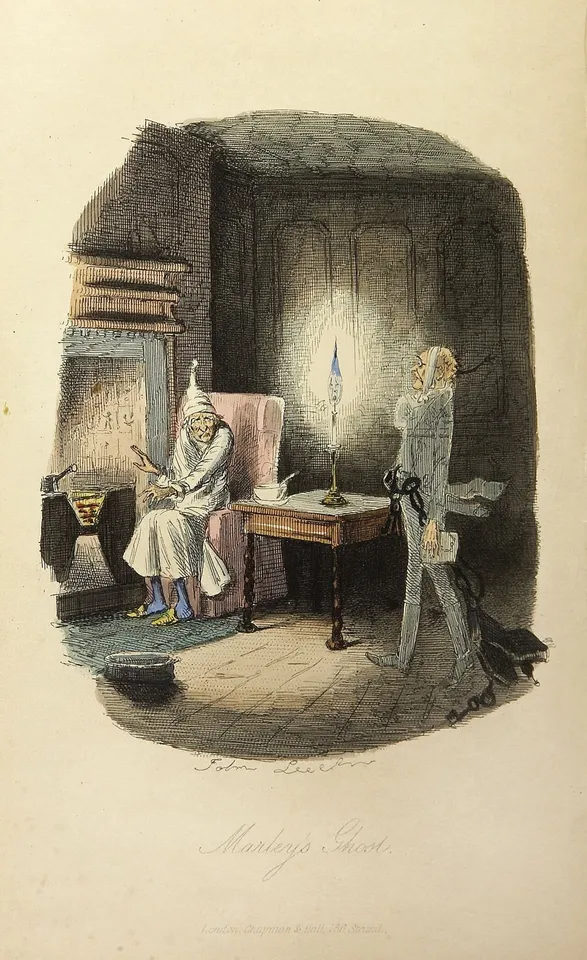
John Leech's 1843 illustration of Marley's ghost in A Christmas Carol. This historical book illustration is not an image from the 2026 film.
The present: other people have lives outside his judgment
The Ghost of Christmas Present takes Scrooge into circumstances he ordinarily overlooks. The Cratchit household and Fred's gathering offer different kinds of community. Tiny Tim's vulnerability makes the consequences of deprivation personal. The figures of Ignorance and Want broaden the warning beyond the experience of one family.
A useful reading habit is to notice who receives attention. At the beginning, Scrooge speaks as though other people's needs can be reduced to categories. The visits supply faces, relationships and conversations. The movement from an abstract category to a particular person is one reason a narrative can challenge a reader's assumptions.
Avoid describing the Cratchits as content simply because they can share affection. Their affection does not cancel material difficulty. An essay becomes more thoughtful when it can hold both facts together: warmth exists in the household, and the household's vulnerability remains real. Neither observation should erase the other.
For discussion, compare two statements: “They are happy, so nothing needs to change” and “Their relationships matter, and their circumstances still deserve attention.” Explain which statement better accounts for the tension of the scene. You do not need specialist vocabulary to show why the distinction matters.
The future: a warning is not a fixed timetable
The final spirit shows Scrooge a possible future marked by death, indifference and loss. The crucial reading question is whether these scenes describe an unavoidable destiny or the direction of a life that can still change. Scrooge's response makes the relationship between future consequences and present choices central to the ending.
Pay attention to how uncertainty creates urgency. If everything were already settled, a warning would have little practical purpose. If consequences were entirely disconnected from conduct, change would have no clear meaning. The story places its central character between those extremes and asks what he will do with the opportunity to respond.
When analysing this section, distinguish a prediction within the story from a real-world rule. A literary ghost can dramatise consequences in a way ordinary life cannot. You do not need to claim that every action produces a neat or immediate reward in order to discuss the scene's moral pressure.
Try writing the same summary in two ways. First describe what Scrooge sees. Then describe what the experience forces him to ask. The first version records events; the second identifies the conflict. Using both together gives an essay a clearer purpose than a long sequence of “then this happened.”
The ending: look for actions after the promise
Scrooge wakes with a chance to behave differently. His response includes generosity toward the Cratchits, a renewed relationship with Fred and a changed approach to Bob. The ending matters because the transformation becomes visible in dealings with other people rather than remaining a private declaration of good intentions.
For a character-development paragraph, pair an early action with a later one that addresses a similar relationship. Explain the contrast and identify who benefits. This is stronger than announcing that the protagonist becomes good, because it shows the reader what “change” means in practice.
You can also ask a more demanding question: what would count as evidence that a change lasts? The text's closing account is relevant here. In a classroom discussion, compare a dramatic one-day gesture with a continuing pattern of treatment. The distinction encourages careful reading of the ending rather than an automatic celebration of any generous act.
That question also helps when comparing adaptations. A production may make a final celebration visually impressive, but your analysis should still consider which actions establish a different relationship between Scrooge and the people around him. Music, lighting and costume can support a moment; they are not substitutes for explaining its dramatic function.
How to compare a book with a screen adaptation
Choose one scene rather than attempting to compare an entire novella with an entire film in a short assignment. Record what happens in the text, then examine how the adaptation presents the equivalent moment. Focus on a question such as sympathy, suspense, power or the visibility of another person's need.
For example, a prose passage can tell you how a narrator describes a room. A screen version must make choices about the room's appearance, framing, sound and movement. Your task is not automatically to decide that one medium is better. Explain how a particular choice changes the viewer's access to the moment.
Do not invent a filmmaker's intention when you only have an interpretation of the result. “The close framing makes the reaction more prominent” is a defensible observation if you can point to it. “The director wanted every viewer to feel exactly this” claims knowledge you may not have.
Keep a three-part note for each comparison: textual evidence, observed screen choice and your explanation. If you have not watched the 2026 film, leave its screen-choice field blank. A promotional image or another adaptation cannot fill that gap reliably. A good preparatory guide knows where its evidence stops.
A reading plan for students encountering Dickens for the first time
The novella is divided into five staves. Read one at a time and write a brief note about the main encounter, one revealing action and one question you still have. Do not stop at every unfamiliar word on the first pass; establish the scene before returning to expressions that affect its meaning.
On the second pass, choose a small set of passages connected to your question. Read the sentences around each passage so that a short quotation does not lose its context. Paraphrase the event in your own words before deciding whether a quotation adds something useful to your explanation.
Build a vocabulary list from the passages you actually use. Include the original expression, its meaning in context and a simple sentence explaining why it matters there. A long dictionary list detached from the story is less useful than a few words that make an important scene understandable.
Finally, write a short response with a clear claim and two well-explained examples. Ask another reader whether the examples support the claim. Revise the reasoning before adding more plot. For other reading and study articles, browse Blogs and Updates and choose material relevant to your learning goal.
Quick questions about Ebenezer and Scrooge
Is Ebenezer Scrooge a real person?
He is the fictional protagonist of Dickens's A Christmas Carol. The name in the film title refers to that literary character. A performance, an illustration and a historical author photograph represent different things; none should be presented as a photograph of the fictional businessman himself.
Does 13 November confirm a Pakistan release?
No. It is the date listed on the studio's film page. A Pakistan release needs a local distributor or cinema listing. This article does not supply an unverified local booking date, streaming promise or ticket price. Check the actual venue and market before making plans.
Is this an ending explanation for the 2026 film?
No. The spoilers above concern the original novella. They are intended to help readers understand its character development and prepare a comparison. The new film may make different choices, so its plot, ending and reception should be discussed only after those details can be checked independently.
Sources
- Official film announcement and theatrical date
- Distributor synopsis and production listing
- Charles Dickens: A Christmas Carol, original text
Image credits: cover: Kevin Paul, source, CC BY 4.0. Resized and converted to WebP. inline: John Leech, source, Public domain. Resized and converted to WebP.
Found an error or an outdated detail? Report a correction with the article URL and original source.