
FAA Ground Stop: 9,000 Flights Cancelled
The FAA grounded all US departures for over four hours on 13 November 2026. See the timeline, 9,000 cancellations, refund rights and recovery.

The Federal Aviation Administration ordered a nationwide ground stop on Friday 13 November 2026 after an equipment outage disrupted air traffic communications. The halt lasted from 3:54 pm to 8:15 pm Eastern time, about four hours and 21 minutes, and triggered thousands of cancellations that continued through the weekend.
FAA ground stop: what happened
The FAA issued the order at 3:54 pm ET. All flights departing within the United States were grounded until further notice. More than 3,500 aircraft were already in the air at the time. Some were diverted, others continued to their destinations, and a small number of departures were allowed from specific airports before the full order was lifted.
The ground stop was lifted at 8:15 pm ET. The FAA said the system was stable, but airlines warned that recovery would take days. The disruption was the longest nationwide halt to US air travel since the attacks of 11 September 2001.
The trigger was an outage that affected radar feeds and communications with aircraft. Officials said the problem was isolated at a remote FAA site and involved the systems that connect regional air traffic control centres. Transportation Secretary Sean Duffy said the affected systems came back online after the problem was isolated. Investigators were still looking at whether the outage stemmed from faulty equipment, installation or configuration.
The timeline in plain terms
The sequence matters because it explains why a technical fault became a nationwide stoppage.
- Before 3:54 pm ET: FAA systems begin showing disruptions. Controllers lose some radar and communications feeds.
- 3:54 pm ET: The FAA issues a nationwide ground stop for departing flights.
- During the stop: About 3,500 aircraft already in the air continue. Some are diverted. Eurocontrol suspends US-bound traffic from its member states.
- 8:15 pm ET: The FAA lifts the ground stop. Departures resume, but airports face a backlog of aircraft, crews and passengers.
- Friday night: Airlines cancel flights and begin repositioning aircraft and crews.
- Saturday 14 November: Cancellations continue. More than 6,000 flights are cancelled, and airports warn of further delays.
- Sunday 15 November: The FAA says it expects the system to be fully recovered by the end of the day, though hundreds of flights are already cancelled.
The immediate cause of the ground stop was not a shortage of controllers or a weather event. It was a communications and surveillance outage that made it unsafe to keep launching flights into the system at the normal rate.
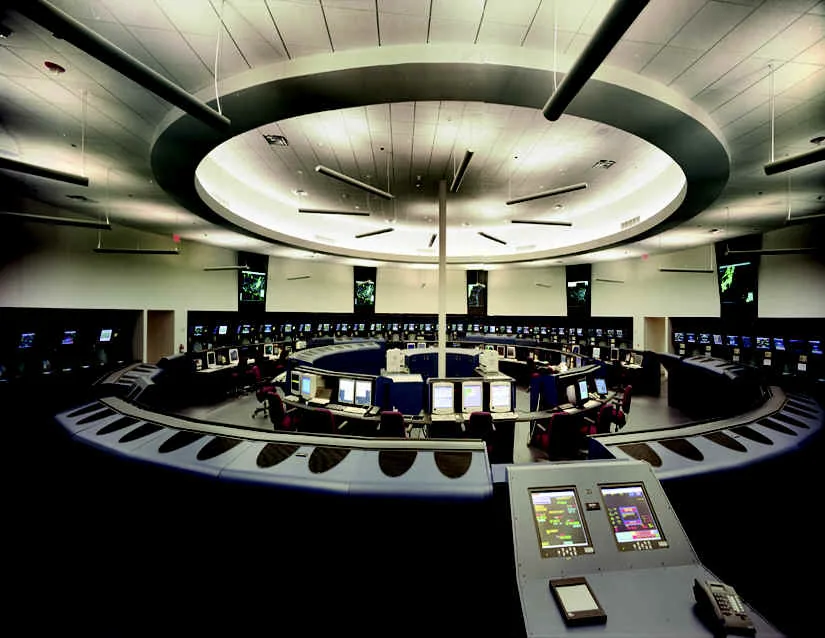
Archive photograph of the Potomac Consolidated TRACON facility. It is not the site of the 2026 outage.
How many flights were affected
The numbers changed throughout the weekend as airlines updated their schedules. The figures below are the ones reported by major outlets, with the source and time noted.
| Measure | Reported figure | Source and time |
|---|---|---|
| Flights cancelled on Friday | More than 9,000 | FlightAware, cited by BBC and NPR, 14 November |
| Flights delayed on Friday | More than 25,000 | FlightAware, cited by NPR, 14 November |
| Flights cancelled on Saturday | More than 6,400 | FlightAware, cited by Reuters, late 14 November |
| Flights delayed on Saturday | More than 8,000 | FlightAware, cited by Reuters, late 14 November |
| Flights cancelled on Sunday | About 875 to 910 | FlightAware, cited by Reuters and ABC, 15 November |
| Aircraft airborne at the time of the stop | More than 3,500 | Transportation Secretary Sean Duffy, cited by NBC |
| Flights scheduled on Friday | About 50,000 | FAA Administrator Bryan Bedford, cited by NBC |
| Flights still to complete journeys at the time | About 20,000 | Bedford, cited by NBC |
The totals are not exact, and they should not be treated as a single fixed number. Airlines report cancellations at different times, and some flights are cancelled, rescheduled and then cancelled again. The safest reading is that the ground stop caused the largest single-day disruption to US air travel since 2001, and that the effects lasted into Sunday.
What caused the outage
Officials described an equipment failure rather than an attack. Bedford said there was zero evidence of anything nefarious and zero evidence of anything AI-related. NBC reported that officials saw no evidence of a cyberattack. Duffy said the affected systems came back online after the problem was isolated at a remote FAA site.
The contractor L3Harris was named by Duffy as the company involved in the work linked to the outage. L3Harris said it was cooperating with the FAA investigation. The Professional Aviation Safety Specialists union, which represents more than 11,000 FAA employees, said its technicians were not involved in the upgrades that led to the ground stop. The union argued that its members should have a larger role in modernisation work.
Those statements do not settle the cause. They show that the investigation was still active when the ground stop was lifted, and that responsibility was being contested in public. Readers should be careful with claims that the cause is fully known. The verified facts are narrower: an equipment or communications fault occurred, it affected the systems used by regional air traffic control centres, and it led the FAA to stop departures nationwide.
Why the FAA stopped all departures
A nationwide ground stop is an extreme measure. It is used when the system cannot safely handle the volume of traffic that would otherwise take off.
Air traffic control depends on radar, communications and flight data systems. If controllers cannot see aircraft reliably or cannot communicate with them, the safe response is to slow or stop the flow. A local outage can sometimes be managed with local restrictions. A fault that affects multiple regional centres is harder to contain, because aircraft move between centres and the backlog spreads.
The FAA had to weigh two risks. Continuing departures would have added more aircraft to a system with degraded visibility and communications. Stopping departures would strand passengers and disrupt schedules, but it would keep the system from becoming unsafe. The agency chose the second option, then lifted the order once the system was stable.
That decision is why the disruption was so large. A four-hour stop does not just delay four hours of flights. It displaces aircraft and crews, creates overnight gaps in schedules, and forces airlines to cancel flights the next day because the aircraft are in the wrong place.
Airline responses and passenger options
Airlines responded differently.
American Airlines extended its travel alert and waived change fees for travel scheduled through 18 November. Delta encouraged travellers with flexible plans to move their flights to Monday or later. United and Delta both cancelled about 20 percent of their Saturday flights, according to the BBC. JetBlue cancelled about 40 percent of its Saturday schedule. American cancelled hundreds of flights as well.
The FAA said passengers would be rebooked or receive a full refund, and that travellers should contact their airlines directly. In practice, the fastest route was usually the airline app or website, because call centres were overwhelmed.
Travellers caught in the disruption should check three things:
- The airline's current travel waiver, which usually lists the dates and airports covered.
- The rebooking options in the app, including partner airlines and nearby airports.
- The difference between a cancellation and a long delay, because the two can trigger different rights.
The US Department of Transportation's rules on refunds apply when an airline cancels a flight or makes a significant schedule change and the passenger chooses not to travel. The airline must refund the fare, even if the ticket is non-refundable. Vouchers are not a substitute unless the passenger accepts them.
Which airports were hit hardest
The disruption was national, but some airports felt it more than others. FlightAware's data showed the largest concentrations of cancellations and delays at Chicago O'Hare, Hartsfield-Jackson Atlanta and Dallas Fort Worth. New York area airports, including JFK, LaGuardia and Stewart, recorded more than 800 cancellations and more than 600 delays by the end of Friday, according to a statement from Governor Kathy Hochul and the Port Authority.
Those airports are hubs. When a hub loses a bank of departures, connecting passengers miss onward flights, crews time out, and aircraft end up out of position. The effects then spread to smaller airports that depend on the hubs for connections.
International travellers were affected too. Eurocontrol suspended all US-bound air traffic from its member states during the stop. Airports in the UK, Canada and Australia warned of delays and cancellations on US routes. Some flights returned to their departure airports rather than waiting.
The recovery problem
Lifting a ground stop does not restore the schedule. The recovery is a separate operation, and it is often harder than the stop itself.
Airlines must move aircraft to the airports where they are needed. They must move crews, who have legal limits on working hours. They must find seats for passengers whose flights were cancelled. They must also manage the aircraft that were diverted, some of which need to fly back empty or with a new crew.
That is why the FAA and airlines warned that the effects would last through the weekend. Bedford said airline partners believed they could restore full schedule integrity by the close of business on Sunday. Reuters reported that the FAA did not expect US air travel to return to normal schedules until late Sunday.
For passengers, the practical lesson is that a rebooking on the day of the disruption may not hold. Aircraft and crew positions can change again, and a flight that looks confirmed in the morning can be cancelled in the afternoon. Checking the airline's app before leaving for the airport is essential.
Was this a cyberattack?
Officials said there was no evidence of a cyberattack. Bedford explicitly ruled out anything nefarious and anything AI-related. NBC reported that investigators were looking at whether the outage stemmed from faulty equipment, installation or configuration.
That does not mean the investigation was closed. It means the public evidence at the time pointed to a technical fault. Readers should distinguish between a statement that no evidence has been found and a statement that the cause has been definitively established. The first is what officials said. The second is not yet supported by the public record.
What this means for air travel policy
The disruption has revived a long-running debate about the age and resilience of US air traffic control infrastructure. The FAA has been modernising its systems for years, and the outage showed how a single fault can cascade across regional centres.
The union representing FAA technicians argued that its members should be more involved in upgrades. Duffy pointed to a contractor. Those are different explanations of the same problem: who is responsible for testing and maintaining the systems that controllers rely on.
For travellers, the policy debate matters less than the practical outcome. A system that can be stopped nationwide by a single equipment fault is a system with a single point of failure. Until that failure mode is addressed, the risk of another disruption remains.
Questions readers are asking
When did the FAA ground stop happen?
The order was issued on Friday 13 November 2026 at 3:54 pm Eastern time. It was lifted at 8:15 pm Eastern time the same day. The disruption continued through the weekend.
How long did the ground stop last?
About four hours and 21 minutes. NBC reported the times as 3:54 pm to 8:15 pm ET. Some reports described it as more than four hours, and one described it as almost five. The official times give the precise duration.
How many flights were cancelled?
More than 9,000 flights were cancelled on Friday, according to FlightAware data cited by the BBC and NPR. More than 6,400 were cancelled on Saturday, according to Reuters. Hundreds more were cancelled on Sunday.
Was it a cyberattack?
Officials said there was no evidence of a cyberattack. The FAA administrator said there was zero evidence of anything nefarious or AI-related. Investigators were looking at equipment, installation and configuration issues.
Which airline should I contact?
Contact the airline that issued your ticket. If your flight was cancelled, check the airline's app or website first. If you booked through a travel agent or a third-party site, contact them as well, because they may control the rebooking.
Can I get a refund?
Under US Department of Transportation rules, if an airline cancels your flight or makes a significant schedule change and you choose not to travel, you are entitled to a refund of the fare, even if the ticket is non-refundable. Vouchers are optional, not a substitute for a refund you are entitled to.
Is the system back to normal?
The FAA said it expected the system to be fully recovered by the end of Sunday 15 November. Airlines continued to cancel flights into Sunday, so passengers should check their flight status before travelling.
What to check next
The first thing to check is your airline's travel waiver. It will tell you whether your dates and airports are covered, and what rebooking options are available.
The second is your flight status. Check it before leaving for the airport, and check it again shortly before departure. Recovery days are unpredictable, and a flight can be cancelled after it has been confirmed.
The third is your rights. If your flight is cancelled and you choose not to travel, you may be entitled to a refund. If you accept a rebooking, the terms depend on the airline's policy and the fare rules.
Finally, keep a record of expenses. Hotels, meals and ground transport caused by a cancellation may be covered by some airlines, but the rules vary. Receipts make a claim easier.
Sources
- Reuters, Air travel issues to persist well into Sunday, officials say, with thousands of flights affected, 14 November 2026
- ABC News, FAA ground stop live updates: Air travel expected to recover by end of Sunday, FAA chief says, 14 November 2026
- NPR, FAA ground stop ends but passengers stuck at airport, 14 November 2026
- NBC News, Live updates: FAA expects up to 5,000 flight cancellations as airports reel after ground stop, 14 November 2026
- BBC News, What we know about the longest US nationwide flight ground stoppage since 9/11, 14 November 2026
Sources checked on 15 November 2026. Times and cancellation figures were checked against Reuters, ABC News, NPR, NBC News and the BBC. Refund guidance was checked against the US Department of Transportation's published rules. Image credits: cover photograph of FAA Administrator Bryan Bedford by the Federal Aviation Administration, public domain, via Wikimedia Commons, resized and converted to WebP. Inline photograph of the Potomac Consolidated TRACON by an unnamed photographer, public domain, via Wikimedia Commons, resized and converted to WebP. The inline image is an archive photograph and is not the site of the 2026 outage.
Found an error or an outdated detail? Report a correction with the article URL and original source.