
FATA vs Lahore Whites: 241-Run Win and Quaid-e-Azam Trophy Scorecard
Read the FATA vs Lahore Whites scorecard for 3 to 6 November 2026. See the four innings, the 412-run target and how FATA won by 241 runs.

FATA Region beat Lahore Region Whites by 241 runs in the opening round of the 2026–27 Quaid-e-Azam Trophy Gold. The match took place at Diamond Cricket Ground in Islamabad from 3 to 6 November 2026. FATA scored 362 and 283, while Lahore Whites made 234 and 170. Lahore needed 412 in its final innings. Shahid Aziz and Afaq Afridi took four wickets each as FATA defended that target.
The four innings are the quickest way to understand the result. FATA led by 128 after both sides had batted once. Mohammad Farooq's second-innings century helped extend that advantage. Lahore's fourth-innings 170 then left a 241-run margin. The target, the lead and the margin are related, and each answers a different question about the match.
FATA vs Lahore Whites scorecard at a glance
This was the third match listed for the Gold competition. Lahore Whites won the toss and chose to field, so FATA batted first. The order below follows the game. The bowling figures are attributed to the player from the opposing side who took those wickets. The fixture and innings information can be checked through the PCB match centre and the completed reports in the sources.
| Innings | Team total | Standout batting | Standout bowling |
|---|---|---|---|
| First | FATA 362 | Fawad Arshad 115 | Hammad Aziz 6 for 97 |
| Second | Lahore Whites 234 | Aamir Jamal 74 | Afaq Afridi 3 for 55 |
| Third | FATA 283 | Mohammad Farooq 123 | Mohammad Salman Mirza 3 for 78 |
| Fourth | Lahore Whites 170 | Zain Bin Farooq 44 | Shahid Aziz 4 for 32 and Afaq Afridi 4 for 46 |
Why the innings order is worth keeping
A scorecard often puts both totals for one team beside its name. That is compact, but the innings happened in alternating order here. Reading all of FATA's runs together before reading either Lahore score hides the first-innings lead, which was already known before FATA batted again. A chronological table makes it easier to see what each side knew when it started an innings.
How did FATA build its first-innings lead?
Fawad Arshad scored 115 in FATA's 362. Rehan Afridi contributed 69. Hammad Aziz took six wickets for Lahore Whites, conceding 97 runs. A six-wicket haul and a substantial team total can occur in the same innings. One number describes how many batters a bowler dismissed. The other counts the runs the batting side accumulated across all its partnerships and extras.
A bowler's haul and the team's total measure different things
The six in six for 97 counts wickets credited to Hammad. The 97 counts runs charged to his bowling. FATA's 362 includes the rest of the innings as well. To compare bowling performances, check both wickets and runs and identify the innings. A reader who treats 97 as the full team score would miss all the runs accumulated against other bowlers and through relevant extras.
Lahore's reply set the starting position for the second half
Aamir Jamal's 74 and Ali Zaryab's 51 contributed to Lahore's 234. Subtracting 234 from 362 gives FATA's first-innings lead of 128. That figure explains the position before the third innings. It does not settle the result. At that point FATA still had another innings, and Lahore still had an opportunity to bat again. The fourth-innings chase would depend on the runs FATA added next.
What did Mohammad Farooq's 123 add?
Farooq made 123 in FATA's second-innings 283. The PCB's third-day report records that century and the team total. Salman Khan Jnr contributed 53. Farooq's runs counted toward the new innings total, which was then added to the existing first-innings advantage. That is how 283 runs in the third innings translated into a chase larger than 283.
Track one player's innings separately
Farooq scored 32 in the first innings and 123 in the second. The scorecard can show 155 as his aggregate for the match if the two scores are added. Only the 123 describes his century innings. A useful data record keeps the two innings separate and computes the combined figure when requested. This lets a reader distinguish the player's match contribution from a single score.
Read the date on a progress report
The PCB's third-day report describes the match position before the final day was complete. It can support Farooq's score and FATA's total even though the final result belongs to the completed record. When combining reports, attach each fact to the stage it describes. This avoids mistaking a target or an overnight score for the final margin. The same distinction matters when a live scorecard is captured in a screenshot and shared after play has ended.
Why was Lahore Whites' target 412?
FATA's 128-run first-innings lead grew by 283 in its second innings. The lead was then 411. Lahore needed one more than that to finish ahead, giving a target of 412. The same calculation works using the innings totals. FATA had scored 645 across its two innings, and Lahore already had 234. To reach an aggregate of 646, Lahore needed another 412.
The lead and the target differ by one
If Lahore had made 411 in the fourth innings, the two sides would have had equal aggregate runs. Reaching 412 would have taken Lahore ahead. A tie and a draw have distinct meanings in cricket. If the match ends with the last batting side dismissed and the aggregate scores equal, the scores are tied. In a match where time expires before a result is reached, the outcome can be a draw under the applicable conditions. The result line is the place to confirm the actual classification.
Why the victory margin was 241 rather than 242
Lahore finished with 170. The difference between the 411-run lead and that score is 241. Subtracting 170 from the winning target gives 242, which is the number of additional runs Lahore would have needed to win. The official margin instead compares the teams' actual aggregates. FATA had 645 and Lahore had 404. The gap is 241. The one-run difference is a useful check when reading chase summaries.
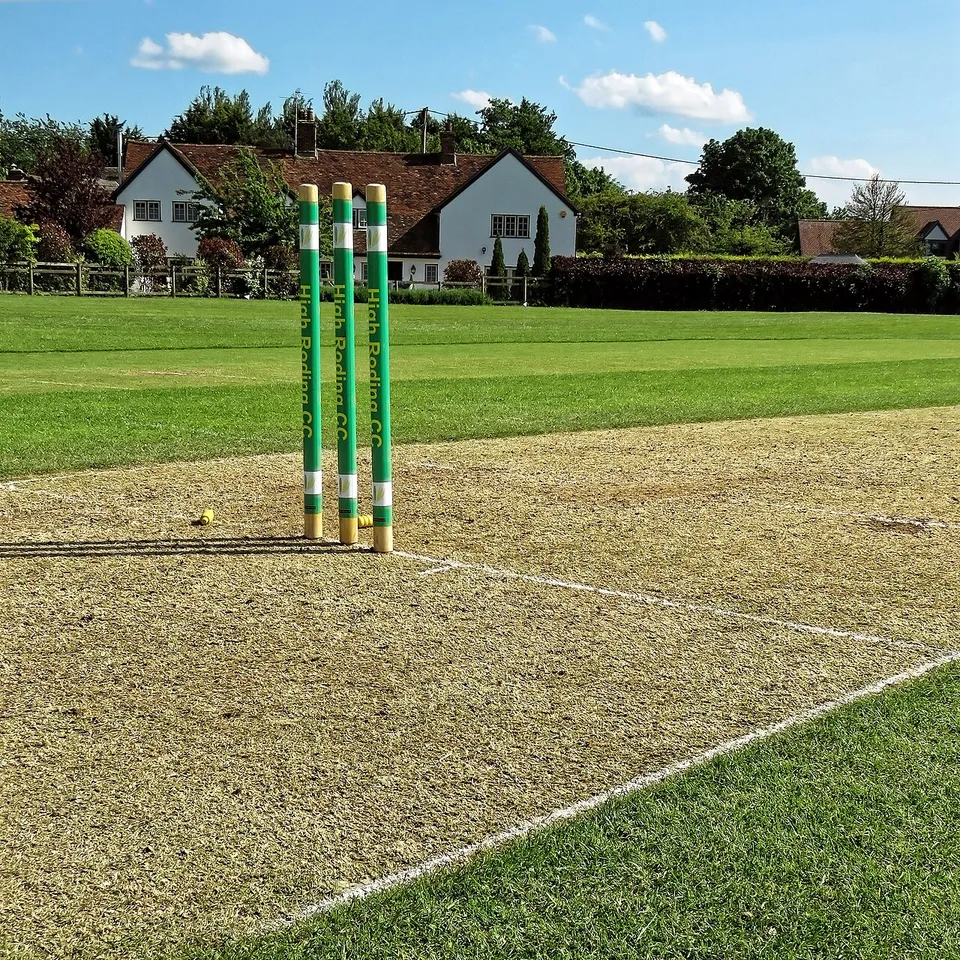
Cricket pitch and stumps at High Roding Cricket Club in England, an illustrative photograph.
How did Lahore's final innings end?
Lahore Whites were dismissed for 170. Zain Bin Farooq scored 44 and Babar Azam made 42. Shahid Aziz took four wickets for 32 and Afaq Afridi took four for 46. Those two bowlers account for eight wickets between them. The completed batting card explains the other dismissals. For instance, it records Zain Bin Farooq as run out, which counts as a team wicket without being credited to a bowler.
Compare bowling figures within the same innings
Shahid and Afaq both took four wickets in the final innings. Shahid conceded fewer runs in his spell. A fuller comparison would include each bowler's overs and the match situation. If the question is who took the most wickets in the chase, the two figures show a shared lead. If the question is who conceded fewer runs, the second part of the figures answers it. Define the question before selecting a single standout.
Keep similar player names distinct
Mohammad Farooq's 123 came for FATA in the third innings. Zain Bin Farooq's 44 came for Lahore in the fourth. Team and innings labels help distinguish these two entries. The same care applies to Afaq Afridi and Shaheen Shah Afridi, who appear in the bowling records. In a spreadsheet, use full names together with team and innings identifiers so that a search for a surname does not merge unrelated performances.
How do you read 43.1 overs on this scorecard?
Lahore's final innings lasted 43 overs and one legal ball. The .1 is a ball count, so the innings used 259 legal deliveries. Treating 43.1 as a decimal in a calculation would give the wrong denominator. To convert the scorecard notation for arithmetic, multiply completed overs by six and then add the remaining legal balls. When displaying the original scorecard, retain the familiar overs-and-balls format.
Apply the same check to FATA's second innings
FATA's 283 came in 59.1 overs, which equals 355 legal deliveries. Dividing 283 by 355 and multiplying by six gives about 4.78 runs per six legal balls. This is the innings rate. A rate describes scoring pace across the recorded balls. It does not establish which phase was fastest or how the teams approached a particular session. For that, a reader would need a more detailed timeline.
Compare runs and wickets alongside the rate
A team can score quickly and still finish with a lower total if it loses its wickets early. In a four-day game, the match situation also includes the remaining time. For this fixture, the innings totals and dismissals establish the result directly. Rates can help a reader describe the innings, while the aggregate tells them why the official win margin was 241 runs.
Verify the fixture before reusing the result
The PCB match ID is 36951. Its listing identifies FATA Region, Lahore Region Whites, Islamabad and the dates 3–6 November 2026. Using those details together distinguishes this match from other Lahore fixtures and from reports about Peshawar Blues in the same round. The regional name Whites is part of the team identity. Keep it in the title or metadata when archiving the result.
Use separate fields for the competition and round
The competition is the Quaid-e-Azam Trophy Gold and this fixture belongs to its opening round. The listing also calls it the third match. A match number can identify a fixture within the competition's schedule, while a round label groups games played during the same stage. Recording both fields is useful when readers search using either description. It also keeps the format clear when a second competition runs at the same time.
A classroom exercise using the four totals
Make a record with a team name and runs for each innings. Group the entries by team to calculate 645 and 404. Then calculate the first-innings lead using the first two rows alone. Finally compute the fourth-innings target by adding one to the lead after three innings. Test whether the difference between the two final aggregates agrees with the recorded result. The exercise practises ordered records and grouped sums, concepts also covered in the programming courses.
Quick answers about FATA vs Lahore Whites
FATA won by 241 runs at Diamond Cricket Ground. Fawad Arshad made 115 in the first innings, and Mohammad Farooq made 123 in the second. Lahore Whites chased 412 and were dismissed for 170. Shahid Aziz and Afaq Afridi took four wickets apiece in that last innings. Use the 3–6 November date and the PCB match ID when matching the result to a search or scorecard.
What to include when sharing the score
Give the two team names, the competition and the margin first. If you have space, include all four totals or the last-innings target. That lets a reader check the result without adding a separate explanation of why the lead mattered. Keep individual batting and bowling figures attached to their innings so the match recap remains clear when quoted on its own.
Reconcile the batting figures before publishing a scorecard
The leading scores in the innings table are a selection. A complete batting card includes every batter's entry and an extras line. To audit the total, add all the individual runs and extras for that innings, then compare the sum with the team score. Keep the two FATA innings in separate columns even though the same team name appears twice. If the sums disagree, start by checking whether a row was left out or copied from the other innings. This gives students a second verification exercise beyond simply repeating the final margin.
How much of FATA's second innings did Farooq score?
Farooq's 123 accounted for about 43.5 percent of the second-innings total of 283. Divide the individual score by the innings total and multiply by 100 to get that share. It answers a different question from strike rate, which uses balls faced as its denominator. The percentage describes his contribution to the total, while the strike rate describes the pace of his own scoring. Including the denominator when reporting either figure lets readers see exactly what the number measures.
Sources
- PCB match centre for fixture 36951
- PCB third-day report and FATA second innings
- Wisden completed first-round results
- PlanetCricket completed scorecard
Image credits: cover: Bilalnaqeeb, source, CC BY-SA 4.0. Resized and converted to WebP. inline: Acabashi, source, CC BY-SA 4.0. Resized and converted to WebP.
Found an error or an outdated detail? Report a correction with the article URL and original source.