
Finn Allen: Dunedin 137, Opening Batting and T20 Scorecard Skills
Explore Finn Allen’s dated Dunedin 137 and learn how strike rate, powerplay fields, boundaries and partnerships explain attacking T20 batting.

Finn Allen is a New Zealand batter whose attacking opening role makes him an interesting player to study beyond a short highlights clip. His 137 from 62 balls against Pakistan at Dunedin on 17 January 2024 is a documented example of sustained T20 scoring. It is a historical innings, not a new November 2026 result.
For a student watching cricket, the useful question is not simply how far a six travelled. It is how an opening batter balances scoring opportunities, limited deliveries and the risk of losing a wicket. This guide uses Allen's verified innings as a starting point, then explains the arithmetic and decisions that help a viewer understand aggressive batting without inventing his private training routines.
Who is Finn Allen, and what does an opener do?
Allen represents New Zealand in international cricket. His ICC profile identifies the Dunedin century among his major achievements. An opening batter begins the innings, usually against the new ball, and helps establish the initial scoring pace. That job involves a different set of opportunities from arriving late with only a handful of deliveries remaining.
Opening is a position in the batting order, not a guarantee that every innings will follow the same script. A target, surface, opposition attack and early wickets can all change what a team needs. When reviewing Allen, record the format and match situation before comparing scores. A twenty-over innings and a fifty-over innings are different problems even when the same person plays both.
The description attacking opener should also remain descriptive rather than absolute. It explains a recognizable role, but it does not mean every delivery deserves a boundary attempt. Good analysis leaves room for defended balls, singles, missed shots and changes of plan.
What happened in the January 2024 Dunedin innings?
The ICC's dated report records Allen making 137 from 62 balls in the third T20 international against Pakistan. He struck 16 sixes. At the time of that report, his score set a New Zealand men's T20 international record and his six count equalled the world-record mark described by the governing body.
Those qualifications matter. A record stated in a January 2024 report is a record at that reporting point. It should not automatically be presented as an unchanged world record in November 2026. Readers looking for current leaderboards need a current official statistics table, not an old headline copied into the present tense.
The innings is still useful without claiming that its record remains untouched. It provides a concrete example of how repeated boundary scoring can transform a T20 innings. The official report establishes the facts; the following calculations are our explanation of what those numbers mean.
How do you calculate Allen's strike rate?
Batting strike rate measures runs per one hundred balls faced. For the Dunedin innings, divide 137 by 62 and multiply by 100. The result is approximately 220.97. That means his scoring pace across the innings was equivalent to about 221 runs per hundred balls, not that he actually faced one hundred deliveries.
Keep the units visible when explaining this to a younger learner. Runs are the numerator, balls faced are the denominator, and the multiplication creates a comparable rate. A scorecard might round the answer, so a small display difference does not necessarily mean the underlying calculation is wrong.
Strike rate describes pace, not the whole value of an innings. A very fast ten-ball contribution and a long innings at a lower rate have different sizes and contexts. Always read the runs and balls together. The rate helps compare speed; it does not replace the actual contribution.
What do sixteen sixes tell us about the score?
Sixteen sixes account for 96 runs. Subtracting 96 from Allen's total of 137 leaves 41 runs that were not scored through sixes. This is a useful piece of boundary arithmetic because it shows both the importance and the limits of a spectacular headline number.
Do not assume those remaining 41 runs were all singles. They could include fours and other scoring outcomes. A complete scorecard or delivery record is needed to break them down accurately. The subtraction establishes only the amount outside the sixes, and stopping at that conclusion is better than filling the gap with a guess.
It is equally incorrect to call 16 divided by 62 the percentage of runs from sixes. That calculation concerns the share of balls on which a six was struck. To calculate the share of runs, use 96 divided by 137. Different denominators answer different questions, even when both calculations use correct numbers.
Why does the powerplay change an opener's options?
Fielding restrictions create a distinctive opening phase in T20 cricket. With fewer fielders allowed outside the inner circle than later in the innings, an opener can find different boundary opportunities. The restrictions do not remove the bowler's ability to swing the ball, vary the length or take wickets.
For a practical viewing exercise, pause before a delivery and sketch the visible field. Identify an area with protection and an area with space. Then watch where the batter attempts to score. The purpose is to notice the relationship between field placement and shot choice, not to claim that one camera angle reveals the entire plan.
If the broadcast does not show the complete field, write that limitation in your notes. A confident explanation built on an unseen fielder is less useful than a narrower observation that can be checked. This habit improves both cricket understanding and general evidence-based reading.
Aggression and recklessness are not the same thing
An aggressive approach accepts some risk to create scoring pressure. Recklessness is a judgement about whether the risk was poorly chosen, and that judgement needs context. A dismissal by itself does not prove that an attacking role was wrong. A successful boundary does not prove that the same shot was safe.
Consider a fictional chase requiring 24 runs from the final two overs. A boundary attempt may be necessary even if it carries dismissal risk. Compare that with a situation in which a side needs four runs from three overs with wickets available. The same ambitious shot can carry a different cost because the team problem has changed.
These are teaching examples, not reconstructions of Allen's decisions. Their value is in helping a learner ask a better question: what did the team require at that moment? That question is more informative than labelling every miss careless and every six brilliant.
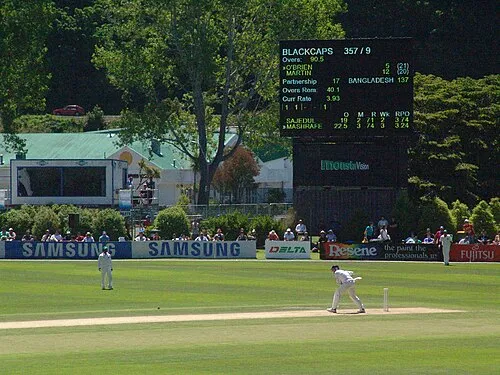
Archive: New Zealand versus Bangladesh at University Oval in January 2008. This illustrates the field and venue, not Finn Allen or the Pakistan T20 match.
How should you read a short opening cameo?
A small score can still arrive quickly, while a larger score can consume more of the innings. Suppose a fictional opener makes 24 from 12 balls and another makes 32 from 28. The first has a strike rate of 200; the second has a rate of about 114.29. Neither number alone tells you which innings best served its match.
Check the target, wickets lost, conditions and what followed. The faster contribution may have provided a useful start. The slower innings may have taken place when survival was unusually difficult. These possibilities require evidence from the actual match rather than a universal rule about batting speed.
When studying Allen, avoid evaluating an entire career through one cameo or one century. An individual innings is an observation. A reliable pattern needs a larger, clearly defined sample, ideally separated by format and batting position.
What can a highlights video leave out?
Highlights are selected moments. They often make a batter's innings appear more continuous and effortless than the full delivery sequence. A collection of sixes does not show every dot ball, running decision or interruption. It can introduce a player, but it cannot independently establish all the details of the innings.
Use a simple two-column notebook. In the first column, write what is directly visible, such as a ball clearing a particular boundary. In the second, write what remains unknown, such as the field before the delivery or the sequence of dot balls that preceded it. This separates observation from interpretation.
For students learning English through sports coverage, this is also a vocabulary exercise. Words such as appeared, attempted and completed carry different levels of certainty. A precise sentence about one visible action teaches more than an exaggerated claim about a player's entire mindset.
Why does the new ball deserve attention?
An opener encounters a ball that can behave differently from one used later in the innings. The amount of movement depends on conditions and bowling skill; it should not be assumed from the clock alone. Seam position, length and delivery angle can affect the challenge faced by a batter.
Watch a short sequence rather than a single wicket ball. Did several deliveries challenge the same area? Did the bowler change the length after a boundary? Did the batter adjust position? If the footage supports these observations, they can help explain a contest between two players.
Avoid diagnosing technical weaknesses from a blurred replay. A camera angle can distort the apparent line of the delivery. A beginner's first task is to describe the sequence accurately. More detailed technical conclusions should remain proportional to the quality of the footage and the number of deliveries observed.
How can partnerships support an attacking opener?
A partnership is a joint contribution while two batters are together. It is not simply the sum of two final individual scores, because either batter may have played in several partnerships. Extras can also contribute to a stand. This makes a partnership table important when explaining how an innings developed.
An attacking opener may benefit from a partner who rotates the strike, but it would be speculative to claim a particular instruction without evidence. Instead, record observable events: which batter faced each over, how singles changed the strike, and when a boundary followed a quieter sequence.
Try a fictional exercise with an over containing a single, a dot, a four, a single, a dot and a two. Track which batter faces after each delivery and after the over ends. The exercise demonstrates why the running between boundaries is part of attacking cricket rather than merely time between big shots.
What makes a fair comparison between openers?
A useful comparison starts with a common question. Are you comparing scoring speed in the powerplay, frequency of substantial innings, or total contribution over a season? Choose the measure after the question, rather than collecting whichever number makes a preferred player look strongest.
Keep formats separate. Also consider innings count, opposition and batting position. A player with a handful of appearances can move sharply up or down an average table after one performance. A longer sample is usually less sensitive to one innings, although it can still hide changes in role or conditions.
State the reporting date for any changing total. This guide does not supply a live career aggregate, current franchise contract list or current selection announcement. Those details require fresh official confirmation and should not be inferred from the historical Dunedin example.
A short worksheet for watching Finn Allen
Choose one complete innings or an official highlights package with a scorecard. Write down the match date, format, opposition and final individual score. Calculate the strike rate independently. If the number of sixes is available, calculate their contribution to the total without guessing the remaining scoring breakdown.
Next, select three deliveries and describe only what you can see. Include one successful attacking shot, one delivery that did not produce a boundary and one change in the bowling sequence if available. Explain how the field or match situation might matter, using conditional language where the evidence is incomplete.
Finally, write a five-sentence review that includes one verified fact, one calculation, one direct observation, one limitation and one question for further study. This format produces a stronger piece of sports writing than a paragraph containing only praise or criticism.
Common questions about Finn Allen
Was the 137 scored in an ODI?
No. The documented 137 from 62 balls at Dunedin was in a men's T20 international against Pakistan on 17 January 2024. Keep that format attached to the score when discussing records or comparing innings.
Does a strike rate above 200 mean every ball went for a boundary?
No. Strike rate measures the overall scoring pace. Different combinations of boundaries, singles, other runs and dot balls can produce the same rate. A delivery-by-delivery record is needed to describe the exact sequence.
Is this a report of Allen's latest match?
No. This is a researched profile and batting guide checked on 14 November 2026. Its central match example is historical. It does not claim a new result, current injury update or confirmed selection for a future fixture.
Where can students find related cricket explanations?
The RayTech updates library contains further sports explainers. Read each article's match date and scope before connecting it with a live fixture. A clear date is part of understanding the information, not a minor detail to skip.
Sources
Source facts are limited to the identified player and dated innings. Calculations, fictional scenarios and study activities are original educational explanations, not attributed player instructions.
Image credits: cover: Benchill, source, CC BY-SA 3.0. Resized and converted to WebP. inline: Bryce Edwards from Dunedin, New Zealand, source, CC BY 2.0. Resized and converted to WebP.
Found an error or an outdated detail? Report a correction with the article URL and original source.