
Frances Tiafoe: Delray Beach, US Open Progress and Attacking Tennis
Explore Frances Tiafoe’s Delray Beach title and US Open progress. Learn attacking choices, serve patterns and clear tennis conversion calculations.

Frances Tiafoe's tennis story is about turning opportunity into a sustained run, not merely producing one spectacular point. His first ATP Tour title at Delray Beach in 2018 and his 2022 US Open semi-final are distinct steps in that story. They offer a useful route into understanding how confidence, attacking choices and match structure interact without pretending that a player's private thoughts are visible from the stands.
This guide explains those historical milestones and gives readers a practical way to analyse attacking tennis. It does not announce a current ranking, predict a tournament winner or turn a memorable celebration into proof of present form. Where numerical examples appear, they are fictional exercises unless linked to an explicitly identified event record.
Who is Frances Tiafoe?
Frances Tiafoe is an American professional tennis player whose ATP career includes the 2018 Delray Beach singles title and US Open semi-final appearances in 2022 and 2024. A title and a semi-final describe different outcomes. Keeping those labels clear allows readers to appreciate his progress without accidentally presenting a deep run as a championship victory.
Why a career should include more than highlights
Highlight videos select entertaining moments. They rarely show every return error, routine service hold or decision that established the final score. A career profile should therefore connect attractive moments with the event's complete result. Tiafoe's story becomes more meaningful when a reader understands the tournament stage rather than simply knowing that a crowd reacted loudly.
A national identity does not define one style
Calling Tiafoe an American player identifies his representation; it does not explain every technical decision he makes. Players from the same country can have very different patterns. When discussing his tennis, describe observable choices such as stepping forward or changing direction instead of using nationality as a substitute for actual tactical analysis.
What did the 2018 Delray Beach title establish?
ATP's records identify Delray Beach in 2018 as Tiafoe's first tour singles title. Winning a first title means completing that tournament's draw successfully, but it does not guarantee a smooth sequence of later trophies. The achievement is valuable precisely because a complete tournament asks for repeated performances against different opponents rather than one isolated upset.
One good match and a good tournament are different
A player can beat a highly ranked opponent and lose in the next round. Another can build a title run without facing that particular opponent. Both results have context. To describe a tournament accurately, record the rounds and opponents rather than using the most famous name in the draw as the whole story.
Development does not follow a straight line
An early breakthrough can be followed by periods of adjustment. Changes in opponents, surfaces and expectations create new problems. Avoid drawing a straight line from a first trophy to an assumed future ranking. The historical record shows what happened, while a development discussion asks how a player adapted. Those questions are related but not interchangeable.
Why is the 2022 US Open run remembered?
Tiafoe reached the men's singles semi-finals at the 2022 US Open after defeating Rafael Nadal during the tournament. ATP's biography identifies him as the event's first American men's semi-finalist since Andy Roddick in 2006. That boundary belongs in the sentence: it concerns that event and category, not every American tennis player in every competition.
An upset is a result with a comparison
The word upset usually signals that a result challenged expectations based on factors such as ranking or reputation. It is not an extra round in the draw or a separate title. When discussing Tiafoe's win over Nadal, keep the match achievement and the later semi-final finish distinct. One helped create the other, but neither should be mislabelled.
A semi-finalist has not reached the final
In a standard knockout draw, the semi-final stage contains the last four competitors. Winning that match earns a place in the final. A photo of a player celebrating a quarter-final victory can therefore show the moment he reached the semi-finals, not the moment he won the tournament. Captions should preserve that sequence rather than amplify the claim.
What does attacking tennis actually involve?
Attacking tennis is not simply hitting every ball as hard as possible. It involves recognising a favourable situation and choosing a shot that increases pressure while remaining controllable. Court position, incoming height and opponent location all influence the decision. A powerful swing from a poor contact position may be less effective than a well-placed ball with greater margin.
Look for the opportunity before the winner
Select a point and ask why an attacking shot became available. Perhaps a return landed short or a deep ball pushed the opponent back. The finishing stroke might be visually dramatic, but the earlier shot created the space. Explaining that chain helps a learner understand what to notice before trying to copy the final swing.
Taking the ball early changes available time
Meeting the ball sooner after its bounce can reduce the opponent's recovery time. It also gives the hitter less preparation time. This is a trade-off, not an automatic improvement. Use video to observe the contact position and resulting control. Do not infer a precise reaction interval from a broadcast angle without the measurements needed to support it.
Forward movement needs a purpose
Moving inside the baseline can improve attacking options when the incoming ball permits it. Advancing too soon can leave a player vulnerable to a deeper reply. Watch whether the player moves because a shot has created an advantage or merely appears closer to the net in one camera frame. Position has meaning only within the developing point.
How should you evaluate a serve-and-next-shot pattern?
The serve begins a sequence. A useful serve may create a weak return that the server can direct into space, even if the serve itself is not an ace. Track the return's location and the server's following contact. The pattern explains more than an ace total because many strong service points involve the receiver touching the ball.
Separate placement from speed
A wide serve and a body serve can create different responses at similar speeds. A faster delivery can also be less useful if it lands in a predictable area. Speed is one variable among several. A balanced note records the target, return quality and subsequent court position before judging whether the serve achieved its tactical purpose.
A first strike need not end the point
After a weak return, the server may choose a controlled shot that preserves pressure rather than attempt an immediate winner. If the opponent reaches that ball, the attack can continue. Avoid judging the first attacking shot only by whether it ended the rally. Its value can lie in keeping the opponent off balance for the next contact.
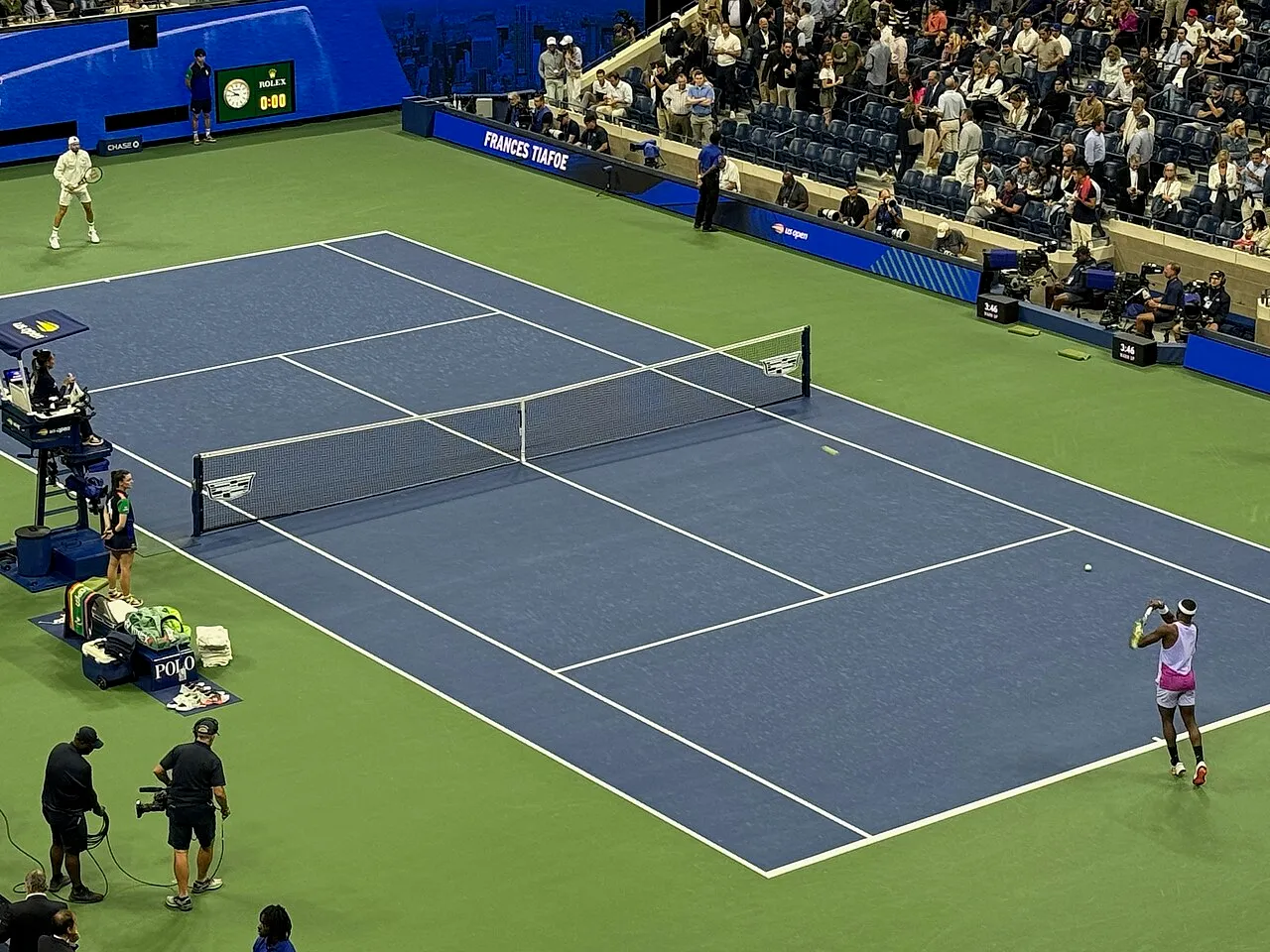
Frances Tiafoe’s quarter-final against Grigor Dimitrov at the 2024 US Open; dated match context rather than the 2022 semifinal.
What can a winner-to-error comparison reveal?
Winners and errors describe outcomes, but a simple subtraction does not capture every contribution. A shot can force a weak reply without becoming a winner, and an opponent's error may arise from pressure created earlier. Different providers can classify difficult situations differently. Use the official event definitions when quoting statistics and label personal observations as informal analysis.
Build a fictional example carefully
Imagine a player records 24 winners and 20 unforced errors in a teaching dataset. The difference is four, but it is not a score that determines who won the match. Service outcomes, forced errors and point distribution still matter. These fictional totals illustrate why a compact statistic should not replace the actual game and set sequence.
Distribution can matter more than the total
A cluster of errors in one service game can have a different effect from the same number spread across comfortable holds. Tennis scoring groups points into games and sets. A player can win a higher total number of points and still lose the match. The score structure is essential context for interpreting attractive aggregate statistics.
How does a player manage a momentum change?
Momentum is often used to describe a visible sequence of successful points or games. It should not be treated as a measurable invisible force that guarantees the next outcome. A player may respond by changing targets, preparation routines or pace between points within the rules. Analyse visible changes rather than claiming to know what he was thinking.
A reset is an observable sequence
For a viewing exercise, note what happens after a lost service game. Does the player continue using the same return position? Are rallies shorter or longer? Does the next service game involve different targets? These questions produce evidence. They are more useful than deciding that one facial expression proves confidence or panic.
Crowd response is not a coaching instruction
An energetic crowd can be part of a match's atmosphere, but it does not reveal the player's private decision-making. A celebration can follow a point earned through careful patience. Describe the atmosphere separately from the tactical pattern. This keeps the account lively without replacing match analysis with assumptions about emotion or personality.
A practical point-by-point exercise
Choose ten consecutive points from a legally available historical match recording. Record the server, return quality, first player to attack and final outcome. Consecutive points are useful because they include ordinary exchanges as well as highlights. State that the sample is small and avoid turning ten observations into a conclusion about an entire career.
Define an attacking position before counting
Decide what you mean by attack. You might use a visible contact inside the baseline following a shorter ball, but this is a classroom definition rather than an official universal measure. Write it down so another student can apply the same method. If you change the definition halfway through, your counts stop being directly comparable.
Compare your labels with another viewer
Two people may disagree about whether a particular ball created pressure. Discuss the visible evidence: contact height, opponent balance and open court. A disagreement can reveal that the definition needs improvement. The aim is not to force identical opinions but to make the reasoning clear enough that the difference can be understood and examined.
How do you calculate conversion rates?
Suppose a fictional player converts three of eight break-point opportunities. The conversion rate is 37.5 percent. That number describes those opportunities, not every receiving point or service game. Show the fraction alongside the percentage. It helps readers understand why two players with similar percentages may have created very different numbers of chances.
Avoid judging a whole match from one rate
A player who converts one of one opportunity has a 100 percent conversion rate, but the sample is only one point. Another who converts five of ten creates and takes more opportunities while showing a lower percentage. Neither number should be praised or criticised without context. Counts and proportions answer complementary questions rather than competing versions of the same question.
A spreadsheet can expose a mistaken label
Use columns named opportunities and conversions, then add a formula that divides the second by the first. Reject values where conversions exceed opportunities. If there are no opportunities, show no sample instead of dividing by zero. This simple validation encourages students to examine what a sports statistic actually means before using it to support an argument.
Questions about Frances Tiafoe
Did Tiafoe win the 2022 US Open?
No. His documented finish was a semi-final appearance. Defeating Nadal was an important part of the run, but it was not the championship match. Accurate wording preserves both achievements: a notable individual victory and a place in the last four. There is no need to inflate either result to explain why the tournament mattered to his career.
Are aggressive shots always the best choice?
No. A useful attack depends on time, balance and available space. From a difficult position, a controlled neutralising ball can be a better decision than a spectacular attempt. Watching Tiafoe with that question in mind turns entertainment into a learning exercise: identify the situation first, then judge whether the chosen shot suited it.
Where can students practise match analysis?
The class resources can support the mathematics, while the programming courses provide a place to build a small point-log tool. Start with fictional records, label each column and calculate rates from raw counts. When adding real observations, include the match date, source and your counting rules. Clear methods make the final report more useful than unsupported praise.
Sources
- ATP Tour: Frances Tiafoe biography and career milestones
- ATP Tour: Delray Beach tournament notes and the 2018 title record
Image credits: cover: Carine06, source, CC BY-SA 2.0. Resized and converted to WebP. inline: Oleg Yunakov, source, CC BY-SA 4.0. Resized and converted to WebP.
Found an error or an outdated detail? Report a correction with the article URL and original source.