
Gadi Eisenkot’s Government-Formation Mandate: What the Announcement Means
Understand the presidency’s 8 November Eisenkot mandate, recommendation figures and the difference between forming a coalition and taking office.

What happened to Gadi Eisenkot's government-formation bid?
Israel's president, Isaac Herzog, formally tasked Gadi Eisenkot with forming a government on 8 November 2026, according to the presidency's own announcement. The notice identifies Eisenkot as leader of Yashar. Receiving the mandate is a step in government formation; it is not, by itself, an announcement that a new government has already taken office.
That distinction is the central point for readers encountering the name through a headline. A candidate can receive the opportunity to assemble parliamentary support while negotiations remain unfinished. Reporting the mandate accurately does not require predicting the outcome or assigning an incoming cabinet before it has been announced.
This guide explains the dated public announcement and the parliamentary vocabulary around it. It does not offer a prediction about the eventual coalition, endorse a party or convert campaign promises into enacted policy.
The numbers in the presidential announcement
| Recommendation described by the presidency | Members represented |
|---|---|
| Eisenkot | 67 |
| Benjamin Netanyahu | 46 |
| No candidate recommended | 7 |
| Total | 120 |
These numbers describe recommendations during consultations concerning the incoming 26th Knesset. They should not automatically be labelled the final voting strength of a completed coalition. A recommendation about who should attempt to form a government and an agreement on every governing arrangement are different acts.
The presidency also acknowledges that Likud is the largest individual faction. Its explanation distinguishes that fact from the candidate considered better placed to assemble broader support. This is why the largest single party and the recipient of a formation mandate need not be described as though they are always the same thing.
The figures and date above belong to the reviewed announcement. If negotiations produce another development, that event needs its own source and date rather than being silently folded into this earlier checkpoint.
Mandate, coalition and government are different terms
A mandate to attempt formation identifies a person entrusted with the task. A coalition is an arrangement through which parties or factions may work together. A government is the institution that ultimately takes office through the applicable process. Keeping the terms separate prevents an intermediate step from being reported as a completed transition.
An everyday analogy is a group choosing someone to organise a joint project. The choice establishes who will try to bring the participants together. It does not mean every participant has already agreed on the final plan, distribution of responsibilities or conditions for continuing the project. The analogy explains the sequence without claiming that state institutions operate like a classroom committee in every respect.
When a headline uses “set to become” or “tasked with,” preserve that degree of uncertainty in a summary. Rewriting either phrase as “has become” changes the claim. A small grammatical adjustment can create a substantial factual error.
Why the largest party may still need partners
In a parliamentary setting with several parties, an individual party's position and the combined support available to a candidate answer different questions. Being the largest faction identifies relative size. Forming a viable governing arrangement involves relationships across the legislature as well.
Imagine a fictional assembly of 100 members. Party A has 35, Party B has 30 and the remaining seats belong to smaller groups. Party A is the largest, but a set of agreements involving other groups could create a different majority. The example is not a description of Israel's actual seat distribution; it demonstrates why “largest party” and “broadest support” are not synonyms.
This distinction helps readers understand the presidency's explanation without needing to assume that an election has been disregarded. It also avoids the opposite mistake of treating any collection of preliminary recommendations as a fully negotiated programme for government.
What a recommendation does not establish
A faction may recommend a candidate while still negotiating policy priorities, ministerial responsibilities or the terms of cooperation. The presidential consultation tally therefore cannot answer every question about the eventual cabinet. It is evidence of a particular stage, not a complete agreement published in numerical form.
Nor does a recommendation necessarily mean that every member shares every view expressed by the candidate. Parliamentary arrangements often involve cooperation among people who disagree on important matters. The details need to be read from actual statements and agreements rather than inferred from one total.
For a reader following the process, the useful next question is what document or announcement marks further progress. An identified coalition agreement, an official government announcement and a procedural vote would each add different information. This guide does not invent such developments before they occur.
The difference between a political promise and a completed policy
During formation negotiations, participants may discuss intended changes. A statement that a politician wants a reform is evidence of that position. It is not evidence that the reform has been passed, implemented or tested in practice. Reports should retain the stage of the proposal.
This matters for international readers because a dramatic policy headline can travel farther than its qualification. Someone may see only a shortened caption and assume an immediate change in law or foreign policy. Checking the verb and source helps prevent that leap.
When following a particular issue, keep separate notes for proposal, agreement, formal decision and implementation. Not every proposal reaches each stage, and a later version may differ from the original. A clear chronology is more informative than a single sentence that compresses a long process into “the government changed everything.”
Reading the presidency as a primary source
The presidency's announcement is a primary source for the ceremony and the explanation Herzog gave. It identifies the date, candidate and recommendation figures. That makes it the appropriate reference for the narrow question of what the president announced.
It is not an independent evaluation of every party's programme or the likely success of negotiations. Those questions require other evidence and, where relevant, clearly attributed analysis. Primary-source status does not mean one document answers every political question surrounding the event.
A balanced report can use the original notice for the procedural fact while consulting additional reporting for reactions. It should not turn a politician's description of their own proposal into an objective guarantee about its consequences.
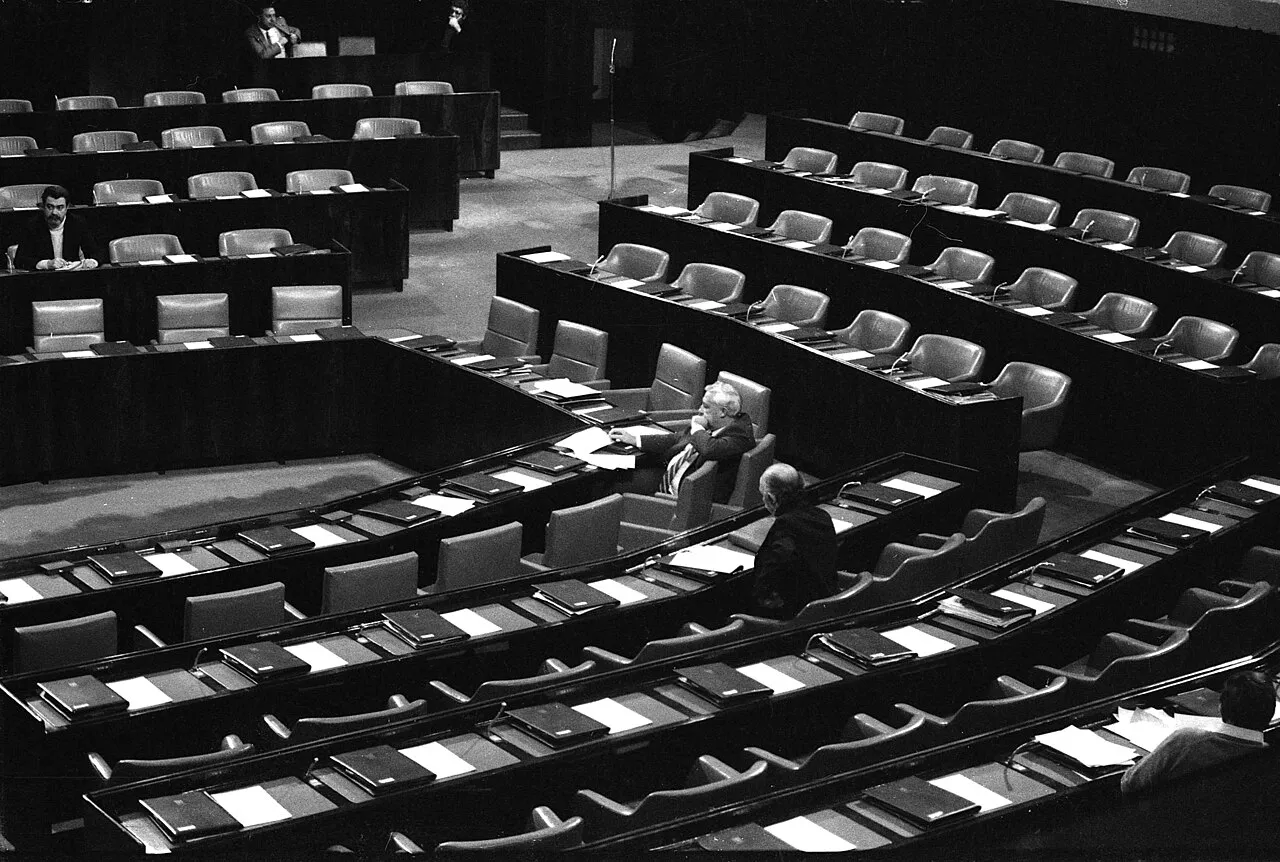
Historical parliamentary image. It does not depict the 26th Knesset or a current coalition vote.
Why dates and titles deserve attention
A person's public title can change, and an archived biography may retain an earlier position. The title appropriate to this checkpoint is the one established by the dated announcement. An older military role, a party role and a government office are different categories of identification.
If a later article calls someone prime minister, check when it was published and what transition it reports. Do not automatically apply that title backwards to every earlier appearance. Equally, do not treat a historical title as proof that the person's current duties remain unchanged.
Spelling variations can also affect searches. Eisenkot's name appears in more than one English transliteration. Confirm the person through the official context rather than assuming each spelling identifies a separate individual or using a similarity in spelling to merge unrelated profiles.
What readers in Pakistan can learn from the process
The useful comparative lesson is about institutions, rather than assuming two countries have identical constitutional procedures. Parliamentary politics often involves a distinction between election results, party leadership and the support needed to govern. The exact rules still need to be checked in each system.
A student can draw a sequence with boxes for election, consultations, mandate and subsequent formation steps. Under each box, write what has actually been confirmed and what remains open. This makes it easier to see why a newspaper might publish several legitimate updates about one transition.
Avoid using the comparison as a shortcut to a legal conclusion about Pakistan or another country. Similar vocabulary can conceal different procedures. The aim is to ask clearer questions, not copy one jurisdiction's process into another without checking its governing documents.
Distinguishing news from prediction
“The president issued a mandate” is a reportable event. “Negotiations will succeed” is a prediction. “A particular coalition would change policy” is an analysis that depends on assumptions. These statements may appear together in coverage, but their evidential status is different.
A reader should be able to identify which sentence belongs to which category. Responsible writing makes the distinction visible through attribution and wording. It does not hide speculation inside an apparently factual list.
This is particularly important when political developments affect markets or international expectations. A prediction can influence people's decisions even if it later proves wrong. Presenting it as uncertain is part of accuracy, not a refusal to explain why the event matters.
A practical method for following the next development
Keep a short record with date, institution, action and source. For this event, the institution is the presidency and the action is assigning the formation task. Add later events as new rows rather than overwriting the earlier one with what eventually happened.
Use a separate column for open questions. Who has agreed to cooperate? Which arrangements are announced rather than suggested? Has a formal step occurred or is a meeting merely scheduled? This prevents anticipation from becoming an accidental entry in the confirmed chronology.
If two reports disagree, compare the event they describe. One may be about an earlier consultation and another about a later ceremony. A different date is not necessarily a contradiction, but the articles should explain their own checkpoints clearly enough for the reader to tell.
Questions about Gadi Eisenkot
Has this announcement made him prime minister automatically?
No. The reviewed event is a mandate to form a government. It should not be substituted for a completed government-formation announcement. Subsequent official evidence is needed to establish later procedural stages and the final governing arrangement.
Why does the announcement mention 67 recommendations?
That is the number of members represented by factions recommending Eisenkot in the consultations described by the presidency. It is a dated consultation figure. It should not automatically be presented as the final membership or voting strength of a coalition that has not yet been fully documented.
Does the largest faction always receive the mandate?
The president's own explanation distinguishes the largest faction from the candidate considered more likely to form a government with wider support. This guide reports that explanation without turning it into a universal rule for every parliamentary system or every possible constitutional situation.
Does the mandate establish a new foreign policy?
No. It identifies a procedural step and a candidate. Policy positions, coalition commitments and enacted decisions require their own evidence. A formation announcement alone cannot prove that a proposed international or domestic change has already taken effect.
What to watch next
Look for official announcements that identify actual agreements and completed steps. Read reaction and commentary as attributed views rather than substitutes for those records. A strong interpretation should explain its assumptions and leave room for negotiations to develop differently.
The story is significant because it concerns a possible change in governing arrangements, but significance does not remove uncertainty. The most useful report tells readers what has happened, why the terminology matters and which evidence would establish the next stage.
For other international and civic explainers, visit the RayTech article collection. This page preserves the 8 November mandate as a dated checkpoint, allowing later developments to be added without changing what the original announcement actually established.
Avoid judging a process from one translated headline
An international reader may encounter the announcement through a short translation that removes institutional context. Before deciding what the event establishes, identify the speaker, the legal or political role being described and the action that has actually occurred. A ceremony assigning a task and a ceremony marking a completed transition can look similar in a photograph while signifying different things.
This is also why a news image should not be used to manufacture a later event. An archive portrait can identify a person, but it does not prove that a coalition agreement was signed that day. The accompanying document remains the relevant evidence.
When comparing coverage, ask whether each outlet is reporting the same stage. A disagreement in wording may be a translation choice, a different publication time or an actual factual conflict. Establishing those possibilities is more productive than assuming that one shortened headline settles the entire process. The result is a clearer account of events and a fairer basis for discussing their significance.
Sources
- Source: Presidency announcement of the formation mandate
- Source: Earlier presidential consultation notice
Image credits: cover: יהב טרודלר (Yahav Studio), source, CC BY-SA 3.0. Resized and converted to WebP. inline: Dan Hadani collection / National Library of Israel / The Pritzker Family National Photography Collection, source, CC BY 4.0. Resized and converted to WebP.
Found an error or an outdated detail? Report a correction with the article URL and original source.