
GAIL Shares: Gas Transmission, Marketing, Petrochemicals and Results
Read GAIL shares through gas transmission, marketing, petrochemicals and cash flow. Understand MMSCMD, utilisation and the limits of price headlines.

GAIL share-price searches concern GAIL (India) Limited, not a household gas-cylinder price or an automatic claim on every company in India's gas industry. The business includes activities with different financial drivers. Gas transmission, gas marketing and petrochemicals should therefore be read separately before their results are connected at the company level.
GAIL's official annual report and investor presentation distinguish operating volumes, capacity and financial segments. This guide explains the units and relationships behind those disclosures. It does not provide a fabricated live share quote, a universal gas tariff or an investment recommendation. Numerical teaching examples below are fictional unless explicitly identified as a dated reported figure.
What should be checked before comparing GAIL results?
Begin with the legal entity, reporting period and scope. A standalone table and a consolidated table can both be accurate while covering different boundaries. Similarly, a physical operating measure and a financial measure can move differently without contradicting each other.
A student should record the source beside every input. A copied figure without its heading can lose whether it refers to a quarter, a full year, capacity or actual volume. Restoring that context is the first task, before calculating growth or drawing a conclusion about performance.
| Field | Essential distinction |
|---|---|
| Natural-gas transmission | Movement through the transmission activity |
| Natural-gas marketing | Gas bought and sold under the business model |
| Petrochemicals | Manufacturing and product economics |
| Capacity | Capability under its stated definition |
| Actual volume | Measured activity during the stated period |
Transmission and marketing are different businesses
Transporting gas and buying or selling gas concern different commercial functions. A pipeline can move gas without the transporter's transmission revenue equalling the full sale value of that gas. The reporting segments help explain where each activity belongs.
Imagine a fictional transporter moves a customer's gas and earns a transport charge. A separate marketer buys gas and resells it. The first business's revenue is not automatically the value of the commodity it transported. Combining those amounts without understanding the relationship would misstate activity.
For GAIL's actual accounts, use the disclosed segment definitions and reconciliation. A natural-gas market headline may be relevant context, but it does not show how every rupee of the company's revenue was earned or identify the margin on a specific contract.
Understanding MMSCMD without confusing time periods
MMSCMD expresses a gas-volume rate: million standard cubic metres per day. The standard conditions and measurement definitions matter. A daily rate cannot be compared directly with an annual total or a different physical unit without the necessary conversion and assumptions.
For a fictional operation with an average rate of two million standard cubic metres per day over ten days, the corresponding volume is 20 million standard cubic metres under the exercise's simplified conditions. A rate of two is not an annual total of two.
When constructing a worksheet, include a unit column and a period column. Keep mass, volume and energy measures separate. A conversion between them may require physical properties or a stated basis; do not invent a universal conversion simply to complete a table.
Capacity utilisation needs a matching denominator
A utilisation percentage relates actual activity to the relevant available or installed capacity under a defined method. The denominator should match the assets and period being analysed. Comparing one network's volume with another network's capacity produces an unhelpful ratio.
In a fictional example, a system with capacity of 100 volume-rate units carries 60 on the same basis. Simple utilisation is 60 percent. If an expansion changes capacity during the year, the appropriate annual comparison needs more care than using the last day's capacity for every month.
GAIL's historical annual-report tables separate installed capacity and actual transmission measures. Use the actual year labels when reading them. A historical utilisation figure is not automatically the current network's operating level or a prediction for the next reporting period.
A transmission tariff is not a household gas bill
Transmission charges concern a particular network activity. A customer's final delivered gas price can involve different components, providers and commercial conditions. Substituting a household bill for the company's transmission realisation would confuse the stages of the supply chain.
Build an invented chain with commodity cost, transport and a final service component. If each has a different owner, adding the whole final bill to the transporter's revenue counts amounts the transporter may not earn. The example illustrates commercial boundaries rather than an actual tariff formula.
For a current applicable rate, consult the responsible provider and official documents for that specific service. This article does not set a gas price. Its purpose is to help readers distinguish the company-level financial measure from a consumer transaction.
Marketing margins require both purchase and sale context
Gas marketing involves costs and realised sales values under actual contracts and accounting rules. A higher sale price does not independently establish a wider margin if acquisition costs or other relevant factors also change. The timing of purchases and sales can matter as well.
For a fictional marketer, purchase cost is eight units and sales value is ten, leaving two before other costs. If both rise by two, the simplified difference stays two. A higher revenue figure alone would not reveal that unchanged difference.
Do not present this illustration as GAIL's actual contract economics. Use its reported segment figures and notes for real comparisons. A broad commodity-price chart is useful context only when the relationship to the company's actual activity has been established rather than assumed.
Contract timing can affect a quarter's result
An operating business can have different purchase, delivery and settlement dates. The accounting record identifies what belongs in the reporting period. A news story's publication date is not necessarily the date when a transaction affected the company's income statement or cash balance.
In a fictional timeline, an agreement is signed in one month, delivery occurs in another and payment arrives later. Those dates describe separate events. Treating the signature date as proof of completed revenue and cash would collapse the timeline without support.
For actual company analysis, preserve the distinctions shown in the disclosures. If timing cannot be established from the public record, state that limitation. A useful explanation need not fill every missing field with an apparently precise but unsupported assumption.
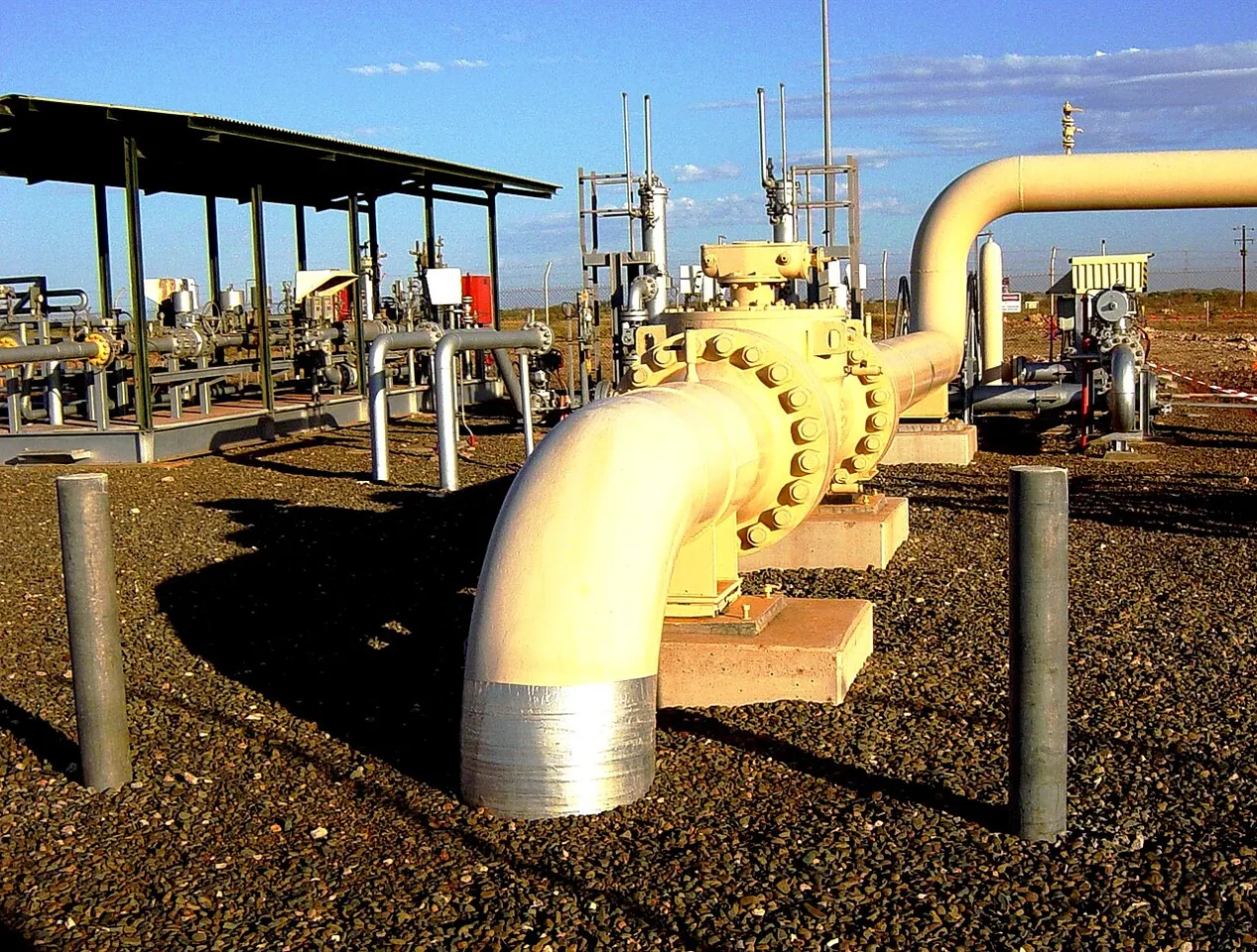
A section of the Dampier to Bunbury pipeline in Australia, photographed in 2004; illustrative gas-infrastructure context, not a GAIL asset.
Petrochemicals add manufacturing economics
GAIL's reporting also includes petrochemical activity. Manufacturing introduces product output, input costs, operating availability, sales mix and other measures beyond gas-transport volumes. A transmission-volume increase does not by itself explain the performance of a petrochemical segment.
Suppose a fictional plant produces two products with different selling values and costs. Even if total tonnes remain unchanged, a change in product mix can alter revenue and margin. That possibility is why a single physical-output total cannot fully describe the financial result.
Read the company's actual explanation of segment changes rather than infer a plant's performance from an unrelated commodity quotation. The business model can be taught with hypothetical quantities while leaving confidential process details and unsupported operational claims out of the article.
Tonnes, standard cubic metres and energy units differ
Different GAIL activities can use different physical measures. An LPG table may use a mass measure while natural-gas transmission uses a standard-volume rate. Similar-looking numbers cannot be added simply because they appear in the same annual report.
A fictional worksheet containing 50 tonnes and 20 cubic metres has not recorded 70 of one meaningful unit. Each quantity needs its own label. A valid conversion, when relevant, requires an appropriate stated basis rather than an arbitrary spreadsheet formula.
This is a useful school-level lesson in dimensional consistency. Ask what the unit measures before performing arithmetic. It prevents a business article from turning a collection of legitimate operating statistics into a technically meaningless combined total.
One-time adjustments can change reported profit
An investor presentation can identify provisions, reversals, settlements, depreciation effects or other adjustments affecting a period. Their actual treatment should be read from the disclosed statements. These items should not disappear merely because an analysis focuses on operating volumes.
For a fictional company, a recurring activity contributes 40 and a separately stated adjustment contributes ten. Total reported earnings and the components both deserve attention. Assuming that all 50 repeats next quarter would add a forecast not supplied by the record.
If presenting an alternative comparison, reconcile it transparently to the reported measure. Do not selectively remove unfavourable items while retaining favourable ones without explanation. The purpose is to understand the result, not to engineer a preferred appearance of growth.
Accounting estimates can affect period comparisons
Changes in an asset's estimated useful life can affect depreciation under the relevant accounting treatment. That is different from a new cash receipt or a physical increase in gas transported. The source note explains the estimate and its reported impact.
GAIL's FY2025-26 investor presentation discusses useful-life revisions for specified assets. A reader should distinguish that accounting explanation from changes in demand or sales volume. The exact effect belongs to the stated period and scope rather than being assumed to apply indefinitely.
For an invented machine costing 100, spreading a simplified depreciable amount over ten rather than five years changes the annual charge under the exercise's assumptions. It does not change the original cash purchase. The example explains timing without reproducing the company's actual asset calculation.
Pipeline investment and cash flow need a separate view
Building or expanding a network can require cash before the asset produces its eventual operating contribution. Capital expenditure, commissioning and recognised depreciation describe different aspects of that process. A project announcement is not a completed year's revenue.
Use a fictional project timeline with planning, construction, commissioning and operation. Mark which stage each source actually supports. A later planned capacity figure should not be combined with present operating volumes to create an artificially low or high utilisation conclusion.
Then review the company's cash-flow statement alongside its profit statement. Reported profit, investment spending and funding movements are distinct. A business can earn accounting profit while using substantial cash for long-lived infrastructure, and the explanation should preserve that distinction.
Receivables and working capital help explain cash
Gas sales or transmission services can create amounts due under the relevant terms. Receivables are therefore part of the relationship between recognised activity and cash receipts. Their movement needs context rather than an automatic interpretation as either good or bad performance.
For a fictional business, revenue of 120 with cash receipts of 100 leaves a timing question about the remaining amount under the exercise's assumptions. It does not independently establish a loss. Opening balances, other receipts and accounting adjustments can make an actual statement more complex.
Read the notes and matching periods before assigning a cause. A single quarter's closing balance cannot establish every customer's payment behaviour. The practical skill is to identify what the public record supports and avoid extending it into a claim it cannot prove.
A useful GAIL learning worksheet
Make separate sections for transmission, marketing and petrochemicals. Include period, scope, unit, physical activity, relevant financial measure and source. Keep a group-level reconciliation rather than simply adding every visible number across segments.
Next, write three short explanations: what changed in physical activity, what changed in financial performance and what changed in cash. If those answers differ, investigate their definitions and timing. Different movement is a reason for analysis, not an excuse to discard whichever measure seems inconvenient.
Use class resources to practise rates, percentages and units. Learners exploring programming courses can create a small tool that requires unit labels before comparing two inputs and warns when one is a daily rate while the other is an annual total.
Questions readers ask about GAIL shares
Does a higher gas price always help GAIL?
No single price movement answers the whole-company question. Transmission, marketing and manufacturing have different relationships to commodity prices and costs. The actual sales arrangements, volumes and reported segment results are needed before attributing a profit change to one market headline.
Is transmission volume the same as sales revenue?
No. One is a physical operating measure and the other is a financial measure. Transporting gas does not automatically mean earning its entire commodity value. Preserve the business role, units and reporting period when reading or calculating either figure.
Can a historical annual report supply today's share price?
No. It supplies dated business and financial information. A current market quote requires a separately identified security and timestamp. Historical accounts can support understanding of the business, but they should not be presented as a live market-data service.
What should be done when units do not match?
Keep the figures separate until a legitimate conversion basis is available. Mass, standard volume, energy and daily rates measure different things. A missing conversion is better recorded honestly than replaced with an invented factor that makes a spreadsheet appear complete.
Sources
Image credits: cover: paul birrell, source, CC BY-SA 2.0. Resized and converted to WebP. inline: Glen Dillon, source, CC BY 3.0. Resized and converted to WebP.
Found an error or an outdated detail? Report a correction with the article URL and original source.