
Gina Hinojosa: Texas Governor-Elect, Public Record and Education Questions
Read Hinojosa’s governor-elect transition and House 49 background, then distinguish education promises, budgets, appointments and measured outcomes.

Gina Hinojosa is Texas governor-elect following the November 2026 election, according to Associated Press reporting. The post-election coverage describes her preparing an administration after defeating incumbent Greg Abbott. Governor-elect means the transition is under way; it does not mean every power of the governorship has already transferred or every campaign proposal has become policy.
For an educational website, her public-school and legislative background offers a useful way to understand the story. This guide separates her documented earlier role from the reported incoming office, then explains how to assess education promises, budgets and transition announcements without presenting predictions as completed changes.
What has been reported about the Texas election?
AP identifies Hinojosa as the governor-elect and reports preparations for a bipartisan administration. This article reflects that reporting as checked on 6 November 2026. It does not claim to have independently inspected the final certified vote count, and it does not attach an invented winning margin to the result.
| Item | Public record or reporting scope |
|---|---|
| Person | Gina Hinojosa |
| Reported incoming office | Governor of Texas |
| Earlier legislative record | Texas House District 49, Austin |
| Professional background in the directory | Attorney |
| Educational record in the directory | University of Texas; George Washington law degree |
| Present reporting stage | Governor-elect and transition |
| Not established by this article | Completed inauguration or final certified margin |
The older House record remains useful for biography. It should not be altered in meaning to suggest that House District 49 is the electorate for a statewide governor's race. A district-based legislative seat and a statewide executive office are different roles, even when the same person moves between them.
How her earlier public record helps identify her
The Texas legislative directory identifies Hinojosa with House District 49 and lists her legal education and occupation. Her official House biography describes a Rio Grande Valley upbringing and a civil-rights and labour-law career. These public records provide a firmer identity check than a social profile that supplies a name but no institution or term.
Committee information on a biography may refer to the period covered by that page. Do not assume it announces a role in the incoming administration. A historical committee assignment can help explain experience while remaining distinct from an executive appointment. The institution and date give the information its proper scope.
Readers should also distinguish similarly named public figures. Use the full name, state and office rather than a surname alone. A correct photograph caption and a matching directory entry reduce the risk of importing a quote, career detail or election result belonging to someone else.
Governor, state representative and education commissioner are different roles
A state representative works in the legislature; a governor leads the state's executive branch under the state's constitutional system. An education commissioner is a separate office with its own appointment and responsibility structure. These roles can interact, but one should not be used as a synonym for another in a policy story.
This matters when an incoming governor discusses education priorities. A statement of intent may begin a process involving appointments, legislation, budgets or agency action. The announcement is important news, but the next steps depend on the actual authority and procedure. A report should identify those steps instead of describing an intention as an accomplished reform.
For students, draw a flowchart with separate boxes for proposal, decision, implementation and observed result. Place each institution where it participates. The exercise makes it easier to see why a public official can influence a subject without personally controlling every classroom, examination or funding decision.
What is a transition team for?
A transition prepares an incoming administration for the responsibilities it expects to assume. It can involve reviewing priorities, considering personnel and arranging the practical handover. A transition announcement is evidence of preparation, not proof that an appointee has already taken office or that a proposed programme has been implemented.
The reporting on Hinojosa places education among the transition priorities. The careful reading is that this identifies an area of attention. It does not independently establish a new statewide school rule, a changed household entitlement or a completed personnel replacement. Those developments require their own official records when they occur.
Avoid judging a transition solely by its title or visual presentation. A list of advisers does not explain every future decision. The useful follow-up questions are what responsibilities have been assigned, which appointments require additional steps and what public documents will show the eventual decisions. That is accountability based on actions rather than ceremony.
Read education promises by asking what changes for a student
An education policy can affect different things: access, instructional time, staffing, curriculum, assessment, facilities or financial support. A broad claim to improve schools may cover several of these or only one. Ask the proposal to identify the actual mechanism before assuming a particular effect on every student.
For example, a plan to repair buildings is not the same intervention as a plan to change an assessment system. Both can concern education, but they need different evidence and different measures of success. A useful article explains the intended change rather than presenting all spending or administrative activity as equivalent to improved learning.
This is a general framework, not a list of policies attributed to Hinojosa. The distinction is deliberate. Her future administration should be assessed against the measures it actually publishes, not proposals invented by a writer filling out a profile. Readers can prepare good questions without claiming to know the answers in advance.
Why per-student figures need careful definitions
A spending figure divided by a student count can be informative, but both inputs need a definition. Does the spending include buildings, debt service or only certain operating costs? Is the student count an enrolment snapshot or another measure? Two per-student figures may differ because their definitions differ, not because a simple calculation is wrong.
Consider a fictional budget of 12 million units serving 2,000 students. Dividing produces 6,000 units per student. If the same budget includes a one-time building project, the average does not mean every classroom receives that amount in recurring instructional funds. The total and its components must remain visible.
Now compare a second fictional system spending six million for 1,000 students. It produces the same average but is not necessarily identical in facilities, staffing or needs. A ratio compresses information. It is a starting point for questions, not an automatic ranking of educational quality or a direct measurement of what each child learns.
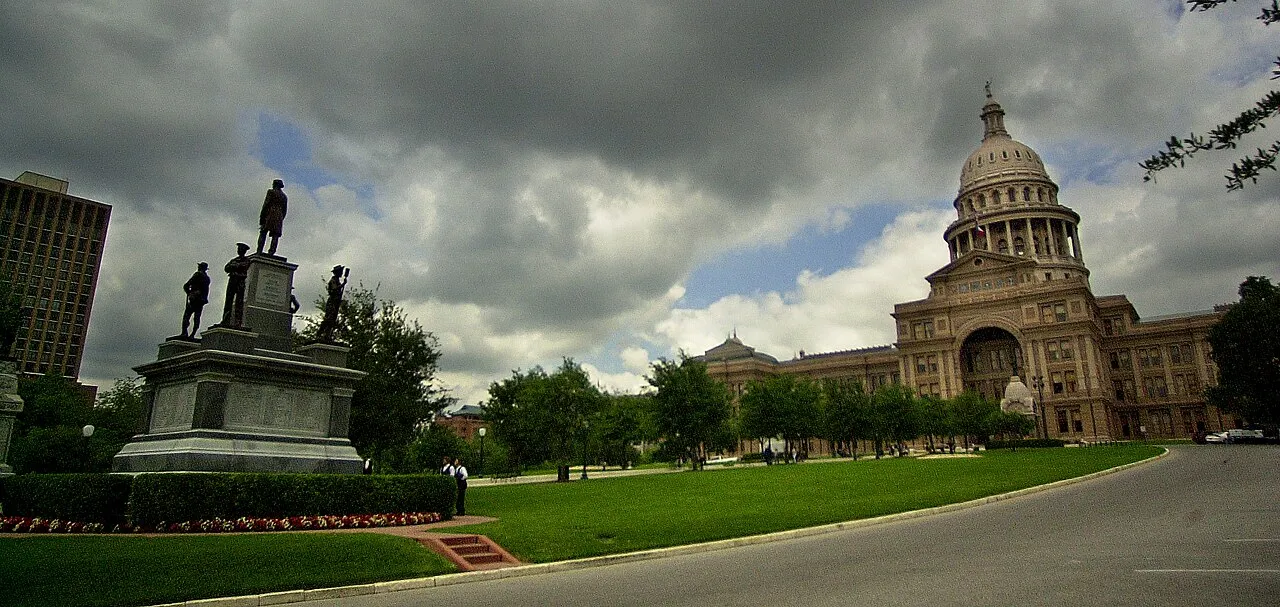
The Texas Capitol in Austin, shown as institutional context rather than a photograph proving an election result or completed transfer of office.
Budget increases are not always increases in purchasing power
Nominal spending is the amount expressed in the currency of the period. Purchasing power depends on costs as well as the stated total. A larger budget can buy less than expected if relevant costs also rise. Conversely, a flat total can conceal changes in enrolment or in the services being funded.
Use a fictional example with a budget rising from 100 to 105 units. That is a five-percent nominal increase. It does not by itself establish a five-percent improvement in resources available per student. To investigate that claim, a reader would need the student count, the cost context and the composition of the spending.
No invented figure here describes Texas's actual budget. These examples are tools for reading future announcements. When an administration publishes a proposal, keep the reference year, measure and comparison group attached. The word increase has little explanatory value unless the reader knows what is increasing relative to what.
Outcomes, activities and promises belong in separate columns
Hiring staff, approving a budget and launching a programme are activities or decisions. Improved attendance, learning or completion can be outcomes. A promise describes an intention before the result is known. Treating all three as the same evidence makes it difficult to judge whether a policy delivered what was claimed.
For a fictional tutoring scheme, announcing the scheme is one event; enrolling students is another; measuring learning after participation is a further step. An evaluation should ask how students were selected and what comparison is being made. A positive change may be encouraging without proving that the programme alone caused it.
This distinction is particularly valuable during a political transition, when announcements arrive before implementation. Readers can acknowledge the importance of a plan while waiting for evidence about its execution. Skepticism need not mean rejecting every proposal, and enthusiasm need not mean declaring success before students experience any change.
How to interpret school averages without losing individual students
An average can summarise a large system while hiding variation. If two fictional schools have different class sizes or different access to materials, a statewide average may not describe either school particularly well. A policy assessment should ask who experiences the change and whether the summary masks important differences.
That question should be approached with evidence rather than stereotypes. Do not infer a student's ability or a school's quality from a neighbourhood label alone. Look for the actual measure, the timeframe and the conditions. A result can reflect multiple factors, and an educational article should avoid blaming individuals for a broad statistical pattern.
For students learning data literacy, create a small invented dataset and compare mean, range and individual entries. Then explain what information disappears when only the mean is shown. The exercise prepares readers to evaluate real education statistics without pretending that a single headline number tells the whole story.
What the historical milestone does and does not establish
Post-election reporting describes Hinojosa's victory as ending a long period without a Democratic governor in Texas and identifies a Latina representation milestone. Those statements concern electoral history. They do not automatically establish the quality of future policy, the views of every voter or the outcome of the next legislative session.
A neutral profile can recognise the reported significance while continuing to examine performance. Representation and public accountability are not competing ideas. An incoming officeholder should be identified accurately and assessed through public decisions and results, rather than praised or dismissed solely because a milestone attracts attention.
Avoid broad claims about why entire demographic groups voted. A result does not provide the reasoning of every voter. Explaining a margin or a change in support requires suitable evidence and a stated method. This article reports the development without assigning a single political motivation to millions of people.
How to follow the incoming administration responsibly
Keep a dated list of announcements and the records that later confirm them. For an appointment, look for the official appointment and any required approval. For a proposal, look for the published text and subsequent action. For spending, distinguish a requested amount from an authorised amount and money actually spent.
Preserve the older records rather than overwriting history. A House biography can remain a valid record of an earlier role after an executive transition. The new office should have its own dates and documentation. A reliable timeline can hold both without pretending that one cancels or retroactively changes the other.
When correcting a shared post, quote the precise point at issue. If the problem is the word governor before service begins, replace it with governor-elect and explain the timing. There is no need to speculate about the sharer's motives. A small factual correction can make a large difference to the clarity of the story.
Questions about Gina Hinojosa's transition
Has the governorship already transferred in this report?
This article identifies Hinojosa as governor-elect and covers the transition reporting. A completed inauguration or assumption of office requires its own record. The election result, preparations and exercise of executive authority are related stages, but they should not be described as a single event.
Does House District 49 define the governor's electorate?
No. It identifies her earlier legislative seat. The reported governor's race is statewide. Keeping the previous district in a biography is useful, but it should not be mistaken for the scope of the incoming executive office or used to infer statewide vote totals.
Are the budget examples actual Texas figures?
No. They are explicitly fictional calculations showing how to evaluate future announcements. Use official budget documents for real amounts. Explore class learning resources for more work with ratios and news explainers for public-record reading that separates promises, decisions and outcomes.
Sources
- Source: AP report on Hinojosa's governor-elect transition
- Source: Texas legislative directory
- Source: Texas House public biography
- Source: Axios, education-focused transition announcement
Image credits: cover: LBJ Library, source, Public domain. Resized and converted to WebP. inline: Public-domain source, source, Public domain. Resized and converted to WebP.
Found an error or an outdated detail? Report a correction with the article URL and original source.