
Hasan Mahmud: Chennai Five-Wicket Milestone and Bowling Figures Explained
Explore Hasan Mahmud’s dated Chennai five-wicket milestone. Learn overs notation, economy, bowling average, strike rate and scorecard scope.

Hasan Mahmud's five-wicket Test innings in Chennai in September 2024 offers a useful starting point for understanding fast-bowling records. ICC's player profile records figures of 5/83 and identifies the performance as a first for a Bangladesh bowler in a Test in India. The exact category matters: a Test innings is not the same record as a limited-overs match or a performance elsewhere.
This guide explains the milestone and shows how to read overs, wickets, runs and bowling rates without mixing them together. It is not a live score for a later Bangladesh fixture, a current selection announcement or a technical training prescription. Numerical examples are original teaching exercises unless explicitly linked to the historical performance.
Who is Hasan Mahmud?
Hasan Mahmud is a Bangladesh cricketer associated with fast bowling. ICC's record identifies his Test debut against Sri Lanka in 2024 and the later Chennai milestone. His name should not be confused with other public figures or players appearing in a broad search. A reliable profile matches the sport, team and source before selecting a photograph or repeating a biographical detail.
A player identity needs more than a name
Search engines can return politicians, namesakes and unrelated team photographs. Check the description and original source rather than accepting the first image. A clearly labelled stadium or team-context photograph is preferable to falsely identifying another person as the bowler. Image accuracy is part of the article's factual accuracy, not merely a design choice.
A debut and a record innings differ
The first appearance in a format and a later notable performance are separate milestones. A timeline should name each event rather than use one date for the entire career. The format also belongs beside the date. A Test debut should not be silently described as the first time the player ever appeared in senior cricket of any kind.
What happened in Chennai in 2024?
The ICC profile records Hasan's 5/83 in the September 2024 Test against India in Chennai. It identifies him as the first Bangladesh bowler to take a Test five-wicket haul in India. The statement has boundaries: nationality, format, number of wickets and location. Removing those qualifiers can turn a correct milestone into a different and unsupported claim.
A five-for belongs to a defined innings
Five wickets in an innings is different from five across a whole Test. A Test can contain more than one opposition innings, and match figures combine the relevant work. Use innings and match labels carefully. A report that drops the distinction can make an ordinary total sound like a separate record or understate an actual innings achievement.
A player's performance and the match result differ
A strong bowling innings does not guarantee a team victory. Other batting, bowling and fielding contributions shape the final result. A profile can recognise the milestone without implying that Bangladesh won that match simply because one bowler took five wickets. The official match outcome needs its own record and should remain separate from the individual figures.
How do you read 5/83?
The notation in this bowling context means five wickets for eighty-three runs conceded under the scorecard's accounting. It is not five runs from eighty-three balls or a batting strike rate. Some displays reverse the order in a table or use separate columns, so check the headings. The digits alone do not carry enough context to interpret every sports notation correctly.
Runs conceded are not every team extra
Scorecards distinguish bowling charges and team scoring categories under their rules. Do not assume every run in the opposition total is charged to the bowler. Use the official columns rather than reconstructing a bowling total from a headline. A classroom calculator should preserve the scorecard's definition instead of inventing an accounting rule that seems convenient.
Wickets have a scoring definition
Not every dismissal is credited to the bowler in the same way. For a particular innings, the official scorecard is the reference. A team can lose wickets through different dismissal types, so adding every team wicket to one bowler's count is incorrect. Keep the team innings total and each bowler's individual figures in distinct fields.
Why are overs not decimal numbers?
An overs notation uses the number after the point to indicate legal balls within the next over, not tenths of an over. In a six-ball-over format, 10.2 overs represents ten complete overs plus two legal balls. Treating 10.2 as a decimal when calculating a rate produces the wrong answer. Convert to legal balls before doing the arithmetic.
Work through a fictional economy example
Imagine a bowler concedes thirty-one runs in 10.2 overs. That is sixty-two legal balls, or sixty-two divided by six overs. The economy rate is thirty-one divided by that quantity, which equals three runs per over. These are fictional inputs. The example shows why parsing the notation correctly matters more than simply letting a spreadsheet divide two visible numbers.
Validate the ball field
For a six-ball-over exercise, the remainder should not be six or a larger digit in ordinary completed-over notation. An input such as 10.8 needs review rather than being accepted as 10.8 decimal overs. Preserve the original text so a reader can check it. Software should identify unsupported input instead of silently producing a polished but incorrect rate.
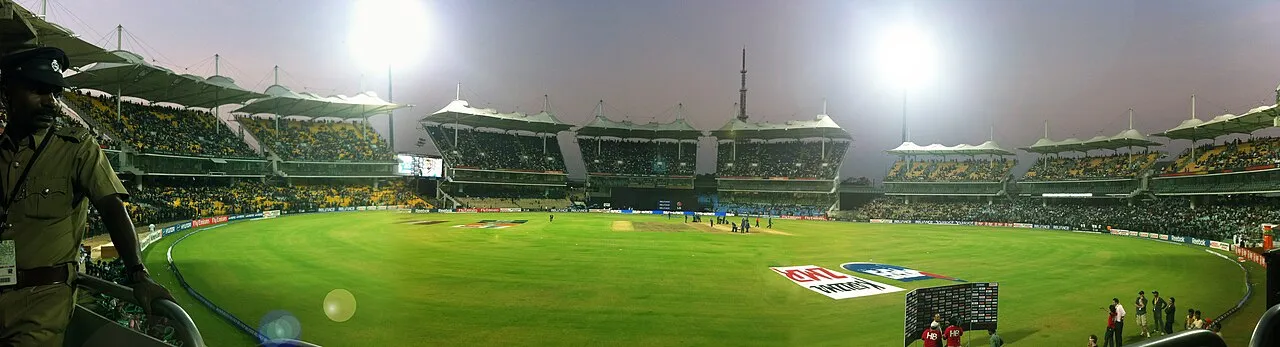
MA Chidambaram Stadium in Chennai in a 2011 photograph; historical venue context, not the September 2024 Test.
What do bowling average, economy and strike rate mean?
Bowling average uses runs conceded per wicket. Economy rate measures runs conceded per over, while bowling strike rate concerns legal balls per wicket. The three measures answer different questions. A low figure in one category does not automatically mean the same outcome in another. A useful table names each measure and states the sample period and format.
Use one fictional dataset
Suppose a bowler takes four wickets for forty runs across sixty legal balls. The bowling average is ten runs per wicket. The economy rate is four runs per over, and the strike rate is fifteen balls per wicket. These invented figures are not another Hasan Mahmud performance. They demonstrate how the same inputs can produce several valid measures with different units.
A wicketless sample needs special handling
If no wickets were taken, average and strike rate cannot be calculated using a positive wicket denominator in the usual way. Economy may still be available if legal balls were bowled. A dataset should preserve that distinction rather than fill every field with zero. Zero would make the unavailable rate look like an extraordinary measured result.
A short spell is a small sample
An excellent rate over a few balls can change quickly. A longer sample offers more information but may involve different opponents and conditions. Show the raw runs, balls and wickets beside the rates. This lets readers see what supports the calculation instead of treating a percentage or ratio as a permanent label of the player's ability.
How should a fast-bowling spell be studied?
Observe line, length, bounce and the batter's response where footage permits. The purpose is to understand how pressure develops, not to prescribe a physical action for a beginner. A good analysis connects several deliveries rather than judging the entire spell from one wicket ball. The outcome can also depend on the batter's decision and the support of the field.
A dot ball can contribute to pressure
A delivery producing no run may help a field or sequence work, but it is not automatically proof of perfect execution. The batter might have missed an available scoring opportunity. Describe what can be seen and avoid assigning a private plan to every ball. Repeated observations give a more useful picture than a single favourable outcome.
A wicket ball has a surrounding sequence
An earlier delivery can influence the batter's preparation for a later one. That is a possible tactical relationship, but it should be demonstrated rather than assumed. Use the visible changes in line, length or response. Do not invent a detailed plan merely because the final delivery produced a dismissal that fits an appealing story.
Speed is one part of the problem
A faster ball is not automatically a better ball. Placement, movement and the batter's preparation matter. A speed display also needs its source and measurement context. This guide does not invent a maximum pace for Hasan or use an unrelated player's reading. The aim is to explain the categories a viewer should examine, not collect the largest available number.
Why do format and conditions matter?
Test and short-format bowling can involve different tasks, fields and time horizons. A rate from one should not be judged solely against expectations from another. Pitch, ball condition and the stage of the innings can also affect opportunities. The goal is a fair comparison, not an excuse to ignore poor execution or a reason to call every wicket entirely bowler-created.
A venue label does not explain everything
Knowing that a match was in Chennai provides location, not a complete description of every delivery. Conditions can differ across matches and sessions. Avoid using a city's reputation as a substitute for evidence from the actual game. A narrow supported observation is more useful than a universal statement about what all bowlers or batters must do at a ground.
Career figures need a date and scope
A player's average changes as new innings enter the record. A profile should state the period and format when quoting aggregates. An old ranking or career total should not be presented as live simply because it appears beside a current webpage header. This guide uses a dated innings milestone rather than a quickly stale collection of undated totals.
A bowling-statistics project for students
Create fields for original overs text, legal balls, runs conceded and wickets. Convert the overs carefully, then calculate each rate with its correct denominator. Keep team totals outside the bowler row unless clearly labelled. A useful project shows how the figures relate rather than combining every number into a single unexplained performance score.
Test meaningful edge cases
Include a complete over, a partial over, a wicketless spell and an empty sample. Check that the tool does not divide by zero or treat balls as decimal tenths. Reject negative counts and keep unsupported notation for review. These checks test the meaning of the input, not merely whether the program can display a number without crashing.
Use the learning resources
The class resources can support the arithmetic, while the programming courses offer a place to implement a scorecard parser. Begin with fictional examples and then add verified historical data with a source and date. Keep calculated results separate from the original notation so another reader can trace the answer and identify any mistake in interpretation.
Separate the two opposition innings
A bowler can have different returns in the two innings of a Test. Store each innings with its own identifier before calculating match figures. Adding wickets and runs may produce the relevant combined totals, but a rate still needs the combined legal balls and the correct denominator. Do not average two economy rates equally if the spells had different lengths. This small data model helps explain why an innings best and a match best are separate records even when they appear beside each other in a career table.
Questions about Hasan Mahmud
Does 5/83 mean five wickets in the whole career?
No. In the historical example discussed here, it describes an innings return. A career record combines many separately defined appearances and has its own totals. The format, match and innings belong beside the figure. A compact number becomes meaningful only when the reader knows which part of the scorecard it represents.
Is the Chennai milestone a new November 2026 result?
No. The performance is dated September 2024. A later match involving Hasan requires its own verified scorecard. Reusing the old figure as a current result would be inaccurate even though the historical number is genuine. A career guide should preserve the milestone's date and avoid turning renewed interest in a player into an invented live report.
Sources
- ICC: Hasan Mahmud's player profile and Chennai milestone
- Wisden: the historical Test five-wicket milestone
Image credits: cover: Press Information Department, source, Public domain. Resized and converted to WebP. inline: Prasad1287, source, CC BY-SA 3.0. Resized and converted to WebP.
Found an error or an outdated detail? Report a correction with the article URL and original source.