
How a Helicopter Flies: Rotors, Hovering and Flight Controls
Learn how helicopter rotors create lift, why hovering needs power, what collective and cyclic mean, and how air density affects performance.

A helicopter flies by moving rotor blades through the air rather than relying only on the whole aircraft moving forward. Those blades act as rotating wings. This lets a helicopter hover, move sideways and take off or land vertically when the aircraft, conditions and operating area permit.
The interesting science is not simply that the blades spin. It is how they interact with air, how the resulting force is directed and why the available performance changes with weight and atmosphere. This is an introductory explanation for students, not a flight lesson or instructions for operating an aircraft.
Why does spinning a rotor produce lift?
Air must move relative to a wing for it to produce aerodynamic forces. A conventional aeroplane normally obtains that relative movement by travelling forward. A helicopter's engine-driven rotor creates movement across its blades even while the aircraft's position over the ground remains nearly unchanged.
The blades are shaped and operated as airfoils. Their interaction with the surrounding air produces a force, with an upward component that can support the helicopter's weight. Pressure differences and the movement of air belong to the same physical process, not two unrelated explanations that must compete with each other.
Avoid the misleading picture of an aircraft floating without doing work. A hovering helicopter still needs power and still interacts strongly with the air around it. From the ground it may appear stationary, but the rotating system is continually active.
Is a rotor just a large fan?
The comparison can help introduce moving air, but it leaves out important parts of rotor design and control. A helicopter rotor is a lifting and control system whose blades work through a changing flow environment. Its geometry, blade angles and mechanical arrangements matter.
A desk fan's everyday purpose is to move air through a room, not support a piloted aircraft through a certified range of conditions. Treating the two as interchangeable makes the helicopter seem much simpler than it is. The shared idea is momentum exchange with air, not identical engineering requirements.
For a classroom discussion, compare the questions each design must answer. How much force is needed? In which direction? How is that force controlled? What happens when the surrounding conditions change? Those questions connect the familiar object to the aircraft without pretending they are the same machine.
What is the difference between hovering and climbing?
Hovering describes maintaining a position, while climbing involves gaining height. Supporting weight is not automatically the same as accelerating upward. In a simplified steady hover, the forces balance so the aircraft does not keep speeding up vertically.
This is a useful connection to Newton's laws. A net force changes motion; it is not required merely because an object already has a particular position. The complete aircraft also encounters aerodynamic and control effects, so the simple force picture is a teaching model rather than a performance calculation.
When drawing a diagram, label the aircraft's weight downward and the relevant upward force. Then distinguish the diagram of a steady condition from one showing an acceleration. A student who can explain the difference has learned more than the statement that “lift makes things go up.”
How does a helicopter move forward?
The rotor system can direct its thrust so that the resulting force has a horizontal component. The aircraft's movement depends on that direction and the other forces acting on it. This is different from imagining that a helicopter must first point a separate large propeller forward to begin travelling.
A vector diagram makes the idea clearer. Draw one slanted arrow and separate it into vertical and horizontal components. The total arrow is not two different engines; the components are a mathematical way to describe a force acting at an angle.
The diagram is conceptual. It does not tell a person which control movements to make or how much performance is available. Actual flight requires aircraft-specific training, operating limits and a qualified pilot, none of which can be replaced by a general article's arrow sketch.
Collective, cyclic and pedals: what do the names describe?
| Control concept | Introductory role |
|---|---|
| Collective | Changes blade pitch collectively across the rotor |
| Cyclic | Changes blade pitch through the rotation cycle to control the rotor's force direction |
| Anti-torque pedals | Control the anti-torque system and yaw in a conventional arrangement |
The names describe different control functions rather than three unrelated ways to “go up.” They interact, which is one reason a helicopter is not operated by memorising a single lever direction. The aircraft's design and flight condition affect the coordinated response required.
For beginners, learning what each system is for is enough. A table of concepts should not be mistaken for a procedure. The applicable flight manual and professional instruction are the authoritative route for operation, including circumstances where a simplified description is inadequate.
Why do many helicopters have a small tail rotor?
In a common single-main-rotor design, driving the main rotor also produces a reaction that must be controlled. The tail rotor provides an anti-torque function and contributes to directional control. It is not merely decorative or a second main lifting rotor scaled down for appearance.
Other designs solve the problem differently. Counter-rotating rotor arrangements, for example, do not look like the familiar one-main-rotor-and-tail-rotor layout. A photograph without a small exposed tail rotor is therefore not enough to conclude that an aircraft is missing an essential part.
When comparing pictures, identify the design before labelling the components. The useful question is how that particular aircraft manages forces and control. Starting with the assumption that every helicopter must share the same visible shape can hide the engineering variety.
Can a helicopter fly in a vacuum?
Not by using aerodynamic rotor lift as it does in the atmosphere. The rotor needs surrounding gas to interact with. Spinning blades without that medium does not supply the same lifting process. This is a helpful distinction between an aircraft rotor and a rocket's propulsion system.
It also explains why “space helicopter” needs careful context. A helicopter operating on another planet is interacting with that planet's atmosphere, however thin it may be. It is not hovering in empty interplanetary space by turning a propeller.
For students, keep the environment in the explanation. A mechanism can work differently when air density, gravity or available power changes. The familiar appearance of a rotor does not guarantee that a design built for one environment will function unchanged in another.
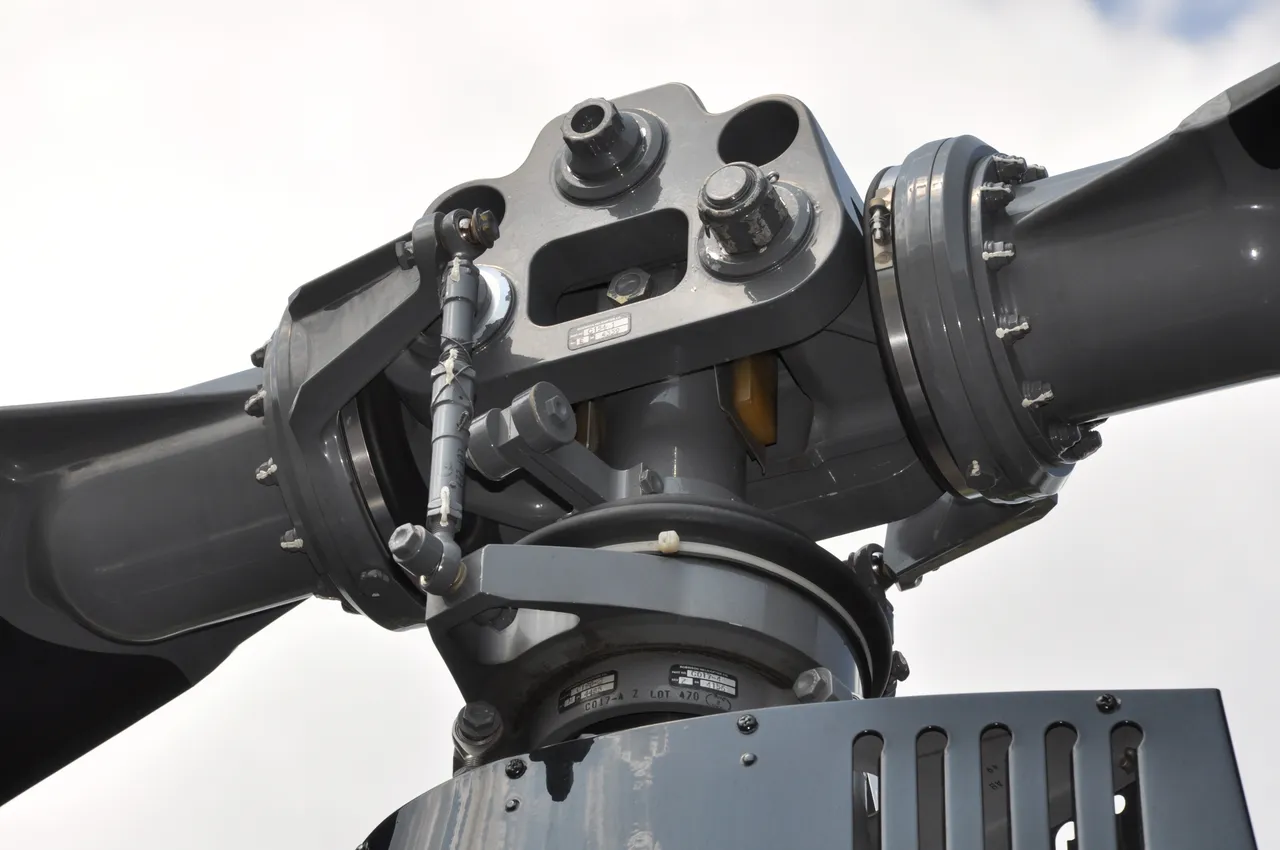
Component photograph illustrates a different aircraft design from the cover; it is not a maintenance or operating procedure.
Why does thin air matter?
Air density affects rotor performance. The FAA's performance guidance explains why atmospheric conditions, aircraft weight and wind must be considered rather than relying on altitude alone. A location's height on a map is not a complete description of the conditions the aircraft encounters there.
Density altitude is a way of expressing the performance-relevant air-density condition in relation to a standard atmosphere. It should not be confused with the aircraft's literal height above the ground. The word “altitude” in the name can otherwise lead students to treat two different quantities as identical.
This article does not supply an operational weight limit or a formula for approving a flight. Those require the actual aircraft's performance data and conditions. The learning point is that a machine's available capability depends on its environment, not only on the size of its engine.
How does weight affect the question?
An aircraft carrying more mass has a greater weight under the same gravitational conditions. The lifting system must support that load, and the available performance is not unlimited. Passenger count alone is not a sufficient description of a helicopter's loading condition.
Fuel, equipment and other carried items also contribute. Two flights with the same number of passengers can therefore have different total loads. A photograph of a helicopter carrying something heavy is not a reliable guide to what a different aircraft can carry in different weather or at another location.
For a non-operational classroom model, compare a force balance for two different symbolic weights. Ask what changes in the upward support requirement. Keep the exercise at the level of physical reasoning rather than presenting an invented payload chart as usable aviation data.
Why is the air beneath the rotor noticeable?
A rotor interacts with a substantial flow of air. The resulting downwash is one reason the environment around an operating helicopter deserves attention. It can disturb loose material and make the area very different from a quiet patch of ground with a parked vehicle.
An approaching passenger or spectator should follow crew and site instructions rather than improvise a route based on a video. This general explanation does not identify a universally safe direction or distance for every aircraft and operation. The correct arrangements depend on the actual situation.
For the physics lesson, notice the connection between supporting the aircraft and changing the motion of surrounding air. The airflow is not an accidental extra added to an otherwise motionless machine. It is part of the mechanism that makes the flight possible.
What is autorotation?
Autorotation is a rotorcraft flight condition in which airflow drives the rotor rather than the engine providing the normal driving power. It is an important aerodynamic concept, but it must not be reduced to a promise that any engine failure leads to an easy or guaranteed landing.
The FAA's material emphasises aircraft-specific procedures and the role of training. A general student article can explain the change in energy source without giving control sequences or operational recovery instructions. That boundary preserves the difference between understanding a concept and being qualified to perform a manoeuvre.
It is also incorrect to describe the rotor as instantly stopping whenever engine power changes. The mechanical and aerodynamic state matters. Use the actual technical context rather than borrowing a dramatic movie image as an explanation of how every real helicopter behaves.
What can a paper spinner teach?
A simple paper rotor can demonstrate how a falling object and the surrounding air interact. NASA JPL provides a paper-helicopter classroom activity that encourages comparing designs. The paper model is not a powered passenger helicopter and should not be used as proof of identical performance.
For an original observation exercise, choose one design feature to compare, such as blade length. Keep the release height and paper type consistent. Record several trials instead of declaring a winner from one unusual drop, and use a clear area without climbing on furniture to create extra height.
The useful habit is controlled comparison. If you change blade length, paper weight and release method together, a different descent time will not reveal which change mattered. A small experiment can therefore teach both a rotor-related observation and the logic of fair testing.
Why does a video sometimes show slow or backward blades?
A camera samples motion in frames rather than recording every intermediate position as a continuous visual experience. A rapidly rotating object can therefore appear to move differently in the recorded sequence. The apparent pattern should not be assumed to be the rotor's real direction or speed.
Think of looking at a marked wheel only at regularly spaced moments. Depending on where the mark appears at each observation, your brain may infer a slower rotation or the opposite direction. The observation interval has hidden part of the real movement.
This is a general sampling explanation, not a measurement of any specific helicopter video. Without the recording settings and reliable timing, counting the apparent blade movement in a short clip does not supply an accurate rotor-speed reading.
Questions about helicopters
Does a helicopter need a runway?
A helicopter can take off and land vertically, but that does not mean every open area is suitable or authorised. Aircraft performance, obstacles, weather and operating arrangements matter. Vertical capability is a feature, not permission to use any location.
Is every rotorcraft a helicopter?
No. Rotorcraft is a broader category that also includes other designs, such as gyroplanes. The presence of rotating wings helps identify the family, but the way the rotor is powered and the aircraft operates distinguishes particular types.
Does a larger rotor always mean a stronger helicopter?
One dimension is not enough to establish performance. Blade design, power, weight, atmosphere and operating limits all matter. Compare properly specified aircraft data rather than treating a photograph's apparent size as a complete engineering measurement.
A better way to understand the aircraft
Begin with moving air and rotating wings, then connect the force direction to hovering and forward movement. Add the role of anti-torque control and the effect of environment and weight. Those relationships explain much more than memorising a list of visible parts.
Explore science and technology articles and our class study resources for related learning. For operational aviation, use formal training and the applicable aircraft manuals. This introduction is intended to build physical understanding, not replace either.
Sources
- NASA: What is a helicopter?, for rotating-wing lift and basic capabilities.
- FAA: Rotorcraft technical discipline, for the broader aircraft category.
- FAA: Helicopter Flying Handbook, for controls, aerodynamic concepts and the separation between introductory explanation and operation.
- FAA: Helicopter performance chapter, for weight, atmosphere and performance considerations.
- FAA: Helicopter emergencies and hazards chapter, for the importance of aircraft-specific procedures in autorotation.
- NASA JPL: Paper Mars helicopter lesson, for the classroom-design activity. Force sketches, the sampling explanation and the comparison exercise above are original teaching explanations, not flight procedures.
Image credits: cover: Wilfredor, source, CC0. Resized and converted to WebP. inline: Glueball at English Wikipedia, source, Public domain. Resized and converted to WebP.
Found an error or an outdated detail? Report a correction with the article URL and original source.