
Inde Navarrette: Screen Credits and Performance Study
Explore Inde Navarrette with clear explanations, worked examples, source checks and practical questions for independent student learning.

Inde Navarrette is a screen actor whose 2026 work includes Nikki in the horror film Obsession. The distributor's official material identifies the film as written and directed by Curry Barker and lists Navarrette among its cast. This guide focuses on professional credits and ways to understand a performance, rather than private-life speculation or a review pretending that we watched material we did not access.
Checked on 2 November 2026, the article is designed for media literacy and critical writing. The exercises use original, non-graphic scenes and do not require watching a horror film. Readers should follow the age guidance and lawful availability applicable to any work they choose to view.
What is verified about Obsession?
Focus Features' official film page lists Navarrette alongside Michael Johnston, Cooper Tomlinson, Megan Lawless and Andy Richter, with a 15 May 2026 release date in its market. The date belongs to that distributor listing. It is not a promise that the same viewing option, classification or release arrangement applies in every country.
The distributor's filmmaker feature identifies Nikki as Navarrette's character and describes a wish-driven horror premise. That establishes a broad story context. It does not justify reproducing an entire plot, inventing scene-by-scene reactions or claiming a personal screening experience.
Capstone's production listing also identifies Barker as writer and director and includes Navarrette in the cast. Comparing those professional records helps confirm the title and credit without relying only on a promotional image or a fan-created page that happens to use the actor's name.
Why separate an actor from a role?
A role is a fictional construction shaped by writing, performance, direction, editing and other contributions. A character's behaviour does not establish the actor's private personality. This distinction becomes especially important in horror, where an actor may portray disturbing actions that are part of the story rather than a statement about the performer.
For an original exercise, imagine a character who smiles while concealing a broken object. We can discuss the contrast between expression and information. We cannot infer that the actor is deceptive outside the scene. The visible choice belongs to a performance in a designed situation.
Write your observations with precise subjects. “The character hides the object” describes an action in the story. “The actor delays the reply” describes a performance choice. “The edit withholds the reverse angle” describes presentation. Those statements can work together without pretending they are the same kind of evidence.
How can a performance communicate uncertainty?
Uncertainty can be conveyed through timing, attention, posture, speech and the relationship between action and dialogue. A viewer should identify the actual choice before describing its possible effect. There is no universal gesture that always means the same emotion in every scene or cultural context.
Consider an original, age-appropriate scene: a student opens an envelope containing an unexpected invitation. One version uses an immediate excited response; another uses a pause and a second look at the address. Ask what each version makes the audience wonder. The exercise explores performance without borrowing a protected scene or requiring frightening content.
Avoid writing that a performer “must have felt” a particular private emotion. The scene can create an impression without revealing the actor's actual internal state. Critical writing can describe that impression clearly while acknowledging the boundary between an effect on the viewer and a fact about the person performing.
What is the difference between suspense and surprise?
Suspense often involves waiting with an unresolved question, while surprise involves an unexpected development. A scene can use both, but they are not interchangeable labels. Ask what the audience knows, what a character knows and how the gap changes over time. Those questions are more useful than calling every tense moment a jump scare.
In an original exercise, show a character placing a cup near the edge of a table, then reaching for another object. If the viewer notices the unstable cup, waiting can create suspense. If the cup falls without prior emphasis, the event may function more as surprise. Neither version requires danger, gore or supernatural imagery.
This is a general storytelling model, not a description of an Obsession scene. A real analysis needs the actual sequence and a clear account of what was shown. Do not attach a classroom example to a film merely because its genre makes the example sound plausible.
How do sound and silence affect a scene?
Sound can guide attention, establish space and influence expectation. Silence or reduced sound can also change how a viewer notices a movement or a reply. The effect depends on the sequence, not simply on whether the soundtrack is loud. A composer credit alone does not explain every sound-design decision.
Create an original ten-second recording of a door opening. Present it once with ordinary room ambience and once with a pause before the latch clicks. Ask listeners what they expected in each version. The physical action can remain the same while its presentation changes the experience.
Do not claim that this reproduces a professional film's audio process. It demonstrates one variable in a simplified model. When reviewing a released work, describe the sound that is actually audible and the effect it had on you, rather than inventing production methods from the finished impression.
Why does a reaction shot matter?
A reaction shot can tell the audience how a character receives information, but its meaning depends on what surrounds it. The same expression can appear relieved, doubtful or amused beside different preceding events. Editing participates in performance by determining what the viewer sees before and after an expression.
For an original classroom activity, pair a neutral drawn face with three invented captions: an exam has ended, a bus has been missed and a friend has arrived. Discuss how the caption changes the reading. Then remove the captions and identify what remains genuinely observable in the face itself.
This helps students avoid overclaiming from a still photograph. A publicity portrait or isolated frame cannot establish the whole emotional journey of a role. It can illustrate a person or moment, but a performance analysis needs the scene and its context.
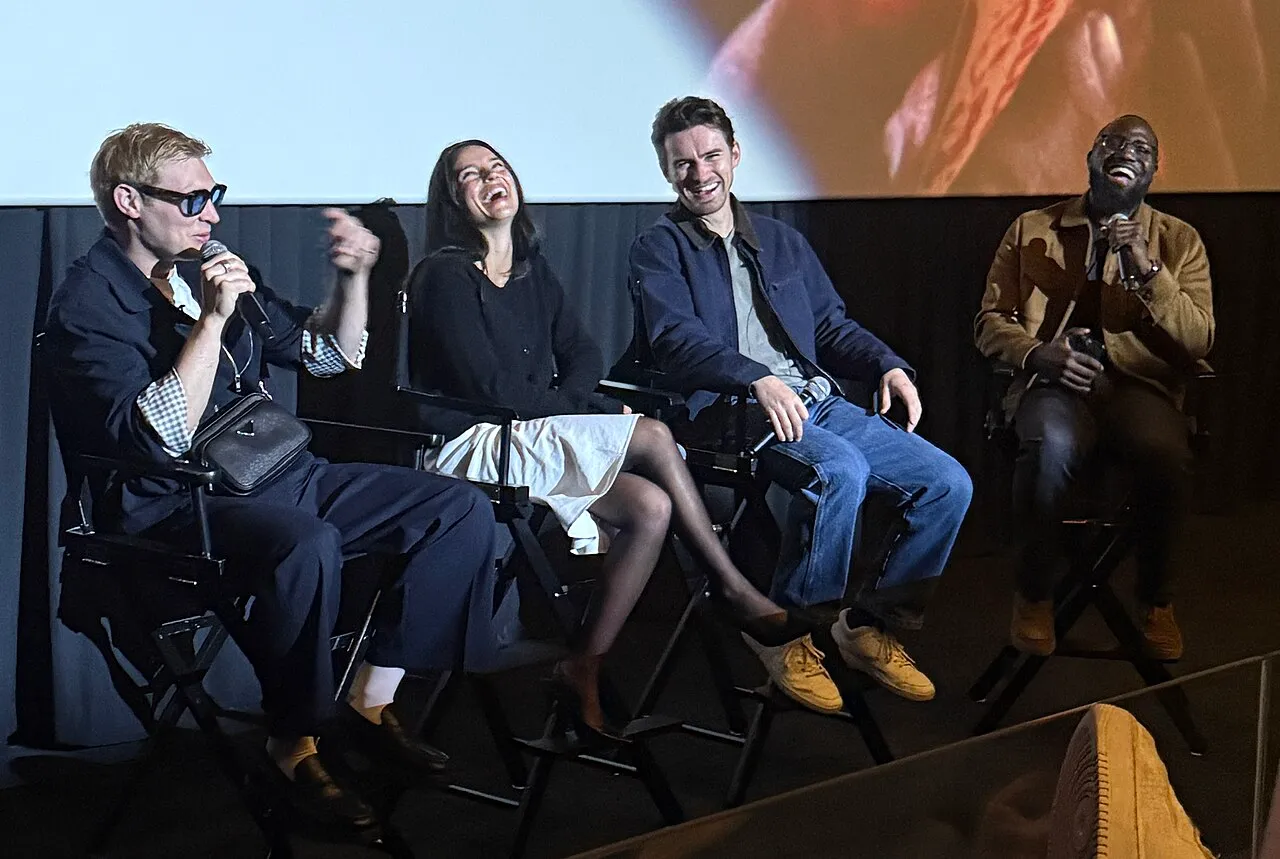
Public production-event context, not a fictional scene from the film.
How should casting news be distinguished from a completed performance?
A casting announcement identifies a planned or agreed role as reported at a particular time. It is not footage of the finished performance, a release date guarantee or proof of how a character will be interpreted. Keep the announcement separate from later production and release milestones.
Associated Press reported Navarrette's casting as Rogue in a forthcoming X-Men film in August 2026. That is dated casting context, not a claim that the film has already released or that this guide can review her performance in it. Avoid turning publicity about a future role into an invented description of completed scenes.
For an original timeline, record casting, production and release as separate events. A delay in one stage does not automatically erase the earlier announcement, but it can change what is appropriate to say now. An article should identify the stage instead of using the same vague word upcoming indefinitely.
What can an interview establish?
An interview can provide a person's stated account of an experience or process. Attribute it as that account rather than presenting it as independent access to every production decision. A short quotation can be informative, but selective editing and the interview's date still matter.
This article does not invent quotations from Navarrette or claim a conversation with her. The practical lesson is to separate a public statement from a viewer's interpretation. “The actor said” and “I noticed” can both be useful beginnings, but they introduce different kinds of evidence.
For an original exercise, imagine a fictional actor saying that a scene required repeated rehearsal. A viewer might still find the result spontaneous. Those statements are not necessarily contradictory: the process and the impression are different questions. Careful criticism can discuss both without assuming one invalidates the other.
Is a promotional description the same as a review?
No. A distributor's description introduces and promotes a work, while a review evaluates an identified viewing experience. Promotional language can help explain the intended premise, but it is not an independent verdict on quality. A review should say what the writer actually viewed and support judgements with specific examples.
For an original writing task, introduce a fictional short film in fifty words without rating it. Then write a separate response after reading its complete script. Notice how the evidence available to you changes. A preview should not pretend to know the ending's effectiveness, while a review should not rely entirely on the trailer's promises.
The same discipline applies to awards campaigns. A campaign, submission or prediction is not an award win. This guide does not turn attention around a performance into an unverified prize. Label each stage precisely, and use the awarding body's actual result for a claim about who won.
How can students discuss difficult themes responsibly?
Begin with the assignment's purpose and the audience's age and comfort. A class can study narrative agency, consent in fictional relationships or the difference between a character's wish and another person's autonomy without recreating disturbing scenes. Choose suitable material and allow a neutral alternative activity when needed.
An original non-graphic scenario might involve one student deciding a group project's plan without consulting the others. Ask who has a choice, whose preference is ignored and how the scene could show that clearly. The exercise addresses agency without equating a fictional classroom disagreement with the film's events.
Avoid diagnosing real people or treating a horror character as a medical explanation. Storytelling can raise ethical questions, but a screen role is not a clinical case study. Keep the discussion focused on the represented choices, their consequences and the evidence within the chosen material.
What belongs in a short performance review?
Identify the title and scope, describe one observable choice, explain its effect and acknowledge a limit or alternative reading. You do not need to declare a performer universally best or worst. A narrow, supported observation gives another reader more to consider than a paragraph of unsupported praise or insults.
Use an original template as a starting point, then replace its blanks with real observations: “During this exchange, the reply becomes quieter after the interruption. I read that change as hesitation, although the scene leaves another explanation possible.” The useful part is the relationship between evidence and interpretation, not the exact wording of the template.
If you have not watched the work, write an introduction to the credits or premise instead. There is no need to manufacture a review to make an article seem complete. Honest scope is part of professional writing, particularly when a topic is attracting searches and rumours move faster than verification.
What should you remember?
Navarrette's verified professional credits provide a starting point for exploring screen performance. Keep actor and character separate, distinguish casting news from a released role and identify whether a statement comes from promotion, an interview or your own observation. A still image and a trailer can support limited questions without replacing a complete viewing experience.
Explore more media-literacy guides for original classroom activities. You can practise timing, framing, reaction and interpretation with simple scenes you create yourself. The aim is to become a more attentive reader of images and performances, not to repeat publicity as though it were a personal review.
Keep a separate note for what a scene made you feel and what it actually showed. Both can belong in a review, but they answer different questions. A reader can disagree with your reaction while still checking your observation. That separation supports a thoughtful conversation instead of turning a personal response into an unsupported universal verdict.
For more original performance-observation activities, explore our Sonakshi Sinha screen-work guide.
Sources
- Focus Features: Obsession, for credited cast and the distributor's release listing.
- Focus Features: filmmaker introduction, for Barker's role and the broad Nikki premise.
- Capstone: Obsession production listing, for production credits.
- Associated Press: August 2026 casting report, for the limited future-role context. No completed X-Men performance or award win is claimed. All classroom scenes are original and non-graphic.
Image credits: cover: Kevin Payravi, source, CC BY-SA 4.0. Resized and converted to WebP. inline: Nguyk, source, CC BY-SA 4.0. Resized and converted to WebP.
Found an error or an outdated detail? Report a correction with the article URL and original source.