
Interest Rates Explained: Simple Interest, Compounding and Clear Comparisons
Learn simple and compound interest, percentage points, basis points and rate comparisons using fictional calculations with explicit assumptions.
An interest rate expresses interest relative to an amount of money and a period. The percentage is only the beginning of a comparison. The calculation method, timing, fees, repayment pattern and contractual conditions determine what the figure means. Two offers displaying the same percentage can therefore produce different cash flows.
This learning guide was reviewed on 6 November 2026. It uses invented amounts and rates to explain the arithmetic. It does not quote today's RBI policy rate, recommend a lender or determine anyone's legal entitlement. For a real financial product, read the current written terms and obtain appropriate advice about your own circumstances.
What information must accompany an interest rate?
At minimum, identify the principal, percentage, period and method of calculation. Principal is the amount used as the calculation base under the stated arrangement. A rate described per year should not be treated as a rate per month. The timing of payments or additions also needs to be clear.
Create a fictional note reading five percent on one thousand units. It is incomplete. Does five percent apply over one year or one month? Is interest calculated only on the original amount? Are there repayments during the period? Completing these fields turns an attractive percentage into an interpretable statement.
An original worksheet can use columns for amount, annual rate, term, compounding and charges. Leave a column marked unknown when information is missing. That is a better answer than selecting whichever offer has the smaller number before understanding the basis of the comparison.
How does simple interest work?
In a simple-interest exercise, interest is calculated on the specified original principal rather than repeatedly adding previous interest to the calculation base. With compatible units, the familiar formula is principal multiplied by rate multiplied by time. State whether the rate is written as a decimal or percentage before calculating.
For an invented principal of one thousand units at five percent per year over two years, use 1,000 multiplied by 0.05 multiplied by 2. The interest is one hundred units. Adding that to the original amount gives eleven hundred, assuming no intermediate payments, charges or other changes.
The example is intentionally narrow. It is not a quote for a deposit or loan, and it does not establish that any advertised product uses this method. The useful habit is identifying the calculation base and assumptions. A correct formula applied to the wrong contract still gives the wrong practical answer.
How does compounding change the calculation?
Compounding means interest added at one stage can enter the base used for a later stage under the stated arrangement. The compounding frequency and timing matter. An annual rate with annual compounding is a different mathematical description from the same stated nominal rate with more frequent compounding.
Use the same fictional one thousand units and five percent annual rate, compounded annually. After one year, the model gives 1,050. Applying five percent to that amount in the second year adds 52.50, producing 1,102.50 before any deductions. The 2.50 difference from the simple-interest example comes from the changed base.
Do not interpret that difference as a recommendation to choose a product. Real terms may include charges, taxes, withdrawal conditions or a different calculation method. The exercise teaches why the word compounding matters; it does not settle the suitability or risk of a financial arrangement.
Why must monthly and annual rates stay distinct?
A monthly percentage describes a different period from an annual percentage. Multiplying a monthly rate by twelve produces a simple nominal comparison, but it does not automatically reproduce a compounded annual outcome. The result depends on whether interest is added, paid out, repaid or otherwise treated during the year.
For an invented one percent monthly compounding model, the one-year factor is 1.01 raised to the twelfth power. This is approximately 1.1268, or a 12.68 percent increase under that model. Twelve percent and 12.68 percent arise from different calculations, not an arithmetic contradiction.
Use a calculator and retain sufficient precision until the final step. Rounding every month's result can produce a slightly different total. If an actual agreement specifies a rounding convention, that convention belongs in the calculation. A classroom approximation should identify itself rather than pretending to match a real account statement exactly.
What is the difference between percent and percentage points?
Percentage points measure the direct difference between two percentages. Relative percentage change compares that difference with the original value. Confusing them can make an interest-rate report sound much larger or smaller than the change it actually describes.
Suppose a fictional rate moves from four percent to five percent. It rises by one percentage point. Relative to the original four, the increase is twenty-five percent. Saying the rate rose one percent would not clearly express either of these intended comparisons and can mislead a reader.
An exercise can present three headlines and ask students to rewrite each precisely. Include the original rate, new rate and chosen comparison. This skill is useful beyond finance: examination pass percentages, inflation statistics and survey results also require a clear distinction between points and relative change.
What are basis points?
A basis point is one-hundredth of a percentage point. One hundred basis points equal one percentage point. The unit helps describe small changes in rates without repeatedly using long decimal expressions. It does not change the underlying arithmetic or establish the effect on a particular household.
In an invented example, a rate moves from 6.00 percent to 6.25 percent. The change is 0.25 percentage points, or twenty-five basis points. The relative increase in the rate itself is a separate calculation. Keep the units visible so readers can follow which comparison has been made.
Now ask whether a twenty-five-basis-point policy change guarantees an identical immediate change in every loan. It does not follow from the unit alone. The actual product's benchmark, reset arrangements and terms need to be examined. A small unit conversion should not become an unsupported claim about all financial contracts.
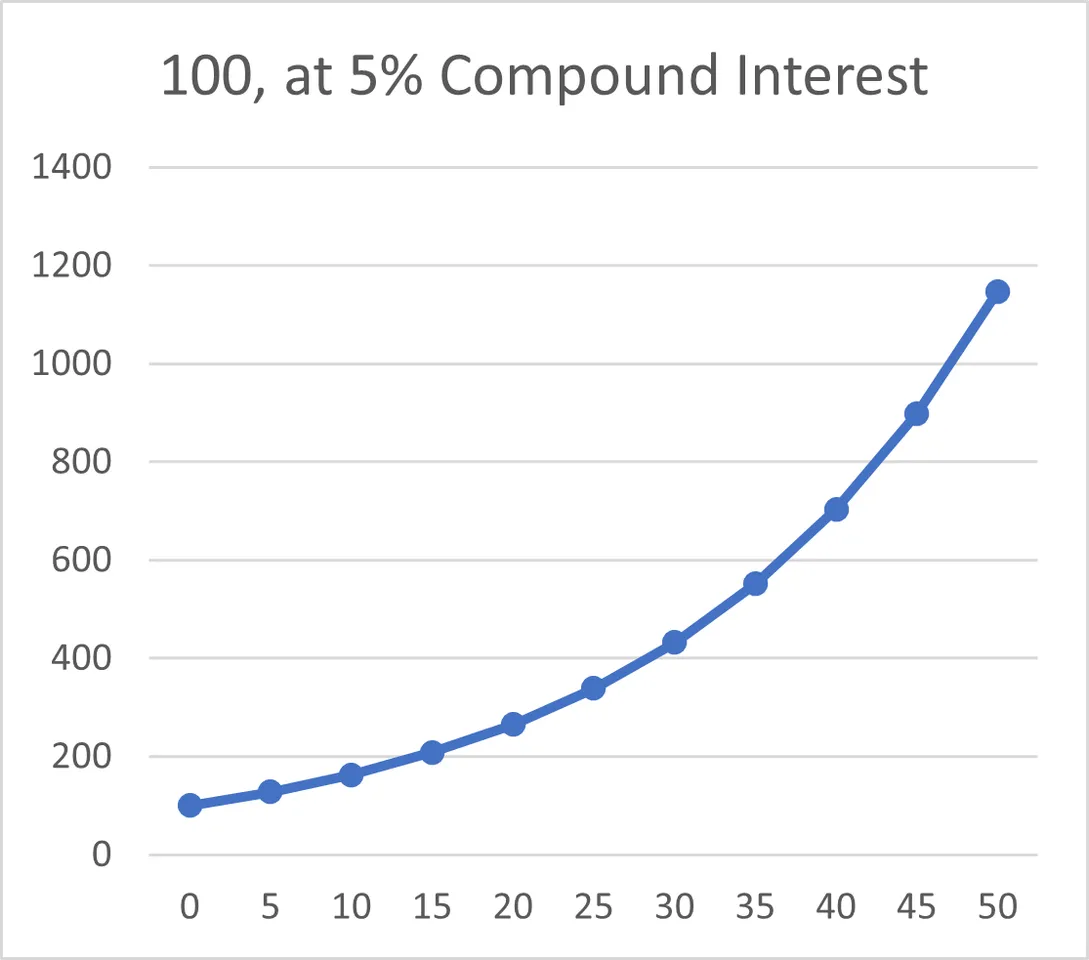
An illustrative chart of five-percent compounding on a starting amount of 100; it is a mathematical example, not a quoted financial product or forecast.
How do fixed and floating rates differ?
A fixed-rate arrangement and a floating-rate arrangement treat future rate changes differently according to their written terms. A floating rate can change through an applicable reference or reset mechanism. Read the agreement's duration and conditions rather than assuming the everyday meaning of fixed answers every question.
RBI's public information encourages borrowers to examine rates and reset conditions, while its floating-rate personal-loan guidance addresses particular regulated arrangements. Those documents should be read within their scope. They are not a reason to generalise that every borrower, country and product has identical options.
For a fictional comparison, write two short contracts. One keeps a stated rate for the exercise's complete term. The other resets at a specified date using an invented reference. Ask students what additional information is needed to calculate the second contract's later payments. The missing future reference cannot be supplied by guessing.
Is a policy rate the rate on every account?
A central-bank policy rate and a customer's deposit or loan rate describe different things. Policy can influence financial conditions, but the customer's actual arrangement has its own pricing, eligibility and terms. A news headline should not be copied directly into a personal repayment calculator as though it were the contract rate.
Our RBI functions guide explains the institutional distinction. In this lesson, separate the policy announcement date, any product-rate notice and the date a particular contract resets. These dates can answer different questions and should not be merged into a single claim that all rates changed immediately.
Make a timeline with three invented events. Label one a policy announcement, another a lender communication and a third a contractual reset. The exercise demonstrates why timing matters without asserting how a real institution will respond. Check current official communications before describing an actual change.
Why does the outstanding balance matter for borrowing?
Interest can be calculated against a balance that changes as repayments are made. A reducing-balance arrangement is therefore different from a classroom model that charges the same original amount throughout. The repayment schedule determines the balance on which later interest calculations are based.
Use a deliberately simplified two-period example. Start with one thousand units, calculate one period's interest under a stated rate, and then repay two hundred units of principal. For the second period, calculate using eight hundred if the model says the repayment reduces the principal immediately. State exactly when each payment occurs.
This example is not an EMI calculator. Real instalments can combine interest and principal through a defined schedule and include additional conditions. Its purpose is to show why multiplying the starting loan amount by the annual rate cannot by itself explain every later statement or payment.
How can fees change a comparison?
The interest percentage may not describe the complete cost of a borrowing arrangement or the net outcome of a saving arrangement. Application charges, service charges and other applicable terms can change cash flows. Compare documented amounts and timing rather than assuming that an identical interest rate means an identical total.
For a fictional exercise, two arrangements both charge fifty units of interest, but one also has a twenty-unit initial fee. Their stated interest amounts match while their total cash costs differ. A transparent worksheet lists the fee separately instead of hiding it inside a vague description of the cheaper option.
Do not assume which charges are permitted or applicable in a real case from this example. Ask for the relevant disclosure and read the current rules for the jurisdiction and product. The educational point is the comparison method: identify every cash flow before deciding that the headline percentage tells the whole story.
What is the distinction between nominal and real outcomes?
A nominal money increase and a purchasing-power increase are different concepts. Inflation affects what money can buy over a period. Comparing an interest outcome with a relevant price change can help explain that distinction, but an individual's actual consumption pattern and taxes introduce further questions.
In an invented one-year model, money grows by six percent while the comparison price basket grows by four percent. The purchasing-power factor is 1.06 divided by 1.04, approximately 1.0192. That is about 1.92 percent under the simplified model, rather than an exact two-percent result.
The example is a lesson in ratios, not a forecast or a promise of protection against inflation. State the chosen price measure and interval when discussing real historical data. A personal claim that a product beats inflation needs more evidence than comparing two percentages drawn from unrelated periods.
A complete worked comparison checklist
Start with two fictional offers and write every known input: initial amount, term, interest method, payment dates and charges. Use the same comparison date. Calculate cash flows under each offer's own rules before trying to rank the results. If an input is missing, mark the calculation incomplete.
Next, vary one assumption. For a floating-rate model, change the invented reset rate; for a savings model, change whether interest is withdrawn or retained. Explain why the result changes. This sensitivity exercise teaches that a single number can conceal dependence on future events or user choices.
Finally, write a plain-language explanation another learner can reproduce. Include the formula, units and assumptions, and keep invented examples clearly labelled. Students can explore fixed-deposit concepts separately or use study resources to practise percentages. Understanding the calculation is a foundation, not a substitute for reading a real agreement.
Questions learners often ask
Is a higher advertised rate always better? The rate alone cannot answer that. Product purpose, risk, access conditions, charges and timing matter. A mathematically larger outcome in a fictional model is not an endorsement of an actual provider or a recommendation for someone's savings.
Can a rate comparison ignore dates? No. The same percentage over different periods describes different outcomes. Record the start date, end date and any intermediate payment or reset date. A clear timeline often reveals a mistake before a calculator is needed.
Does this article provide today's official rates? No. It explains how rates work. Use current official policy publications and the provider's written product information for live figures, then check that the calculation method and conditions match the question being asked.
Sources
- RBI: public information on loans and rates
- RBI: floating-rate EMI-based personal-loan FAQs
- RBI: official website and current publications
Image credits: cover: Pittigrilli, source, CC0. Resized and converted to WebP. inline: Pbergerd, source, CC BY-SA 4.0. Resized and converted to WebP.
Found an error or an outdated detail? Report a correction with the article URL and original source.