
Jacob Duffy: Otago Pathway and Seam Bowling Explained
Meet Jacob Duffy and explore his Otago pathway, seam-bowling role and match figures, with worked examples of economy, average and strike rate.

Jacob Duffy is a New Zealand right-arm fast-medium bowler with a long domestic connection to Otago. His story is useful for readers interested in both cricket performance and the work behind an international career. A breakthrough is easier to understand when you examine the preparation, the bowling role and the evidence behind the headlines.
This guide explains Duffy's identity, how to read his bowling and how to compare performances fairly. It does not replace a live scorecard or announce a current team selection. For today's match, use the dated playing eleven and official innings record. For learning how seam bowling works, start with the delivery rather than the social-media reaction.
Who is Jacob Duffy?
The New Zealand Cricket archive identifies Jacob Andrew Duffy as born on 2 August 1994 in Lumsden, Southland. The ICC classifies him as a right-arm fast-medium bowler and records his international career beginning in 2020. Otago is the key domestic connection when distinguishing him from other New Zealand players.
His career also illustrates why international recognition need not arrive immediately after domestic selection. The player record contains different levels of cricket, and those levels should not be merged into one total. First-class wickets, List A wickets, domestic T20 wickets and international wickets refer to different competitions and match types.
A search for his name may return national-team reports, county cricket records or franchise references. Each can be relevant, but check the date and organization. A historical county signing does not establish his current contract, just as an international profile does not guarantee selection in the next fixture.
What does a fast-medium bowler actually try to do?
The simplest answer is to dismiss batters while controlling scoring, but the method matters. A seamer can threaten the stumps, draw an edge, use bounce to create an awkward contact or restrict the batter's strongest scoring areas. The appropriate plan changes with the ball, pitch, field and phase of the innings.
Pace is one part of that problem. A delivery can be difficult because it arrives quickly, but also because its line and movement force a late decision. A bowler who repeats a threatening line may create more uncertainty than one who bowls faster but gives the batter comfortable width.
For Duffy or any other seamer, ask what the batter is being made to decide. Can the ball safely be left? Is the batter reaching away from the body? Is the scoring area protected? Those questions describe the contest more accurately than treating the radar reading as the only evidence of bowling quality.
Why domestic experience matters
Domestic cricket exposes a bowler to repeated spells, different grounds and a range of batting styles. Experience is not simply the number of seasons completed. Its value lies in learning how to adapt when the first plan does not work and how to maintain control when conditions offer less help.
A bowler may learn to bowl into the wind at one ground, defend a short boundary at another or change a length on a slower surface. Those situations encourage practical judgment. They do not guarantee international success, but they give the player more experiences to draw on when pressure increases.
This is a useful lesson for students outside sport as well. Repetition becomes productive when feedback changes the next attempt. Practicing the same error without noticing it is different from practicing with a clear objective. Duffy's pathway provides a reason to look beyond the idea that a career consists only of instant breakthroughs.
Reading a bowling spell beyond wickets
Begin with the match format and phase. A new-ball spell is not identical to a spell against a settled batter at the end of a T20 innings. The bowler may be trying to take an early edge in one situation and prevent boundaries in the other. Both jobs can be important.
Next examine runs, legal deliveries, wickets and extras together. An economical spell can create pressure, but not every low-scoring passage is caused by exceptional bowling. The batter may be protecting a chase, conditions may be difficult or the target may be small. Context should explain the number, not disappear behind it.
Similarly, wickets can come from very different events. An accurate delivery that beats a defensive stroke differs from a mistimed attempt to clear the boundary in the final over. Both dismissals count. A fair assessment recognizes their different circumstances without pretending that one should be erased from the scorecard.
Three bowling measures with worked examples
Bowling average is runs conceded divided by wickets. Economy rate is runs conceded divided by overs, using legal balls correctly. Bowling strike rate is legal balls divided by wickets. These measures answer different questions, so they should not be used as interchangeable rankings.
| Fictional spell | Measure | Calculation |
|---|---|---|
| 4 overs, 24 runs, 2 wickets | Economy | 24 divided by 4 equals 6 |
| 4 overs, 24 runs, 2 wickets | Average for that spell | 24 divided by 2 equals 12 |
| 4 overs, 24 runs, 2 wickets | Strike rate | 24 legal balls divided by 2 equals 12 |
Now imagine another spell of four overs, sixteen runs and no wickets. It has a better economy rate, four, but no finite wickets-based average for that spell. Replacing the missing average with zero would falsely make the wicketless spell look perfect. Mark the measure unavailable rather than hiding the absence of a denominator.
These are arithmetic examples, not reported Duffy figures. They show why a reader needs more than one column. One spell may be more useful for controlling a chase; another may break a crucial partnership. The value depends on the team's problem and the opportunities the bowler creates.
Overs are not ordinary decimal numbers
The notation 3.2 means three overs and two legal deliveries. That is twenty legal balls. It does not mean 3.2 multiplied by six balls. This distinction becomes important when calculating economy rates from an incomplete spell or a chase completed partway through an over.
If a bowler concedes twenty runs from 3.2 overs, divide twenty by twenty legal balls and multiply by six. The economy rate is six runs per over. Dividing twenty by the displayed figure 3.2 gives a different and incorrect result.
Wides and no-balls add another reason to inspect the scorecard carefully. They can increase the delivery count shown in commentary without completing the expected number of legal balls. The recorded over remains governed by legal deliveries under the playing conditions, so count the right units before comparing rates.
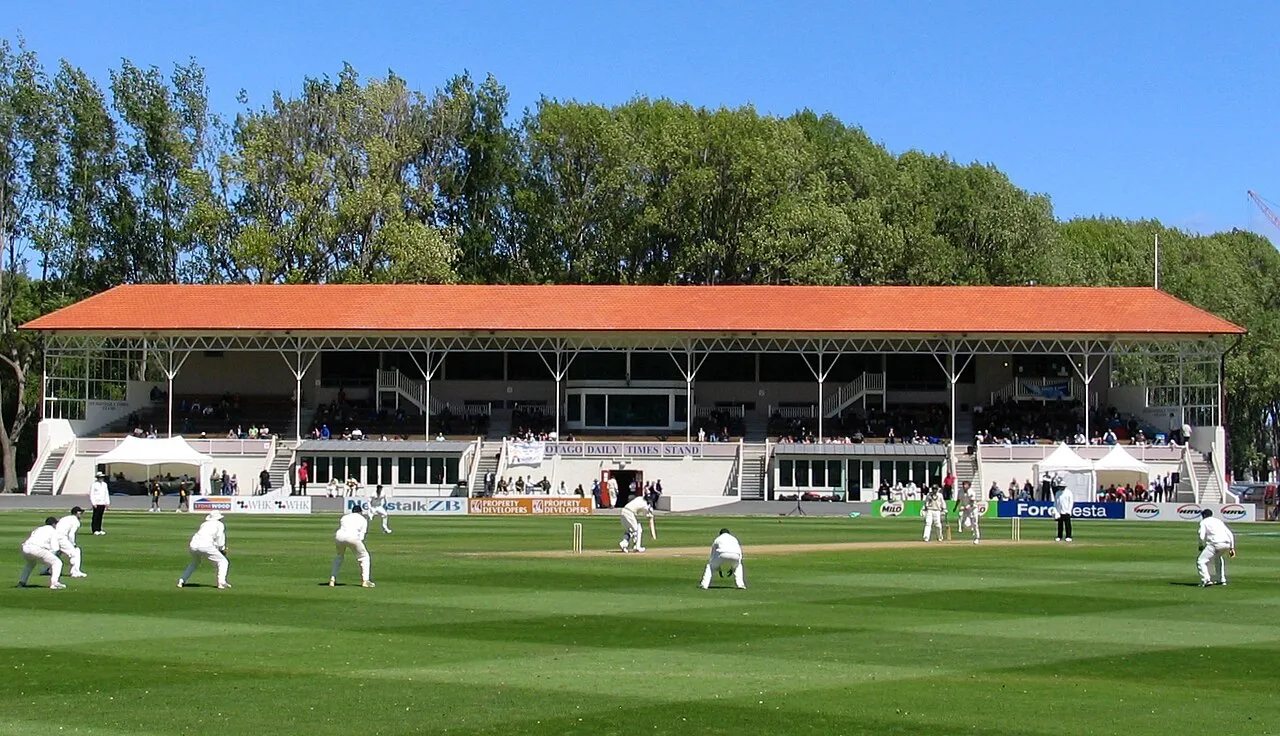
New Zealand and Pakistan at University Oval in Dunedin; historical venue image, not a live match report.
A practical new-ball example
Consider a fictional opening spell to a right-handed batter. The bowler begins with a line near off stump and enough length to make the batter consider a forward defense. Two deliveries hold their line. A third moves away after pitching. The batter must now decide whether a similar initial line will behave the same way.
If the bowler then releases a ball slightly fuller that comes back, the stumps may become relevant. But that plan works only if the delivery is controlled. A ball that drifts harmlessly down the leg side does not become clever because the bowler intended a surprise.
Watch the sequence rather than only the final ball. Was the batter's movement changing? Had the bowler established a repeated picture? Did the field support the intended mistake? Those observations help explain why an apparently ordinary delivery sometimes produces a wicket after several disciplined balls.
How white-ball roles can change within one innings
A bowler may start by attacking with the new ball, return in the middle overs to break a partnership and finish with a defensive field. The same player is solving three related but different problems. That is why one overall economy rate can conceal useful detail about the spell.
At the end of an innings, protecting a boundary can matter more than creating a picturesque delivery. Field placement and execution must work together. A wide line is ineffective if it becomes a wide extra; a yorker plan becomes expensive if the ball repeatedly turns into a hittable full toss.
Keep the batter's intention in view as well. A set player trying to clear every ball presents different opportunities from a new batter protecting the wicket. The bowler must adjust to that intent, not merely repeat a prewritten plan regardless of what is happening.
What rankings can and cannot establish
An ICC ranking summarizes performance within a particular system and format. It is not a permanent label or a guarantee that a player will outperform every opponent in the next match. Check the date and whether the ranking concerns Tests, ODIs or T20 internationals.
Avoid combining a current ranking with an old total and presenting both as if checked at the same moment. Sports records update frequently. A careful reader records the source, format and date together so the comparison can be understood later.
Rankings also differ from selection. A highly rated bowler can be rested or unavailable; an unranked or lower-ranked player can be selected for conditions or team balance. The official squad explains the selection decision more directly than a ranking table does.
A learning exercise for the next Duffy spell
Create a simple twelve-ball notebook. Record line, length, batter response, runs and any extras. Add a short note only when you can see movement clearly. Do not infer swing from a camera angle that does not show it reliably.
After two overs, calculate the number of legal balls without a scoring shot. Then separate excellent defensive bowling from balls the batter chose not to attack. That distinction requires observation, and it may remain uncertain. Writing that uncertainty down is better than manufacturing precision.
Choose one question for the next spell. Perhaps the bowler is changing position on the crease, or the batter is beginning to move across the stumps. Watch whether that pattern continues. Analysis becomes more useful when one observation leads to a testable next question instead of a sweeping verdict.
Frequently asked questions
Is Jacob Duffy a New Zealand player?
Yes. The ICC identifies him with New Zealand, while the NZC archive provides his Southland birthplace and Otago domestic record. Those sources establish identity. The current playing eleven must still be checked for any particular match.
Are domestic wickets included in international totals?
Not as one interchangeable category. Different record types have different competition boundaries. A profile may display several tables, so read the table heading before quoting a total. Combining first-class and Test wickets without explaining the overlap would be especially misleading.
Does a wicketless spell mean the bowler failed?
Not automatically. Consider runs conceded, chances created, fielding outcomes and the match situation. However, pressure should be described through visible evidence rather than used as a vague defense for any performance. A balanced review can acknowledge both control and missed opportunities.
Can I find today's score from a career profile?
A career profile may link to recent matches, but it is not itself proof of a live score. Open the dated fixture, confirm the innings and check whether play is ongoing or complete. Do not share a historical best performance as today's bowling figures.
Test the comparison before trusting it
Suppose one bowler takes two wickets in twenty-four legal balls and another takes two in thirty-six. Their bowling strike rates are twelve and eighteen respectively. That calculation is straightforward, but it does not establish who bowled better overall. You still need runs conceded, conditions, opposition and the phase of play. The useful conclusion is narrow: the first bowler took wickets more frequently in those particular samples. Extending that statement into a permanent ranking of their ability would require much more evidence than two spells provide.
Continue with the wider match context
Read our India and New Zealand scorecard guide to connect individual performances with a team innings. Explore the study directory for structured learning resources. Good cricket analysis and good study share a useful habit: check the units, understand the context and explain how the evidence supports the conclusion.
Sources
Image credits: cover: Dave Morton, source, Public domain. Resized and converted to WebP. inline: Benchill, source, CC BY-SA 3.0. Resized and converted to WebP.
Found an error or an outdated detail? Report a correction with the article URL and original source.