
Jensen Huang: NVIDIA Founder and GPU Computing Explained
Learn who Jensen Huang is and why NVIDIA connects gaming, GPUs and AI. Clear examples explain parallel work, CUDA and how to read performance claims.
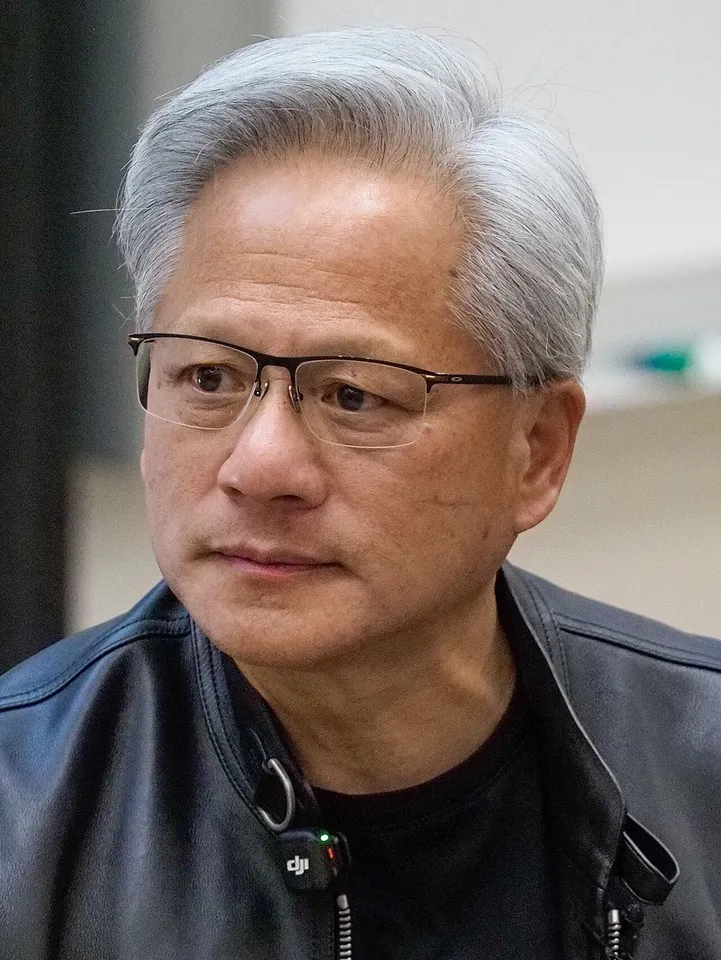
Jensen Huang is NVIDIA's co-founder, president and chief executive officer, according to the company's leadership page checked on 1 November 2026. His name appears frequently in discussions of graphics cards, artificial intelligence and accelerated computing. Understanding the connection is more useful than memorizing a billionaire ranking: it explains why software developers care about hardware designed to perform many related calculations.
This profile combines a short verified career outline with an introductory computing explanation for students. It does not quote a live share price, estimate personal wealth or present a prediction about an unannounced product as news.
Who is Jensen Huang?
NVIDIA's official biography identifies Huang as a founder who has led the company since its establishment in 1993. It records previous work at AMD and LSI Logic and electrical-engineering degrees from Oregon State University and Stanford University. These details describe a career combining engineering and company leadership; they do not make him the individual author of every NVIDIA product.
That distinction is worth remembering whenever a technology story concentrates on one recognizable executive. Hardware development also involves architecture, software tools, manufacturing relationships, testing and many other roles. A leader can shape priorities without personally designing every circuit or writing every software component.
Why does his name connect gaming and artificial intelligence?
The Computer History Museum's profile describes NVIDIA's development from graphics technology into wider accelerated computing. It highlights the 1999 GeForce 256, the introduction of CUDA in 2006 and the use of GPUs in the 2012 AlexNet milestone. These are historical reference points, not evidence that gaming and every AI task are identical workloads.
The connection is a computing idea: some tasks contain many operations that can be performed independently or in coordinated groups. Graphics processing offered an important setting for building hardware around that kind of work. General-purpose software tools then made it more practical for developers to express other suitable computations on GPU hardware.
What does a GPU do in plain language?
A graphics processing unit is a processor designed around particular kinds of parallel work. A central processing unit and a GPU are not interchangeable labels for a fast chip. A useful system assigns work according to its structure rather than assuming the device with the most impressive marketing number must do everything.
Consider a classroom exercise: twenty students each calculate the square of a different number. Those twenty calculations can be distributed because no student needs another student's answer first. The teacher still has to distribute the work, collect the answers and deal with mistakes. The example illustrates parallel organization, not an exact description of a particular GPU's internal architecture.
Now compare that with a chain in which each new calculation requires the previous result. Dividing the chain among more people does not automatically remove that dependency. The lesson is that available parallelism depends on the task, not simply on how many workers you can name.
What is accelerated computing?
In practical terms, acceleration means assigning suitable work to hardware that can perform it effectively as part of a wider system. The rest of the program does not disappear. Reading input, organizing data, making control decisions and presenting output still require a coherent application.
An introductory programming example makes the distinction clear. A program might read a list of values, transform each value and then print a summary. The independent transformation may offer parallel work, while the input and output have different costs. Optimizing one part does not necessarily make every other part faster.
For that reason, performance claims need a named workload and a measurement method. “Faster” is incomplete unless you know what was calculated, which hardware and software were used, and whether the measurement included data movement and setup. A headline percentage without that context is difficult to apply to your own project.
What does CUDA add beyond a physical graphics card?
CUDA is part of NVIDIA's approach to making compatible GPUs usable for broader computation. The museum's historical account describes it as a programming platform and model. The important beginner distinction is between owning hardware and having a software route that can actually use its capabilities.
Installing a graphics card does not automatically transform every existing script into a GPU program. The code, libraries, device support and workload have to fit together. Conversely, a user of a high-level framework may benefit from GPU-backed operations without directly writing every low-level calculation.
Think of a well-equipped workshop. Tools are useful only if there is a process for selecting, operating and maintaining them. In software, that process includes interfaces, libraries and development practices. Hardware capability and developer usability are related parts of the same system rather than competing explanations.
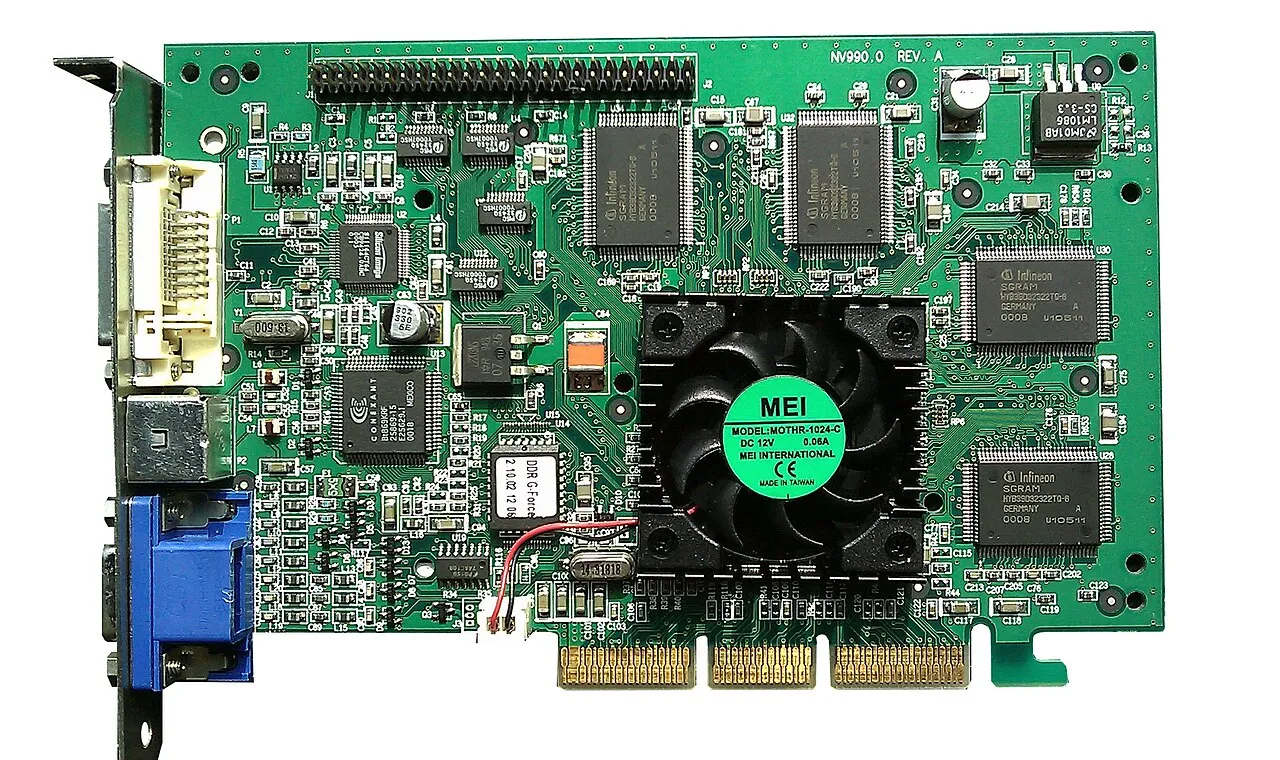
A historical GeForce 256 graphics card. This is not a photograph of a current AI accelerator.
Why are matrices often discussed alongside AI hardware?
Many numerical methods organize values into arrays or matrices. A matrix is a rectangular arrangement of numbers, not an AI model by itself. Understanding the underlying arithmetic helps students read technical explanations without treating every mathematical object as mysterious machine intelligence.
For example, take one row containing 2 and 3 and one column containing 4 and 5. Their dot product is 2 × 4 + 3 × 5 = 23. That is ordinary arithmetic. Larger computations repeat structured operations across many values, which is why the organization and movement of data become important.
Do not infer a benchmark result from this tiny example. Real applications differ in size, precision, memory use and the balance between arithmetic and other work. The example's purpose is to show a building block, not to claim that a particular card will run an arbitrary AI project at a guaranteed speed.
Does every student need an expensive GPU to start learning?
No particular hardware purchase follows from this profile. A beginner can learn variables, conditions, loops, functions and basic data structures before making decisions about specialized compute. Understanding those ideas also makes later hardware discussions less confusing.
Start with a small, understandable program and identify what it does. If the program is slow, measure where the time goes before deciding that the solution must be a new device. A workload that spends its time waiting for a network request has a different bottleneck from one dominated by numerical computation.
Our Python course is a suitable place to learn those foundations. The programming topic tests help check understanding. These are learning links, not promises that the website provides a remote GPU or unrestricted access to an AI-training server.
How should you read a Jensen Huang announcement or interview?
Separate three categories: a product that is available, a product that has been announced for a future date, and a wider vision about the industry. These statements can appear in the same presentation while requiring different evidence. An illustration of a future system should not be reported as a current retail specification.
Next identify who is making the claim. A company presentation can explain its own plans and published measurements, while an independent evaluation can test a particular product under stated conditions. Neither should be substituted for the other without telling the reader what changed.
For a dated news story, preserve the announcement date and the conditions attached to the statement. A clip reposted months later may look new in a social feed. The date of a repost does not necessarily identify the date of the original announcement.
What should a useful technology comparison contain?
| Comparison question | Information needed |
|---|---|
| Which system is being discussed? | Exact hardware and relevant software versions |
| What work is performed? | A clearly named task and representative input |
| What is measured? | Time, throughput, memory or another defined metric |
| Is setup included? | A statement about preparation and transfer costs |
| Can the result be reproduced? | Enough method detail to repeat the comparison |
| Is the conclusion limited? | Clear boundaries on what the test does not establish |
These questions are useful beyond NVIDIA. They help students distinguish a technical explanation from an advertisement, an experiment from an anecdote, and a current result from a prediction. They also prevent a biography from turning into an unsupported product recommendation.
What is the main lesson from Huang's career for a computing student?
The verified historical outline shows the importance of connecting hardware capability with software that people can use. A student does not need to copy an executive's personal path to learn from that relationship. Build a foundation, test ideas on small examples and learn to explain what a program actually does.
Begin with one manageable exercise: write a function that transforms each number in a list, then explain which calculations depend on one another. You have started reasoning about task structure. That habit is more durable than memorizing an unverified ranking, a changing wealth estimate or a slogan about the next generation of AI.
Sources
Leadership information checked 1 November 2026. The arithmetic and classroom examples are original teaching illustrations, not hardware benchmarks or investment advice.
Image credits: cover: Anderseidesvik, source, CC BY-SA 4.0. Resized and converted to WebP. inline: Hyins, source, Public domain. Resized and converted to WebP.
Found an error or an outdated detail? Report a correction with the article URL and original source.