
Jonas Brothers: Members, Albums and a Beginner Listening Guide
Start with verified members and selected releases, then use original listening exercises to understand rhythm, arrangement, credits and catalogue labels.

The Jonas Brothers are Kevin, Joe and Nick Jonas. If you are exploring their music for the first time, start by separating the band's releases from its members' individual projects. A familiar surname on a song does not necessarily mean it is a Jonas Brothers recording, and a tour announcement is not the same thing as a new album.
This guide provides verified release reference points and original listening exercises for beginners. It does not reproduce lyrics, claim to have attended a concert or rank recordings through invented first-hand reviews. The source checks were made on 1 November 2026.
Which albums provide a useful starting route?
Three clear reference points are Happiness Begins from 2019, The Album from 2023 and Greetings From Your Hometown from 2025. The last of these was released through Republic Records on 8 August 2025. This is a selected route into the catalogue, not a claim that the band has made only three albums or that these are its only important releases.
| Release | Year | Useful question for a new listener |
|---|---|---|
| Happiness Begins | 2019 | How does the opening of a track establish its identity? |
| The Album | 2023 | What changes between a verse and a chorus? |
| Greetings From Your Hometown | 2025 | How do credits and collaborations help identify a recording? |
The questions are suggested activities, not conclusions about a particular track's sound. Listen first, identify an example and describe what you actually hear. You may notice different things from another listener, and that difference can make a discussion useful rather than wrong.
Do not confuse this route with an exhaustive chronology. A compilation, soundtrack, studio album and live release can all appear in a music catalogue. Their presence in a list does not make them the same kind of record. Check the release type before counting a band's studio albums yourself.
What does the 2025 album announcement establish?
The label announcement identifies Greetings From Your Hometown as a studio album and describes collaborations with Dean Lewis, Switchfoot and Marshmello. It places the release within the band's twentieth-anniversary period. Those are dated release details, not proof that a particular 2025 concert or stream is available to every reader today.
Keep the tense attached to the date. An announcement saying a tour will start that Sunday is referring to the Sunday in its own publication context. Reading it in November 2026 does not move that event into the coming weekend. This is a simple but important habit when search results surface older promotional pages.
The same rule applies to streaming and tickets. A historical broadcast partnership or sale link does not establish current access in Pakistan. Open the current official event or service listing if you are making a present-day viewing or purchase decision.
A release announcement can help verify names, dates and credits. Its promotional praise is a different kind of information. You do not need to repeat every adjective to explain what the record is, and you should not present publicity language as an independently measured audience verdict.
Band, solo artist and featured guest are separate labels
A band's name identifies the main act credited on a release. A member's solo recording belongs to that member's individual catalogue. A featured credit identifies another contribution to a particular track. These categories can overlap in a live show without becoming interchangeable in a discography.
Use a fictional example: a trio called North Window releases an album, its singer separately releases a solo single, and the trio later features a guest musician on one album track. You would create three different credit records. Placing everything under one undifferentiated artist field would make the catalogue harder to understand.
When checking an actual recording, read the displayed artist credit and the official release page. Do not decide from an unofficial video's thumbnail alone. A fan-made title may omit the guest, describe a solo track as a band song or attach a popular name to a cover version.
The exercise is not about making listening complicated. It helps you find the recording you intended, recognise contributors correctly and avoid carrying an incorrect credit into a school presentation or shared playlist.
First listening pass: follow the pulse
Choose one officially released recording and listen at a comfortable volume. In the first pass, focus on the steady pulse rather than trying to analyse every instrument. Tap gently if it helps you keep track, and notice whether you can maintain the same pulse through a change of section.
Do not assume a louder section must be faster. Loudness, density and tempo are different qualities. A chorus can feel more energetic because more instruments enter even when the underlying pace remains unchanged. Your task is to notice a change and describe which quality appears to change.
For a safe original exercise, use only your own claps or taps. Make two patterns at the same pace: one sparse and one busier. Compare how they feel. You have changed the number of sounds without necessarily changing the pulse, which helps explain why "more energetic" needs a more specific description.
If you cannot identify a stable pulse in the chosen passage, record that uncertainty. Do not invent a beats-per-minute value simply because a worksheet has an empty box. You can return with a more suitable tool or choose another clear passage for the beginner exercise.
Second listening pass: compare sections
On the second pass, mark where you hear a section return. You do not need to transcribe lyrics to notice repetition. Listen for a familiar melody, instrumental pattern or arrangement returning, and note the approximate timestamp so you can revisit the passage.
Then ask what changes at the transition. Does the number of audible layers increase? Does a vocal texture become fuller? Does the instrumental pattern alter? These are prompts for observation, not pre-written answers that every song must satisfy.
A simple notebook can use three columns: section label, timestamp and observed change. If you are not sure whether a section is a pre-chorus or a bridge, use a neutral label such as Section A or Section B first. The observation is more valuable than forcing terminology you have not yet established.
Compare notes with a friend. If one person hears a new section and another hears a variation, replay the passage and explain the evidence. The goal is to improve the description, not win an argument by using the most technical word.
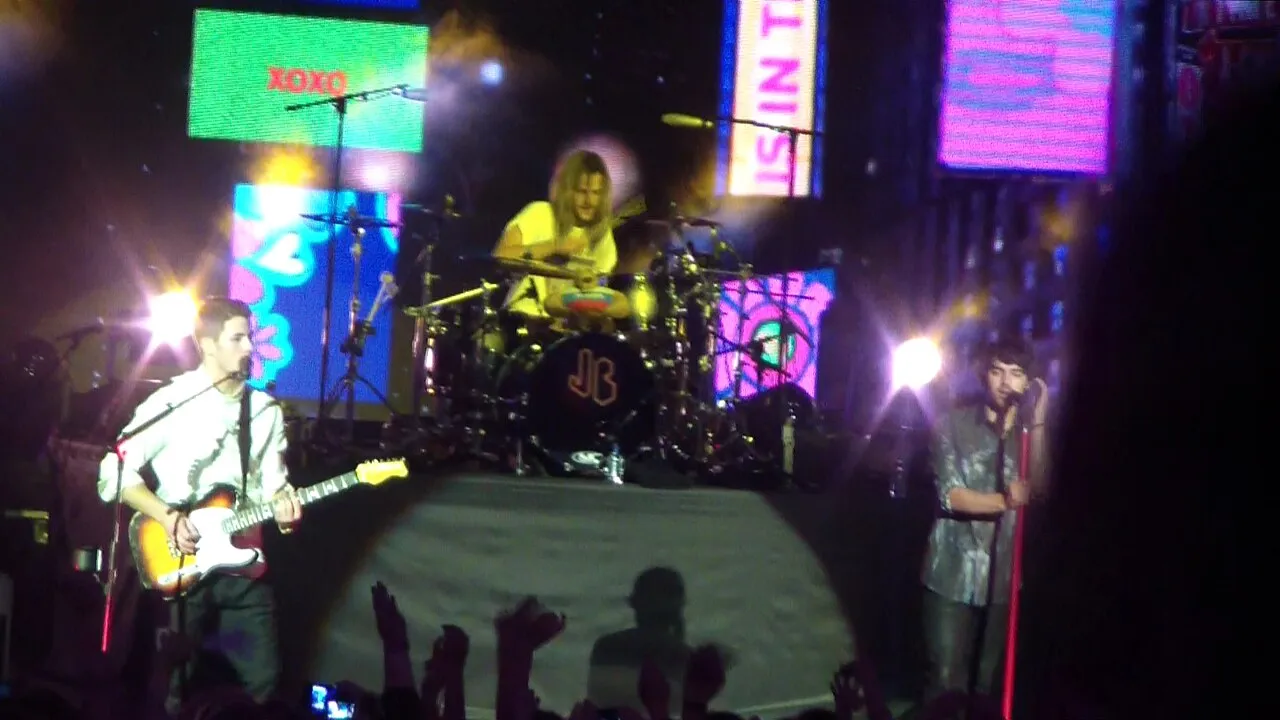
Historical 2012 photograph of Jonas Brothers in Moscow. It is not a photograph of the 2025 album tour or a newly announced event.
Third listening pass: distinguish melody and arrangement
Melody is not the same thing as every sound heard around it. A recording can preserve a familiar melodic idea while changing instrumentation or vocal layers. Conversely, similar instruments do not prove two pieces have the same melody. Listen to one feature at a time before drawing a comparison.
Try humming a brief pattern you create yourself and then repeat it while tapping a rhythm. The melodic pattern can remain the same while its surrounding texture changes. This original activity teaches the distinction without copying a recorded song or reproducing protected lyrics.
For the selected recording, describe a voice or instrument only when you can identify it with reasonable confidence. "A bright repeated sound enters" is an honest beginner observation. Naming a specific instrument with certainty when you cannot recognise it does not improve the analysis.
Credits can answer some questions that listening alone cannot. A producer, writer or performer credit tells you who is credited for a role, but it does not reveal every private studio decision. Preserve that limit instead of inventing a story about who demanded a particular sound.
How should you compare a studio track with a live version?
First establish that both recordings are correctly identified. A live performance needs a date or event context if you plan to describe it historically. A video labelled "live" by an unknown uploader is not automatically an authorised document of the event claimed in its title.
Once the identities are clear, compare the same passage. Note differences in length, audience sound, instrumentation or vocal delivery that you can actually hear. Do not call every difference an error. A live arrangement may deliberately change a transition or extend an instrumental section.
Equally, do not infer technical details that are unavailable from the recording. A compressed online clip cannot tell you everything about the room, mixing decisions or what a performer heard on stage. A careful comparison states the recording being examined and the limits of that evidence.
The historical photographs on this page provide visual context for the band. They are not audio evidence of a specific version, proof of a current tour lineup or photographs from an unannounced 2026 event. Image dates matter just as recording dates do.
Make a playlist that teaches you something
Choose a small set rather than adding every recommended track at once. Give each choice a reason: an earlier release to establish context, a later release to compare arrangement, or a collaboration to examine credits. A short purposeful playlist is easier to discuss than a large list played without attention.
After listening, write two sentences per track. The first describes one observed feature. The second explains your response to it. "I enjoyed the repeated instrumental pattern" makes a personal preference clear without pretending it is an objective score awarded to the musician.
You can keep a separate column for public facts such as release year or credited artist. Do not mix your own rating with an external chart position or award. Each needs a different label and, for the external claim, a reliable source.
For readers who also enjoy film, our Janhvi Kapoor viewing guide uses a similar approach to separate verified credits from personal observation. The method is shared, while the evidence comes from a different medium.
Turn the listening notebook into a small coding project
Students can build a local catalogue with fields for title, artist credit, release year, release type, source and personal notes. Use fictional records while testing the interface, then add verified public metadata if you decide to make a real personal catalogue.
Here is an original JavaScript example using an imaginary act. It filters release types without claiming a soundtrack or live album is a studio album:
const releases = [
  { title: 'Morning Window', type: 'studio', year: 2024 },
  { title: 'At the Hall', type: 'live', year: 2025 },
  { title: 'Second Street', type: 'studio', year: 2026 },
];

const studioTitles = releases
  .filter(release => release.type === 'studio')
  .map(release => release.title);

console.log(studioTitles.length); // 2 fictional studio releases
The code demonstrates classification, not a complete discography service. Its result is only as reliable as the records supplied. If a release has an unknown type, keep that uncertainty rather than automatically counting it in whichever category makes a headline more impressive.
Our programming courses cover the arrays and functions behind a project like this. You do not need to copy audio files into the project. Metadata and your own short observations are enough to practise the structure without distributing someone else's recordings.
Common questions about the Jonas Brothers
Who are the three members?
Kevin, Joe and Nick Jonas are the members identified in the official label biography. Do not confuse the band's membership with every guest who may appear on a particular recording or tour date.
Is Greetings From Your Hometown a 2026 release?
The album discussed here was released on 8 August 2025. This guide does not redate it because it is being read later, nor does it claim that an older release announcement establishes the band's latest activity on every future date.
Are the exercises reviews of specific songs?
No. They are original prompts for readers to use while listening. A useful answer identifies an actual passage and describes it. The prompts do not claim every track has the same structure, instrument or production technique.
Can I use an old tour list to buy for a new event?
Check the current official event and authorised ticket route. A past announcement supplies historical context but does not confirm a new date, price or remaining seat. This article does not offer a ticket or claim to verify a seller.
Why are no lyrics reproduced here?
The listening activities focus on structure, rhythm, credits and your own observations. They do not need a lyric transcript to be useful. Use authorised services for recordings and any lyrics those services are permitted to display.
Sources
- Official Jonas Brothers website
- Official label release announcement, 8 August 2025
- Official label music catalogue
Image credits: cover: Erik Drost, source, CC BY 2.0. Resized and converted to WebP. inline: Максим Макс Захаров, source, CC BY-SA 3.0. Resized and converted to WebP.
Found an error or an outdated detail? Report a correction with the article URL and original source.