
Jude Bellingham: Career Path, Midfield Movement and Football Statistics
Follow Jude Bellingham’s career path and midfield role. Learn how movement, chance creation and minutes-based statistics explain performances.

Jude Bellingham's route from Birmingham City through Borussia Dortmund to Real Madrid is a clear example of development across different football environments. He joined Madrid in 2023 and was named the 2023/24 UEFA Champions League Young Player of the Season. Those milestones provide a starting point for understanding his career, but a good profile should also explain what a midfielder contributes beyond one goal total.
This guide follows official club and competition records. It distinguishes Jude from his brother Jobe, separates historical achievements from live statistics and explains movement, match roles and football data through clearly labelled examples. It does not invent a current transfer, an injury update or a new match result.
Jude and Jobe are different players
The shared surname does not make Jude Bellingham and Jobe Bellingham the same footballer. A search result, photograph or club profile needs the full name and the relevant career context. Using one brother's club history or appearance count for the other would create a misleading biography.
For Jude, the official record identifies Birmingham City before Borussia Dortmund and then Real Madrid. Dortmund's transfer announcement describes his arrival in 2020 and departure for Madrid in 2023. These are dated career stages rather than a claim that all his appearances came at one club.
| Career stage | Historical context |
|---|---|
| Birmingham City | Earlier senior development |
| Borussia Dortmund | 2020-2023 |
| Real Madrid | Joined in 2023 |
| Champions League young-player award | 2023/24 season |
| International context | England national team |
A development pathway is not one uninterrupted role
A player can move through clubs with different teammates, coaching approaches and competitive demands. The same position label does not prove that the exact task remained unchanged. Career development is better understood as a sequence of environments and responsibilities.
For a fictional midfielder, one team asks for deeper involvement in building attacks while another uses the player closer to the opposition penalty area. Different scoring totals could follow without implying that one version of the player suddenly stopped contributing in other ways.
When reading Bellingham's career, preserve the club and season around a statistic. A number from Dortmund and a number from Madrid can be compared, but the interpretation should consider the role and opportunities described by the actual match evidence.
The 2023 move needs its own date
Real Madrid and Dortmund both published announcements about Bellingham's move in 2023. A current profile may list the career sequence, while the original announcement establishes the transfer event. The two source types complement each other.
A transfer announcement is different from a first appearance, a first goal or the end of a season. Those milestones should not be collapsed into one date simply because they occurred during the same summer or campaign.
For a timeline exercise, create separate rows for agreement, arrival and playing milestones where sources establish them. If one date is unavailable, leave it unfilled. A complete-looking timeline is not worth an invented event attached to the wrong day.
Midfield labels describe a starting framework
Terms such as central midfielder and attacking midfielder help describe a player's area and responsibilities, but they do not capture every movement during a match. Football is dynamic, and a player's position can change as the team gains or loses possession.
Imagine a fictional midfielder beginning behind the forwards and later moving into the penalty area. The starting position and the destination describe different moments. A still image of either moment cannot independently establish the player's entire role for ninety minutes.
For an actual analysis, use a sequence of play and the relevant team context. A position label is a useful introduction, not permission to assume that every action must occur inside one fixed rectangle on a tactical diagram.
Timing a run can matter as much as starting near goal
A midfielder arriving into space can create a different problem for defenders than a player already standing there. The timing, surrounding movement and path of the ball all affect the opportunity. A goal total alone does not describe that process.
For a fictional sequence, a forward occupies a defender while a midfielder arrives behind the first action. The value of the second run depends on the space created and the pass available. The example illustrates a football principle rather than reconstructing an undocumented Bellingham goal.
When studying a verified clip, note the player's starting location, the movement of teammates and the moment of arrival. This produces a more useful explanation than attaching a broad adjective to the final shot without examining how the chance developed.
Goals and chance creation answer different questions
A scorer finishes an action, while other players may contribute through passes, movement and earlier decisions. Goals and assists record particular outcomes under their definitions. They do not include every action that helped create the opportunity.
In a fictional attack, a midfielder moves a defender away, another player makes the final pass and a forward scores. The first player's work may matter even without a goal or assist. That does not justify inventing an official statistical credit; it calls for a separate qualitative explanation.
For Bellingham, read recorded statistics alongside match context. A clear profile can describe both measurable outcomes and observable contributions while keeping the two forms of evidence distinct.
A season award is not the same as every award
UEFA named Bellingham the Champions League Young Player of the Season for 2023/24. The category and season are essential parts of that achievement. Dropping the young-player qualification would change the claim rather than simply shorten it.
An award for a competition season, an individual match and a calendar year can have different eligibility and assessment contexts. Their names should remain attached when comparing honours. A trophy photograph alone may not establish which specific award is being discussed.
For a student catalogue, record awarding body, competition, category and season in separate fields. That makes it possible to celebrate the actual recognition without accidentally upgrading it into a different honour that the source did not announce.
Club football and international football need separate totals
Real Madrid appearances and England appearances belong to different teams and competition structures. A club-season total should not be described as the player's full international record. A combined figure requires a clearly defined scope.
For an invented example, a player scores ten club goals and two national-team goals during a stated period. A total of twelve is meaningful only if the period and inclusion rules are stated. It cannot be labelled as twelve league goals.
When checking a current statistic, identify the team, season, competition and update date. This is especially important for players whose profile pages display several tabs or competitions using similar-looking tables.
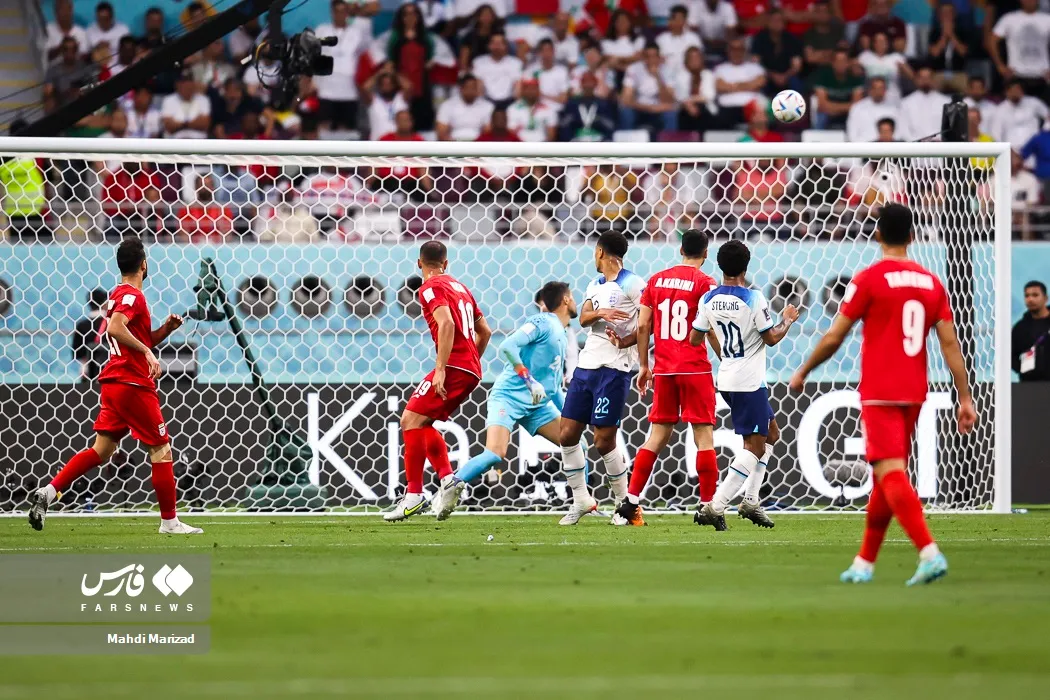
England’s match against Iran at the 2022 World Cup, shown as dated international football context rather than a current match report.
Appearances and minutes are different opportunities
Two players can have the same number of appearances while playing different numbers of minutes. A short substitute appearance and a full match both contribute to an appearance count, but they offer different playing time.
For a fictional comparison, one player has 900 minutes across ten appearances and another has 300 across ten. Their appearance counts match, while their minutes do not. A scoring comparison that ignores that distinction can obscure the opportunity behind the totals.
A per-90 calculation can help express an outcome relative to minutes, but it does not remove every contextual difference. It should be labelled and interpreted alongside the sample size rather than presented as an automatic ranking of overall quality.
A per-90 rate needs its formula
For a count measured over playing time, a simple per-90 rate multiplies the count by 90 and divides by minutes. The inputs must cover the same competition and period. Combining goals from one scope with minutes from another produces an invalid rate.
In an invented example, three goals in 450 minutes produce 0.6 goals per 90. Three goals in 180 minutes produce 1.5. The second rate comes from a smaller sample and should not automatically be projected across a full season.
Use actual official data when applying the method to Bellingham. The fictional calculation teaches the relationship and its limitations; it does not supply a current career rate or a forecast for the next match.
Defensive contribution can occur before a tackle
A midfielder can influence an opponent through positioning, closing a passing route or supporting teammates. A recorded tackle is one observable outcome, not the whole defensive story. Some useful work changes the opponent's choice before a direct challenge occurs.
For a fictional sequence, a midfielder occupies a central passing lane and the opponent recycles the ball sideways. The action may matter to the team structure, but it should not be counted as a tackle that never happened.
This illustrates the relationship between observation and statistics. A careful explanation can identify the movement seen in a clip while avoiding an invented data label. Both forms of analysis become clearer when their boundaries are explicit.
Transitions change the immediate task
The moments after possession changes can ask different things of a midfielder from settled attacking play. The next action may involve offering a passing option, moving into space or helping the team recover its shape. The relevant match sequence determines the interpretation.
For an invented example, a player who was supporting an attack must react when the ball is lost. A still image taken before the loss cannot establish whether the later reaction was effective. The sequence and timing need to be watched.
When studying Bellingham, avoid turning one isolated frame into a claim about effort or attitude. Describe the visible action and the match context. Private motives and fitness conclusions require evidence beyond a single football image.
A highlight clip is a selected sample
Highlights emphasise moments chosen for presentation. They can show excellent skill while omitting long periods of ordinary involvement. A compilation is therefore not equivalent to a complete-match record or a neutral sample of every touch.
For a classroom exercise, compare a short highlight list with a fuller event log from a fictional game. Ask which actions are represented and which are missing. The goal is not to dismiss highlights but to understand what the format can and cannot establish.
This habit helps readers enjoy a notable Bellingham moment without treating it as proof of every claim about an entire season. A specific clip supports a specific observation; broader conclusions need broader evidence.
Photographs should identify the occasion
An awards portrait and a match-action photograph provide different kinds of context. A red-carpet image can identify the player without showing a new football performance. Its caption should say which occasion it represents rather than attach it to an unrelated result.
For a public profile, retain the creator, source and known date with each image. Avoid using a photograph of Jobe for Jude or an older Dortmund image as evidence of a newly announced Madrid event.
Accurate captions are part of the article's factual record. They make historical images useful while preventing the visual material from implying a current claim that the text and sources do not support.
Build a midfield observation worksheet
Choose a verified sequence and record competition, date, player identity and the start and end of the action. Note the position, movement, passing options and outcome. Keep the observed action separate from a statistical label that requires an official definition.
Next, compare the qualitative description with a small set of matching statistics. Ask what each measure captures and what it leaves outside the calculation. This creates a fuller understanding than either a list of goals or a paragraph of unsupported praise alone.
Use class resources for ratios and evidence-based writing. A project in programming courses could build a player-statistics table that requires competition and season fields before allowing figures to be combined.
Questions about Jude Bellingham
Is Jude the same player as Jobe Bellingham?
No. They are different players. Use the full name, official profile and career context to identify the person in a statistic or image. A shared surname is not enough to transfer one brother's club history or appearances to the other.
When did he join Real Madrid?
The clubs announced the move in 2023, following his Dortmund period from 2020 to 2023. A transfer announcement, a first appearance and a season's final results are separate milestones, so each should retain its own date and source.
What Champions League award did he receive in 2023/24?
UEFA named him Young Player of the Season. The category matters and should remain in the description. It is different from a player-of-the-match honour or an award with a different competition, year or eligibility scope.
Do goals describe everything a midfielder contributes?
No. Goals record an important outcome, while movement, passing, defensive positioning and the surrounding team structure can require additional analysis. Use matching statistics and actual sequences of play, keeping observations separate from invented official credits or assumptions about private motives.
Sources
- Real Madrid: Bellingham's 2023 arrival
- Borussia Dortmund: Bellingham transfer record
- UEFA: 2023/24 Young Player of the Season
- UEFA: Bellingham career and competition context
Image credits: cover: Barcex, source, CC BY-SA 4.0. Resized and converted to WebP. inline: Fars Media Corporation, source, CC BY 4.0. Resized and converted to WebP.
Found an error or an outdated detail? Report a correction with the article URL and original source.