
Khilan Patel 84 Off 29: Gujarat vs Odisha T20 Result
Khilan Patel made 84 from 29 as Gujarat beat Odisha by 21 runs in the Syed Mushtaq Ali Trophy. Read the verified score and what it means.
Khilan Patel's 84 off 29: Gujarat vs Odisha T20 result explained
Khilan Patel scored 84 runs from 29 balls for Gujarat against Odisha in the Syed Mushtaq Ali Trophy Elite on 14 November 2026. The Board of Control for Cricket in India identifies him as player of the match. Gujarat finished on 250/9 from 20 overs; Odisha replied with 229/8 from 20 overs, giving Gujarat a 21-run victory at Eden Gardens in Kolkata. These are the essential, independently checkable facts behind the sudden search interest in his name.
An individual score is only part of the story. Patel's 84 occupied less than one quarter of the 120 legal balls available to a T20 innings, yet it represented more than one third of Gujarat's team total. Odisha's 229 would win many domestic T20 matches, but it was not enough against 250. This article explains the confirmed score, what can be calculated from it, and what the BCCI match page does not establish. It does not invent a ball-by-ball narrative or career biography from an incomplete public scorecard.
Match at a glance
| Detail | BCCI record |
|---|---|
| Competition | Syed Mushtaq Ali Trophy Elite 2026/27 |
| Fixture | Gujarat vs Odisha, Match 13 |
| Date | 14 November 2026 |
| Ground | Eden Gardens, Kolkata |
| Toss | Odisha won and chose to field |
| Gujarat | 250/9 in 20 overs |
| Odisha | 229/8 in 20 overs |
| Result | Gujarat won by 21 runs |
| Player of the match | Khilan Patel, 84 from 29 balls |
The BCCI match details page supplies the result, ground, toss and player-of-the-match entry. Its score summary supplies both innings totals. Readers should use that official match centre for corrections or a subsequently published full scorecard. A search snippet may omit wickets or overs, which can change the meaning of a result. For instance, 229 after 20 overs is a completed chase that fell short, not a live score with time remaining.
Why 84 from 29 balls drew attention
A score of 84 from 29 deliveries implies a batting strike rate of approximately 289.66 runs per 100 balls: 84 divided by 29, multiplied by 100. That is a calculation from the officially reported runs and balls, not a separate statistic supplied in the BCCI summary. It means Patel scored at nearly three runs per ball on average during the deliveries credited to him. In T20 cricket, such a short, high-scoring contribution can alter the size of a target quickly.
The calculation also shows why ball count matters as much as the headline runs. An 84 from 80 balls and an 84 from 29 balls add the same 84 to the score, but use very different portions of a 120-ball innings. Patel's 29 balls are roughly 24.2% of Gujarat's legal deliveries. His runs are 33.6% of the team's 250. He therefore supplied a larger share of the runs than his share of deliveries. That comparison is descriptive; it does not reveal the exact stage at which he batted or how other batters scored while he was at the crease.
Some reports say the innings included particular counts of boundaries. The official match details available for this article show 84 from 29 but do not show each shot in the accessible summary. We are therefore not treating a boundary count as a verified primary-source fact here. The result remains notable without it. If BCCI later makes a complete, accessible scorecard available, that record can be used to check fours, sixes, dismissal and partnership details.
How the team totals fit together
Gujarat's 250/9 means 250 runs for nine wickets by the end of 20 overs. Odisha's 229/8 means 229 runs for eight wickets from its own 20 overs. The margin is 250 minus 229, or 21 runs. A 21-run result can look modest beside 250, but the comparison should be made in the context of a full T20 chase. Odisha scored at 11.45 runs per over on average. Gujarat scored at 12.50. The average gap of 1.05 runs an over across 20 overs is exactly 21 runs.
That is useful arithmetic rather than an account of how every over unfolded. Cricket matches are uneven: one over may yield far more than the average and another far less. Averages summarize the completed innings; they cannot reconstruct a momentum chart. The BCCI page presents a final result, and that is enough to say Gujarat defended 250. It is not enough to assert that a particular over ended the contest, that a specific bowler changed the game, or that Odisha never threatened the target.
The wickets offer another limited clue. Gujarat lost nine, Odisha eight. Losing fewer wickets did not win Odisha the match because a limited-overs contest is decided by runs achieved within the allotted overs. The chasing side needed 251 to win outright. It finished on 229, 22 short of the winning target and 21 below Gujarat's total. People sometimes confuse those two numbers: the result margin is 21 runs; the gap to the first winning total is 22. That distinction is a small but useful way to read a scorecard precisely.
The toss and the chase
Odisha won the toss and elected to field, according to the BCCI match details. That means Gujarat batted first and set the target. It does not prove that the toss decision was wrong. Toss choices can reflect pitch assessment, expected dew, team strengths or a captain's preference, but the match details page does not state Odisha's reasoning. A high target and a losing chase are outcomes; they do not allow us to read the captain's private analysis after the fact.
Odisha's reply of 229 is substantial. It demonstrates that the chase generated runs, even though the visitors could not reach 251. A reader should avoid the false binary that Gujarat's win must mean Odisha batted poorly throughout. The official result tells us only that Odisha ended 21 behind after using its 20 overs. A full analysis of the chase would need the batting card, fall of wickets and over-by-over progression. Those details should be taken from the official scorecard when reliably accessible, not made up to fill a narrative.
Patel's score is central because it is directly linked to both the team total and the player-of-the-match award. It is still a team result: the remaining runs, wickets taken and fielding contributions mattered. Subtracting Patel's 84 from 250 leaves 166, but that figure includes all other runs and possible extras, and cannot be assigned to named batters from the summary alone. It would be inaccurate to say that every one of those 166 came off another player's bat without checking the scorecard.
What the player-of-the-match award establishes
The BCCI match centre labels Khilan Patel player of the match and displays 84 runs from 29 balls. That is a clear official recognition for this fixture. It does not establish that he was the tournament's leading scorer, that he broke a competition record, or that an IPL team has signed him. Those are separate claims requiring their own records. A single award also should not be turned into a prediction about a future international career.
The distinction matters because trending names often attract rapid biographies assembled from unrelated social posts. A result page can confirm what happened in one game. It cannot confirm a person's birthplace, age, academy, contracts, family details or private plans unless the organizer publishes those facts. This article keeps the focus on the performance that generated the search interest. Readers looking for a full player profile should consult a verified official profile rather than assume that every page sharing the name is about the same person.
The innings is impressive without embellishment. Eighty-four runs in 29 balls is a high scoring rate; Gujarat put up 250; Gujarat won; and BCCI named Patel the player of the match. Those four facts together are strong enough to explain why the performance is being discussed. Adding an unsupported “fastest ever” or “first in history” label would weaken the report rather than improve it.
Reading the scorecard like a student of cricket
Start with the teams and the format. This was a domestic T20 fixture in the Syed Mushtaq Ali Trophy Elite, not an international match or an IPL game. T20 gives each side up to 20 overs. The notation 250/9 records both runs and wickets. The notation 229/8 does the same for the chase. A casual reader who sees only “Gujarat 250 Odisha 229” gets the winner, but misses that both teams used their full 20 overs and that Odisha still had two wickets in hand.
Then look at the result margin. Because Gujarat batted first, a run margin is reported. If Odisha had reached 251 before using its overs, the result would instead have been expressed as a win by wickets, with the remaining balls often noted as context. Here the BCCI record says Gujarat won by 21 runs. The margin is not the same as the number of wickets remaining for either side.
Next, examine the individual contribution without confusing it with the whole innings. Patel's 84 is 33.6% of 250. That percentage is simple division, and the 250 may include extras. It is therefore best described as “84 equals 33.6% of Gujarat's final total,” rather than “Patel scored exactly one third of all runs made by batters.” The second phrasing would need a batting-only denominator that the brief score summary does not provide.
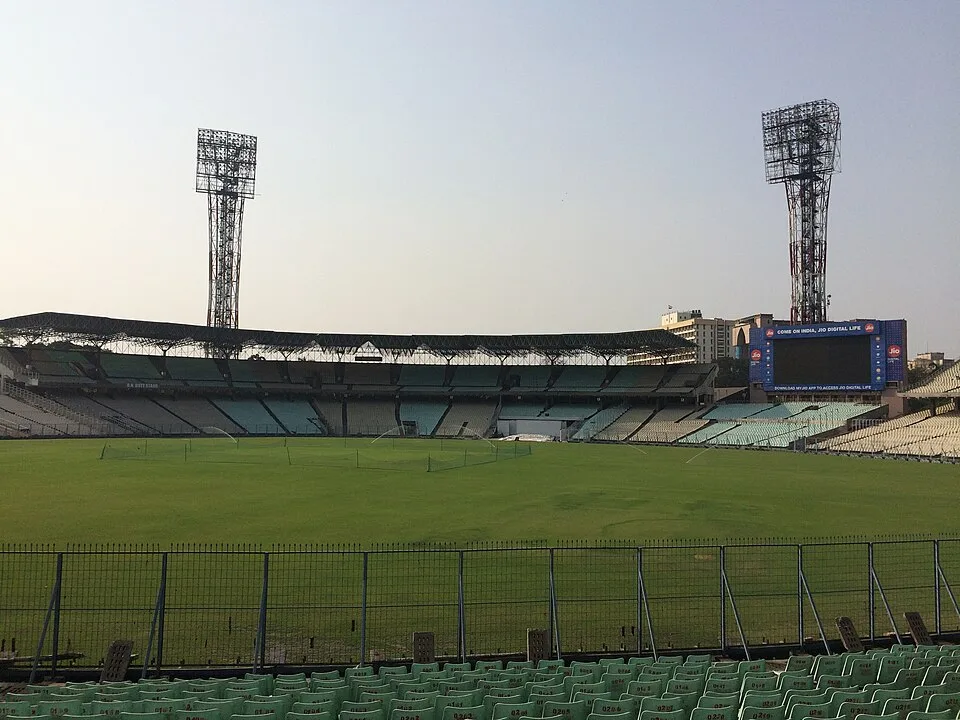
Finally, check the venue and date. The official page says Eden Gardens, Kolkata, on 14 November 2026. Generic images of Eden Gardens can illustrate the venue, but an archive photograph must never be captioned as if it shows this 2026 match. Likewise, a cricket ball photograph can illustrate the sport but cannot document Patel's innings. Images are useful context only when their date and role are clear.
Why a 250 total is significant, carefully stated
A 250-run T20 innings sets a demanding chase because it requires at least 251 from a maximum of 120 legal deliveries. The required scoring rate at the start of such a chase is 12.55 runs per over. That figure comes from dividing 251 by 20 and rounding to two decimal places. Odisha's completed rate was 11.45, enough for 229 but not 251. This explains the arithmetic pressure without claiming a specific tactical failure.
Pressure in a chase is dynamic, however. If the side scores quickly early, the remaining required rate can fall; if it loses quiet overs, it rises. The final average cannot show whether Odisha was close to the target at one stage. For that, a reader needs over-by-over data. The BCCI page has a commentary section, but the text returned in the accessible public page did not provide a complete ball-by-ball record for this review. We therefore describe the final totals and the mathematical requirements rather than fabricate turning points.
Gujarat's nine wickets also show that a big total need not be a wicket-free innings. A side can score rapidly while losing batters. Without the detailed card, we cannot say whether Patel opened, batted in the middle order, or scored mostly at the end. The number of balls he faced and his final score are confirmed; the precise phase of his contribution is not established by the match-details summary. Readers should treat a confident claim about his entry over with caution unless it cites a full card.
Common questions about Khilan Patel and the match
How many runs did Khilan Patel score?
The BCCI match details record 84 runs from 29 balls. He is listed as the player of the match. This was Gujarat against Odisha in the Syed Mushtaq Ali Trophy Elite on 14 November 2026.
What was Khilan Patel's strike rate?
Using the confirmed runs and balls, the calculated strike rate is approximately 289.66. The calculation is 84 ÷ 29 × 100. It is an arithmetic inference from the official summary, so small differences on another site may result from rounding conventions rather than a different innings.
Who won Gujarat vs Odisha?
Gujarat won by 21 runs. Gujarat made 250/9 in 20 overs and Odisha finished at 229/8 in 20 overs, according to BCCI. Odisha had elected to field after winning the toss.
Where was the match played?
The official venue was Eden Gardens in Kolkata. An archival photograph of the ground is a location illustration, not a photograph of the 14 November match. That distinction is stated in the image credit below.
Was this an India international or IPL match?
No. The BCCI labels it a domestic T20 fixture in the Syed Mushtaq Ali Trophy Elite. It involved Gujarat and Odisha, two domestic sides, and was Match 13 in the competition listing.
Did Patel score a record-breaking fastest fifty?
The accessible official match-details page confirms his 84 off 29 but does not make a fastest-fifty or competition-record claim. We do not label the innings a record without an official record table and the exact balls taken to reach fifty. A final strike rate alone cannot establish a fastest-fifty milestone.
Why did Odisha lose after scoring 229?
Because Gujarat had scored 250 first. Odisha needed 251 to win and finished on 229 after 20 overs. The official result is a 21-run Gujarat victory. The final totals do not alone identify the individual overs that decided the match.
A useful way to follow the next update
Use the BCCI match centre as the anchor for any later correction. If the full scorecard becomes accessible, compare the names, dismissal details, boundaries and extras there. Check that a social-media clip really belongs to this fixture before describing it as Patel's innings; a video of a different season or team can look plausible when shared without context. The date, opponent, venue and score are practical checks. They make the story stronger than a recycled caption.
For now, the verified account is clear: Odisha chose to field at Eden Gardens, Gujarat scored 250/9, Odisha reached 229/8, and Gujarat won by 21 runs. Patel's 84 from 29 earned the official player-of-the-match designation. The score shows an unusually rapid individual contribution to a high-scoring domestic T20. Beyond that, claims about records, career milestones or detailed ball-by-ball events should wait for evidence.
Sources
- BCCI: Gujarat vs Odisha match details, result, toss and player of the match
- BCCI: Gujarat vs Odisha match centre and score summary
- BCCI: match statistics page
Image credits: Cover by Hemang Rindani, CC BY-SA 4.0; inline by Mr Khubaib Sani, CC BY-SA 4.0. Both images were resized and converted to WebP. The stadium is an archive photograph and the ball is a generic illustration; neither depicts the 14 November match.
Checked on 15 November 2026. Strike rates, percentages and required-rate figures are calculations from the BCCI totals. The publicly accessible match summary did not provide a complete batting card for this review.
Found an error or an outdated detail? Report a correction with the article URL and original source.