
Kimberly Powell at NVIDIA: Healthcare AI, Medical Imaging and Student Learning
Explore Kimberly Powell’s NVIDIA healthcare role, GPUs, MONAI and research tools, with clear limits between demonstrations and clinical evidence.
Who is Kimberly Powell at NVIDIA?
Kimberly Powell is identified by NVIDIA as its vice president of healthcare, with responsibility for the company's healthcare business. Her professional remit connects accelerated computing with medical imaging, life sciences, drug discovery and healthcare analytics. This profile focuses on that documented work, rather than speculation about private relationships or personal matters.
NVIDIA's biography says she joined the company in 2008 and worked on GPU platforms for medical imaging. That provides a useful starting point for understanding her role: the work is about connecting computing technology with organisations trying to solve healthcare and research problems, not practising medicine through a corporate title.
For students encountering the name through a trending search, the professional context is worth understanding in its own right. Healthcare AI involves software, data, scientific research and operational decisions. A company executive can help shape that ecosystem, but an executive's presentation is not proof that every proposed application is clinically validated.
What does a healthcare technology leader do?
A healthcare technology business needs to understand several audiences at once. Researchers may need tools for experiments; developers may need reliable libraries; hospitals may care about deployment and accountability; commercial partners may need support and integration. A leadership role brings those needs into a wider business and technical strategy.
That work differs from writing every line of software or making each clinical decision. Large platforms depend on teams and partnerships. A responsible profile can describe an executive's remit without attributing every scientific discovery, engineering contribution or medical outcome in the organisation to one person.
For a learner, this distinction is useful when reading a corporate announcement. Ask whether the speaker is describing a product, a research collaboration, an operational deployment or a demonstrated patient benefit. Those categories can be connected, but they are not equivalent. The evidence required for each should match the claim being made.
Why GPUs are relevant to healthcare computing
A graphics processing unit is designed to perform many operations in parallel. That can make it useful for suitable workloads beyond drawing a screen. In healthcare-related computing, some image-processing and machine-learning tasks involve large collections of repeated numerical operations, which helps explain the interest in accelerated hardware.
Parallel computing is not a magic substitute for a good method. A faster calculation can still be wrong if the model, input data or evaluation is unsuitable. Hardware speed and scientific validity answer different questions. This is particularly important when an impressive performance chart appears beside a claim about real-world medical usefulness.
An accessible analogy is a classroom marking exercise. More people can check many independent answers at once, but dividing the work does not fix an incorrect answer key. Likewise, additional computing capacity can make a process faster without proving that its underlying assumptions are sound.
Medical imaging: tools, models and actual care
Medical imaging creates a setting where software can help organise and analyse complex visual information. However, developing a model on a research dataset is different from using it responsibly in a real clinical workflow. The latter introduces questions about reliability, integration, oversight and the consequences of errors.
Consider a hypothetical image-classification project. A learner might train a model to sort example images and report an accuracy value. Before anyone treats that result as clinically useful, they would need to understand the dataset, how it was labelled and whether evaluation genuinely tested new cases. A high number alone cannot answer those questions.
This profile does not recommend a diagnostic tool or suggest that readers upload personal scans to an unfamiliar service. The educational point is the chain from data to model to evaluated workflow. An announcement at the beginning of that chain should not be described as though every later step is complete.
What MONAI contributes to the discussion
NVIDIA's documentation describes MONAI as a domain-specific medical-imaging AI framework and distinguishes the open-source project from the company's enterprise offering. The toolkit supports development workflows such as preparing data, training and deployment work. That is a useful example of the software infrastructure behind the broader healthcare-AI conversation.
An open-source framework and a clinically approved application are not the same product category. A framework can help developers build systems, but the resulting applications still need appropriate evaluation and governance. The existence of a library does not automatically certify every model someone creates with it.
For students, the practical lesson is to identify the layer you are learning. Are you studying programming, a machine-learning method, a specialised framework or a clinical workflow? Knowing the layer helps you choose a sensible project and avoids pretending that a beginner demonstration has already become a medical service.
Drug discovery is not the same as drug approval
The company's healthcare developer material also describes BioNeMo as a platform for AI-driven research and development. That places it in the world of scientific tools. Research tools may help explore questions or prioritise work, but a computational output is not automatically a safe, effective medicine ready for use by patients.
The distinction is easy to lose in a short headline. A model proposing a candidate, an experiment investigating that candidate and the evidence needed for a real treatment are separate stages. Progress at one stage can be important without removing the need for the others.
When reading a claim about “AI discovering a drug,” ask what was actually demonstrated. Was the result a prediction, a laboratory observation or a clinical outcome? This article does not assess a particular medicine. It offers a way to read platform announcements without converting a research capability into an unsupported treatment claim.
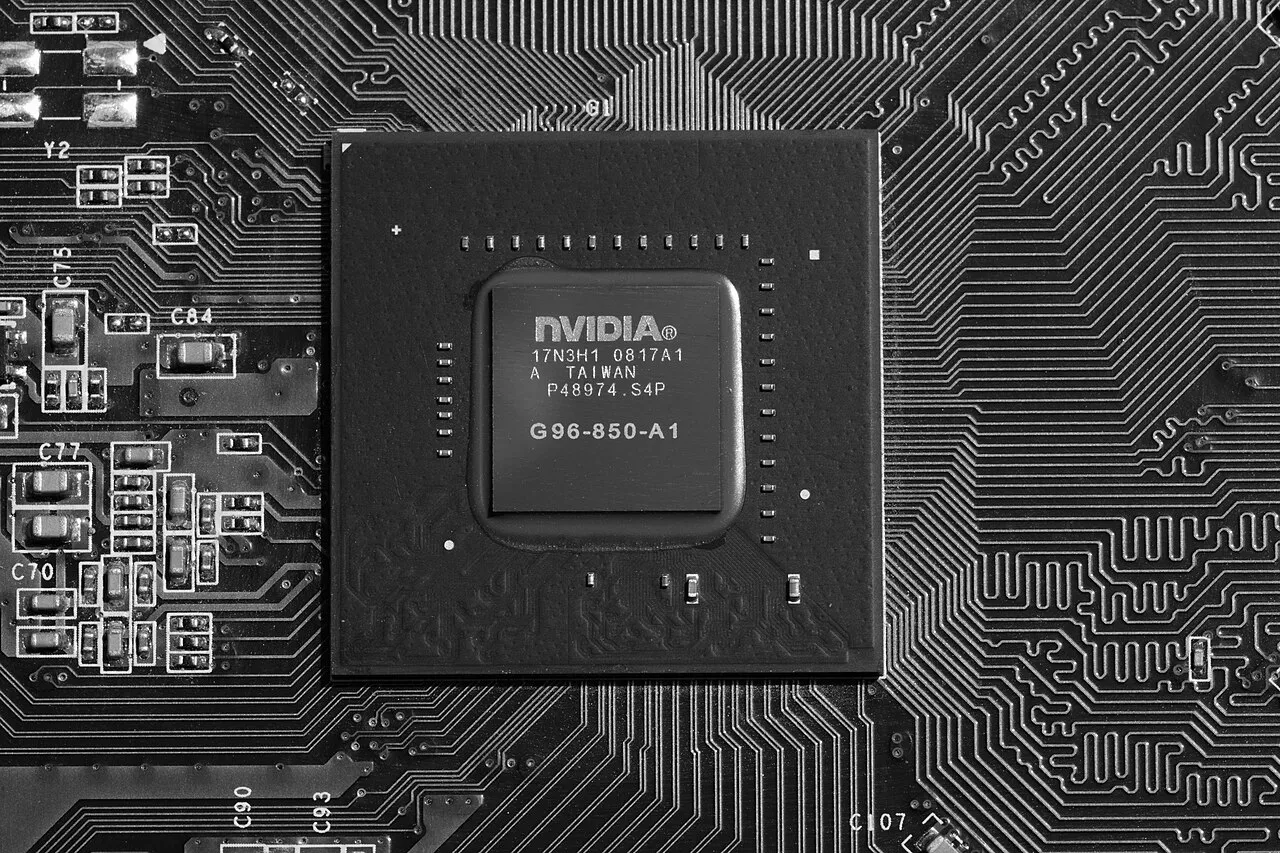
Illustrative GPU hardware. It is not a photograph of Powell or a benchmark of current healthcare systems.
Data quality is part of the engineering problem
A model learns from the data and labels provided to it. If those are incomplete, inconsistent or unrepresentative of the intended task, more computing power does not automatically solve the problem. Good engineering includes understanding the data's origin and limitations, not just selecting a larger model.
For an illustrative classroom project, imagine a system trained only on photographs taken in bright rooms. It may perform poorly when used with dim images. In a healthcare setting, the relevant differences can be more complex and consequential. The example is deliberately simple, but it shows why evaluation conditions matter.
Students should therefore practise documenting datasets, separating training from evaluation and explaining what a result does not establish. These habits are useful before entering a specialised field. They make a project more trustworthy and help a reviewer understand whether a claimed improvement reflects the method or merely an easier test.
Privacy and accountability cannot be added at the end
Healthcare information can be sensitive, so a learning project should avoid casually collecting identifiable records. Use appropriately licensed public teaching data or synthetic exercises where suitable, and follow the rules attached to any dataset. A convenient upload interface is not evidence that uploading another person's medical information is permitted.
Accountability also means knowing who is responsible for a decision. A software suggestion, a clinician's judgement and an institution's operating policy are different parts of a workflow. A presentation about automation should not erase those responsibilities or imply that a model can silently take over every decision.
This is a useful question to ask of any proposed system: what happens when it is uncertain or wrong? A serious design needs a way to handle those situations. An attractive demonstration that shows only successful examples cannot establish how safely the system behaves outside its prepared scenario.
A sensible learning route for students in Pakistan
Start with programming and basic data handling before trying to reproduce a medical-AI headline. Learn to read a dataset, write a clear function and check an output. Then study the mathematical ideas needed for the specific task. A sequence of understandable projects is more valuable than copying a complex notebook whose assumptions you cannot explain.
Next, build a small non-clinical demonstration with a clear boundary. For example, compare the runtime of two ways to perform a numerical task on appropriate teaching data. Describe what you measured and the hardware used. Do not label a speed demonstration a diagnostic breakthrough simply because the example data came from a healthcare-themed tutorial.
When moving to specialised material, read the framework's documentation and licence. Distinguish free educational code from a commercial service or a resource that needs substantial hardware. This profile does not promise that every healthcare-AI tool is free, that every student needs a costly GPU or that a course guarantees employment.
How to read a corporate biography critically
A corporate biography is a primary source for the role the company assigns to a person. It is not an independent audit of every claim about the business. Use it for the appropriate purpose: identifying the position, stated responsibilities and documented professional background.
For product performance, look for the relevant technical documentation and evaluation. For patient outcomes, look for suitable clinical evidence. For the terms of a partnership, read the announcement and any supporting documents. A single profile page cannot serve as evidence for all of those different questions.
This approach is neither dismissive nor promotional. It allows a reader to recognise professional experience while retaining the same standards they would apply to another company. Trustworthy reporting does not need to turn a person into either the sole inventor of an industry or the subject of unsupported speculation.
Questions about Powell and healthcare AI
What is Kimberly Powell's documented role?
NVIDIA identifies her as vice president of healthcare. Its biography describes a remit spanning healthcare computing and related research areas. This profile uses that professional identification and does not investigate private life, repeat unverified allegations or infer personal details from the fact that a name is trending.
Does healthcare AI replace a doctor's judgement?
A technology announcement alone provides no basis for that general claim. A real application needs an appropriate role, evidence and oversight. Software may support a task without becoming a replacement for every professional responsibility. This page discusses technology literacy and does not offer medical advice or a diagnosis.
Is MONAI a ready-made diagnosis for every patient?
No. A development framework and an evaluated clinical application are different things. MONAI-related tools support software work in medical imaging, but the resulting systems need their own evidence and appropriate use. Access to a framework does not automatically establish clinical suitability for a model built with it.
What should a beginner learn first?
Begin with programming, data handling, basic statistics and careful testing. Then choose a small project whose purpose and limitations you can explain. A modest, reproducible demonstration is a stronger foundation than an impressive-looking medical application that uses unknown data or makes claims its developer cannot substantiate.
A project-review checklist
Before sharing a healthcare-themed computing project, state its task, data source, evaluation method and intended audience. Explain whether it is a teaching demonstration or something more advanced. Remove any implication that a classroom output has been clinically approved unless appropriate evidence actually supports that statement.
Include limitations alongside results. What kinds of input were not tested? What would make the method fail? Which decisions remain outside its scope? Clear answers make a project easier to review and more useful to the next learner. Hiding uncertainty behind a polished interface does the opposite.
The broader value of Powell's professional context is that it points to an industry where software, science and organisational responsibility meet. Students can explore that intersection through the RayTech learning and updates collection while keeping claims proportionate to evidence. Interest in a prominent name can become a starting point for learning how the technology actually works.
A helpful project habit is to write the intended user before choosing the technology. A researcher exploring a hypothesis, a student learning an algorithm and a clinician making a decision need different outputs and evidence. Starting with that distinction can prevent unnecessary complexity. It also makes it easier to explain why a small educational tool may be valuable without claiming it is ready for clinical use. Good technical communication identifies both the audience and the boundary of the task, then uses measurements that answer that task rather than borrowing an impressive but unrelated benchmark.
Sources
- Source: NVIDIA professional biography
- Source: NVIDIA MONAI documentation
- Source: NVIDIA healthcare developer resources
- Source: BioNeMo research framework paper
Image credits: cover: Lizadeborah03, source, CC BY-SA 4.0. Resized and converted to WebP. inline: Mickael Courtiade, source, CC BY 2.0. Resized and converted to WebP.
Found an error or an outdated detail? Report a correction with the article URL and original source.