
Kuldeep Yadav: Left-Arm Wrist Spin, Bowling Figures and Match Context
Understand Kuldeep Yadav’s bowling category and learn how turn, flight, line, length, economy and wicket-taking statistics fit a proper spell review.
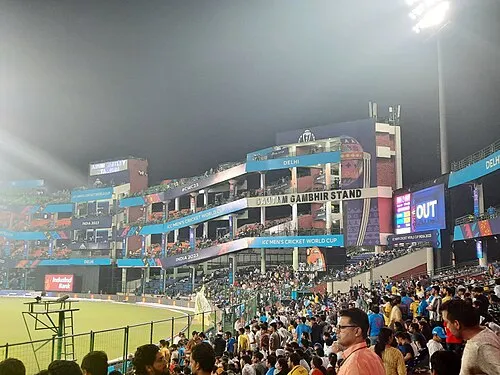
Kuldeep Yadav is an Indian left-arm wrist-spin bowler whose record should be read with the format, date and role clearly identified. His official BCCI profile and Delhi Capitals player page provide the starting points for a factual career check. For learners, his bowling category is also a useful way into understanding spin, variation and bowling statistics.
This guide was checked on 13 November 2026. It explains the role and offers original score-reading exercises. It does not claim to know a private coaching plan, promise that a particular delivery will turn on every surface or report an unverified current injury, selection or transfer.
The examples are teaching examples rather than invented Kuldeep spells. A career profile and a live match score serve different purposes. For current figures, use the relevant official completed scorecard and preserve the date beside the numbers.
What left-arm wrist spin means
The label identifies the bowling arm and a broad method of imparting spin. It is more precise than calling every slow bowler the same type. Left-arm wrist spin and left-arm orthodox finger spin are different categories, even though both involve a left-handed bowling action.
The category does not tell you the exact movement of every ball. Variation, release, pace and conditions can change what a delivery does. A useful explanation avoids turning a style label into a promise that the next ball must follow one fixed path.
When learning the terms, draw a simple table with bowling arm in one column and spin category in another. Keep the two labels separate. That makes it easier to understand why two left-arm bowlers can present quite different problems to a batter.
Turn is only one part of the problem
A spinning delivery can challenge a batter through more than sideways deviation after pitching. Flight, pace, length and the point of release can affect how the ball is read. Describing a spinner only by how far one ball turned leaves out much of the task.
When watching a public clip, start before the bounce. Note the ball's path and where it lands, then describe the later movement. Avoid claiming that a particular grip or finger position caused the outcome if the footage does not show enough detail to establish it.
This is an observation method, not a full technical lesson for copying an action. A beginner can learn to identify differences without being told to reproduce a professional movement from a short highlight. More detailed physical coaching needs the appropriate setting and guidance.
Line and length still matter
Spin does not remove the need for a useful line and length. A delivery that turns can still be poorly placed for the situation. Equally, a ball that turns little may create a challenge through where it pitches or how quickly it reaches the batter.
For a paper exercise, mark several landing points on a simple pitch drawing. Ask how moving one point changes the batter's likely options. Do not attach a guaranteed wicket outcome to any mark; the exercise concerns the question posed, not a certain result.
Keep the field in mind too. A ball directed toward one scoring area can have a different purpose when fielders occupy that space. The delivery and field form a shared context rather than two unrelated lists on a match page.
Variation should not become random guessing
A variation changes some feature of a delivery, but the fact that a bowler can vary does not mean every ball is chosen at random. A detailed claim about a plan needs evidence from the match or a reliable explanation, not merely a dramatic commentary phrase.
For a learner, compare visible differences across a short sequence and record what remains the same. That can reveal why subtle changes matter. One ball alone often provides less information than a group of deliveries viewed in their actual order.
This article does not assign a secret plan to Kuldeep. It uses the general idea of variation to help readers ask better questions. Distinguishing observation from interpretation is especially valuable when a highlight edit removes the deliveries before a wicket.
A wicket ball has a history
The delivery that takes a wicket is easy to remember, but earlier balls may have shaped the situation. A clip showing only the dismissal can therefore be incomplete evidence for explaining the whole contest between bowler and batter.
Watch the preceding sequence where it is publicly available. Note changes in line, pace and the batter's responses. Then state only what is supported. Do not say that a bowler deliberately set a trap unless there is enough evidence for that interpretation or an attributed source describing it.
The goal is not to make analysis sound mysterious. It is to replace an unsupported story with a clear account of the visible sequence. That makes a technical explanation more useful to someone learning how overs develop.
Bowling figures in their proper order
A bowling return commonly records overs, maidens, runs and wickets. Read the headings rather than assuming every table uses the same compact arrangement. A figure copied without its column labels can be misunderstood even when the digits themselves are accurate.
Runs conceded and wickets taken describe different outcomes. A bowler can have a low run cost without a wicket, or take wickets while conceding more. To understand the spell, inspect the full return and the match situation instead of deciding from one column alone.
For actual Kuldeep figures, use a dated scorecard. This guide deliberately does not publish an unlabeled live career total that may change after the next match. A stable lesson explains the statistic while the current record remains available through the official source.
Economy rate explained
Economy measures runs conceded per over. In a fictional completed four-over spell costing 24 runs, economy is six. That tells us the average run cost across the spell, not that each individual over cost exactly six runs.
Now imagine the overs cost two, ten, four and eight. The total is still 24, and the economy is still six. The pattern differs within the spell, which is why an average cannot reconstruct the sequence of events.
This distinction helps when reading a tight finish. A full-spell rate can hide a demanding final over or an earlier expensive passage. State the period being measured and avoid making a claim about one over from a number calculated across all of them.
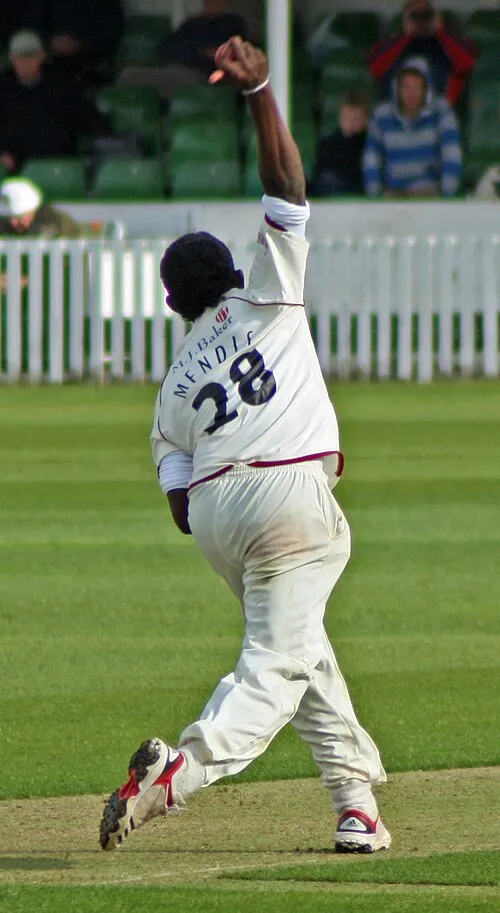
Archive Ajantha Mendis delivery photograph. This illustrates a different spin method for comparison, not Kuldeep Yadav or his wrist-spin action.
Incomplete overs need ball conversion
An entry of 3.2 overs means three completed overs and two legal balls, or twenty legal balls. It is not 3.2 decimal overs. To calculate economy from that figure, multiply runs conceded by six and divide by the legal-ball count.
For an invented 20 runs from twenty legal balls, economy is six. Dividing 20 by 3.2 instead produces a different number because the denominator has been misread. A calculator cannot correct a cricket notation error that occurs before the calculation begins.
Write completed overs and additional balls separately in a spreadsheet if necessary. Converting to total balls first makes the unit clear and helps prevent a plausible-looking decimal from being used in the wrong formula.
Bowling average and strike rate
Bowling average is runs conceded divided by wickets. Bowling strike rate is balls bowled divided by wickets. A fictional return of two wickets for 24 from 24 legal balls gives an average of twelve runs per wicket and a strike rate of twelve balls per wicket.
The values happen to match in that example, but their units differ. In another spell they need not be equal. Never decide which statistic you are reading from the number alone; the label is part of the meaning.
If no wicket is taken, do not invent a normal runs-per-wicket average for that spell by dividing by zero. The presentation used by a statistics provider may show a dash or another defined convention. Read that convention rather than treating it as a hidden claim of poor or perfect bowling.
Format changes the setting
An ODI, a T20 and a Test provide different match structures and workloads. A rate from one format should not be copied into another as though it describes an identical task. The same bowler can be asked to perform different roles across them.
Start a comparison by matching format and period. Then consider when the overs were bowled and what the batting side needed. A raw economy rate is useful, but it does not automatically make two spells directly equivalent.
This is not an excuse to ignore numbers. It is a way of using them more carefully. A clear comparison states the scope, identifies the relevant figures and avoids a wider conclusion than those figures can support.
The batter's handedness and the field
A ball's relationship to a right-handed batter can differ from its relationship to a left-handed batter. Keep the viewpoint explicit when discussing movement. Words such as away and into need a reference point, or the explanation can become confusing.
Draw a simple batter and wicket before describing the path. Then reverse the handedness and ask which description changes. This exercise helps readers understand why a broad spin label is not enough to explain every matchup.
The field provides another part of the context. A scoring option that appears open in one view may be covered in another. Avoid claiming that one delivery type guarantees a particular shot or dismissal regardless of the batter and field.
Read selection news separately
A profile on the BCCI or a club website is not a confirmed lineup for the next match. Selection, availability and medical updates need current dated sources. An old player page can remain online without proving any of those matters.
This guide therefore does not infer a new selection from a search trend. Interest in a name tells us what people are looking for, not the cause or the exact team decision. Check the specific official announcement before presenting a current status as fact.
The same applies to rankings and contracts. They are distinct records with their own update times and categories. A strong bowling performance can be relevant to a discussion without automatically establishing a new rank or appointment.
A spinner observation exercise
Choose six consecutive publicly available deliveries rather than six unrelated wickets. Record visible line, length, outcome and any change you can actually see. Put uncertain technical explanations in a separate column instead of treating them as observed facts.
Next compare the sequence with the bowling figures. Ask what the figures show well and what they leave out. The scorecard may establish runs and wickets while the footage helps explain the challenge presented to the batter.
Use the exercise to study cricket, not to claim access to a player's mind. An explanation becomes stronger when it makes the evidence and limits clear. It does not need an invented private plan to be interesting.
What readers should retain
Kuldeep's left-arm wrist-spin category is a useful starting point, but bowling is not explained by one style label or one turning delivery. Line, length, pace, sequence, field and format all help define the task.
More cricket and learning articles are available here. For current performances, consult dated official scorecards. For learning, keep the distinction between an actual record and a fictional calculation visible so that a useful exercise does not become a false claim about a real spell.
A good next step is to explain one over in plain language using both the scorecard and the visible action. If a detail cannot be established, leave it as a question. Careful observation is more valuable than a confident technical phrase with no evidence behind it.
Common questions
Is wrist spin the same as orthodox finger spin?
They are different bowling categories. The arm used and the broad spin method should both be identified. The category alone does not guarantee how every individual delivery will move on a particular surface.
Are these Kuldeep's actual spell figures?
No. Numerical examples are fictional and clearly labelled. They teach economy, average and strike rate. Use the relevant dated scorecard for a real performance rather than adding the examples to his career record.
Why is 3.2 overs not a decimal?
The final digit counts legal balls within an incomplete over. Three overs and two balls equal twenty legal balls. Convert first before using a rate formula, and preserve the unit beside the result.
Sources
Image credits: cover: Ciell, source, CC BY-SA 4.0. Resized and converted to WebP. inline: Harrias, source, CC BY-SA 3.0. Resized and converted to WebP.
Found an error or an outdated detail? Report a correction with the article URL and original source.