
Lisa Su: Her Engineering Career and a Student Guide to AMD Computing
Explore Lisa Su’s verified career and learn how chips, software, performance and engineering decisions fit together through clear original examples.

Lisa Su is AMD's chair and chief executive officer, with a background in electrical engineering and semiconductor development. Her public career connects research, product execution and the commercial decisions behind computer hardware. Understanding that connection is more useful than treating a chief executive's name as a substitute for learning what a chip actually does.
This guide begins with her verified professional record, then uses original learning examples to explain the engineering questions surrounding the company she leads. The examples are not quotations from Su, descriptions of confidential AMD projects or predictions about AMD shares. They are a way for students to understand the work behind familiar technology headlines.
Lisa Su's professional record
AMD identifies Su as its chair and CEO. Its biography records her arrival at the company in January 2012 and her earlier work at Freescale, IBM and Texas Instruments. The company says she held responsibilities spanning research, operations and product execution. These are distinct parts of an engineering business, rather than different names for designing a single processor.
The Semiconductor Industry Association's announcement dated 20 November 2025 records her election as its board chair. It also identifies her electrical-engineering doctorate from the Massachusetts Institute of Technology and her receipt of the association's 2020 Robert N. Noyce Award. The announcement date should not be misread as a new election on the date of this article.
Those facts establish the public profile. They do not explain an entire industry on their own. To understand why semiconductor leadership matters, follow the chain from a computing problem to a design, from that design to a working system, and from a working system to something customers can reliably use.
What is a semiconductor, in practical terms?
A semiconductor material can be used to build electronic devices that control current. In digital computing, many such devices are organised into circuits representing and manipulating information. A processor is therefore a physical device implementing logical operations, not a miniature person who understands the meaning of every instruction.
For a beginner, a switch is a useful first analogy, but it has limits. Real devices have electrical characteristics, delays, leakage and operating constraints. A drawing of perfect switches helps explain a logic gate; it does not describe every difficulty of manufacturing a dependable chip. Engineering begins where the simple drawing stops answering questions.
Consider a fictional circuit that adds two binary values. Its logical design must produce the right result, but its physical implementation must also do so within the required time and operating conditions. A mathematically correct design that regularly misses its timing target is not yet a satisfactory finished product.
Why a CPU and a GPU are different tools
A CPU is a general-purpose processor suited to a wide range of control and computation tasks. A GPU provides a different organisation that can suit workloads with substantial parallel work. This is an architectural distinction, not a rule that one device is automatically superior for every program.
Imagine a classroom task involving one instruction after another, with each answer determining the next question. Compare it with a task applying the same calculation independently to thousands of values. The second task offers more obvious parallel work. These simplified examples explain why the structure of the problem matters when choosing how to compute it.
A real application can contain both kinds of work. Preparing data, coordinating steps and handling irregular decisions may have different requirements from executing a large regular numerical operation. Measuring only one fast section can therefore hide delays elsewhere. A whole application succeeds when its parts work together, not when one component has the most impressive label.
The difference between designing and manufacturing
Design describes what a chip should do and how its internal elements are organised. Manufacturing concerns making the physical device. Packaging, board integration and system testing add further stages. These categories explain an industry workflow; they should not be mistaken for a claim that a chief executive personally performs each stage.
An original classroom analogy is a carefully designed printed textbook. Writing, typesetting, printing and binding are connected, but an error in one stage can survive into the final object. Checking only the manuscript cannot guarantee that every printed page is legible. Similarly, a correct digital design still needs successful physical implementation and verification.
The analogy becomes less useful if pushed too far. Chips involve electrical behaviour and highly specialised fabrication, not simply shrinking a drawing onto a surface. The important lesson is organisational: responsibility crosses boundaries. A product schedule must account for the dependencies between teams rather than pretending that a finished diagram is the finished product.
Performance is a question with conditions
“Faster” is incomplete unless the comparison names a workload and a measurement. Does it mean a task finishes sooner, more tasks finish in a minute, or the system responds more quickly to a single request? Those outcomes may matter differently to a student, a game developer and a server operator.
Take a fictional program that processes 600 items in 60 seconds. Its throughput is ten items per second. A second configuration processes the same items in 40 seconds, giving fifteen items per second. Throughput increased by 50 percent, while elapsed time fell by one third. These are different percentages describing the same example.
Neither calculation establishes how any AMD product performs. The numbers are deliberately invented for arithmetic practice. When evaluating a real result, record the software version, task, input size, settings and hardware configuration. A percentage without those conditions is difficult to reproduce and easy to misunderstand.
Why more parallel resources do not guarantee a proportional gain
Suppose half of a fictional program's running time belongs to work that can be accelerated, while the other half cannot. If the accelerated half becomes twice as fast, the total time changes from one whole unit to three quarters of a unit. Overall speed rises, but the program does not become twice as fast.
Write the example as 50 seconds of unaffected work plus 50 seconds of accelerated work. After improvement, the second part takes 25 seconds, so the total becomes 75. Dividing the original 100 seconds by 75 gives an overall speedup of approximately 1.33 times. The unchanged work limits the gain.
This exercise is valuable when reading computing headlines because it separates a component improvement from an application improvement. It also encourages a practical habit: measure where the time goes before deciding what to optimise. A faster component is useful only to the extent that the application can benefit from it.
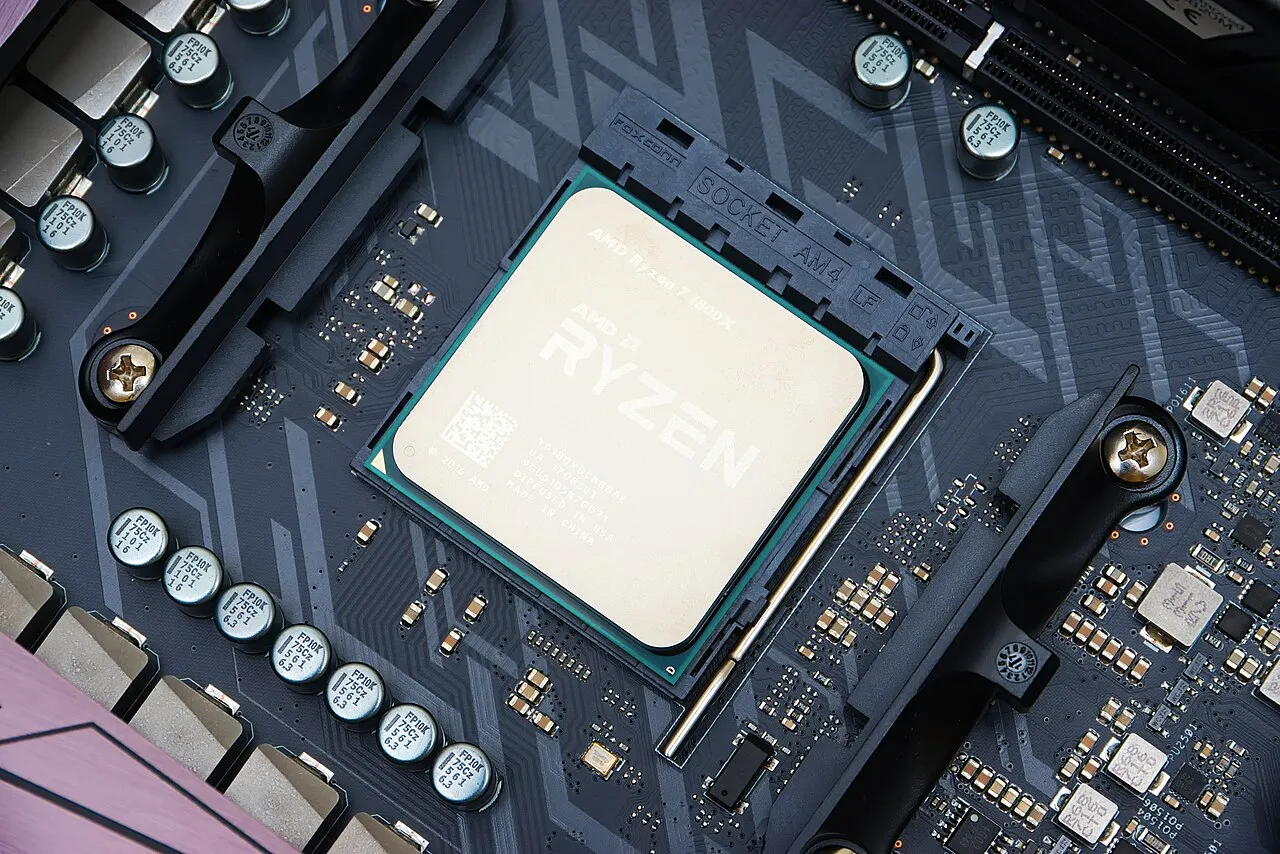
Archive photograph of an AMD Ryzen 7 1800X, illustrating processor hardware. The article does not present a benchmark of this chip.
Memory and movement belong in the explanation
A computation needs its data. If data cannot reach the processing units quickly enough, those units may wait. The amount of available storage, the rate at which data can move and the delay before it arrives are related but distinct concerns. A larger number in one category does not automatically solve the others.
Picture a fictional workshop with many workers and one narrow doorway for supplies. Adding workers may not increase finished output if the doorway remains the constraint. The analogy illustrates a bottleneck without claiming that computer memory literally behaves like a queue of people. Use it to ask which resource limits the task.
For students, a useful experiment is to compare two approaches to the same data task: one repeatedly retrieves values and another reuses values already available. Measure the whole operation under the same conditions. The lesson is not to guess a chip's internal behaviour from a stopwatch, but to see how program organisation can affect observed performance.
Energy, power and cooling are separate ideas
Power is a rate; energy accumulates over time. A device drawing a higher power for a shorter interval can use more or less energy depending on both quantities. Confusing the two leads to poor comparisons, particularly when a headline discusses efficient computing without defining the actual task.
In a fictional example, a system using 100 watts for ten seconds consumes 1,000 joules. Another using 150 watts for five seconds consumes 750 joules. The second has a higher power draw during the task but uses less energy to complete this particular calculation. These numbers are a teaching exercise, not measured specifications.
Cooling and sustained operation add further questions. A short demonstration may not describe a long-running workload under different environmental conditions. Good comparisons therefore state the duration and setup as well as the result. This is a general engineering principle, not a recommendation to change voltage, disable safeguards or modify a computer's cooling system.
Software turns hardware capability into usable work
An application reaches hardware through layers of software. Languages, compilers, libraries, operating systems and drivers help translate a programmer's intention into operations the machine can execute. A processor's theoretical capability does not automatically mean every existing application will use it well.
This is why a student should learn to describe a problem clearly before focusing on a brand. Begin with a correct program, representative input and a way to check the output. Only then compare implementations. An extremely fast wrong answer is still wrong, and a benchmark that changes the problem between runs is not a fair comparison.
For an introductory exercise, calculate the sum of a small list by hand, then write a program and check its result. Increase the input size while preserving the same definition of the task. You are learning the foundations of validation and measurement, which remain important even when the hardware becomes far more complex.
What engineering leadership adds
A large technology organisation must choose which problems to address, allocate resources and coordinate delivery. Those decisions involve trade-offs between performance, reliability, cost, schedule and customer needs. A professional profile becomes more informative when those responsibilities are visible instead of reducing every outcome to an individual's personality.
Consider a fictional design team with time to improve either a rarely used feature or a bottleneck affecting most users. The technically exciting option may not deliver the greatest practical benefit. Choosing requires evidence about actual needs. This example explains why product strategy and engineering judgement have to communicate.
It also explains the limits of a biography. A leader's education and past responsibilities are useful context, but they do not independently verify a product claim. For specifications, consult product documentation; for a reproducible performance claim, examine the test method. Different questions require different evidence.
How to build a student project from this topic
Create a one-page comparison of two ways to complete a simple computing task. State the problem, inputs, expected result and measurement method before running anything. Keep the data small enough that you can independently verify the answer. Record failures as carefully as successes, since they reveal whether the method is dependable.
Then explain the result without claiming more than you measured. If one run finishes sooner, report that observation for that setup. Do not turn it into a universal statement about all computers or every application. Repeatability, correct units and transparent assumptions make a modest classroom project more valuable than a dramatic unsupported claim.
Readers can find further study material through the RayTech guides and updates. The practical connection to Su's career is straightforward: computing brings together physical devices, software and coordinated engineering decisions. Learning how those layers fit together gives a beginner a stronger foundation than memorising an executive's title alone.
Questions readers ask about Lisa Su
Is Lisa Su an engineer or a business executive?
Her public record includes both. The professional biographies cited below describe electrical-engineering training and earlier technical responsibilities alongside executive leadership. Those categories are compatible: a career can move from research into broader responsibility while continuing to require an understanding of technical products and the people who build them.
Does her job mean she designs every AMD chip herself?
No such claim follows from the role. Semiconductor products require specialist teams and multiple stages of development. A useful explanation distinguishes executive responsibility from the detailed work of individual researchers, architects, verification specialists and other contributors. Leadership and hands-on design are connected responsibilities, not interchangeable descriptions.
Does this profile explain why her name is trending today?
It establishes her professional identity and provides computing context. It does not invent a single cause for search interest or claim an unverified new announcement. A dated company release or a clearly identified interview would be needed to report a specific fresh event. A trend alone is not that evidence.
Sources
Image credits: cover: AMD Global, source, CC BY-SA 2.0. Resized and converted to WebP. inline: Brian Wong, source, CC BY-SA 2.0. Resized and converted to WebP.
Found an error or an outdated detail? Report a correction with the article URL and original source.