
The Mandalorian and Grogu: Film, Streaming and a Spoiler-Light Viewing Guide
Find the official Mandalorian and Grogu release details, cast and streaming context, plus spoiler-light exercises for learning about film craft.

The Mandalorian and Grogu is the 2026 feature film featuring Din Djarin and Grogu, distinct from the television series The Mandalorian. The official film page records its theatrical release as 22 May 2026, while the official home-release update and Disney+ guide confirm streaming availability from September. A November search result should not turn those earlier releases into a new premiere.
This spoiler-light guide explains which title is which, the verified cast and release information, and how to use the film's official behind-the-scenes material to learn about screen storytelling. It does not claim an unannounced season, promise availability in every country or pretend that a publicity summary is an independent review of the entire film.
Film, television series and companion material
The shortest way to identify the feature is to include its complete title: Star Wars: The Mandalorian and Grogu. Searching only “Mandalorian” can bring together television episodes, film information, character pages and products. Those results may all be related, but they do not describe the same item.
The Disney+ article identifies the film and an official companion podcast as separate offerings. A podcast about production is not another dramatic episode, and a trailer is not the full movie. Reading the label before pressing play prevents a viewer from expecting a story continuation when the selected material is actually an interview or promotional clip.
For a watchlist, give each entry a type as well as a title: series, film, trailer or behind-the-scenes programme. This small organisational step becomes useful in any large franchise. It preserves the connection between related works without flattening everything into one undifferentiated list of “new episodes.”
The release dates that should stay separate
The official film listing gives 22 May 2026 as the theatrical release date. The home-release update dated 2 September says the film is available on digital platforms, physical formats and Disney+. The Disney+ article revised on the same date confirms streaming and describes the companion material.
Those dates refer to different distribution contexts. A cinema release, a digital purchase listing and a subscription-streaming listing are not necessarily simultaneous events. If you encounter an older article saying a film is “coming soon,” check its publication date and the platform it discusses before deciding that a current listing is wrong.
Regional catalogues and account conditions can differ. An official international announcement is useful evidence of a release, but it does not guarantee the same service, price, language options or subscription features for every reader. Verify those practical details through the authorised platform available in your own region rather than through an unlabelled download page.
Who plays the main characters?
Official material identifies Pedro Pascal with Din Djarin, Sigourney Weaver with Colonel Ward and Jeremy Allen White with Rotta the Hutt. Jon Favreau directs the film, and the Disney+ guide identifies Ludwig Göransson as its composer. These are production credits, not claims that the performers share their characters' personalities or histories.
This distinction matters in science fiction, where a performance can involve costume, voice, physical movement, effects work and contributions from several departments. A character seen on screen is the result of collaboration. The end credits and production material can reveal responsibilities that a short cast list alone does not explain.
For a beginner studying film, choose one role and ask what information the costume, framing and sound provide before the character speaks. The exercise does not require guessing how a particular shot was made. It begins with observable choices and reserves production claims for material that actually documents them.
What is the setting, without major spoilers?
The official premise places the adventure after the Empire's fall, with scattered Imperial warlords and a developing New Republic. Din Djarin and Grogu are enlisted in that setting. That is enough context for this guide; a complete sequence of plot turns would go beyond a spoiler-light introduction.
For a new viewer, separate the immediate premise from the franchise's entire history. You do not need to memorise every proper noun before recognising a scene's immediate goal, obstacle or relationship. When unfamiliar background matters, consult an official character or era entry rather than treating a fan theory as an established event.
This approach also makes discussion more welcoming. A viewer can ask what a character wants in a scene without proving mastery of every previous production. Detailed background can enrich the experience, but a useful introductory guide should make the story easier to approach rather than turn it into an entrance examination.
A practical way to organise your viewing
If you want background before the feature, identify the television series on the authorised service and follow its listed episode order. If you are already familiar with the central pair, use the official film page to confirm that you have selected the feature rather than a similarly titled collection of clips.
Do not confuse an editorial recommendation with a mandatory viewing requirement. People bring different levels of familiarity to a franchise. A useful plan states its purpose: catching up on character relationships, revisiting a favourite sequence or examining production technique. Each purpose may suggest a different amount of background viewing.
Keep a short note of what you know and what you want to understand. After viewing, revisit only the questions that remain relevant. This prevents a search for one unfamiliar name from turning into a long sequence of unrelated spoilers. It is a simple way to preserve curiosity while keeping the research focused.
If you discuss the film with friends, agree beforehand whether the conversation includes plot details. A clear spoiler boundary makes the discussion more enjoyable for newcomers.
What the production material can teach
The official home-release feature highlights collaboration involving costumes, puppetry, miniatures, sound and visual effects. It also describes bonus material and director commentary in the home-release context. The exact extras belong to the listed edition or service, so do not assume that every purchase or subscription includes an identical package.
Behind-the-scenes material is most useful when it answers a specific question. How does a physical object help a performer respond? What does sound contribute when the image remains unchanged? How does an environment establish scale? These questions turn a promotional featurette into a starting point for a genuine lesson about craft.
A production explanation and a viewer's observation should remain separate in your notes. You can observe that an object casts a shadow in the finished scene. You need additional evidence before saying exactly which department built it or which technique produced the final image. The distinction respects both the artists and the evidence.
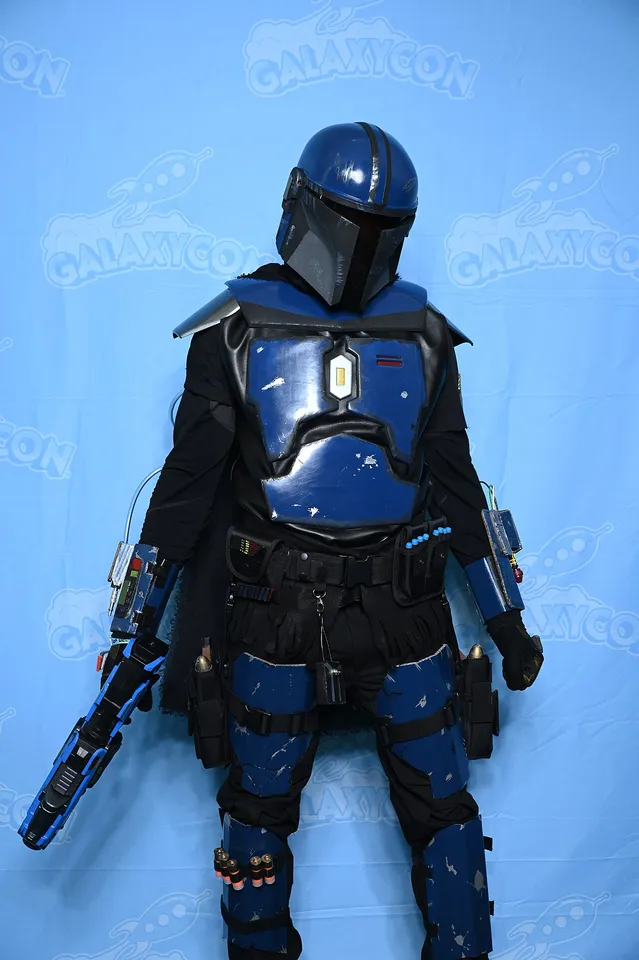
A fan in a blue Mandalorian costume at GalaxyCon Richmond in 2020. This is cosplay, not a production costume or still from the 2026 film.
Learn to describe a shot before explaining it
Start with neutral description: who is visible, where they are positioned, what changes and when a cut occurs. Only after that should you offer an interpretation. This sequence prevents a confident explanation from resting on details you have not actually noticed.
For an original classroom exercise, imagine a fictional shot of an armoured traveller entering a doorway while a small companion remains behind. A close framing could emphasise hesitation; a wider framing could reveal distance. These are possible storytelling choices in the invented example, not claims about a specific scene in The Mandalorian and Grogu.
Now write two descriptions of the same imaginary action. One should contain only visible information. The other may explain the mood you think those choices create. Comparing the two teaches how interpretation grows from evidence and where a reviewer starts adding personal judgement.
Sound is more than background decoration
A soundtrack can include dialogue, music, environmental sound and effects. Their relationship helps a viewer understand space, rhythm and attention. Calling everything “the music” misses the separate work of sound design and the way different elements can support or interrupt one another.
Try a simple listening exercise with an authorised short clip. First note the dialogue. On a second pass, listen for sounds that suggest the surrounding environment. On a third, notice where music begins, stops or changes. Keep the exercise within the platform's normal controls and do not redistribute protected audio.
The result is a more precise vocabulary. Instead of saying that a scene “sounds epic,” you can describe whether the sound becomes denser, quieter, sharper or more spacious. Those observations do not require technical access to the production files. They require patient listening and a willingness to distinguish what you hear from what you infer.
Miniatures, puppets and digital work are not rivals by definition
Viewers sometimes ask whether an effect is practical or digital as though the answer automatically establishes its quality. A better question is how the chosen techniques serve the finished image and performance. The official production overview's emphasis on multiple departments is a reminder that screen images can involve combined methods.
Use an invented model spacecraft as a learning example. A physical model can supply surface detail and lighting references; digital work could contribute other elements in a hypothetical production. Without documentation, the final image alone does not prove the entire process. The example illustrates collaboration rather than identifying an undocumented technique in the film.
For students interested in making their own short videos, the principle is accessible: choose tools that help communicate the idea. A carefully lit cardboard model can teach framing and scale without requiring an expensive workstation. Learning begins with clear intent and observation, not with copying a large studio's budget.
IMAX Enhanced and ordinary availability questions
The Disney+ guide describes an IMAX Enhanced presentation and states that some audio features require certified equipment. A feature name does not mean every television, phone, account and regional catalogue delivers the same experience. Check the platform's current specifications for the equipment and account you actually use.
For a student, this is also a lesson in reading conditional claims. “Available with compatible equipment” contains a condition that cannot be removed when summarising it. A feature can exist while remaining unavailable in a particular setup. That is different from saying the film itself cannot be watched at all.
Avoid unofficial pages claiming that a download is required to “unlock” a viewing format. Use the authorised service's own player and support information. A legitimate feature explanation should not require entering a streaming password into a separate unknown website or installing an unrelated browser extension.
Build a short film-study notebook
Choose one topic for a page: framing, costume, sound or a character relationship. Write a question before watching the relevant authorised material, then record three observations and one interpretation. Add the title and whether you used the feature, a trailer or a behind-the-scenes segment. The type of material affects what it can establish.
End the page with an uncertainty you would need production evidence to answer. For example, you might wonder how a creature's movement was coordinated. An unanswered question is useful when it guides further research. Inventing an answer would make the notebook longer but less accurate.
Students can find related reading in the RayTech article collection. The aim of this exercise is to enjoy a popular screen world while learning to describe how stories are made. Careful observation adds something beyond a cast list without pretending to have confidential access to a production.
Questions about The Mandalorian and Grogu
Is this the television series or a film?
The Mandalorian and Grogu is the feature film identified by the official 2026 film listing. The Mandalorian is the related television-series title. Include the complete name when searching so that trailers, episodes, production interviews and the feature itself do not become confused with one another.
Is a new season confirmed by the film's existence?
This guide does not infer a season announcement from a film release. A separate official announcement would be needed to report that development. Search interest, a familiar cast member or a fan-created release calendar cannot substitute for an identified announcement from the rights holder or production team.
Can I assume the same streaming access everywhere?
No. Check the authorised service's current regional availability and account requirements. The official September streaming announcement establishes the release context discussed here, not a universal price or catalogue promise. This page was checked on 12 November 2026 and should not be mistaken for a live subscription-status service.
Sources
- Official Star Wars film page and theatrical release date
- Official home-release update, 2 September 2026
- Disney+ film, cast and presentation guide
Image credits: cover: Gage Skidmore, source, CC BY-SA 3.0. Resized and converted to WebP. inline: Super Festivals from Ft. Lauderdale, USA, source, CC BY 2.0. Resized and converted to WebP.
Found an error or an outdated detail? Report a correction with the article URL and original source.