
Matteo Berrettini: Wimbledon 2021 and the Serve-Plus-One Pattern
Learn why Matteo Berrettini’s 2021 Wimbledon final mattered. Explore serve placement, grass-court patterns, slice and tie-break score reading.
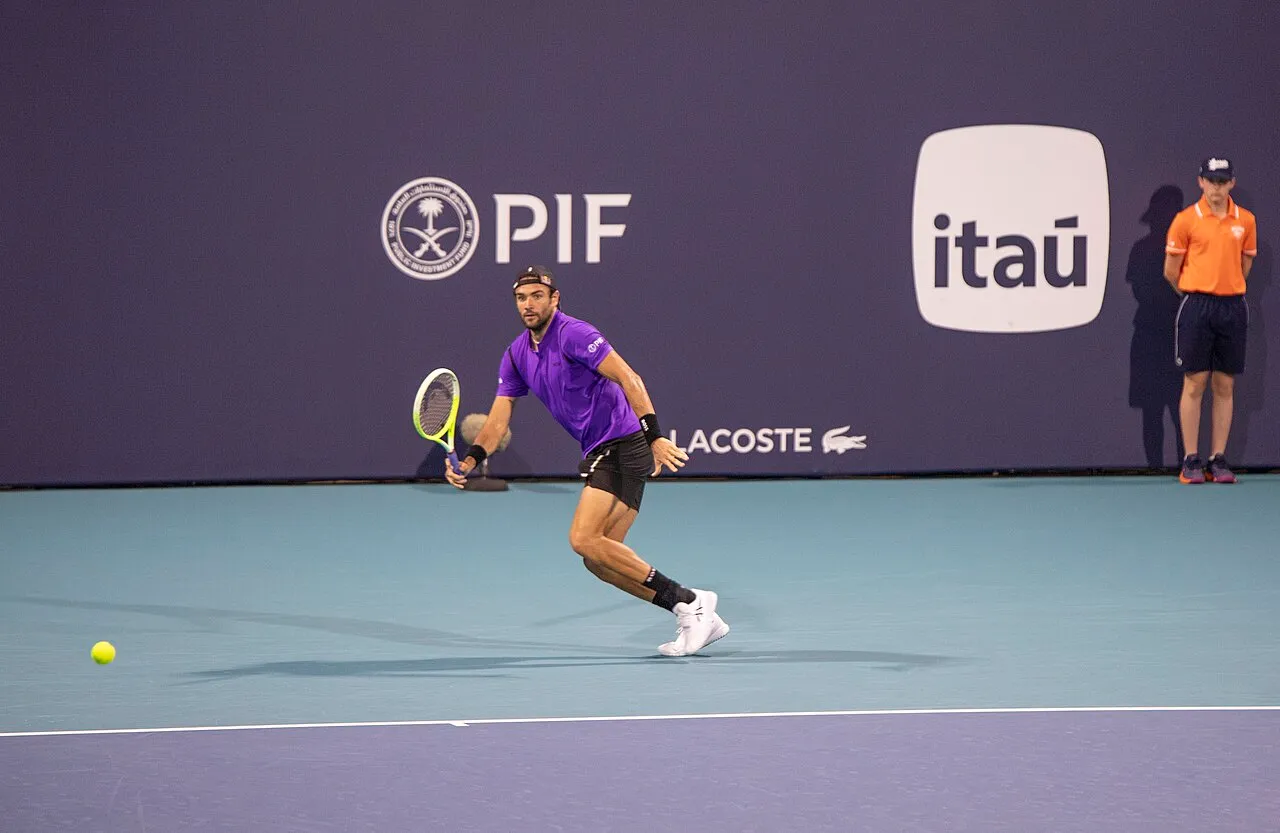
Matteo Berrettini's run to the 2021 Wimbledon final provides a useful way to understand tennis built around the serve and the next ball. A large serve is only the opening action. Placement, recovery and the following decision determine whether the server can maintain an advantage. Watching those connections makes a match more informative than counting aces alone.
This guide explains the historical Wimbledon milestone and uses it to introduce grass-court patterns, forehand positioning and score reading. It is not a live injury report or an announcement of a new title. Examples with invented numbers are labelled as exercises. Current entry lists and results should be checked against their specific tournament and date.
Who is Matteo Berrettini?
Matteo Berrettini is an Italian professional tennis player who reached the men's singles final at Wimbledon in 2021. The ITF's official final notes identify that appearance as the first Wimbledon singles final reached by an Italian player. The achievement should be described with its event, discipline and year rather than expanded into an unrelated claim about every tennis competition.
A finalist and a champion are different
Reaching the final means winning a place in the championship match. Winning the final earns the title. Berrettini was the Wimbledon men's singles runner-up in 2021, with Novak Djokovic winning the championship. A photograph of a finalist holding an award does not change that distinction. Captions and summaries should identify the correct result.
Read the career through confirmed events
An athlete's development contains tournament results, changes in opportunity and periods that cannot be explained from a public score alone. A useful profile anchors its account to verified events rather than inventing a smooth story of inevitable success. The 2021 Wimbledon final is a clear milestone without requiring a prediction about Berrettini's next tournament or long-term ranking.
Why did the 2021 Wimbledon final matter?
The final brought Berrettini to a new historical point for Italian singles tennis at Wimbledon. The ATP retrospective and ITF match notes document the context. That historical record remains meaningful when later players produce other achievements. It is not a claim that the sport stopped changing after 2021 or that every subsequent Italian result belongs to the same category.
Understand the boundary of a first
Sports headlines often use first without explaining the group being counted. Ask whether the record concerns nationality, gender, event, round or era. The narrower wording is usually more informative. It tells readers what was new and prevents accidental comparisons with doubles, junior events or other major tournaments that have their own separate histories.
A final run includes more than the final
The championship match attracts attention, but reaching it requires handling earlier rounds and opponents. A retrospective can examine how a player sustained his patterns across the event without assuming that every match presented the same challenge. Consistency is not repetition of identical points. It is the ability to solve different problems while maintaining a workable performance level.
What is serve-plus-one tennis?
Serve-plus-one describes the serve followed by the server's next shot. The objective is to use the delivery to create a favourable reply and then play the next ball effectively. It is a sequence rather than a requirement to finish in two contacts. The receiver may neutralise the serve, forcing the server to adjust rather than continue an unsuitable attack.
Start with the return you expect
A serve directed wide can create different space from one aimed at the body. The server needs to anticipate the likely return while remaining able to respond to variation. Watching the recovery position after the serve reveals this preparation. A serve's speed alone does not show whether the player was ready for the ball that actually came back.
The next ball may be awkward
Even a strong serve can be returned low, deep or unexpectedly short. A player who planned a forehand winner may have to play a controlled backhand or move forward carefully. Good patterns include alternatives. A rigid plan that ignores the arriving ball is less useful than a clear intention combined with the ability to adapt.
Winning the first exchange is not winning the point
An aggressive first groundstroke may force an opponent to defend without ending the rally. The server then needs appropriate recovery and another decision. Analyse whether the advantage was preserved. Calling every returned attack a failure misses the possibility that the shot created a simpler opportunity later in the point.
Why does serve placement deserve attention?
The service box contains different targets, each changing the receiver's contact position. A serve can reduce time, stretch the receiver or interfere with a comfortable swing. None of those outcomes is guaranteed simply by aiming at a named area. Execution, disguise and the receiver's preparation all contribute to whether the target produces the intended advantage.
Speed and accuracy are separate measurements
A fast serve that misses does not begin a successful point. A slower serve placed well can create a useful return. When comparing service performance, examine first-serve percentage, points won and return quality rather than using the largest speed reading as the entire explanation. Each metric describes a different part of the sequence.
Second serves have their own purpose
A second serve must start the point while managing the risk of a double fault. Spin, placement and margin can become particularly important. It should not be dismissed automatically as an invitation to attack. Observe how the receiver responds and whether the server remains ready for the next ball. A label does not replace the actual point pattern.
How does grass change the questions a player faces?
Surface and conditions influence bounce and movement, but grass tennis should not be reduced to one universal rule. Court wear, weather and the ball arriving from an opponent also matter. A viewer can examine shorter preparation time and the usefulness of lower contacts without claiming that every grass match must contain the same rallies or tactics.
A lower contact needs an appropriate response
When a ball stays low, lifting it safely over the net can become part of the challenge. A player may use a different swing path or choose a controlled reply rather than force an aggressive drive. The important observation is the available contact point. Avoid assuming that every low ball was deliberately created by the opponent's tactical plan.
Movement should follow the surface safely
Professional footwork reflects years of preparation and event-specific conditions. Beginners should not copy a televised slide or sudden change of direction without suitable instruction and a safe court. This article explains what viewers can notice, not a personalised physical training programme. Learning to identify balance and recovery is useful before trying to imitate demanding movements.
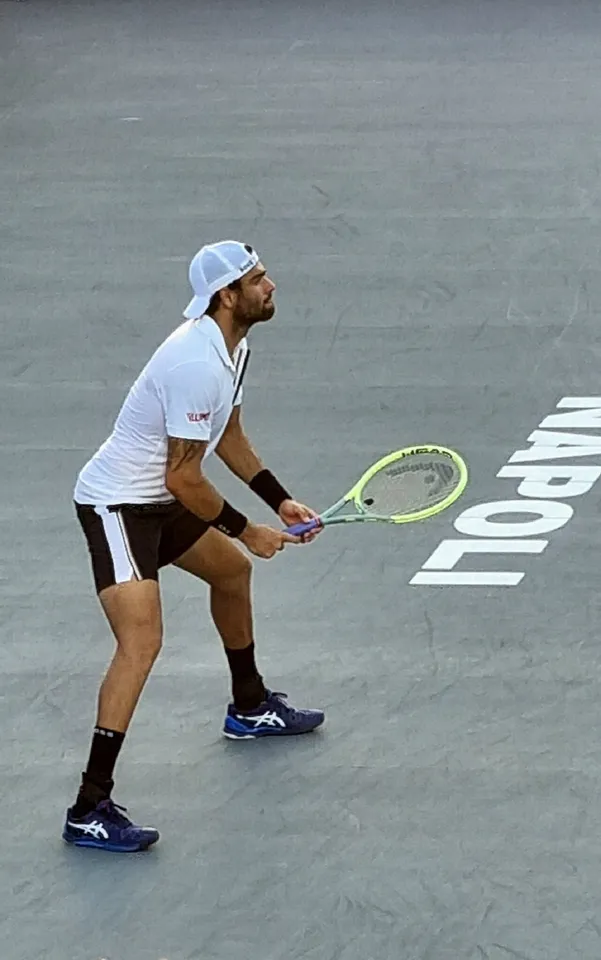
Matteo Berrettini during the 2022 Tennis Napoli Cup final, shown as dated career context.
What role can a backhand slice play?
A slice can change height, pace and contact conditions for the opponent. It may help manage a difficult ball or alter the rhythm of an exchange. It is not automatically a weak shot, and it is not automatically effective because it looks controlled. Judge what it makes possible for both players on the next contact.
Variation is useful when it changes a problem
A slower ball can give the hitter time to recover, but it can also give the opponent time to move forward. The outcome depends on depth, bounce and position. Describe the trade-off rather than praising variation for its own sake. A tactical change should be evaluated by the situation it creates, not merely by being different.
A defensive choice can protect an attacking strength
Players sometimes use a controlled shot to avoid exposing a more difficult contact and to wait for a better opportunity. This is a general tennis principle, not proof of a private Berrettini strategy in every match. To make a player-specific claim, identify the actual point sequence and explain the visible evidence supporting the interpretation.
How do you read a tie-break score?
A set score containing a small superscript or bracketed number often includes tie-break information. The set's game score and the tie-break's point score are different layers. Read the provider's display convention before interpreting a single number. A notation such as 7-6 does not mean the entire set contained only thirteen individual points.
Use a fictional example
Imagine a set ends 7-6 with a tie-break won 7-4. The set result records the games, while the tie-break result records the points within that deciding game. These are invented teaching numbers. A compact display might show only the losing tie-break score, so the visible bracket should not be treated as a complete separate set without checking the format.
Rules need the event and year
Tie-break arrangements can differ by competition, discipline and historical period. Do not apply a rule remembered from one event to every final set in every year. For a historical match, consult its regulations or official score explanation. Accurate reporting preserves what happened under those conditions rather than rewriting the result using a different format.
What can service statistics hide?
A player can win a high proportion of service points yet still face difficulty in a few concentrated games. Tennis does not distribute points evenly across the score. A double fault at one moment may affect the game differently from one at another moment, though both count in the same total. Analyse the sequence as well as the aggregate.
Calculate a hold rate from the right units
In a fictional sample, holding serve in eight of ten service games produces an 80 percent hold rate. That is not the same as winning 80 percent of service points. Games and points are different denominators. Labelling the input clearly prevents a common mistake when comparing a serving statistic with a match's overall point total.
Avoid overvaluing a tiny sample
One perfect service game can produce impressive percentages without describing a whole match. A full match can also differ from a tournament or season. State the sample size and period. A statistic becomes more useful when the reader knows exactly what was counted, not when it is presented as an unexplained badge of quality.
A serve-pattern project for students
Choose several consecutive service points from a historical match recording. Mark the serve target, receiver's contact location, return depth and server's next shot. Include ordinary points rather than selecting only aces. The exercise teaches how a pattern develops and reveals occasions when the receiver prevents the intended serve-plus-one sequence from happening.
Keep observation separate from a conclusion
Your table may show that a particular target produced shorter returns in the small sample. That does not establish that it always works or that it was the player's only plan. Write a narrow conclusion and mention the limited data. The ability to describe uncertainty is part of good analysis, not a weakness in the project.
Turn the table into a small tool
The programming courses can help students build a simple data-entry form, while the class resources support the underlying arithmetic. Use labelled categories and reject impossible totals. Add the source match and date before using real data. A modest tool that shows its inputs is more valuable than a confident graphic built from unclear definitions.
Questions about Matteo Berrettini
Was Berrettini the 2021 Wimbledon champion?
No. He reached the men's singles final and finished runner-up to Novak Djokovic. The first Italian Wimbledon singles-final appearance is the relevant historical achievement. A precise account does not diminish the run; it explains it properly. Reaching a major final is a substantial result without needing to replace the official outcome with a more flattering label.
Is serve-plus-one the same as serve and volley?
No. Serve-plus-one names the serve and the next shot, wherever that shot is played. Serve and volley involves following the serve toward the net to play a volley when the situation allows. The patterns can overlap, but the terms are not identical. Watch the movement and contact before deciding which description fits a particular point.
Sources
- ITF: official notes for the 2021 Wimbledon men's singles final
- ATP Tour: retrospective on Berrettini's first major final
Image credits: cover: Vbrunophotog, source, CC BY-SA 4.0. Resized and converted to WebP. inline: Gaetano Capaldo, source, CC BY-SA 4.0. Resized and converted to WebP.
Found an error or an outdated detail? Report a correction with the article URL and original source.