
Merub Ali: Verified Dramas, Izzat and Her Praise for Emerging Actors
Explore Merub Ali’s broadcaster-confirmed dramas and her supportive comments about Dananeer and Romaisa, with interview context and viewing routes.

Merub Ali is a Pakistani television actress whose verified screen credits include Sinf-e-Aahan, Paristan, Wabaal and Izzat. In an interview discussed on 2 November 2026, she praised Dananeer Mobeen and Romaisa Khan and spoke positively about social media helping emerging performers find a route into acting. The remarks were supportive, not an announced dispute between the actresses.
Her name appears alongside Dananeer's in current searches because of that conversation about talent and access. A useful profile should explain the work and what was actually said, rather than turn a friendly assessment into a rivalry headline. This guide brings the interview context together with broadcaster-confirmed credits and a practical route for viewers who want to explore the performances for themselves.
Why Merub Ali is being discussed
The recent report concerns a Buzz conversation with host Hassan Choudary, featuring Merub and Atabik Mohsin. The programme was identified as episode 79, dated 31 October 2026. Coverage published on 2 November highlighted Merub's appreciation of Dananeer and Romaisa and her view that online visibility can help young people navigate entry into the entertainment industry.
The important distinction is between getting an opportunity and demonstrating ability once the opportunity arrives. The reported discussion connects both ideas. It does not say that a social-media following automatically replaces acting skill, nor does it establish a universal rule about how every performer is selected.
That makes the conversation relevant beyond a single celebrity name. Many viewers discover actors first through short videos or public profiles and later encounter them in a serial. Merub's comments recognise that route without requiring the audience to dismiss either online beginnings or the work of performing a scripted role.
What she said about Dananeer and Romaisa
The report describes Merub praising Dananeer's talent and expressing gratitude that social media helped bring her forward. Romaisa also received appreciation in the conversation, with the host joining in the discussion of her acting. The substance was recognition of other performers, rather than criticism of them.
It is worth preserving that tone when reading a short translated caption. A headline that places two actresses' names beside each other can suggest competition even when the underlying clip is complimentary. The actual direction of the remarks matters more than the implication created by a dramatic thumbnail.
This article paraphrases the reported conversation instead of manufacturing a new English quotation. Spoken comments move between languages and informal expressions. A careful summary should preserve the meaning while avoiding quotation marks around wording that the speaker did not actually use in that form.
The broadcaster-confirmed work
| Programme | Broadcaster evidence checked |
|---|---|
| Sinf-e-Aahan | ARY's programme introduction lists Merub in the cast |
| Paristan | HUM's Merub Ali cast profile links to the drama |
| Wabaal | HUM's cast profile also links to this serial |
| Izzat | ARY's programme page lists Merub with Atabik Mohsin and Hashaam Khan |
These are useful starting points because they come from the organisations presenting the programmes. They confirm a connection between the performer and the work without relying solely on a fan-made list.
The table is a checked selection, not a claim to reproduce every appearance, advertisement or future project. New credits should be added when an appropriate production or broadcaster record supports them. A project rumour, an edited poster and a confirmed cast listing are different stages of information.
Sinf-e-Aahan places her in an ensemble
ARY's introduction describes Sinf-e-Aahan as the story of seven young women from different backgrounds pursuing a demanding path. Its published credits identify Umera Ahmed as writer and Nadeem Baig as director, with a broad ensemble cast that includes Merub and Dananeer.
An ensemble matters because an actor's contribution exists within a larger network of characters. Some performers carry a central storyline; others help establish a family, friendship or social setting. The amount of screen time is not the only useful way to understand a role's function.
For a viewer exploring Merub's work, the programme provides an early reference point alongside several established and emerging performers. The cast list establishes participation. It does not justify attributing every theme, dialogue or production decision to one actor, and it should not be mistaken for a personal statement of the cast members' beliefs.
Paristan and Wabaal broaden the viewing route
HUM's official cast profile connects Merub with Paristan and Wabaal. Following those links gives the viewer a clearer route than a search result mixing unrelated scenes, interviews and promotional edits under the actress's name.
The practical benefit is continuity. An isolated scene can reveal a moment of delivery, but an episode shows how that moment follows an earlier interaction and affects a later one. A serial's opening episodes can also establish relationships that a viral excerpt assumes the audience already understands.
If you are comparing performances, choose scenes with enough surrounding context to identify the character's immediate aim. Is the character concealing information, asking for support or responding to pressure? Those questions make a comparison more specific than simply deciding that an actor looks different across two thumbnails. They also avoid confusing the fictional character's behaviour with the performer's personality.
Izzat is part of her current programme record
The checked ARY page for Izzat lists Merub, Atabik Mohsin and Hashaam Khan. Its synopsis presents a relationship story in which choices put an apparently ideal love under pressure. The page offers an episode guide and directs viewers to the broadcaster's full-episode service.
That provides a straightforward answer for someone who has seen Merub with Atabik in an interview and wants to connect the conversation with a credited programme. The interview appearance and the serial are related parts of a publicity context, but they remain different forms of performance.
A character's conflict in a drama should not be read as evidence of the actor's private life. Similarly, a friendly promotional interview does not reveal the eventual plot of every episode. Keeping those boundaries clear makes entertainment coverage more informative and less dependent on speculation about people outside their public work.
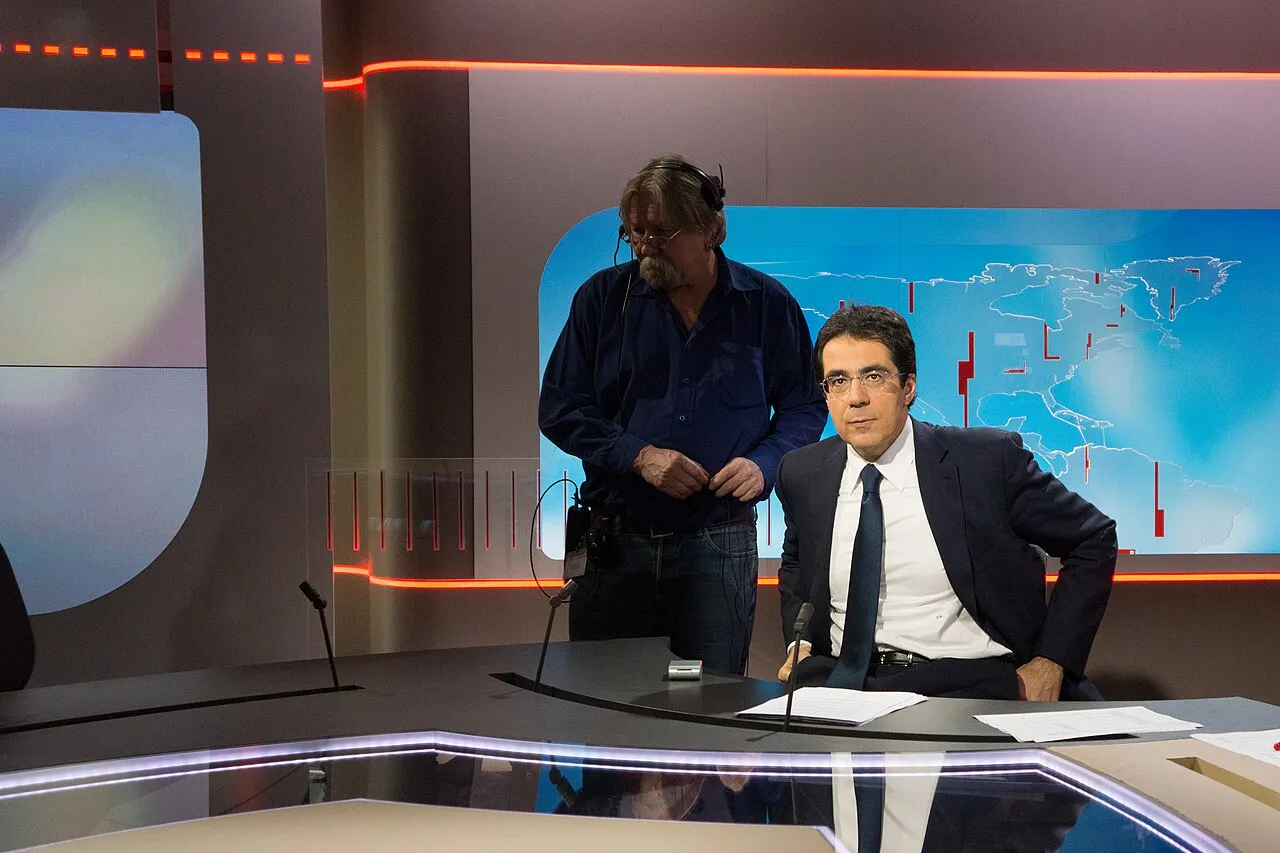
Contextual illustration of television production, not a Pakistani drama set, an ARY or HUM studio, or a photograph of Merub Ali.
Social media can open a door without completing the journey
The interview's most useful idea is that visibility can create access. A casting team can encounter somebody through a public video, an audience can become familiar with a new face and a performer can show work beyond a closed professional network. Those are opportunities to be seen.
Acting in a serial then asks for a different kind of consistency. A performer has to sustain a character through scenes recorded under production conditions, respond to other actors and contribute to the director's interpretation of a script. A popular clip is not the same task as maintaining that role across a longer story.
This distinction gives Merub's praise a constructive reading. It is possible to recognise the value of an online starting point while still judging the resulting screen work on its own terms. The two routes do not have to be treated as rivals in a contest over who counts as a legitimate performer.
What to notice when watching a performance
Start with what the character wants in the scene. That immediate objective gives dialogue a purpose. A request for forgiveness, an attempt to hide embarrassment and an effort to persuade a relative can use similar words while requiring different emphasis.
Then notice listening. Acting includes reactions while another character is speaking, not only the delivery of a line. A pause, a change in attention or a restrained response can carry information that a short dialogue compilation removes.
Finally, connect the scene with the wider episode. An emotional response may seem abrupt in isolation while making sense after an earlier event. This is a more useful approach to assessing any actor, including Merub, than assuming that one screenshot or one unusually intense moment can represent an entire serial's work.
Praise is not the same as a casting announcement
A performer can admire a colleague without announcing a collaboration. The reported comments about Dananeer and Romaisa should not become a headline claiming that all three have signed a new programme together. Such a claim would need its own production confirmation.
Likewise, the host's agreement during an interview is part of the conversation, not an official ranking of the industry. Viewers can value the remarks without treating them as a formal award or a comparative score assigned to other actors.
This matters because celebrity coverage often compresses several different ideas into one exciting sentence. Recognition, friendship, casting and a new release are not interchangeable. The verified news here is the supportive public discussion, with the listed programmes providing career context rather than proof of a fresh joint project.
Finding episodes without losing the story
Use the broadcaster's programme page or official full-episode route. Match the drama title and episode number before starting. A channel can publish trailers, teasers, scene clips and complete episodes together, and their similar thumbnails can make a short preview look like the next instalment.
If you are beginning a serial, start with its first episode unless you deliberately want only a particular scene. The earlier material establishes who the characters are and why a later decision matters. A chronological route is especially helpful when a short social-media clip has introduced the performer before the viewer knows the story.
Current playback, regional availability and advertising arrangements are controlled by the relevant platform. This guide does not promise that every programme is free on every device or that a third-party upload is authorised. The source links below point to broadcaster records so that the next step can be checked directly.
Names and dates need a little care
Merub's name and programme titles can appear with different English transliterations. Paristan may also be styled Paristaan, and Dananeer's surname appears in more than one Roman spelling. Matching the broadcaster, cast and programme identity is more reliable than treating every spelling variation as a different person or serial.
Dates can be misleading too. A website migration can place a recent page date on an introduction describing an older programme launch. The date attached to a retrieved web page is not automatically the original premiere date of the drama it discusses.
For that reason, this profile uses the programme pages to confirm credits and the dated Buzz coverage for the recent interview. It does not infer a fresh debut or a new broadcast launch merely from a recently updated archive page. A proper career timeline needs event dates, not just the date an old page was republished.
Questions about Merub Ali
Why are Merub Ali and Dananeer appearing together in searches?
Recent interview coverage highlighted Merub's praise of Dananeer and Romaisa Khan and her appreciation of social media's role in bringing talent forward. The checked report presents supportive comments about access and ability. It does not establish a feud, a private disagreement or a new joint casting announcement.
Which Merub Ali dramas can viewers verify?
ARY's introduction lists her in Sinf-e-Aahan, HUM's cast profile links her with Paristan and Wabaal, and ARY's Izzat page includes her in its cast. These are verified viewing starting points, not a claim that this short list contains every professional appearance.
Does a drama role explain her private personality?
No. A scripted character belongs to a fictional story created by a production team. Evaluate the performance in its scene and episode context. A character's relationship choices, arguments or mistakes should not be used as evidence about the actor's private conduct or personal relationships.
Is a social following the same as an acting qualification?
Visibility can help a performer be discovered, while acting work still has to be assessed through the performance. The interview's positive discussion can accommodate both points. Audience attention and the ability to sustain a convincing character are related to a career in different ways, not identical measurements.
Browse the article library for more verified entertainment context. Students looking for structured learning can separately explore courses and class resources.
Sources
- Dated Buzz interview coverage, for the supportive remarks, host and programme context. No English quotation is invented.
- ARY's Sinf-e-Aahan introduction, for the credited cast, writer, director and broad programme premise. Its displayed page date is not used as a new premiere date.
- HUM's Merub Ali cast profile, for the links to Paristan and Wabaal.
- HUM: Paristan, for the broadcaster's programme and episode route.
- HUM: Wabaal, for the broadcaster's programme record.
- ARY: Izzat, for the listed cast, broad synopsis and official viewing route. No future plot or country-wide playback guarantee is inferred.
Image credits: cover: דולב, source, CC BY-SA 4.0. Resized and converted to WebP. inline: Fanny Schertzer, source, CC BY-SA 3.0. Resized and converted to WebP.
Found an error or an outdated detail? Report a correction with the article URL and original source.