
Naruto for Beginners: Watch Order, Shippuden, Boruto and Legal Access
Start Naruto with a clear spoiler-light route through the original series, Shippuden and Boruto, with guidance on legal regional access.

If you are starting Naruto, the simplest route is to begin with the original Naruto anime, continue with Naruto Shippuden, and treat Boruto as a later-generation continuation rather than the starting point. The official franchise website lists those anime separately. That distinction is more useful to a beginner than an enormous list that mixes episodes, films, manga volumes and online rumours.
This spoiler-light guide explains how to choose a viewing route, understand the different formats and check legitimate availability. It does not promise that a particular streaming service carries every episode in Pakistan. Catalogues and language options vary by region, so availability should be checked on the authorized service before paying or planning a long viewing schedule.
What is Naruto about without major spoilers?
Naruto follows a young ninja, Naruto Uzumaki, as he develops his abilities and relationships within a wider fictional world. Training, teamwork, rivalry and recognition are central to the story. A beginner does not need to know later revelations, every village's history or the outcome of major battles before watching the opening episodes.
That is why a useful introduction should explain the premise without turning into a plot summary of the entire franchise. Knowing who the story follows and which series comes first is enough to begin. Character identities and relationships are often more rewarding when the story introduces them in context.
If you search for a character before reaching their introduction, be aware that search suggestions, image captions and fan discussion can reveal later events. For a first watch, use the official series directory and a short, spoiler-light guide instead of browsing an unrestricted character database.
What is the difference between Naruto and Naruto Shippuden?
They are separately named anime series within the same broad narrative journey. The original series establishes the early story and relationships. Shippuden continues after that foundation. Beginning with the second title because its clips look more dramatic can leave important motivations and connections unexplained.
The official anime directory gives each title its own listing and details. Use those exact names when searching a service, because a platform can organize the entries differently from a fan-made playlist. An apparently missing season may be listed under the other series title rather than under one combined Naruto heading.
For a beginner's watch plan, keep two separate progress markers. Record which series you are watching and the episode shown by the platform. This prevents confusion when an app restarts numbering, groups episodes into local seasons or presents dubbed and subtitled versions as separate catalogue entries.
Where does Boruto fit?
Boruto belongs after the original Naruto journey and Shippuden in a straightforward introductory viewing route. It is a later-generation continuation, so it assumes a world and relationships that earlier stories helped establish. The official website distinguishes the Boruto anime from the preceding anime titles.
The comics section also contains different Boruto titles. A manga entry is not automatically a newly released anime episode. When reading an announcement, check whether it concerns a comic chapter, television adaptation, event, game or merchandise. The franchise name alone does not identify the format.
A new viewer does not need to consume every later continuation immediately. Finishing one part and understanding its characters is a reasonable goal. Watching in a manageable order usually produces a better experience than treating the franchise as a checklist that must be completed as quickly as possible.
Should you watch in release order or chronological order?
For a first-time viewer, the original anime followed by Shippuden is a practical core route. Release-based viewing generally preserves the order in which the audience was introduced to information. A highly rearranged chronological list can place later explanations before the story originally revealed them.
Chronological lists can be interesting for a rewatch, but they often require judgement about flashbacks, supplementary stories and films. They may also expose spoilers in the very act of explaining where an entry belongs. A beginner should not feel that a complicated fan timetable is necessary to understand the main story.
Decide what you want from the guide. If the aim is to begin comfortably, use a simple core order. If you have already finished the story and want to compare timelines, a more detailed chronology becomes a different project with different spoiler expectations.
What does filler mean in anime discussions?
Fans commonly use filler for material that is not a direct adaptation of the main manga storyline. The label can be useful when discussing pacing, but it is not a universal quality score. An anime-original episode can still offer humour, character interaction or an enjoyable side story.
Different guides can classify mixed episodes differently, especially when adapted scenes and anime-original material appear together. A numbered skip list should therefore identify its method rather than present every label as an official instruction. This guide does not provide an unverified episode-by-episode removal list.
For a first watch, choose whether you prefer the complete television experience or a more focused main-story route. Either can be a legitimate preference. The important point is to know what the list is doing, rather than assuming that an episode has no value because someone attached a shorthand label.
Do you have to watch every film?
Films are separate entries and should not be silently inserted into an episode list without explanation. Their relationship to the main narrative can vary. Before watching a film during your first run, check a spoiler-light description and where a reliable guide recommends placing it.
Avoid opening a detailed plot summary just to answer a placement question. A summary may reveal the entire film and later television developments. Look for the minimum information you need: the title, format and whether the recommendation assumes you have reached a particular stage of the main story.
This guide deliberately does not claim that every film is mandatory, interchangeable or equally connected to the original manga. A beginner can follow the core anime route first, then make a separate film plan with clear spoiler boundaries.
How is the manga different from the anime?
Manga is read as sequential illustrated pages; anime adapts a story into moving images, sound, voice performance and timing. An adaptation can change pacing and add material. A reader should not assume that an anime episode number corresponds neatly to one manga chapter number.
If you switch formats, check the actual chapter or episode position before continuing. Starting from a guessed equivalent can repeat material or skip an important section. A reliable guide should state which version it follows, rather than mixing references from both without warning.
Reading and watching also create different experiences. A page can be studied at your own pace, while an animated scene controls movement and sound over time. Neither format needs to be treated as a lesser substitute. Choose the one that suits your attention, access and interest, while using authorized editions.
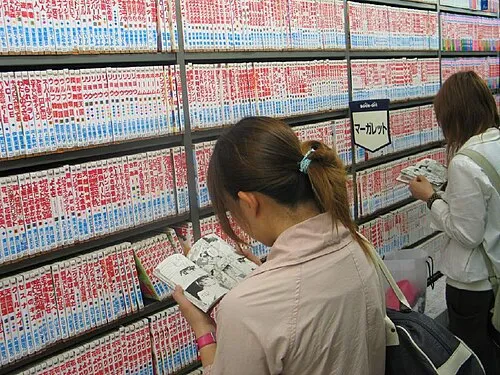
Archive Tokyo bookstore photograph from 2004. General reading-format context, not an official Naruto streaming service or episode image.
How can viewers in Pakistan check legitimate availability?
Start with the official Naruto anime directory, which links streaming information for the different titles. Then open the service's own catalogue from your region and confirm the specific series. Check the available episode range, subtitle languages and audio tracks before assuming a subscription includes everything you want.
The official site itself notes that information can vary by region and publication time. A service available elsewhere may not offer the same catalogue in Pakistan. An old article saying that Naruto is on a platform is therefore not a guarantee about today's local library.
Do not enter payment information into a page merely because it displays a familiar character. Confirm the provider's real domain and app publisher. A copied poster or a search advertisement is not proof of authorization. This is a practical browsing check, not a claim that all unofficial pages behave identically.
Subtitles or dubbing: which should you choose?
Choose the version that lets you follow the story comfortably. Subtitles can help viewers hear the original performances while reading a translation. Dubbing can reduce the amount of reading during visually busy scenes. Availability and the quality of a particular translation can also affect the choice.
Check whether the platform offers the language you expect across the entire series, not just a sample episode. Some catalogues have different language coverage for different seasons or entries. A missing audio option is not necessarily a problem with your device.
For students using entertainment to practise English, pause occasionally to note a useful phrase rather than trying to translate every line. Context matters. Fictional dialogue, dramatic insults and specialized ninja terminology are not always suitable models for ordinary classroom or professional conversation.
How can you avoid spoilers while searching?
Use specific, limited queries. Searching for the official watch order is less likely to reveal major plot details than searching for the fate of a named character. Avoid video thumbnails and discussion threads whose titles announce later outcomes.
Ask friends for a spoiler boundary before discussing the show. For example, say which series and episode you have reached. This is more precise than saying you have watched some Naruto, because the franchise contains a long narrative and several distinct entries.
You can also keep a small list of questions to revisit later. Not every mystery needs an immediate search. Allowing the story to answer its own questions can preserve the experience and reduce the chance that a search engine reveals a much later event in one sentence.
What makes a useful viewing schedule?
Choose a session length that fits your routine and use the platform's displayed episode duration. Long-running fiction is easier to enjoy when it does not displace sleep, studies or other responsibilities. There is no prize for finishing a series faster than someone else.
A simple progress note can contain the series title, episode, one new character and one question. That is enough to return after a break without relying on a spoiler-heavy recap. If you write a short summary, keep it in your own words rather than copying dialogue or a published synopsis.
Families choosing content for younger viewers should check the local service's age guidance and content information. A cartoon presentation does not automatically mean every scene suits every child. This guide does not replace a parent's judgement about violence, themes or an individual viewer's readiness.
How do you check rumours about new Naruto projects?
Identify the original announcement and its format. A licensing presentation, a comic promotion, a game reveal and a television release schedule are different sources. An announcement of a project does not automatically establish a completed release, a local streaming date or a particular cast.
Check the official franchise news pages and the relevant publisher or producer. Read the date and the precise wording. If a page only teases future information, report it as a teaser rather than converting it into a firm premiere announcement.
This guide does not turn current search speculation into a confirmed new-film release date. The practical watch route remains useful without attaching an unverified breaking-news claim. Future project coverage should be a separately researched update with its own direct announcement.
A spoiler-light learning activity
After an early episode, write a short paragraph about one decision a character made. Separate what happened from your interpretation of why it happened. You can discuss teamwork, persistence or communication without revealing later plot developments.
Then compare two scenes in terms of storytelling technique. One might use dialogue to explain a conflict, while another uses action or silence. Describe the method rather than copying the script. This turns viewing into an exercise in observation and writing rather than passive scrolling through clips.
For more reading practice, browse the RayTech article library. Keep entertainment explainers distinct from official release announcements. A good guide helps you choose what to watch and how to understand it; it does not need to pretend that every rumour is news.
Common questions about starting Naruto
Which series should a beginner start with?
Start with the original Naruto anime. Continue with Naruto Shippuden after that foundation. Boruto is better treated as a later continuation, not a substitute for the opening story.
Is a manga chapter the same as an anime episode?
No. They are different units in different formats. Adaptation pacing varies, so chapter and episode numbers should not be assumed to match.
Is every streaming claim on an old guide still reliable?
No. Catalogue rights and regional availability can change. Confirm the title, episode range and languages directly on the authorized service before subscribing.
Does this page provide free episode downloads?
No. It explains viewing order and how to check legitimate access. It does not distribute copyrighted episodes, scripts or unofficial download links.
Sources
- Official Naruto anime directory and streaming links
- Official Naruto comics directory, for distinguishing reading and viewing formats
Checked on 14 November 2026. Viewing-planning advice and classroom activities are original explanations. No regional streaming subscription or unannounced release date is promised.
Image credits: cover: Marek Slusarczyk, source, CC BY 3.0. Resized and converted to WebP. inline: Bobby, source, CC BY 2.0. Resized and converted to WebP.
Found an error or an outdated detail? Report a correction with the article URL and original source.