
N Golo Kante: League Titles, France 2018 and Midfield Cover Explained
Explore N Golo Kante’s Leicester, Chelsea and France milestones. Learn midfield cover, ball recovery, support angles and football-statistics context.
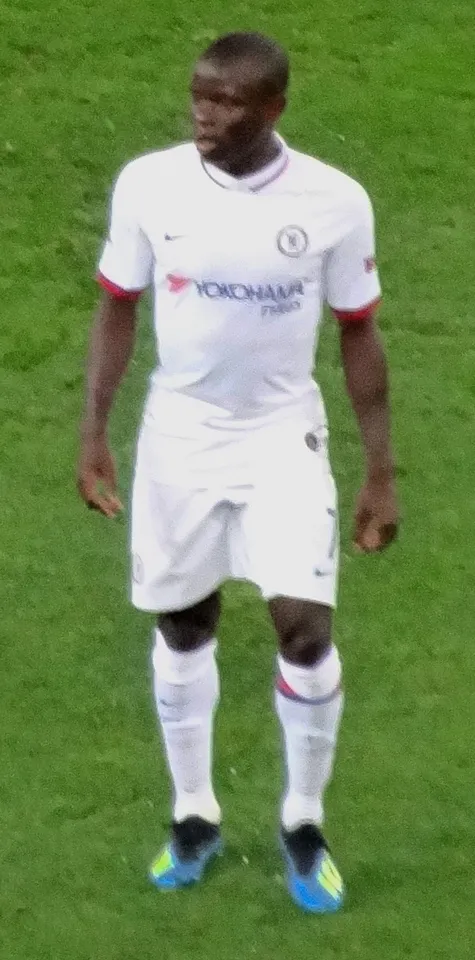
N'Golo Kante's career helps explain why a midfielder's value cannot be reduced to goals or distance covered. Reading danger, protecting space and helping the next pass reach a teammate are less obvious than a finish in front of goal, but they can shape an entire sequence. A useful analysis connects those actions rather than describing every energetic player as doing the same job.
The historical anchors here are Leicester City's 2015/16 league title, Kante's move to Chelsea in 2016 and France's 2018 World Cup victory. Club and federation records establish those stages. This guide then explains midfield cover and recovery through general football concepts, without inventing current fitness, private instructions or a new transfer announcement.
Who is N'Golo Kante?
N'Golo Kante is a French professional footballer whose career includes Leicester City, Chelsea and international competition with France. The French Football Federation records the Leicester and Chelsea periods, while the Premier League documents the 2016 transfer. The dated record is the foundation for this profile; an old club photograph is not used to establish present registration.
Keep three different records separate
A club career, a national-team career and an individual award history describe different categories. A World Cup win with France is not a Chelsea competition title, even if a club museum celebrates the achievement of one of its players. A clear table names the team and event for each honour so readers understand exactly what was won.
A role is not a fixed patch of grass
Calling someone a midfielder gives a broad location within the team, but the exact job depends on teammates and match conditions. One sequence may require pressure on the ball, another may require protecting a passing lane. Avoid treating a position label as a complete explanation of every action. The surrounding team shape gives the role practical meaning.
What happened at Leicester and Chelsea?
Kante was part of Leicester's 2015/16 Premier League title-winning team and joined Chelsea in 2016. The Premier League's signing report records the transition. Chelsea's historical material also identifies his contribution to its 2016/17 league success. These are successive seasons with different clubs, not a claim that one team won the same championship twice in a single season.
A season spans more than one calendar year
The label 2015/16 describes a football season, while 2016 can describe a transfer date. The two systems of dating should not be confused. Place season results and dated moves in separate fields when building a timeline. This prevents the reader from assuming that every event with 2016 in its label happened in the same competitive campaign.
A signing record does not remain current forever
The 2016 announcement establishes what Chelsea confirmed then. It is not evidence of today's contract terms or current squad availability. Later developments require their own records. Historical photographs remain useful when dated honestly, but a shirt worn years ago should not be made to carry a new present-tense claim that the source does not establish.
Why does the 2018 World Cup belong in the story?
Kante was part of France's 2018 World Cup-winning side. The French federation and Chelsea's historical account support that milestone. It is an international team achievement, not a description of every individual match or a claim that one player alone won the competition. The team context makes the honour understandable without erasing the contributions of other players.
An honour does not measure every action
A medal establishes participation in a successful competition outcome under its records. It does not tell you exactly how many recoveries or passes a player made. Those questions need match data. A profile can celebrate the documented achievement while keeping detailed performance analysis tied to its own evidence instead of using the medal as proof that every decision was correct.
Avoid a one-player explanation
Football success involves the goalkeeper, defenders, midfielders, attackers and coaching structure. A midfielder can make important contributions without being the only cause of a result. Identify the visible action and its relationship to teammates. This makes the account more useful for learning than a claim that one player was everywhere or did every job on the pitch.
What does midfield cover mean?
Cover concerns protecting space that may become vulnerable when a teammate moves or the ball changes hands. It can involve adjusting position rather than making an immediate tackle. The aim is to limit dangerous options and support the team's next action. When studying Kante, watch where he is before the ball arrives, not only the final challenge that attracts the camera.
Pressure and cover have different jobs
One player can approach the ball carrier while another protects the space behind or beside that pressure. If both chase the same ball, a passing route may open elsewhere. The arrangement depends on the situation. This general principle should be illustrated from a visible sequence, not presented as a private instruction that Kante followed identically in every team.
Holding position can be active work
A player who stays in a useful lane may prevent a pass without touching the ball. That is not automatically proven by standing still; the relation to opponents and teammates matters. Describe which route was restricted and what the ball carrier did instead. This turns an invisible-sounding compliment into an observation another viewer can assess.
The nearest threat can change quickly
As the ball moves, an opponent who was harmless can become the next receiving option. A midfielder needs updated information rather than reacting only to the previous position. Watch scanning and adjustment where the footage permits it. A single camera angle may not show every check, so avoid claiming that an unseen action never occurred.
How does ball recovery differ from tackling?
A tackle is one way to challenge for possession. A recovery may follow a loose ball, an interception or another event depending on the data provider's definition. The categories should not be treated as identical. Before comparing totals, read what the source counts and decide whether the numbers answer the question being asked.
An interception begins before contact
Recognising a likely passing route can put a player in position to intercept. The final touch is only the visible end of that process. A useful analysis examines the passer's options and the defender's movement beforehand. Do not assume every intercepted pass was entirely forced; an inaccurate delivery can also contribute to the outcome.
Winning the ball is not finishing the task
After a recovery, the team needs to control possession or manage the next risk. A rushed pass can return the ball immediately to the opponent. Follow the next action rather than counting the recovery as a complete success in isolation. The transition from defence to attack often depends on support, orientation and a suitable first pass.
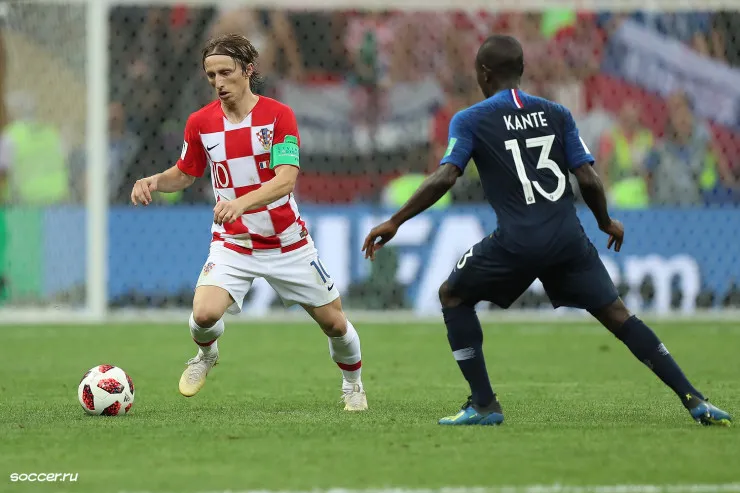
N Golo Kante and Luka Modric at the 2018 World Cup, shown as historical international context.
What should a first pass after recovery achieve?
The best available option may be forward, sideways or back depending on pressure and teammate positions. A forward pass is not automatically more useful if it reaches a player with no next option. A simple pass can help the team reset and preserve the benefit of winning possession. Judge the receiving situation rather than the direction alone.
Support creates a safe exit
A teammate offering a clear angle can make the recovery easier to convert into controlled possession. If the recovering player is surrounded, the whole team's spacing matters. Avoid assigning all responsibility to the person with the ball. The available options are produced collectively, and footage can reveal both a strong recovery and a lack of nearby support.
A carry can draw a new defender
Moving with the ball may attract pressure and open a passing route elsewhere. It can also increase the risk of losing possession. The decision depends on the space and the next options. Describe what changed after the carry rather than praising movement merely because it covered distance. Progress is about the team's situation, not metres alone.
How should running statistics be interpreted?
Distance covered can describe workload, but it does not show whether every movement was useful. A player may run to correct an earlier spacing problem or make a small adjustment that prevents danger efficiently. More distance is not automatically better performance. Combine movement data with role and match context before turning a physical total into an overall ranking.
Similar totals can hide different tasks
Two midfielders can cover the same distance while making very different runs. One may repeatedly support attacks; another may protect a deeper zone. A raw total does not explain those responsibilities. Use clear descriptions or appropriate tracking categories where available, and avoid filling gaps with a personality story about who wanted success more.
Do not prescribe a professional workload
This article is a viewing and learning guide, not an exercise programme. A professional's match distance does not establish a safe target for a beginner. Students can learn the tactical ideas from short sequences and simple diagrams. Physical practice should fit the person's level and conditions, with appropriate qualified guidance rather than imitation of an elite workload.
What can a small statistics exercise reveal?
Imagine a fictional midfielder attempts ten labelled challenges and succeeds in seven. The success rate is 70 percent. Another succeeds in four of five, or 80 percent. The second rate is higher, but the first contains more successful actions. Neither tells you where the challenges occurred or whether they helped the team retain possession afterward.
Opportunities differ by role
A player facing repeated opposition attacks has more chances to make defensive actions than one whose team keeps the ball. Comparing totals without that context can reward exposure rather than effectiveness. Ask what the midfielder was required to do. A statistic should assist that explanation rather than replace it with a simpler claim that the larger number proves the better player.
A missing count is not zero
If a historical source does not provide recoveries, mark the field unavailable. Entering zero would claim no recoveries occurred. The distinction matters when drawing charts or calculating rates. Good data handling preserves uncertainty instead of forcing every blank cell into a convenient number that makes the final table look complete.
A midfield-cover observation project
Choose consecutive possessions from one historical match and record the ball position, nearest opponent, midfielder's position and next action. Include sequences with no tackle. The exercise should help students notice preventative work and how cover changes when teammates advance. State the camera's limits and avoid drawing conclusions about spaces the footage never shows.
Write a narrow conclusion
A useful report might say that the player repeatedly protected one passing lane in the selected sequence. It should not claim this proves the team's entire tactical plan for the season. Keep observation and interpretation distinct, and identify what further video or data would help. A modest supported conclusion is stronger than a sweeping claim built from a short montage.
Connect the analysis with a simple tool
Use the class resources for supporting mathematics and the programming courses to create a possession log. Store source, match date and category definitions with each entry. Validate counts and show raw opportunities beside percentages. A reliable small tool can make the tactical explanation clearer without pretending to score qualities that the data cannot actually measure.
Questions about N'Golo Kante
Did his two league titles belong to the same club?
The milestones discussed here are Leicester's 2015/16 title and Chelsea's 2016/17 title. They belong to successive seasons and different teams. Keeping the season labels clear prevents a confusing summary based only on calendar years. France's 2018 World Cup victory is a separate international honour, not another club league championship.
Is recovering the ball the same as playing well afterward?
No. A recovery changes possession, while the next pass or carry determines what the team can do with it. Both stages matter. A useful assessment recognises the defensive action and then follows the transition. It does not assume a recovery total alone describes control, creativity or the entire quality of a midfielder's performance.
Sources
- French Football Federation: N'Golo Kante's career record
- Premier League: the 2016 Chelsea signing
- Chelsea: historical account of Kante's World Cup and league successes
Image credits: cover: Liondartois, source, CC BY-SA 4.0. Resized and converted to WebP. inline: Кирилл Венедиктов, source, CC BY-SA 3.0. Resized and converted to WebP.
Found an error or an outdated detail? Report a correction with the article URL and original source.