
Oman vs Netherlands: Seven-Wicket Win and League 2 Standings Context
Netherlands beat Oman by seven wickets in Dubai. Read the completed score, Ackermann’s figures and why League 2 standings differ from ODI rankings.
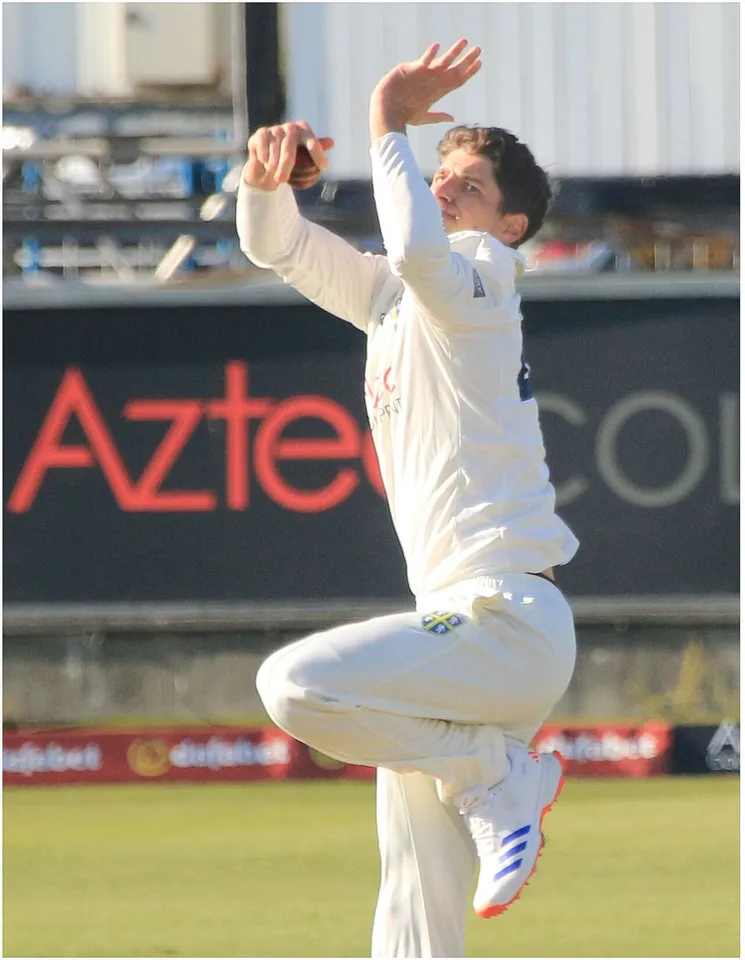
The Netherlands beat Oman by seven wickets on 2 November 2026, chasing 183 at the ICC Academy in Dubai. Oman made 182 in 49.2 overs; the Netherlands reached 183/3 in 36 overs. Colin Ackermann was named player of the match after taking four wickets for 23 runs.
The match was part of ICC Cricket World Cup League 2, not a T20 tournament. If you searched for Oman national cricket team vs Netherlands national cricket team standings, it is important to distinguish that competition's points table from the separate ICC ODI team rankings. They measure different things and do not use interchangeable numbers.
The confirmed match summary
| Detail | Recorded result |
|---|---|
| Date | 2 November 2026 |
| Competition | ICC CWC League 2, match 144 |
| Ground | ICC Academy, Dubai |
| Toss | Netherlands chose to field |
| Oman | 182 all out, 49.2 overs |
| Netherlands | 183/3, 36 overs |
| Winning margin | Seven wickets |
| Player of the match | Colin Ackermann, 4/23 from ten overs |
The ICC's completed match centre is the basis for the result above. Some search snapshots still showed a scheduled fixture or an unfinished chase when reviewed. A page can be genuinely associated with the right match and still contain an earlier state rather than the final result.
That makes the status label essential. “Upcoming,” “live” and “completed” are not decorative labels. They tell the reader whether the displayed numbers represent a plan, an intermediate position or the recorded outcome of the contest.
What do the standings mean here?
League 2 standings record progress within a defined qualification competition. The Netherlands and Oman can each have a position in that league and a different position in the wider ICC ODI team rankings. Searching for one country's “rank” without a competition heading can therefore produce a misleading answer.
The ICC's 15 October preview placed the Netherlands third and Oman fourth at that earlier point. Those positions were attached to specific matches-played and points totals before the Dubai series. They should not be copied into a November result as though no intervening matches occurred.
The current official standings page did not expose a readable table in the source response checked for this article. Consequently, this page does not label a reconstructed table as official live standings. Use the ICC League 2 standings for the current competition order, alongside its update context.
Why not just add the latest win to an old table?
Because other fixtures may have changed both teams' totals between the earlier snapshot and this result. Starting from a mid-October table and adding only the 2 November match would skip the rest of the series. It can produce a neat-looking but incomplete answer.
A reliable reconstruction needs every relevant intervening result and the applicable points and tie-break rules. Without those inputs, the correct response is to distinguish the confirmed match outcome from the unverified current table. Uncertainty about a table does not make the final score uncertain too.
This is particularly important near qualification decisions. A missing result can affect points, matches played and tie-break comparisons. Readers deserve a clearly dated answer rather than an exact-looking rank assembled from incompatible snapshots.
Was this a World Cup match?
It was part of the World Cup qualification pathway, not a match in the main World Cup finals tournament. The ICC describes League 2 as a fifty-over competition connected to the route toward the 2027 event. That connection does not make every League 2 fixture a World Cup finals appearance.
The distinction is similar to separating a qualifying round from the final tournament it leads toward. Both can be important, but they occupy different stages. A team's successful result in the earlier stage must not be reported as winning a place beyond what the applicable qualification rules establish.
The October announcement said the top four League 2 teams advance to the Global Qualifier and that the Netherlands had already secured participation there. That is qualification for another qualifying tournament, not a statement that every remaining step to the main World Cup has disappeared.
How did the Netherlands complete the chase?
Cedric de Lange made 79 and Zach Lion-Cachet made 68 in the completed ICC scorecard. Those innings provided most of the chasing side's batting runs. Max O'Dowd contributed 29, while the final score included smaller unbeaten contributions and extras.
The two larger scores add up to 147, but that sum should not be labelled their partnership without checking the stand itself. Individual final scores can include runs made before or after a particular partnership began. A partnership is a defined interval between wickets, not automatically the sum of two complete innings.
The chase finished with three wickets lost. That supports the stated seven-wicket margin in a standard ten-wicket innings. It does not mean the Netherlands won by seven runs, nor does it describe seven wickets taken by one bowler.
Why was Ackermann player of the match?
The official award identifies Ackermann, whose bowling return was 4/23 from ten overs. His wickets and conceded runs explain why the bowling contribution is prominent in this match summary. His batting entry was one run from two balls, so the award should not be recast as recognition for a large chasing innings.
The figures can also be read without an exaggerated adjective. Four is the wicket count and twenty-three is the number of runs charged to his bowling. Ten overs is the amount bowled. The three elements describe different aspects of the spell and should remain visible together.
His economy for that spell is 2.3 runs per over, calculated by dividing twenty-three by ten. That is a derived rate, not a new event. It does not reveal every delivery's line, length or movement, and it is not a claim that the same rate will occur in another match.
What does 49.2 overs mean?
It means forty-nine complete overs and two additional legal balls. In six-ball cricket that is 296 legal balls. It does not mean 49.2 decimal overs, because the digit after the point counts balls rather than tenths of an over.
This distinction affects rate calculations. Oman's 182 runs divided by 296 legal balls and multiplied by six gives approximately 3.69 runs per over. Dividing by the decimal number 49.2 uses a different denominator and produces a subtly incorrect result.
The notation also explains why an innings can finish before the fifty-over allocation is used. Once the batting innings has ended, the unused legal deliveries do not become extra runs. A scorecard records both the total and the opportunity used to reach it.
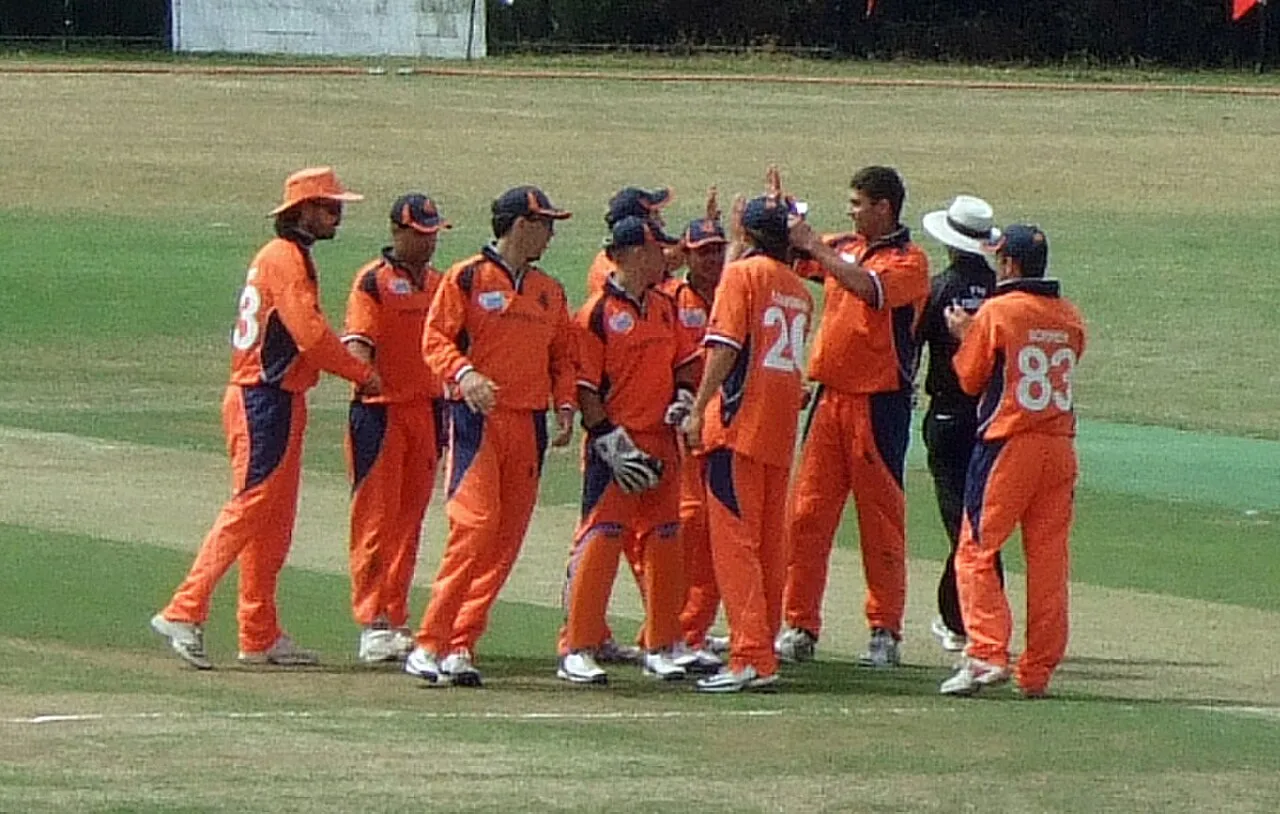
Historical Netherlands team photograph from a different fixture in Rotterdam, not the Dubai match against Oman.
How many balls were unused in the chase?
In an uninterrupted fifty-over allocation, there are 300 legal balls. Thirty-six completed overs use 216, leaving eighty-four, equivalent to fourteen overs. This is arithmetic from the recorded completion point, not a separate claim about the exact time the match ended.
Finishing with legal deliveries remaining is different from finishing with wickets remaining. The Netherlands had both in this result, but the official seven-wicket margin expresses the wicket side of the outcome. A report can mention the remaining balls as context without changing the result wording.
Physical deliveries and legal balls are not always identical because wides and no-balls have their own treatment. When deriving the unused allocation, use the legal-ball progress represented by the over notation rather than counting every action visible in a highlights package.
Why was the target 183 rather than 182?
In an ordinary unrevised chase, the batting side needs one more than the opponent's completed total to win. Oman made 182, so reaching 183 took the Netherlands ahead. A score of 182 would have levelled the totals rather than surpassed them.
The result must still be read in the context of the actual match. Rain-affected games can use revised targets under the relevant method. This page follows the completed scorecard for this fixture and does not apply a hypothetical rain adjustment that the confirmed result does not require.
For readers learning to follow a chase, keep the opponent's total, the current score and the target in separate places. Collapsing them into one number is the source of many off-by-one errors in informal match summaries.
Can one match produce a complete net run rate?
Not necessarily. A tournament net run rate depends on the relevant accumulated scoring and conceded records under the competition's rules. Subtracting two displayed rates from one fixture is not automatically the same thing as calculating a team's entire tournament NRR.
All-out innings, reduced games and the regulations governing the competition can affect the denominator. An accurate explanation therefore needs the proper innings data and rule treatment, not just the final winning margin. It is better to quote the organiser's verified figure than improvise a league-wide decimal from one scoreboard.
The seven-wicket victory is certain from the completed result. Its exact effect on a displayed NRR column is a separate calculation. Keeping those statements apart prevents a correct match report from acquiring an unsupported piece of statistical precision.
What changed from the earlier fixture?
The Dubai series schedule included more than one Netherlands-Oman meeting. A search can therefore return an earlier match involving the same sides in the same city. The date and match number identify which score belongs to which meeting.
Do not merge two results into a single innings or assume that the first result shown is the latest. A series contains separate opportunities, scores and individual performances. The November meeting's player-of-the-match award belongs to this match, not automatically to the earlier contest.
For an archive, use one stable page per distinct match intent and link related fixtures where useful. Renaming a previous result without updating its underlying score creates confusion for readers who arrive from an older saved link.
A quick check before sharing a score
Read the team labels first, then the date and format. Confirm that the status says completed and that the result sentence agrees with the totals. If the page includes a league table, check that table's date separately instead of assuming it refreshed with the match score.
For example, an unfinished chase can show a current required rate and a large number of balls remaining. Those are live-state fields, not the final winning margin. A screenshot captured during that state can continue circulating after the game has finished.
Use an official match centre when available and preserve enough context in the shared image or text for somebody else to identify the fixture. A correctly labelled final result is more useful than an attractive graphic that removes the date and competition.
Common questions
Who won Oman versus Netherlands on 2 November?
The Netherlands won by seven wickets. Oman scored 182 all out, and the Netherlands reached 183/3 in 36 overs at the ICC Academy in Dubai. This was a completed fifty-over League 2 fixture, not a prediction or a T20 result.
Who was player of the match?
Colin Ackermann received the award. His recorded bowling figures were four wickets for twenty-three from ten overs. The completed scorecard also records his small unbeaten batting contribution, which should not be confused with the substantial innings played by de Lange and Lion-Cachet.
Is League 2 rank the same as ICC ODI rank?
No. League 2 is a particular competition table. ICC ODI team rankings compare eligible international sides through a separate rating system. A team can occupy different positions in the two, and points from one should not be copied into the other.
Is this page a live standings service?
No. It is a reviewed result and explanation dated 3 November 2026. The organiser's standings link is provided for the current table. Where the retrieved official source did not expose readable standings, this article states the limitation instead of inventing a current position.
Follow the next result with the right table
This match has a clear outcome: the Netherlands chased the target with seven wickets available, supported by two substantial innings after Ackermann's bowling return. The wider qualification picture requires the competition table, its date and the applicable progression rules.
For the related Dubai series, see our Netherlands and UAE match explanation only if you are following that separate fixture; its result must not be substituted for this one. Browse sports articles for other completed-match coverage, and use the ICC's current records when a fresh table position is the question.
Sources
- ICC: Oman versus Netherlands, match 144, completed scorecard, for the result and individual scorecard entries.
- ICC: Netherlands name squad for League 2 games, 15 October 2026, for the dated qualification and series context. Its earlier table snapshot is not presented as a current November table.
- ICC: League 2 standings, for the official current-table destination. Overs, ball counts and rates derived above are calculations from the reported innings, not a reconstruction of tournament net run rate.
Image credits: cover: Dave Morton, source, Public domain. Resized and converted to WebP. inline: Lemonlolly, source, CC BY-SA 3.0. Resized and converted to WebP.
Found an error or an outdated detail? Report a correction with the article URL and original source.