
Over Rate Explained: Why Pakistan Was Fined After the Final
Pakistan's five-per-cent over-rate fine explained: what happened, how timing differs from run rate, and why the stop clock is a separate rule.

Pakistan's slow over-rate penalty did not change the result of the tri-series final. The ICC's announcement on 2 November 2026 says the players were fined five per cent of their match fee after the team finished one over short of the permitted time, with allowances already considered. That is a financial sanction, not a deduction from the runs Pakistan scored.
If you searched for over rate, the essential distinction is this: over rate measures the pace of bowling overs against time. Run rate measures the pace of scoring runs against overs. A team can score quickly, win its match and still receive an over-rate penalty for taking too long in the field.
What happened in Pakistan's tri-series final?
The ICC identified Pakistan's ODI tri-series final against Sri Lanka in Lahore as the relevant fixture. Match referee Jeff Crowe determined that Pakistan was one over short after permitted time allowances. The announcement says captain Shaheen Shah Afridi accepted the sanction, so a formal hearing was unnecessary.
These details matter because a delayed television schedule alone cannot prove an offence. The governing body's calculation includes the applicable playing conditions and permitted interruptions. The announcement reports the resulting shortfall rather than asking viewers to estimate guilt from the time displayed on their phones.
The five-per-cent fine applies to match fees under the provision cited in the announcement. It does not mean five per cent of a player's annual contract, sponsorship income, career earnings or the team's tournament prize. Those are different financial categories and should not be substituted into the headline.
Over rate, run rate and required rate are different
| Term | Main question | Typical units |
|---|---|---|
| Over rate | How quickly is the fielding team completing overs? | Overs per hour |
| Scoring run rate | How quickly has the batting team scored? | Runs per over |
| Required run rate | How quickly must the chasing team score from here? | Runs per remaining over |
| Bowling economy | How many runs has a bowler conceded per over? | Runs conceded per over |
A side with a high scoring run rate has not necessarily maintained a good over rate. One concerns its batting output; the other concerns the timing of its fielding work. Bowling economy introduces another denominator because it describes conceded runs, not minutes used.
This is why the words beside a number matter. A figure of six might describe six runs per over, six overs per hour or six wickets. The numeral alone is not enough to compare performances or understand a disciplinary decision.
How do you calculate an ordinary over rate?
For a basic measurement, divide completed overs by the time in hours. If twelve completed overs take forty-eight minutes, the elapsed time is 0.8 hours. Twelve divided by 0.8 gives fifteen overs per hour. This is a simple pace calculation, not an official ruling on a real match.
The same calculation can be written as completed overs multiplied by sixty and divided by elapsed minutes. Keeping the minute-to-hour conversion visible prevents a common error: dividing twelve by forty-eight and calling the answer an hourly rate. That unconverted result is overs per minute.
For a quick sense check, forty-eight minutes is less than one hour. Completing twelve overs in that time must correspond to an hourly pace above twelve. If your answer is below one over per hour, the units have probably been mixed.
Why is an official calculation more complicated?
Official decisions use the relevant playing conditions, including time allowances. A raw stopwatch reading can include periods for which the fielding team should not be held responsible. Medical treatment, reviews and other qualifying interruptions must be handled according to the rules applicable to that match.
Consider a deliberately simplified example: twelve overs are completed during a fifty-four-minute period, but six minutes are excluded under the exercise's stated allowance. The adjusted time becomes forty-eight minutes. The raw calculation is approximately 13.33 overs per hour; the adjusted calculation is fifteen.
The example explains the effect of an allowance, not which interruptions an umpire must accept. A viewer cannot choose an arbitrary deduction to make their preferred team pass. The decision belongs to the appointed officials applying the actual conditions, with the final shortfall sometimes announced after play.
Why does 19.4 overs not mean 19.4 in a calculator?
Cricket's over notation is not ordinary decimal notation. In a six-ball over, 19.4 means nineteen completed overs and four additional legal balls. It represents 118 legal balls, or nineteen and two-thirds overs, rather than nineteen and four-tenths.
For a worked example, suppose those 118 legal balls take eighty minutes in a simplified observation. Convert the delivery count into overs first: 118 divided by six is about 19.6667. Multiply by sixty and divide by eighty to obtain approximately 14.75 overs per hour.
Typing 19.4 directly produces a different result because the calculator treats the digit after the point as tenths. This small mistake affects run-rate and economy calculations too. Converting to legal balls first is a reliable way to keep cricket notation separate from decimal arithmetic.
Do wides and no-balls complicate timing?
They can add delivery events and consume time without advancing the legal-ball count in the same way as an ordinary legal delivery. That is one reason the number of physical deliveries seen by a spectator is not automatically the same as the ball count used to complete overs.
When checking a scorecard, keep three columns separate: legal balls, other delivery events and elapsed time. Combining them into a single counter hides the reason a period of play may take longer than expected. The over number records the legal-ball progress rather than every action on the field.
This does not establish that every extra automatically excuses a slow over rate. The applicable conditions determine the treatment. It simply explains why a casual count of how often a bowler ran in is not a sufficient replacement for the official calculation.
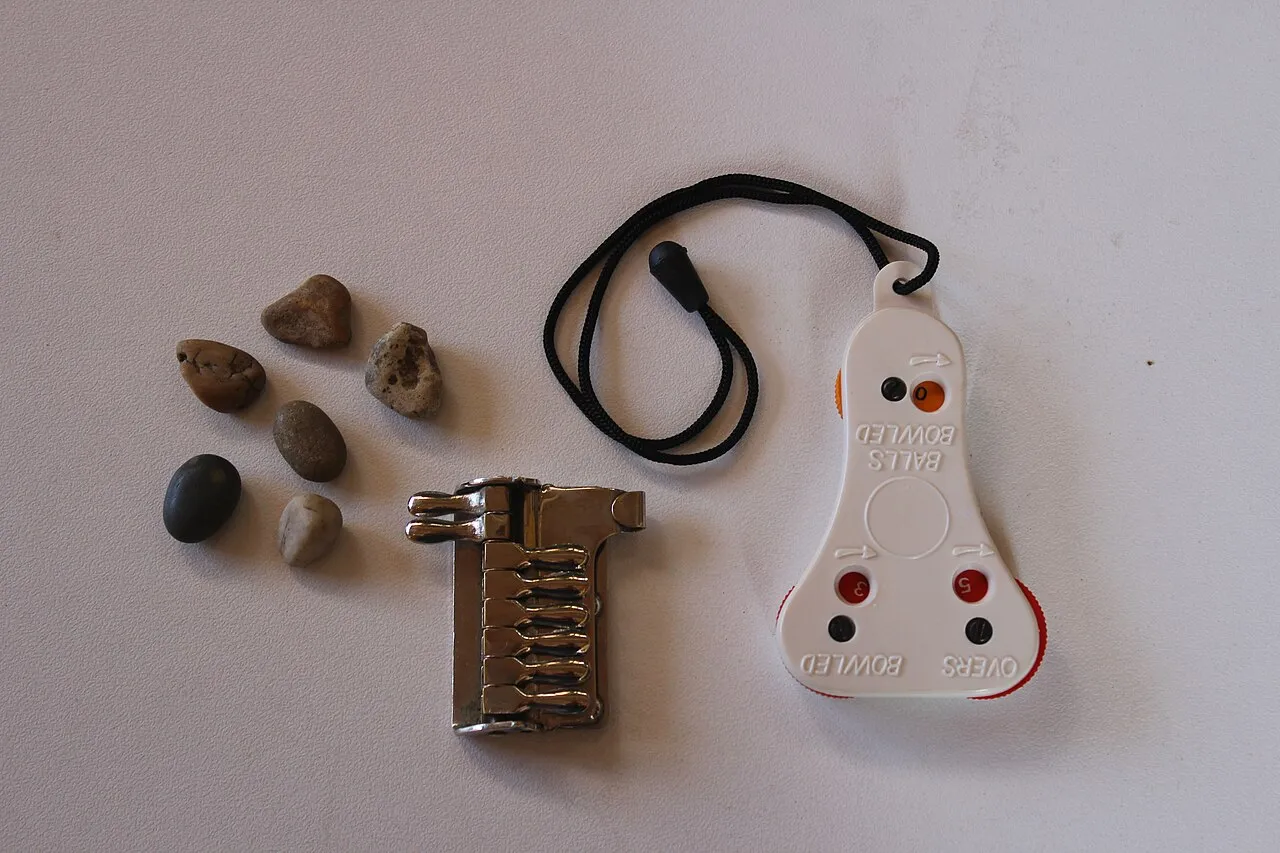
Ball-counting equipment illustrates legal-delivery tracking; it is not the electronic stop clock.
Is the stop clock the same as the over-rate rule?
No. The stop clock regulates the interval between overs, while an overall over-rate assessment considers the relevant period of play. The ICC's stop-clock explanation describes a sixty-second interval for starting the next over. Its later playing-condition announcement also describes the clock's introduction into Test cricket.
A side could prepare promptly between overs but use time elsewhere during play. Conversely, one problematic interval does not by itself reveal the final adjusted rate across an entire innings. The two controls address related timing problems, but they do not use identical measurements.
Think of a bus journey with a limit on each station stop and a separate target for completing the route. The stop length and total journey duration can influence each other, yet they remain distinct tests. That analogy is only an explanation of measurement, not a statement that cricket rules follow transport regulations.
Can a stop-clock breach add runs?
The ICC's playing-condition announcement describes a five-run penalty after two warnings for repeated failure to be ready within the required interval in the Test context it explains. That is a different mechanism from the match-fee fine in Pakistan's November ODI announcement.
Do not combine the two into a claim that Pakistan's five-per-cent fine meant five penalty runs. One number is a percentage of money; the other is a possible scoring consequence under a specified timing provision. Similar-looking fives do not make the rules interchangeable.
For any specific incident, check the event report and the edition of the playing conditions in force. Formats, competition requirements and rule versions matter. An old explanatory clip may illustrate the principle without being a complete statement of the rules for a later fixture.
Can the winning team still be fined?
Yes. A match result and an over-rate sanction answer different questions. The result records the outcome of play; the timing decision records whether the fielding side met its obligations. A victory does not remove the requirement to comply with playing conditions.
That separation helps explain headlines that otherwise sound contradictory. “Won the final” and “fined after the final” can both be accurate descriptions of the same team. Neither statement logically cancels the other, and a report should avoid suggesting that the fine reverses the victory unless an official decision actually says so.
It also keeps sporting analysis fair. Batting success can deserve recognition while the timing offence is reported clearly. Readers do not need to choose between pretending the breach never occurred and pretending the whole performance has been erased.
Why should format and date appear beside the rule?
Cricket has separate playing conditions for different formats and categories. A minimum pace, deadline, allowance or sanction taken from one document should not be pasted into an explanation of another without checking its applicability. Search results can surface older handbooks beside newer announcements.
Before quoting a rule, record the document's title, the competition or format and the date or edition. Then check whether a newer amendment applies. This takes slightly longer than copying the first number shown in a search snippet, but it avoids presenting a historical rule as a universal current standard.
For this article, the confirmed Pakistan sanction comes from the dated ICC release. The arithmetic examples explain units and timing. They do not independently reconstruct the referee's complete calculation or establish a minimum pace for every form of cricket.
A practical way to read the next over-rate headline
Start with the fixture and format. Then identify the sanctioned team, the confirmed number of overs short, whether allowances were considered and the exact type of penalty. Finally, separate any additional sporting consequence from the financial sanction rather than assuming one follows automatically from the other.
For example, a headline saying “one over short” does not tell you how many raw minutes were lost. A penalty based on an adjusted official calculation cannot always be reversed into a stopwatch estimate using a simple multiplication. Missing inputs remain missing even when the final sanction is known.
Check who issued the statement as well. The governing body's disciplinary announcement is a stronger basis for describing the ruling than an angry fan post. Commentary can offer an opinion about fairness, but it should not silently replace the decision's stated facts.
Common questions
Does a five-per-cent fine remove five runs?
No. A match-fee percentage is a financial sanction. Run penalties are separate measures and must be identified as such in the applicable conditions or official report. Pakistan's 2 November announcement described a match-fee fine, not a five-run alteration to the final score.
Is the captain the only person affected?
Read the wording of the specific announcement. The Pakistan release refers to the players' match fees and records the captain's acceptance of the proposed sanction. A captain's procedural role should not be misread as proof that only the captain's finances are involved.
Can I calculate the official penalty from television footage?
You can estimate raw elapsed pace, but you may not know every accepted allowance, interruption or official timing adjustment. Treat your calculation as an observation with stated assumptions. It is not a substitute for the match referee's decision or the conditions governing the fixture.
Why did the story appear after the match?
An official assessment can require officials to confirm the adjusted position and complete disciplinary procedures. The publication date of a sanction is therefore not necessarily the match date. Keep both dates visible when sharing the story so a later announcement is not mistaken for a new match.
Keep the numbers attached to their meaning
The useful takeaway from Pakistan's case is not simply that a fine was issued. It is how to read that fine correctly: one over short after allowances, five per cent of match fees and no automatic reversal of the result. Those details prevent a small timing story from turning into several inaccurate claims.
For more background on cricket records and formats, use our cricket articles and study resources. When you encounter a new penalty, return to its dated official statement. A clear explanation should leave you able to distinguish time, balls, runs and money without needing to memorise a dramatic headline.
Sources
- ICC: Pakistan fined for slow over-rate in tri-series final, 2 November 2026.
- ICC: Stop clock introduced to reduce time wastage by the fielding side, for the original interval-based explanation.
- ICC: Several changes made to playing conditions, for the later Test stop-clock provisions.
- ICC: Code of Conduct and over-rate breach resources, for the official disciplinary framework. Numerical timing examples in this article are original simplified illustrations, not unreported match statistics.
Image credits: cover: Martinvl, source, CC BY-SA 4.0. Resized and converted to WebP. inline: Martinvl, source, CC BY-SA 4.0. Resized and converted to WebP.
Found an error or an outdated detail? Report a correction with the article URL and original source.