
Pakistan 1-0 Bangladesh: First Final
Pakistan beat Bangladesh 1-0 in Dhaka through Abdul Samad Arshad late goal to reach their first SAFF Championship final. Full match analysis.
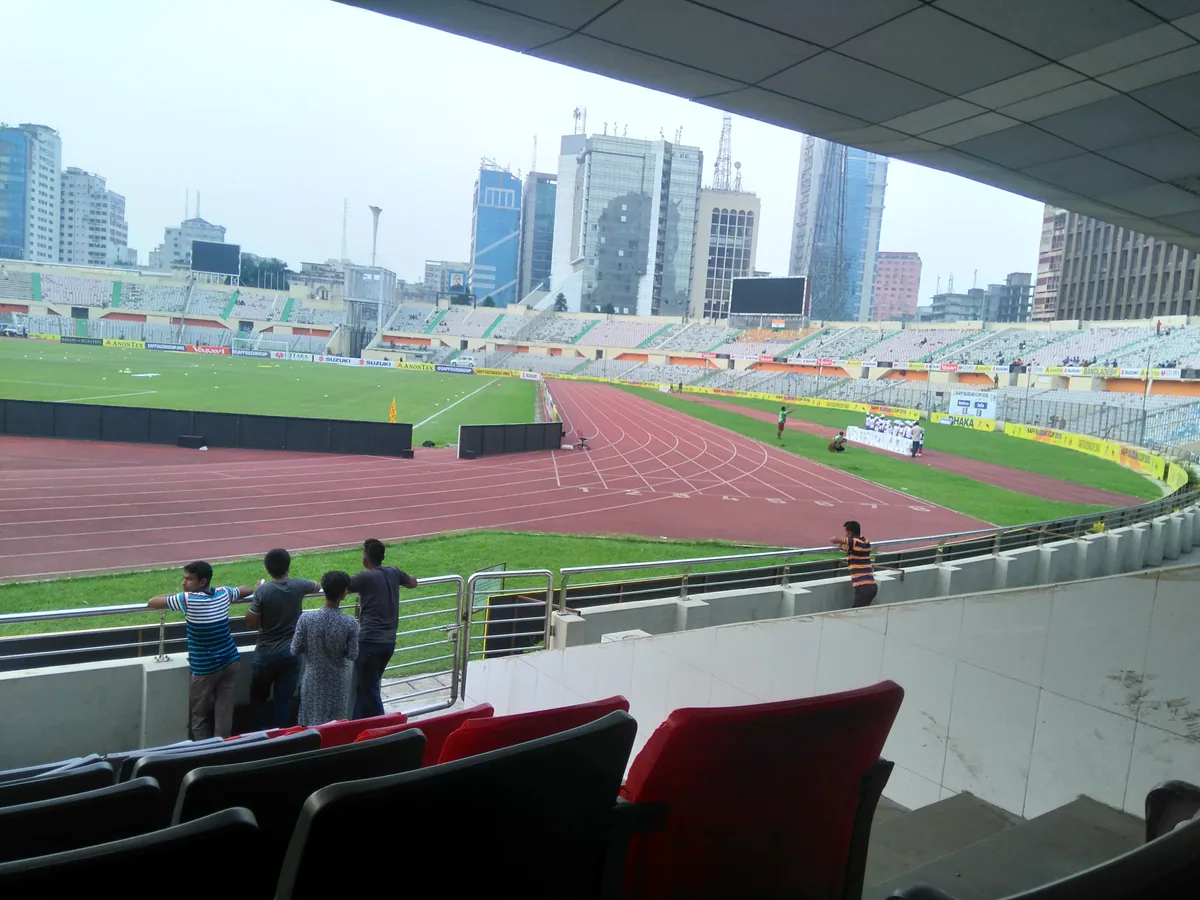
Pakistan beat Bangladesh 1-0 in the second semi-final of the 2026 SAFF Championship at the National Stadium in Dhaka on 14 November. Abdul Samad Arshad scored the only goal in the 86th minute, sending Pakistan into their first-ever SAFF Championship final. They will face India on 17 November at the same venue.
Pakistan 1-0 Bangladesh: the verified result
The match was scoreless for 85 minutes before Samad received a close pass on the right, shifted the ball between his feet to create space, and drove a left-footed shot beyond goalkeeper Mehedi Hasan Srabon. Geo News reported that Hayan Khattak, who had come on as a substitute for Ali Uzair in the 74th minute, provided the assist. Dawn described the finish as a moment of individual brilliance in a match Bangladesh had largely controlled.
The result is historic for Pakistan. The SAFF Championship began in 1993, and Pakistan had never reached the final before this edition. Bangladesh, who last reached the final in 2005, were playing at home and had topped Group A without defeat. Pakistan had finished as Group B runners-up after losing their opener to India and beating Maldives.
The final is set for Tuesday 17 November 2026 at the same venue. India, the defending champions, beat Bhutan 2-1 in the first semi-final earlier on 14 November. Pakistan will play their first SAFF final against the team that beat them in the group stage.
How the goal changed the match
Bangladesh had the better of the first half. They dominated possession, created the early chances, and forced Pakistan to defend in a compact block. BSS reported that Bangladesh held 59 percent possession in the first half and threatened through Syed Quazem Kirmanee and Rakib Hossain. Pakistan's best first-half moment came in the 32nd minute when Abdullah controlled a cross and beat the goalkeeper, only to see the ball strike the post.
The second half was more balanced. Pakistan became more organised and began to press higher. Adil Bani's free-kick in the 75th minute forced a diving save from Srabon. Six minutes later, substitute Najeeb Ullah beat a defender and fired from the edge of the box, and Srabon saved again.
The decisive moment arrived in the 86th minute. Samad, a Denmark-based forward, received the ball on the right, created half a yard with quick footwork, and struck low and hard beyond Srabon's reach. The goal silenced the home crowd and left Bangladesh with only a few minutes plus stoppage time to respond.
Bangladesh pushed forward in the closing minutes and made attacking substitutions, including changes in the third minute of injury time. Pakistan's defence held. The final whistle confirmed a result that had seemed unlikely for long stretches of the match.
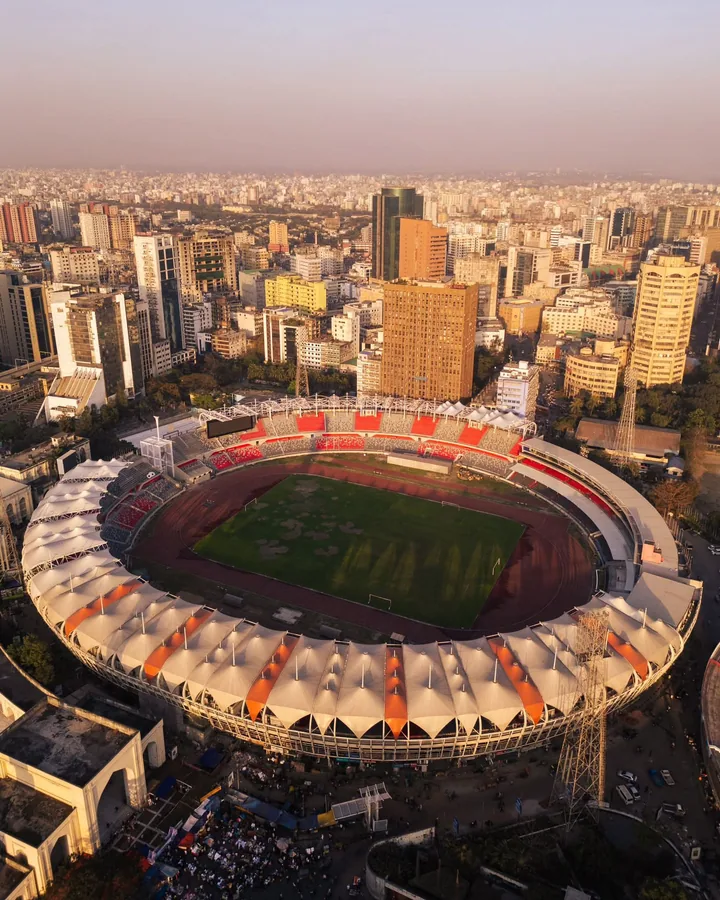
Archive photograph of the Bangladesh national football stadium in Dhaka. It is illustrative and not from the 2026 match.
Why this is a landmark result for Pakistan
Pakistan's football history is full of near misses, administrative disruption and long gaps between competitive windows. Reaching a SAFF final is therefore more than a single tournament run. It is evidence that a structured camp, a clear game plan and a coach with international experience can produce results even when the squad is not the most decorated in the region.
Nolberto Solano, the former Newcastle United and Peru midfielder, took over a team that had struggled for consistency. Under him, Pakistan have shown a recognizable identity: a compact defensive block, quick transitions, and a willingness to defend deep when the opponent has more of the ball. That identity was visible against Bangladesh. Pakistan conceded possession but not composure.
The result also matters for the players. Samad's goal will be remembered as the moment Pakistan reached their first final. Yousuf Ijaz Butt's goalkeeping, Abdullah Iqbal's captaincy and the defensive work of the back line were less glamorous but equally important. In a match where Bangladesh had more of the ball, Pakistan needed every one of those contributions.
There is a broader point about regional football. South Asia is often described as a developing market for the sport, but tournaments like the SAFF Championship give smaller federations a realistic pathway to competitive matches. Pakistan's run shows that the gap between the region's teams is not so large that a well-prepared side cannot close it in a single match.
Pakistan's path to the final
Pakistan's group stage was a story of recovery.
They opened against India and lost 3-2, despite a spirited late fightback. That defeat could have ended their tournament, but the format allowed them to respond. They beat Maldives 3-0 in their second match, a result that lifted them to second place in Group B.
Their qualification then depended on the final group match between India and Maldives. Pakistan needed India to win, and India did, prevailing 1-0. That result sent Pakistan through as runners-up and set up the semi-final against Bangladesh.
The semi-final was therefore Pakistan's third must-win match in a row. They approached it with the same shape that had worked against Maldives: a deep block, disciplined midfield tracking, and quick breaks into the channels. Bangladesh had more possession, but Pakistan had the better chances in the second half and took the decisive one.
Bangladesh's perspective
Bangladesh will feel they let an opportunity slip. They topped Group A with wins over Bhutan and Sri Lanka, had home advantage, and controlled long periods of the semi-final. Their possession share was high, their wingers caused problems, and their goalkeeper made important saves.
But possession without a goal is not control. Bangladesh's best chances came in the first half, and they did not convert them. As the match wore on, Pakistan's defensive block became more comfortable, and Bangladesh's attacks became more predictable. The final ball was often a cross into a crowded box, and Pakistan's defenders were happy to head it clear.
The defeat ends Bangladesh's hopes of reaching a first SAFF final since 2005. It also raises familiar questions about their finishing and about their ability to break down a compact opponent. Those questions will follow the team into the next tournament, but they should not obscure the progress they made in the group stage.
For neutral readers, the match was a useful reminder that home advantage is not a guarantee. Bangladesh had the crowd, the possession and the early chances. Pakistan had the organisation and the better finish. In knockout football, that is often enough.
Solano's tactical plan
Pakistan's approach was built on three principles.
First, protect the central area. Bangladesh's midfielders like to receive between the lines, so Pakistan kept their midfield compact and forced the ball wide. That reduced the number of dangerous passes into the box and made Bangladesh's attacks easier to defend.
Second, defend the first ball and the second ball. Bangladesh's crosses were often cleared, but the danger came from the second ball at the edge of the box. Pakistan's midfielders dropped quickly to contest those loose balls, which limited Bangladesh's shooting opportunities.
Third, attack quickly after winning possession. Pakistan did not try to build long sequences. They looked for the forward pass into the channel, especially after Bangladesh's full-backs pushed forward. Samad's goal came from exactly that kind of transition: a quick pass, a moment of skill, and a finish from the edge of the box.
The plan required discipline. Pakistan's players had to resist the temptation to chase the game after Bangladesh's early pressure. They had to keep their shape even when the crowd grew louder. And they had to take the one clear chance that arrived. They did all three.
The final against India
India will start as favourites. They are the defending champions, they beat Pakistan 3-2 in the group stage, and they have more depth in attacking positions. BSS reported that India reached the final for the 10th time after their 2-1 win over Bhutan.
But the group-stage result was close. Pakistan scored twice against India and stayed in the match until the end. In a final, the dynamics are different. There is no next match, no group table, and no reason to hold anything back. Pakistan will need to defend as well as they did against Bangladesh and take their chances when they arrive.
The venue is the same National Stadium in Dhaka, so both teams will be familiar with the pitch and the conditions. The crowd will be neutral in the sense that neither team is at home, though the stadium may still carry the atmosphere of the tournament. Kick-off details and broadcast information should be checked against the official SAFF and broadcaster listings closer to the match.
For Pakistan, the final is a chance to win a first regional title. For India, it is a chance to defend their crown and extend their record in the competition. For the tournament, it is a final between two teams with a long rivalry and a recent group-stage match that produced five goals.
Key players to watch
Abdul Samad Arshad will be the focus after his semi-final winner. His ability to create space in tight areas and shoot with either foot makes him Pakistan's most dangerous forward in transition. If India defend high, his runs behind the defence will be important.
Yousuf Ijaz Butt was not the busiest goalkeeper in the tournament, but his handling and positioning were reliable in the semi-final. In a final, one save can decide the result.
Abdullah Iqbal, the captain, organizes the back line and wins aerial duels. His leadership will be tested by India's movement between the lines.
For India, the attacking midfielders and wingers pose the biggest threat. Pakistan's full-backs will need help from the wide midfielders to prevent crosses into the box. The central defenders must also be careful not to dive into tackles near the edge of the area, where a free-kick can change the game.
What to check before the final
Readers should check three things before the final.
First, confirm the kick-off time and venue through the official SAFF Championship channels. Match times can change, and local listings are not always updated at the same speed.
Second, check the team news. Suspensions and injuries can change a lineup significantly, especially after a physical semi-final. Pakistan used substitutes effectively against Bangladesh, and Solano may need the same flexibility in the final.
Third, check the weather. Dhaka in November can be humid, and a heavy pitch can slow the game down. That would favor a compact team that defends deep, which is Pakistan's strength.
Questions readers are asking
Is this Pakistan's first SAFF Championship final?
Yes. Pakistan had never reached the SAFF Championship final before 2026. The tournament began in 1993. Their semi-final win over Bangladesh was the first time they qualified for the title match.
Who scored the winning goal?
Abdul Samad Arshad scored in the 86th minute. Some reports use the spelling Abdul Samad Shahzad. He is a Denmark-based forward. Hayan Khattak provided the assist after coming on as a substitute.
When is the final and who is the opponent?
The final is scheduled for Tuesday 17 November 2026 at the National Stadium in Dhaka. Pakistan will play India, who beat Bhutan 2-1 in the first semi-final.
Did Bangladesh dominate the match?
Bangladesh had more possession, especially in the first half, and created early chances. Pakistan had fewer chances but scored the decisive goal. Dawn reported that Pakistan registered more shots and efforts on target despite having less of the ball.
How did Pakistan reach the semi-final?
Pakistan finished second in Group B. They lost 3-2 to India, beat Maldives 3-0, and needed India to beat Maldives in the final group match. India won 1-0, which sent Pakistan through.
Where was the match played?
The semi-final was played at the National Stadium in Dhaka, also known as the Bangabandhu National Stadium. The final will be played at the same venue.
What this result means beyond the scoreline
Pakistan's win is a reminder that tournament football rewards teams that stay in matches. Bangladesh had the better of the opening hour, but Pakistan defended with discipline and grew into the game. The winning goal was a piece of individual quality, but it was made possible by a team structure that kept the match within reach.
For Pakistan's federation, the challenge is now to build on the result. A first final is a milestone, but it is not a foundation on its own. The next steps are the same as they were before the tournament: more competitive matches, better youth pathways, and a stable coaching environment. The result in Dhaka gives those arguments more weight.
For Bangladesh, the task is to turn possession into goals. They have the players to do it, but the semi-final showed that control without penetration is not enough. The next tournament will be a test of whether they can adapt.
For readers, the final on 17 November is the immediate focus. Pakistan will play India with a trophy at stake and a chance to make more history. Whatever happens, the semi-final in Dhaka will remain the match that took Pakistan to their first SAFF final.
Sources
- Dawn, Abdul Samad's late strike sends Pakistan into historic SAFF Championship final, 14 November 2026
- BSS, Shahzad's late strike breaks Bangladesh heart, sends Pakistan into SAFF final, 14 November 2026
- Geo News, Pakistan beat Bangladesh 1-0 to reach SAFF Championship final for first time, 14 November 2026
- Sportstar, Bangladesh vs Pakistan highlights: Pakistan beat Bangladesh 1-0, 14 November 2026
- ESPN, Bangladesh 0-1 Pakistan, 14 November 2026
Sources checked on 15 November 2026. Match details, scorers and timeline were checked against Dawn, BSS, Geo News and Sportstar. Group-stage context was checked against Dawn and Geo News. Image credits: cover photograph of the National Stadium during the 2018 SAFF Championship final by Tasmin Tripty, CC BY-SA 4.0, via Wikimedia Commons, resized and converted to WebP. Inline photograph of the Bangladesh national football stadium by Thisissakib, CC0, via Wikimedia Commons, resized and converted to WebP. Both images are archive photographs and do not show the 2026 semi-final.
Found an error or an outdated detail? Report a correction with the article URL and original source.