
Pataudi Palace: Location, Architecture and Heritage Reading
Explore Pataudi Palace’s location and attributed architectural history, with visual learning activities and clear limits on current access and ownership.
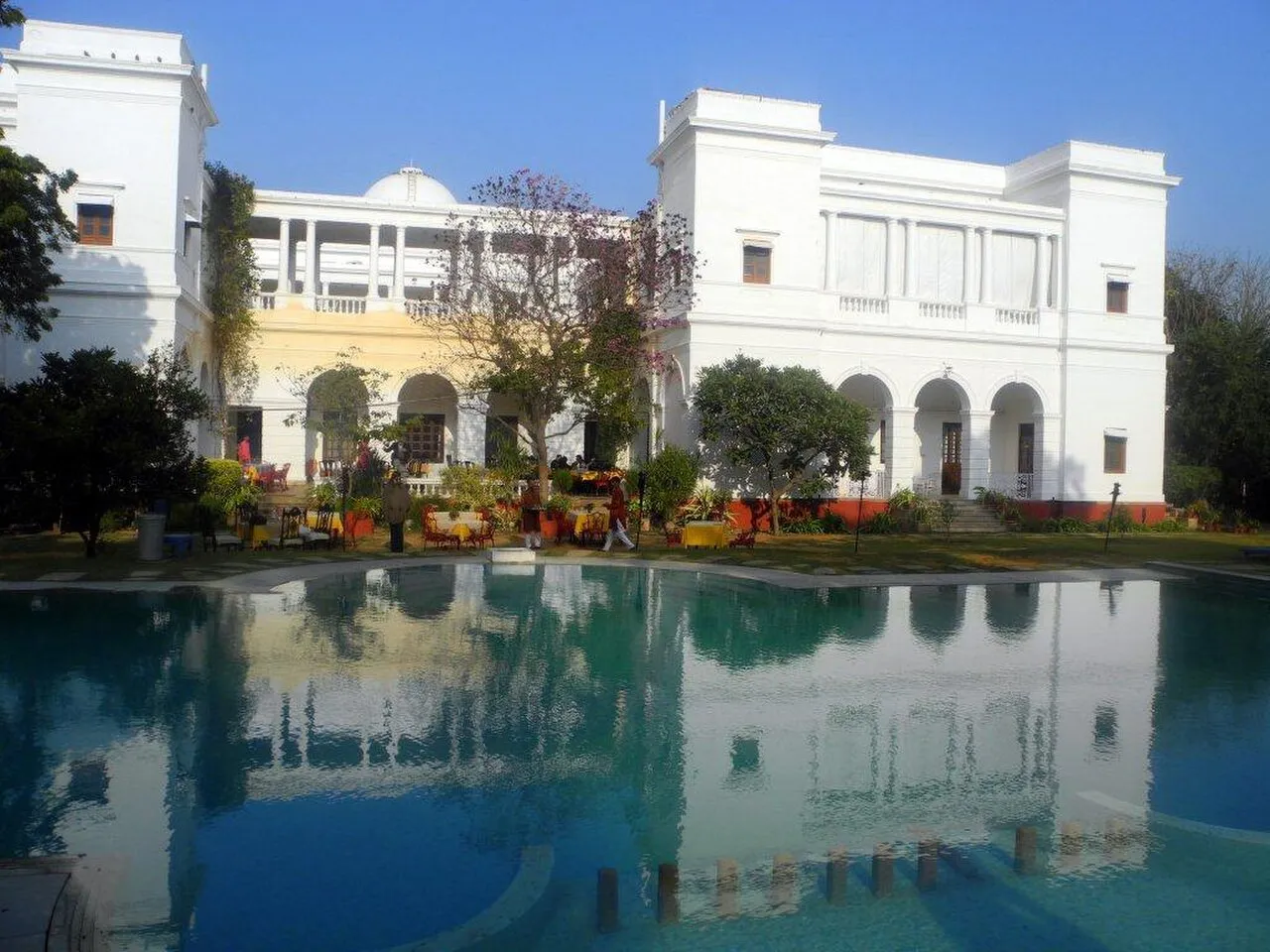
Pataudi Palace is associated with the Pataudi family and stands in Pataudi, in Haryana's Gurugram district. Its appeal combines architecture, family history, cricket and cinema. A useful introduction should separate those connections rather than turn an attractive building into a list of unverified prices, visiting promises and celebrity anecdotes.
This guide was checked on 2 November 2026. It introduces the place through the official tourism account and original heritage-learning activities. It is not a current admission notice, a booking service, a property valuation or a legal ownership record. Historical photographs illustrate the building or its wider context and do not establish present access arrangements.
Where is Pataudi Palace?
The palace is in the town of Pataudi in Haryana, India, within the Gurugram district context described by the official tourism portal. Older sources may use Gurgaon in the district name. Keep town, district and state as separate geographical levels rather than treating each name as a different palace.
Make a simple location ladder: India, Haryana, Gurugram district, Pataudi. Each step narrows the area. A country is not a district, and a district name is not an exact street address. The ladder helps a learner locate a heritage subject without pretending to provide navigation instructions to a private entrance.
When comparing two descriptions, ask whether they use different levels of precision. One may say “near Gurugram,” while another names Pataudi itself. They can refer to the same broad area while serving different purposes. A tourism overview is not automatically a precise route plan or confirmation that a particular gate can be used by visitors.
For a school map exercise, mark the state and district first, then add a labelled point for the town. Avoid inventing a travel time from another city. Journey times depend on route and conditions, while a historical introduction can remain useful without promising how quickly a reader will arrive.
Why is the name linked with several different stories?
Pataudi can refer to a town, a former princely-state context, a family name and a palace associated with that family. Those meanings are related but not identical. A search result about a cricketer, a film actor or regional history may therefore contain the same word while answering a different question.
Before making notes, put the subject of each source at the top of the page. Is it a biography, a building description or a history of a political territory? That heading prevents a detail about one subject from migrating into another. A person's achievement does not automatically describe the construction or use of the building.
This is particularly important with inherited names. A building can be associated with a family across generations without every person bearing the name having commissioned it. Use specific relationships when a source establishes them. Do not fill gaps with a plausible family story simply because the name makes the connection feel familiar.
For an original activity, draw four circles labelled town, state history, family and building. Add a fact only to the circle it directly describes. Connect related circles with a short explanation rather than merging them. The diagram shows how cultural subjects can be connected while keeping the evidence for each claim distinct.
What does the official tourism account say about its architecture?
The tourism portal attributes the design to Robert Tor Russell and Karl Malte von Heinz and describes a twentieth-century palace with formal interiors and landscaped surroundings. It gives 1935 as the completion year. Treat that as the portal's attributed account rather than using an architectural photograph to independently prove a precise construction chronology.
Architectural history often involves several dates: commissioning, construction, completion, occupation and later renovation. If two sources give neighbouring years, first check which stage each is describing. Do not automatically convert a small difference into a dramatic contradiction or silently choose the number that makes the sentence sound simpler.
A practical notebook can have separate columns for event, date and source. Put “completion, according to the tourism account” beside the portal's year. Leave a commissioning date blank unless you have evidence. A clear blank is more useful than a guessed year because it tells the next researcher exactly what still needs checking.
This approach does not make a heritage article less readable. It lets the main explanation stay straightforward while avoiding false certainty. Readers can learn where the attribution comes from and understand that a completion date is not the same thing as the age of every object, decoration or later alteration inside the property.
How can you look at a palace photograph actively?
Begin with visible features: the arrangement of the façade, repeated openings, the relationship between a central section and its sides, and the surrounding landscape. Describe what the image actually shows. A photograph may support an observation about symmetry, but it cannot establish an unseen floor plan or the purpose of every room.
For a simple exercise, draw a vertical line through the apparent centre of a front-facing photograph. Compare corresponding features on each side. Are the shapes repeated? Does the camera angle make one side look larger? The activity teaches observation without requiring a specialist architectural label for every visible element.
Perspective matters. A building photographed from one corner will not look perfectly balanced even if its plan is symmetrical. Trees, cropping and shadows can hide features too. Before concluding that the façade is irregular, ask whether the image gives you a viewpoint suitable for that judgement.
Now separate observation from interpretation. “Several openings appear evenly spaced” is a visual description. “The architect intended this to symbolise a particular political idea” is an interpretation needing documentary support. Both kinds of statement can belong in an architectural discussion, but they should not be presented as if a single photograph proves them equally.
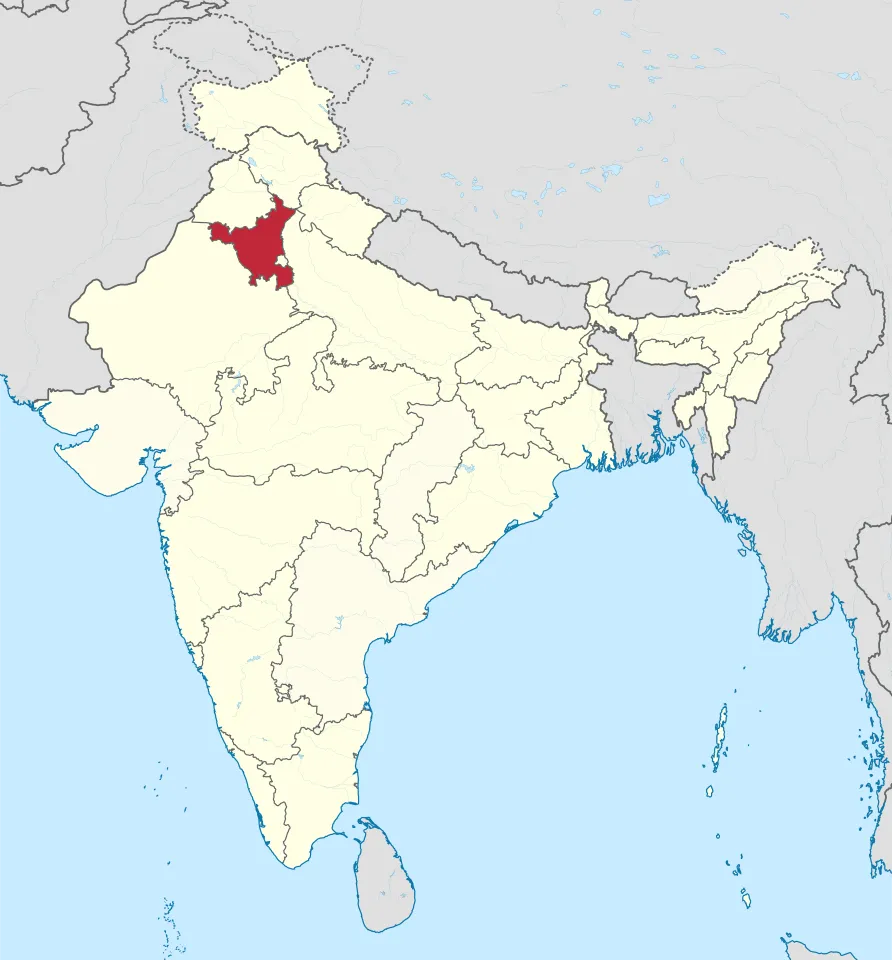
Haryana within India. State-level geographical context, not an exact route, palace boundary or access map.
What can gardens add to a heritage study?
Landscaped surroundings can shape how a building is approached and seen. In a photograph, foreground, paths and planting may frame the main structure. Those observations concern the image and visible design. They do not establish current public access, garden opening hours or permission to enter the grounds.
Try sketching the same building with and without the visible landscape around it. The outline of the architecture stays similar, while the impression of scale and approach changes. This original exercise helps explain why heritage photography often includes more than the building alone. Setting can be part of the visual story.
A second activity is to mark near, middle and far distances in a photograph. A path in the foreground and a façade farther away create depth cues. Do not convert those apparent distances into measured metres without an appropriate scale. A picture can suggest spatial relationships while still being unsuitable for precise measurement.
This distinction is useful when a social-media image makes a property look unusually large. Wide-angle lenses and carefully chosen viewpoints can affect the impression. A learner can appreciate the composition while avoiding the unsupported claim that the photograph proves a land area or exact distance.
Was the palace ever used as a hotel?
The official tourism overview describes a historical hotel period between 2005 and 2014 and a later renovation narrative. That history should not be read as a current hotel listing. It does not establish that a room, event or guided visit can be booked today, or that an old commercial arrangement remains in force.
Historical use and present use are separate questions. A former hotel can appear in old travel directories long after arrangements change. A search result may preserve the earlier description because the page is an archive. Read the date and current operator information before treating an attractive historical listing as a live offer.
For a fictional example, imagine a house used as a school until 1990 and later restored as a residence. An old photograph with a school sign remains genuine, but it does not make the house a school today. The same reasoning applies to a former hospitality use: the past label does not automatically describe the present.
This guide deliberately does not supply an unverified booking link, admission price or opening-hour schedule. If a visit is your goal, obtain current permission or a reliable current visitor notice first. A heritage-learning page can explain the building without encouraging readers to assume access to a property because it is well known.
Why should ownership and valuation claims be handled carefully?
A tourism narrative is not a title deed, lease document or formal valuation. Terms such as leased, bought back, inherited and renovated describe different arrangements. Repeating them as if they were interchangeable can produce a confident but legally imprecise story. This article does not reconstruct a present chain of title.
The same caution applies to widely repeated monetary values. A number can circulate through many articles without becoming a verified current market valuation. Ask who assessed it, on what date and for what purpose. Repetition alone does not provide the missing method or establish that a transaction occurred at that amount.
In a classroom source exercise, give an invented property three numbers: an old restoration cost, an insurance estimate and an asking price. Ask whether any is automatically its sale value. The answer is no: each number has a different meaning. That lesson helps readers resist the appeal of a large figure detached from its definition.
This is not advice about purchasing the property or interpreting a particular contract. It is a reading habit: attach the kind of claim to the kind of evidence that could support it. A measured historical guide can remain engaging without making assertions about private finances or ownership that its sources cannot settle.
How do cinema and celebrity affect the way people see a place?
The tourism account presents the palace as a cinematic attraction and associates it with the family's cultural profile. A filming location, a fictional home on screen and a real residence are different things. Seeing a building in a production does not establish that the story's characters lived there outside the fictional world.
If you want to name a particular production, verify the individual location credit rather than copying a generic list from an unrelated entertainment page. A visual resemblance is not enough. Sets, editing and other properties can create a similar appearance, and a location may be used for only part of a sequence.
An original media-literacy activity is to write two captions for an imagined film still. One describes the fictional setting within the story; the other describes the verified real filming location. Keeping them separate helps a learner understand how cinema transforms places without confusing a character's biography with a property's history.
Celebrity interest can bring attention to architecture, but the building is still worth studying through design, geography and documented change. A strong project can begin with a familiar name and move into questions about evidence. It should not end with private-life speculation simply because that is what makes some search results more clickable.
Make a clear heritage-learning page
Begin with location and the subject's identity. Add a short attributed historical account, a visual observation activity and a clear note about what has not been verified. Keep current visitor logistics separate from enduring background. This structure serves both a curious reader and a student preparing a small research project.
You can build a photographic annotation tool in our programming courses: let learners mark visible features and write evidence-based captions. It should not label unseen rooms or generate invented dimensions. A simple interface that distinguishes observation from questions can teach more than a crowded page of decorative facts.
Before sharing, ask whether each image is correctly captioned and licensed, each date names its source, and any current claim has current evidence. If a field is uncertain, say so or leave it out. The goal is to make the palace's history accessible while respecting the difference between public interest, documented heritage and private arrangements.
Sources
- Incredible India: Pataudi Palace, for the attributed location, architectural account and historical-use context. Current access, valuation and legal ownership are not independently established by this guide. Visual activities and fictional property examples are original educational material.
Image credits: cover: Ajay Goyal, source, CC BY 2.0. Resized and converted to WebP. inline: TUBS, source, CC BY-SA 3.0. Resized and converted to WebP.
Result dates, fees and eligibility must be checked against the issuing authority's current notice. Report a correction with the article URL and original source.