
Pete Hegseth and the Arlington Sentinel: Award Reporting and Memorial Context
Read the Arlington sentinel and Hegseth award reporting, with memorial context and distinctions between evidence, statements and inference.
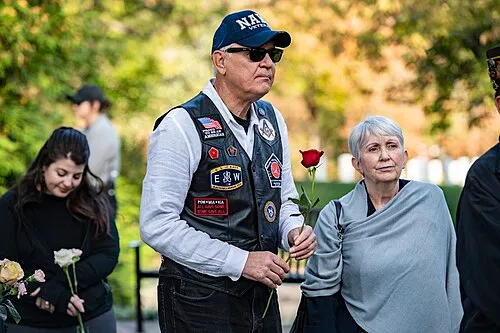
Pete Hegseth awarded Army Specialist Thomas Iglesias a Joint Service Commendation Medal after the sentinel's reminder about silence and respect at the Tomb of the Unknown Soldier. Associated Press reporting on 12 November 2026 connects the award with duties performed during the previous day's Veterans Day observance at Arlington National Cemetery.
The story is best understood by separating the event, the reported official response and the memorial's purpose. A short viral clip does not establish everyone's intention, and an award photograph does not answer every political question surrounding an official. This guide records the dated reporting and provides a neutral framework for reading public-service news without inventing motives or confusing unrelated proceedings.
What is the verified news event?
AP reported that a sentinel reminded the group accompanying Hegseth to maintain the site's expected decorum after a loud laugh was heard. Its subsequent report identifies Iglesias as the soldier who received the commendation. The reporting attributes the award's explanation to the Pentagon.
That is a bounded account. It does not establish that every person in the group laughed, that a private apology occurred or that the award had a motive beyond what was publicly stated. Those additional claims would require additional evidence.
Keep the dates separate: the memorial observance and the later award are connected but distinct events. A picture from one should not be described as if it directly documents every moment of the other.
Why does the location matter?
The Tomb of the Unknown Soldier is a memorial and burial site at Arlington National Cemetery. The cemetery's official history explains its role in remembrance, mourning and reflection on military service. It is not simply a convenient backdrop for a public photograph.
The Unknown from the First World War was interred in 1921. That historical foundation helps explain why expectations of respectful conduct exist independently of the identity or political affiliation of a visitor.
Readers do not need to adopt a particular political view to understand that context. The relevant question is what the site asks of visitors and what the reported event shows. Bringing the memorial's purpose into the article is more informative than treating it only as scenery in a personality dispute.
What is a sentinel's role?
The cemetery and Army describe the guards as members of a ceremonial and protective tradition associated with the 3rd U.S. Infantry Regiment, commonly called the Old Guard. Their duty concerns the memorial and the conduct of its surrounding space, not merely a performance for a camera.
The official descriptions provide useful institutional context, but this article does not claim personal knowledge of Iglesias's training file or service history. A general explanation of a role should not become an invented biography of the individual involved in the news.
For students, distinguish the job from the person. A report can explain what a sentinel does while retaining uncertainty about details that have not been released. That is a basic part of accurate reporting on public institutions.
What can a video establish?
A video can show visible and audible events within its frame and duration. It may show a group, a sound and a guard's response. It cannot automatically identify every off-camera person or explain the private reasoning of everyone present.
Editing also matters. A short clip may begin after an earlier exchange or end before a later response. That does not make it false, but it limits what can be concluded from it alone. The appropriate response is to seek context, not to fill missing moments with a preferred story.
When watching a public-event clip, write down what you directly observe before reading commentary. Then compare those notes with a fuller account. This can help prevent a strongly worded caption from replacing your understanding of the evidence.
Why should motive remain separate from sequence?
Sequence tells us that one event happened before another. Motive tells us why someone acted. The first can often be documented through dates and records; the second may require an explicit statement or other strong evidence.
For example, an award following a widely discussed incident establishes a timeline. It does not by itself prove embarrassment, retaliation, admiration or a public-relations strategy. Those are interpretations unless supported and clearly attributed.
A neutral report does not have to avoid all analysis. It should label analysis honestly and explain its basis. Students can learn more from the difference between a confirmed sequence and an inferred explanation than from a paragraph that treats both as equally established facts.
What does an official statement add?
It provides an attributable account from the institution or person issuing it. That is valuable evidence about what the issuer publicly says. It is not automatically an independent verification of every possible interpretation of the event.
Read the exact scope. A statement explaining the duties recognized by an award may not address every question raised by a clip. The absence of an answer to another question should not be converted into an invented admission or denial.
In a source notebook, create separate entries for the event record, the official explanation and third-party analysis. Keeping them apart makes it easier to write a fair summary and to update the article if a further statement is released.
How should a military award be described?
Use the award's verified name. A commendation should not be casually renamed as a different decoration because a writer wants a more dramatic headline. Different awards have different identities and should not be collapsed into one generic claim about the highest honour.
The reporting here identifies the Joint Service Commendation Medal. This article does not describe it as the Medal of Honor or invent an extraordinary ranking comparison. Accurate terminology respects the institution and gives readers a detail they can check.
Similarly, distinguish the service member's rank from a general role label. If a rank is reported, use it as reported at that time. Do not silently promote, demote or replace it with a different title based on familiarity.
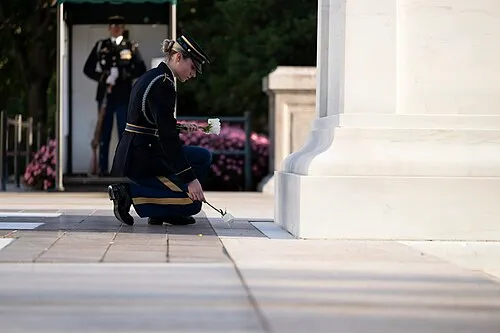
Archive: Specialist Jessica Kwiatkowski during her final-walk ceremony in October 2024. She is not Thomas Iglesias; this illustrates the sentinel role only.
Why are other Hegseth headlines a separate subject?
Several public events can involve the same official during one week. An Arlington story, a press conference and a congressional procedural vote do not become one event merely because the name in the headline is identical.
For instance, the House Clerk's record for 10 November lists a passed motion to refer in connection with a resolution concerning Hegseth. The vote question is part of the record. A reader should not interpret the word passed in isolation as proof of impeachment or a finding on every allegation named in a resolution.
This guide does not offer a legal conclusion about that proceeding. It points out a reading issue: the action voted on must be identified before the result can be summarized. A separate article would need the appropriate primary records to explain the full procedural history.
How can you read a roll-call page without being misled?
Start with the vote question, date and document number. Only then read the outcome. A heading containing the subject of a resolution can look like the action taken, while the actual recorded vote concerns a procedural step.
Next, distinguish a motion from an allegation and an allegation from a finding. These words serve different purposes. Copying a resolution's title into a headline that implies all its assertions were proven would misrepresent the record.
If you do not understand the procedure, retain the narrow wording and seek an authoritative explanation. It is better to say what the page directly records than to translate it into a confident but incorrect political conclusion.
What does respectful reporting look like here?
It can describe criticism without adopting insults as its own factual voice. It can report an official response without presenting promotional language as an independent judgement. Precision allows a reader to understand the disagreement without being told what emotion to feel.
Avoid attributing conduct to an entire group when the evidence identifies only a sound or a particular action. Avoid assigning the sentinel a political motive without a source. The same standard should apply regardless of whether the writer sympathizes with a public official or their critics.
Respectful reporting also remembers the memorial itself. The people commemorated there should not disappear entirely behind a dispute about a contemporary personality. Historical context can be included without turning the article into a partisan argument.
How can a student check a viral caption?
Break it into individual claims. A caption might name a location, a date, a person, a quotation and a claimed consequence. Each component can be checked separately. A genuine video does not automatically validate every sentence attached to it.
Find the earliest reliable publication and compare its date with the event date. Look for a longer version or an institutional record where appropriate. Preserve the difference between direct observation and an attributed report when writing your own summary.
If one component remains uncertain, narrow the claim. You can describe a publicly reported reminder at a memorial without asserting an unverified private conversation. A smaller accurate statement is better than a larger story built from guesses.
Why does the image caption matter?
An archive photograph of Arlington can illustrate the location without showing this incident. A photograph of a guard can explain the role without depicting Iglesias. Those distinctions must appear in the caption rather than being left for the reader to discover.
The same applies to an official's portrait. It identifies a person; it does not prove what happened at a later ceremony. A photo's authenticity and its relevance to a specific event are separate questions.
This guide uses clearly described archive illustrations. It does not present a generic sentinel as the individual receiving the award or a historical ceremony as the November 2026 observance. Accurate imagery is part of factual reporting, not a decorative afterthought.
A classroom exercise in evidence and inference
Create four columns labelled event, source, direct support and unanswered question. Add the memorial report and the award report as separate rows. Identify which details are publicly attributed and which interpretations would require more evidence.
Then write two possible headlines: one that remains within the established facts and one that goes beyond them. Explain the difference without repeating an unsupported allegation as if it were true. This exercise teaches how word choice can change a reader's understanding before the article even begins.
For a second activity, compare a source's title with its actual text. Notice whether the body supports every implication of the headline. Strong news comprehension involves reading the operative details, not merely collecting the most forceful phrasing.
What should readers take away from the story?
The dated reporting concerns a reminder about decorum and a subsequent commendation. The memorial's official history explains why silence and respect have significance at that location. Neither part requires invented motives or an unrelated legal conclusion.
The wider lesson is to distinguish evidence types. A clip records a limited view; an official statement records a public explanation; a procedural page records a particular institutional action. Understanding those boundaries makes a reader less vulnerable to misleading summaries.
For related public-affairs and learning guides, visit the RayTech article library. Treat each page's date and scope as part of the information. This article is checked on 14 November 2026 and does not claim to update automatically with every later statement.
Common questions
Before sharing an update, check whether a newer statement has changed its context. Preserve the original reporting date when quoting a historical account, and avoid presenting a later repost as a newly occurring event.
Who received the reported commendation?
AP identifies Army Specialist Thomas Iglesias. The reporting attributes the award explanation to the Pentagon.
Does a short video prove everyone's motive?
No. It can document events within its frame, but private intention and off-camera context require additional evidence.
Is the Joint Service Commendation Medal the Medal of Honor?
No. They are different named decorations. This report uses the award name supplied in the reviewed reporting.
Does a passed procedural motion prove an official was convicted?
No. The action being voted on must be read accurately. This guide does not present a procedural vote as a conviction or adjudication of allegations.
Sources
- AP: reported Arlington reminder
- AP: subsequent award reporting
- Arlington National Cemetery: official memorial history
- U.S. Army: guarding the Tomb
- House Clerk: the separately dated motion-to-refer record
Classroom activities and the evidence-reading framework are original educational explanations. No private motive, service record or legal outcome is invented.
Image credits: cover: Arlington National Cemetery, source, Public domain. Resized and converted to WebP. inline: Arlington National Cemetery, source, Public domain. Resized and converted to WebP.
Found an error or an outdated detail? Report a correction with the article URL and original source.