
Grade 9 English Smart Syllabus 2027: PDF and Guide
Read the Punjab Grade 9 English smart syllabus for annual exams 2027. Preview the subject PDF, check exclusions and plan your revision.
Check the source, publication date and examination session before relying on it.
Attached document
Download Grade 9 English smart syllabus PDF. Preview opens the PDF hosted on this website. You can also open the document in a separate tab.
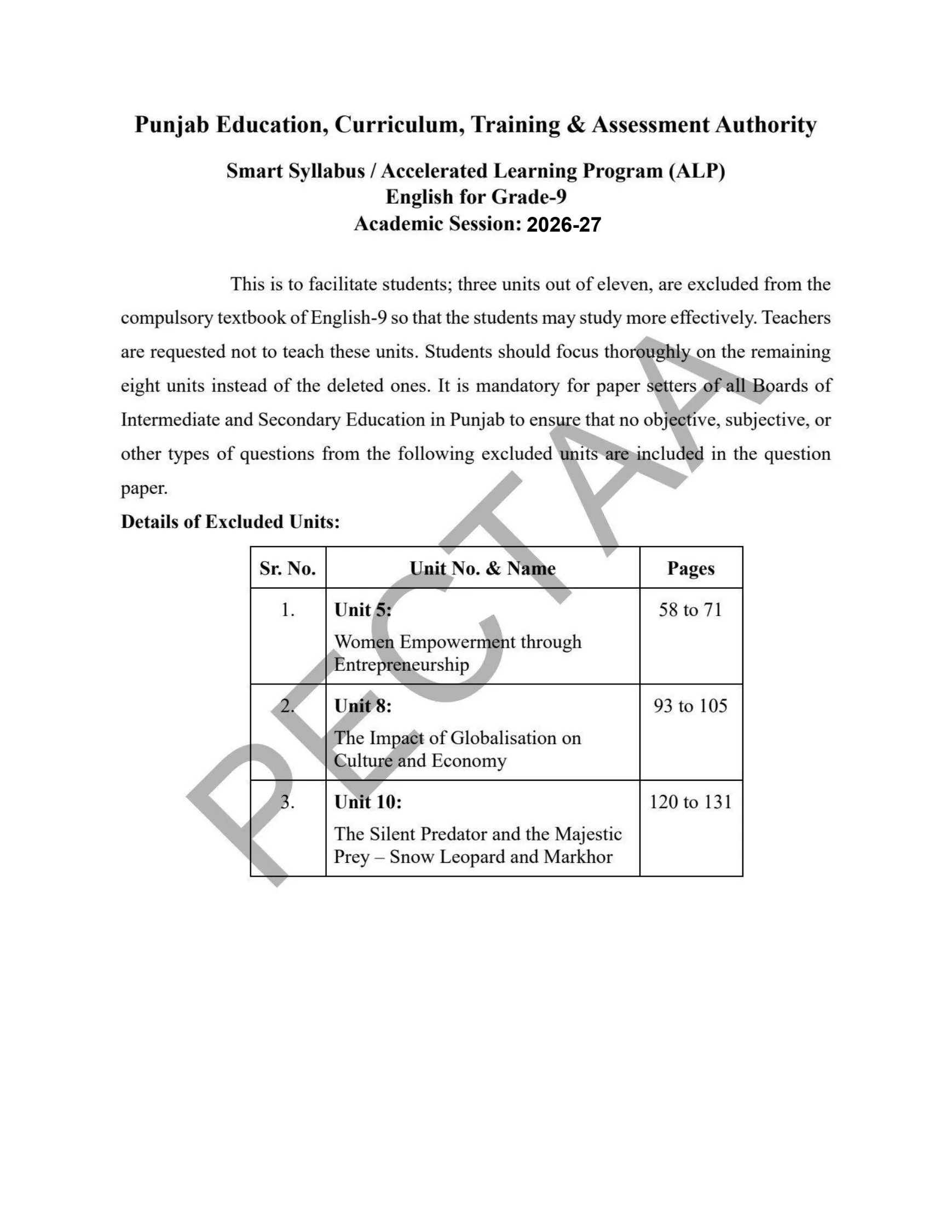
The Punjab Grade 9 English smart syllabus is included in the 6 November 2026 PECTAA notification for academic session 2026-27 and the annual examination 2027. This guide explains how to use the subject section, with a subject-only PDF rather than an unrelated multi-subject download.
Open the English PDF resource, preview and download. The attachment on this article also opens the same subject document.
What does this subject's ALP change?
The Grade 9 English ALP removes three units from the twelve-unit textbook and directs students towards the remaining nine. The excluded units are Unit 5, Women Empowerment through Entrepreneurship, pages 58-71; Unit 8, The Impact of Globalisation on Culture and Economy, pages 93-105; and Unit 10, The Silent Predator and the Majestic Prey: Snow Leopard and Markhor, pages 120-131.
The notice instructs paper setters not to take objective, subjective or other question types from the excluded units. This is wider than simply removing their short-answer exercises. At the same time, removing these units does not mean that every grammar or composition task has disappeared. Consult the following paper-preparation instructions for the tasks that remain.
Use unit numbers, titles and page ranges together. A remembered title from an older edition is not a reliable substitute for this matching process. The seven-page subject PDF includes the exclusion notice and the accompanying assessment material for this subject.
The details above highlight identifiable entries and preparation instructions. They are not presented as a replacement for every row of the original document. Where a table continues across pages, read the continuation before deciding whether a topic or question remains in scope.
Document details at a glance
| Detail | Verified document information |
|---|---|
| Grade | 9 |
| Subject | English |
| Academic session | 2026-27 |
| Annual examination | 2027 |
| Notification date | 6 November 2026 |
| Notification reference | PECTAA/C&C Unit/2026/1238 |
| Subject PDF length | 7 pages |
| Original booklet pages | 47-53 |
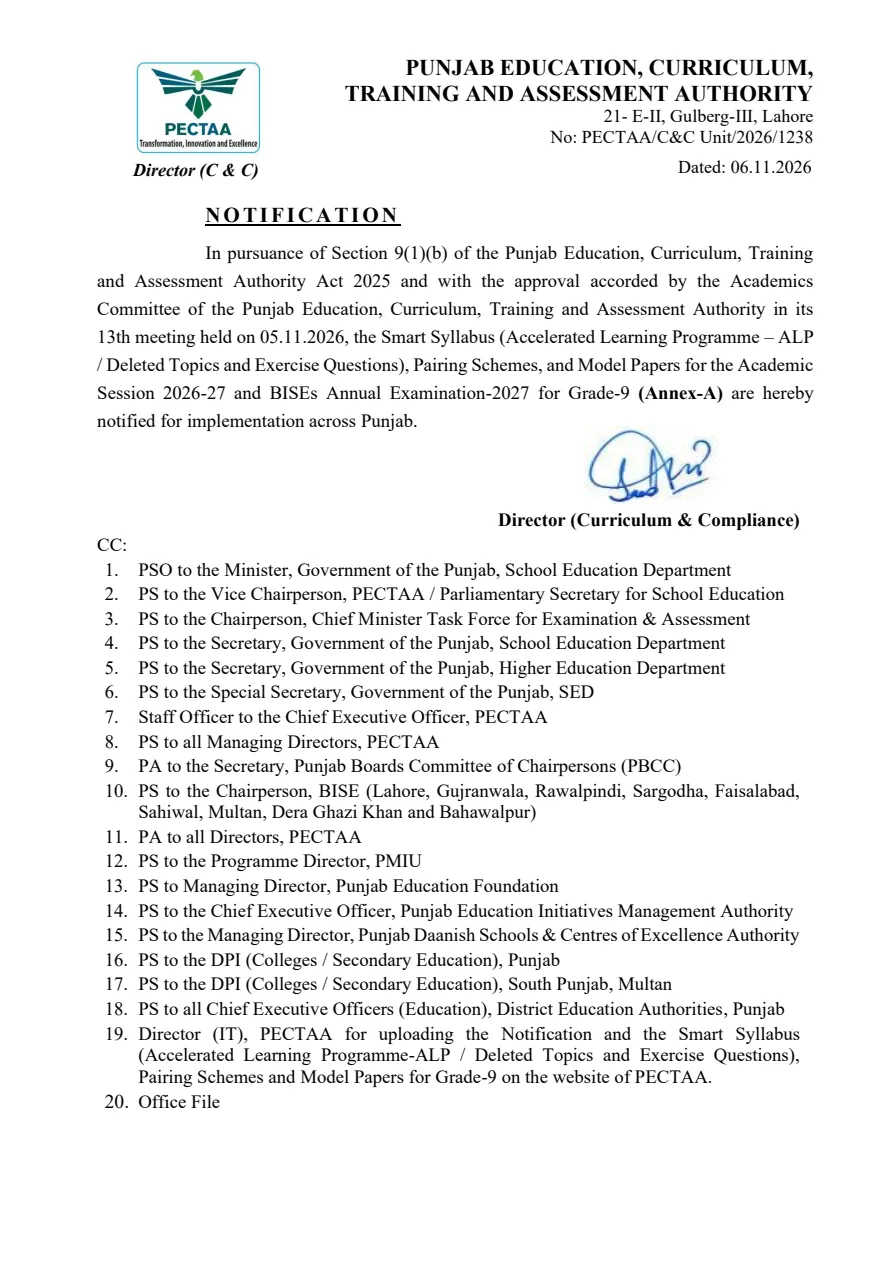
The image preserves the covering notification. The downloadable file is an extract of the subject pages; the complete official booklet remains linked under Sources. The extracted PDF does not include unrelated subjects and has not been rewritten as a substitute notification.
How should you mark your textbook?
Work with the approved textbook edition for this session. First locate the chapter or unit name, then the subsection, page number and exercise reference. Keep separate marks for excluded topics and excluded questions. A row that removes a particular example is narrower than a row that removes an entire exercise; neither should be expanded without evidence.
Make a retained-work checklist after completing the exclusions. This is more useful for daily revision than a list of crossed-out pages alone. If your edition has different pagination, match the wording and ask your teacher to reconcile the difference. Do not silently transfer a page range from another grade or academic year.
Keep comprehension, vocabulary and writing in your plan
Removing textbook units does not remove every English skill. Begin by listing the retained units and the separate language/composition tasks described in the paper instructions. For each retained text, write a short outline of its main idea, the supporting details and the author's purpose. Practise answering the question asked rather than reproducing a memorised paragraph.
Study vocabulary in context. Write a sentence using a retained word, then explain how its meaning changes the sentence. For verb-form practice, identify the time and structure signalled by the sentence before selecting an answer. Reading the surrounding words is more reliable than choosing the option that merely sounds familiar.
Practise writing with the stated format
For a composition task included in the official instructions, plan the opening, development and closing before writing. Keep the purpose and audience clear. After finishing, check sentence boundaries, tense consistency, spelling and whether every required point has been answered. A well-organised answer is easier to review than a long answer with no clear structure.
For poetry that remains in your syllabus, distinguish the literal situation from the idea or feeling it develops. Support an explanation with relevant detail from the retained text. Do not transfer a deleted unit's prepared answer into a different question simply because a few words overlap.
Use unit groups accurately
When the paper instructions identify different unit groups, prepare each group rather than selecting only the shortest texts. Read the number of questions offered and the number required. During a timed attempt, number answers clearly and reserve time to proofread. The subject PDF, not an old grammar handout, controls the current allocation.
What does the assessment material help you practise?
The subject section includes the instructions and assessment material that follow its syllabus notice. Read the objective and subjective instructions separately. Check the number of questions offered, the number required, the marks for each part and the available time. Copy these into a practice plan before starting a timed attempt.
Use the model paper to learn the format and expected level of response. It is not a leak, a guess paper or a guarantee that those same questions will appear. Retained material remains important even if a particular example does not appear in the model. Where a teacher provides an additional practice paper, compare its scope with this current document first.
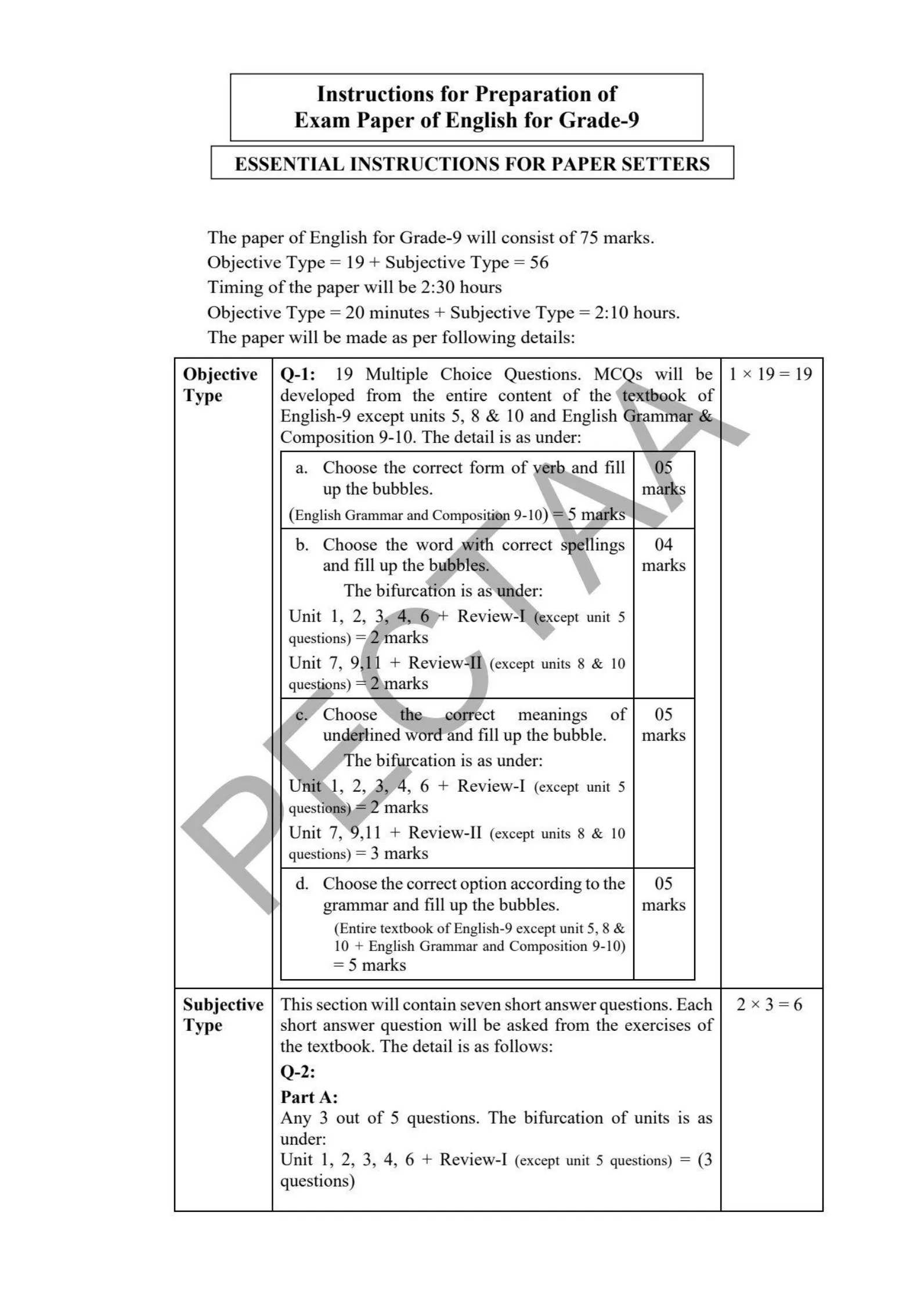
This second image comes from within this subject section. Open the PDF for the surrounding pages and full-size text; an image viewed on a small phone is not a practical replacement for the downloadable document.
A practical revision cycle for this subject
Begin with one retained unit or manageable group of questions. Read it, close the book and attempt a short recall task. Review the difference between your answer and the required explanation or method. Record the specific weakness, then return to it after a gap. This makes revision measurable without pretending that simply rereading a chapter proves understanding.
Before a timed paper, check your retained-work list for gaps. During the attempt, follow the stated choices and number each answer clearly. Afterwards, separate knowledge errors from presentation or timing errors. Plan the next study block around the weakest category rather than repeating only the questions you already answer comfortably.
Keep notes and past papers useful but subordinate to the current syllabus. An older paper may contain content that is now excluded. Filter such practice deliberately; do not assume an old question is in scope just because it appeared in a board examination before.
Common questions
Is this the full textbook or only the subject syllabus?
It is the 7-page English subject section extracted from the Grade 9 notification booklet. It contains the syllabus notice and accompanying assessment material, not the full textbook. The official multi-subject booklet is available through the source link below.
Does smart syllabus mean I can skip every chapter mentioned?
No. Read the level of the exclusion: a topic, example, exercise, question or subpart. A chapter can contain both retained and excluded material. The exact table wording matters more than a shortened list shared without its page and exercise references.
Can I preview the PDF on my phone?
Use Preview document in the attached-document block. If your browser does not display an embedded PDF comfortably, use Open document or Download PDF. Keep the saved copy available for revision, and zoom the original pages when checking small references or Urdu text.
Does this notice announce my examination date?
A syllabus notification and an examination date sheet are different documents. This booklet concerns scope and assessment guidance for the stated session and annual examination. Check your board's separate date sheet and any later amendments for the examination schedule.
What if a later notice changes this document?
A later applicable official amendment may change the preparation instructions. Check the issuing authority and your board before the examination, and compare notification dates and reference numbers. If a circulating image differs from the original booklet, use the complete official notice to investigate the difference.
Related study resources
Use the smart syllabus directory to choose another verified subject. Visit academic programmes and classes for subject notes, chapter tests and past papers. The English resource page keeps this PDF and its source together for quick access.
Sources
Source checked on 11 November 2026. Revision advice in this article is editorial guidance; the attached official document controls the syllabus wording.
Need Direct Access to this Notification?
Check the original source for the latest instructions and any corrections.
Result dates, fees and eligibility must be checked against the issuing authority's current notice. Report a correction with the article URL and original source.