
Romelu Lukaku: Career Records, Centre-Forward Movement and Finishing
Understand Romelu Lukaku’s dated transfer records and centre-forward role. Learn hold-up play, attacking runs, finishing rates and shot context.

Romelu Lukaku's career is a useful introduction to the centre-forward's job beyond the final touch. A striker can create space by moving a defender, protect possession while teammates advance or time a run to meet a pass. Goals remain central to the role, but understanding how the opportunity develops makes a performance more informative than a simple finishing total.
The historical reference points here include Belgium's 2018 World Cup context and Lukaku's documented 2024 transfer from Chelsea to Napoli. Napoli has also published a later departure announcement, so an old signing story must not be treated as proof of current club status. This article is a career and tactical guide, not an unverified live transfer bulletin.
Who is Romelu Lukaku?
Romelu Lukaku is a Belgian professional footballer associated with the centre-forward role. His career has included club football in several countries and senior international competition with Belgium. A club appearance and a national-team appearance belong to different records. Any total should state the competition and period instead of combining unrelated figures under the vague label career form.
Read transfers as dated events
On 29 August 2024, Napoli announced Lukaku's permanent transfer from Chelsea. Chelsea's own statement also confirmed the move. Those two sources establish a historical transaction. They should not be used to claim that every subsequent transfer rumour was false or that the 2024 destination must remain his club indefinitely. A later announcement requires its own date and evidence.
A loan and a permanent transfer differ
Chelsea's departure statement describes earlier loan spells at Inter Milan and Roma before the Napoli move. A loan arrangement and a permanent transfer are distinct relationships between clubs and player registration. A simple list of team names can hide that difference. A career table becomes clearer when it labels the type of move rather than treating every appearance as the same transaction.
What does the 2018 World Cup record show?
FIFA's historical material identifies Lukaku's Bronze Boot award at the 2018 World Cup. That is an individual tournament award, not another name for Belgium's team finish. Keep the scoring award and the national team's result in separate fields. A player can receive an individual distinction while the team occupies its own place in the competition's final record.
Awards have categories and rules
A scoring award may involve more than a reader's quick comparison of visible goal totals, depending on the competition's tie-breaking criteria. Consult the official award record instead of inventing a ranking from memory. The safest historical statement names the award and year exactly. It does not convert one tournament's scoring recognition into an unrestricted claim about all strikers.
International success is not a club statistic
Goals for Belgium should not silently enter a club league total. The opponents, competitions and match opportunities differ. An all-competition summary can be useful only when its scope is explicit and internally consistent. If the source provides one category, do not fill another with a number that happens to be nearby in a search result or graphic.
What does a centre-forward do without the ball?
A centre-forward can occupy defenders, offer a target and create a route for teammates. The position is not limited to standing near goal waiting for a cross. Responsibilities depend on the team's setup and the phase of play. When studying Lukaku, follow where he moves before the pass and what happens to the defensive shape around him.
Pinning a defender is a positional idea
The phrase pinning describes a situation in which a forward's position limits a defender's willingness or ability to leave him. It does not require a foul or physical restraint. A defender may remain close because the forward threatens space near goal. To evaluate the effect, observe whether that attention opens a useful passing lane for another attacker.
A run can help someone else
A forward moving toward one area may draw a defender and leave room elsewhere. He might never touch the ball during the resulting chance. That contribution should not be invented from every run, but it can be explained when the footage shows the reaction clearly. Off-ball analysis asks what changed, not merely how far the player travelled.
Holding position can also be purposeful
Constant movement is not automatically better than a well-chosen position. Remaining near a defender can preserve a target or prevent the defensive line from stepping forward comfortably. Judge whether the position serves the attack. A still frame alone cannot reveal the whole purpose, so use the surrounding sequence before criticising a player for appearing stationary.
How does hold-up play work?
Hold-up play involves receiving under pressure and helping the team retain or develop possession. A forward may protect the ball, return it to a supporting teammate or turn when space allows. The quality of the incoming pass and the proximity of support matter. It is not a task that can be judged entirely from the striker's body size.
The pass should match the available contact
A ball delivered too high, too far away or at an awkward pace can make control difficult. Before assigning blame for a lost possession, examine what the receiver was actually given. A completed long pass on a statistic sheet does not necessarily mean the forward received an easy situation. The next action and defensive pressure provide essential context.
Support determines whether protection becomes progress
A forward can control the ball successfully but have no nearby teammate available for a safe release. If support arrives late, the defender gains time to challenge. Watch the team movement around the striker, not only his first touch. Hold-up play is a connection between players rather than an isolated demonstration of strength.
Turning is not always the best decision
When a defender is close, a simple lay-off can move the attack more effectively than forcing a turn. If the defender backs away, turning may become possible. The decision should follow the actual pressure and available space. A forward who plays a short return pass has not necessarily failed to be aggressive; he may have created the next attacking angle.
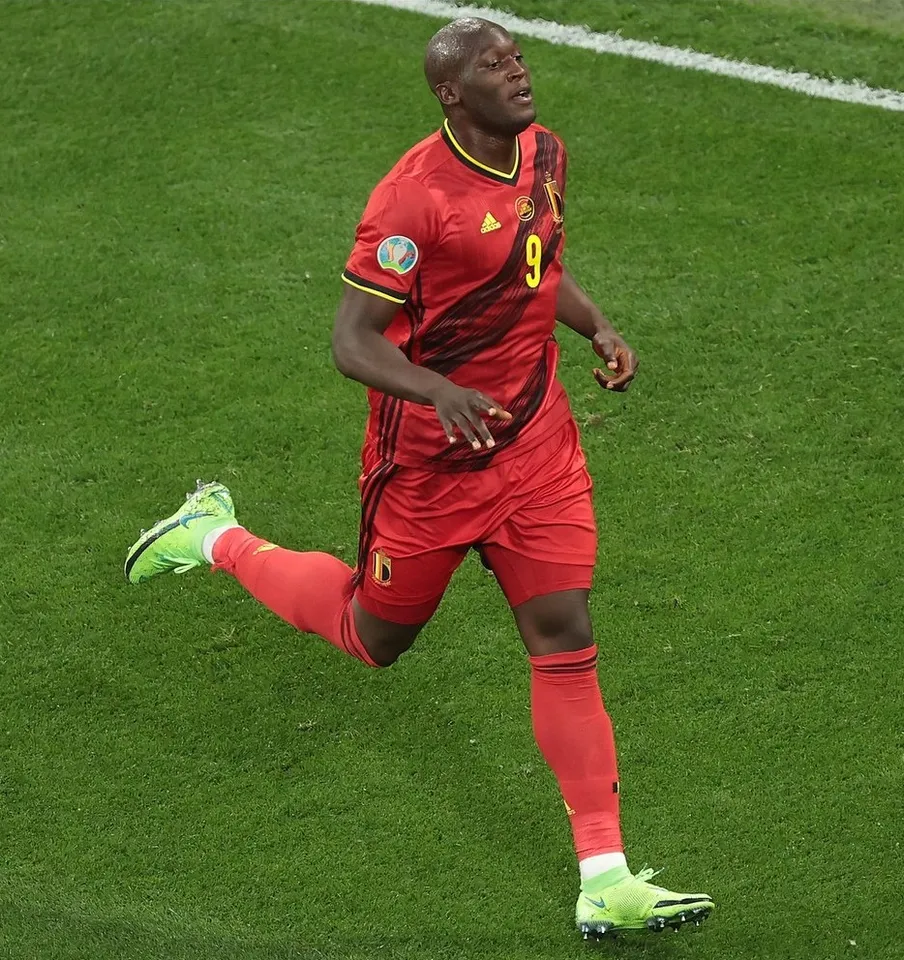
Romelu Lukaku during Belgium against Russia in June 2021, shown as historical international context.
What makes a run behind the defence effective?
Timing, starting position and the passer's opportunity all matter. A fast run that begins too early can leave the forward unable to receive a legal or practical pass. A delayed movement may meet the ball at a better moment. Analyse the relationship between the runner and passer rather than treating speed as the only variable.
Read the line, not one defender alone
Offside decisions depend on the applicable laws and the relevant positions at the correct moment. A broadcast angle can make distances deceptive. For a specific incident, use the official decision and appropriate replay rather than declaring an error from a poorly aligned still image. This guide explains movement, not a replacement system for judging close officiating decisions.
Curved movement can change access to space
A runner may adjust his path to stay available while moving toward a useful target. The route can also affect how a defender tracks him. Describe the visible path and receiving opportunity without assuming that every curve follows the same preplanned instruction. A tactical explanation should remain connected to the actual pass and sequence.
How should you assess finishing?
Goals are the final outcome, but the quality and number of chances influence the total. A striker receiving one difficult opportunity faces a different sample from one receiving several close-range chances. Use shot location, pressure and the type of pass where reliable information is available. A raw goals count should not be asked to explain every element of attacking performance.
Work through a fictional conversion example
Suppose a striker scores four goals from twenty recorded shots. The simple shot-conversion rate is 20 percent. Those invented numbers do not show the difficulty of the shots or whether penalties were included. Another player with a lower percentage might have attempted more difficult chances. State the sample and definitions before using the rate to compare finishing.
Expected goals is an estimate, not a promise
An expected-goals value is produced by a model using selected characteristics of a chance. Different models can assign different values. A missed opportunity with a high estimate is still possible, and a goal from a low estimate is not impossible. Treat the measure as context for chance quality rather than a rule specifying how a real player must finish every shot.
A short run can distort a judgement
Finishing outcomes can vary over a few matches. A streak should be described with its dates and number of attempts instead of being treated as a permanent ability rating. Longer samples offer more information, but changes in role and chance supply still matter. Careful analysis explains the limits rather than promising a certainty the data cannot provide.
Why should club photographs carry dates?
A photograph in an older shirt can identify a genuine stage of Lukaku's career without proving his current registration. This is especially important after multiple transfers or loans. Caption the image as historical context and avoid placing an old club badge beside a new transfer headline as if the photo were taken at the announcement.
A signing photo is not a complete contract
A club announcement may confirm a move without publishing every financial term or condition. Do not fill those gaps with an unverified fee or invented salary. The absence of a public number is not permission to guess. A clear article can explain the confirmed transaction while identifying which details the cited record does not establish.
Later statements supersede assumptions about status
Napoli's later departure announcement illustrates why a 2024 signing cannot serve indefinitely as a current-club reference. When a reader needs present status, the latest official club and competition records should be checked. This guide keeps the historical transfer dated and focuses its detailed explanation on the centre-forward role rather than a quickly changing squad claim.
A striker-analysis exercise for students
Choose ten consecutive attacking possessions from a historical match. Record whether the forward received, moved a defender, offered a passing target or remained uninvolved in the visible sequence. Avoid giving credit without evidence. The exercise should reveal the different jobs within an attack, including actions that ordinary shot and goal totals may not capture.
Make the observation reproducible
Write down how you decide that a run created space. For example, require a visible defender movement followed by a teammate entering the vacated area. This classroom definition will not capture everything, but it makes the method inspectable. A limited transparent method is more useful than an unexplained rating based only on how impressive a moment felt.
Use technology without hiding the inputs
The programming courses can help students build a small possession log, and the class resources support the percentages. Store the match date, competition and source with each dataset. Validate that successful actions do not exceed attempts and show unavailable data honestly. A clear tool should help readers understand the football rather than conceal uncertainty behind a score.
Preserve unsuccessful opportunities
A useful movement can be missed by the passer, while an apparently promising run can be blocked before a pass is attempted. Include those cases with careful labels rather than recording only completed combinations. They reveal how opportunity and execution differ. Make clear that an unplayed pass remains an observed possibility, not a chance whose outcome can be known with certainty.
Questions about Romelu Lukaku
Does the 2024 Napoli announcement prove his current club?
No. It proves the move announced on that date. Later official statements need to be considered for present status, including Napoli's subsequent departure notice. Keeping transfer stories dated prevents a valid historical source from being used to support an outdated claim. Club identity in an old photograph should be treated with the same care.
Is a striker useful only when he scores?
Goals are central, but receiving under pressure, creating space and linking attacks can also matter. Those contributions should be demonstrated through visible sequences rather than offered as an automatic excuse for any performance. A balanced assessment considers both finishing opportunities and wider involvement, while keeping the limitations of the available evidence clear.
Sources
- Napoli: Lukaku's permanent arrival on 29 August 2024
- Chelsea: confirmation of Lukaku's 2024 departure
- Napoli: subsequent departure announcement
- FIFA: Belgium's historical World Cup material and Lukaku's 2018 award
Image credits: cover: Football.ua, source, CC BY-SA 3.0. Resized and converted to WebP. inline: Антон Зайцев, source, CC BY-SA 3.0. Resized and converted to WebP.
Found an error or an outdated detail? Report a correction with the article URL and original source.