
Sunrise in Pakistan: How to Read Times and Plan Observations
Learn what sunrise measures, which location and date details matter, and how to build a careful observation log without confusing dawn with sunrise.

Sunrise is a local event, not one nationwide clock time. To find a useful sunrise time in Pakistan, specify the place, date and time zone, then check what the timetable actually measures. A photograph of a bright sky, the start of dawn and the first visible edge of the Sun are not interchangeable observations.
This guide explains how to read a sunrise listing, compare two results and build a small observation project. It does not invent a live sunrise time for your location or replace an official religious timetable.
What does sunrise actually mean?
The U.S. Naval Observatory defines conventional sunrise by the Sun's upper edge reaching the horizon, using standard assumptions about the atmosphere and a level location. Twilight is a different interval, when scattered sunlight illuminates the sky before sunrise or after sunset. A sky can therefore be getting lighter before the listed sunrise.
Think of a timetable entry as the answer to a precise question. “When does daylight begin?” sounds simple, but it does not define a single measurement. A photographer asking when the sky becomes usable and a student asking when the Sun's edge crosses a standard horizon may need different entries from the same source.
Before copying a number, read its label. Keep the label with the time in your notes. A correctly copied number becomes misleading when it loses the definition that made it meaningful.
Which details should you enter before checking a time?
Start with a location specific enough for your purpose. “Pakistan” is too broad for a local sunrise lookup. A city may be sufficient for a general school exercise, while a more careful observation needs the actual observing location and a description of the visible horizon.
Then select the full date, including the year. A search result can display an old date or a different day from the one you intended. Check the page itself rather than assuming that the date in a search snippet remains current.
Finally, inspect the time-zone setting. Write down the zone shown by the service and whether the result uses a 12-hour or 24-hour clock. A time without these details is difficult to compare with another timetable and easy to misinterpret later.
| Field | What to record | Why it matters |
|---|---|---|
| Location | Named city or coordinates used | Identifies the place being calculated |
| Date | Day, month and year | Prevents comparisons between different days |
| Event | Sunrise, twilight or another labelled event | Prevents different definitions being mixed |
| Clock | Time zone and display format | Makes the time interpretable |
| Source | Page or service and check date | Allows someone else to repeat the lookup |
This is also a useful checklist for a screenshot. Cropping away the city and date may remove the information that makes the displayed time usable.
Why might two sunrise listings disagree?
Do not begin by assuming one service is wrong. First check whether both results refer to the same location, date, time zone and event. A city-centre calculation and a different set of coordinates are not necessarily identical inputs, even if both pages use the same city name.
NOAA's calculation notes explain that atmospheric conditions can make observations differ from calculated values. Its solar calculator is also explicitly no longer actively maintained, so it should not be presented as a continuously supported guarantee of accuracy. These limits belong alongside any recommendation to use its calculations.
For a fictional comparison exercise, imagine two entries: 06:18 and 06:21. Those are invented classroom numbers, not today's sunrise in Lahore, Karachi or any other city. A useful investigation asks which inputs differ before concluding that the three-minute difference proves a faulty clock.
If the inputs match, look for each service's calculation notes and rounding rules. Record the unresolved difference honestly if you cannot establish its cause. A careful comparison can still be useful without announcing that one source has definitively failed.
Is a bright morning sky proof that sunrise has happened?
No. Brightness alone does not identify the specific event labelled sunrise. Your observation might describe the sky, a cloud bank, a reflection or the first visible portion of the Sun. A record should say what you actually saw instead of silently converting every kind of brightness into a sunrise measurement.
Try writing two separate statements: “The eastern sky looked brighter” and “I could see the Sun's upper edge above my visible horizon.” These statements report different observations. The distinction makes a school project more informative than a single unexplained time.
Also describe what was in the way. If a building blocks the view, the first moment you see the Sun above that building is a local visibility event. Do not automatically label it the standard horizon event used by a published astronomical table.
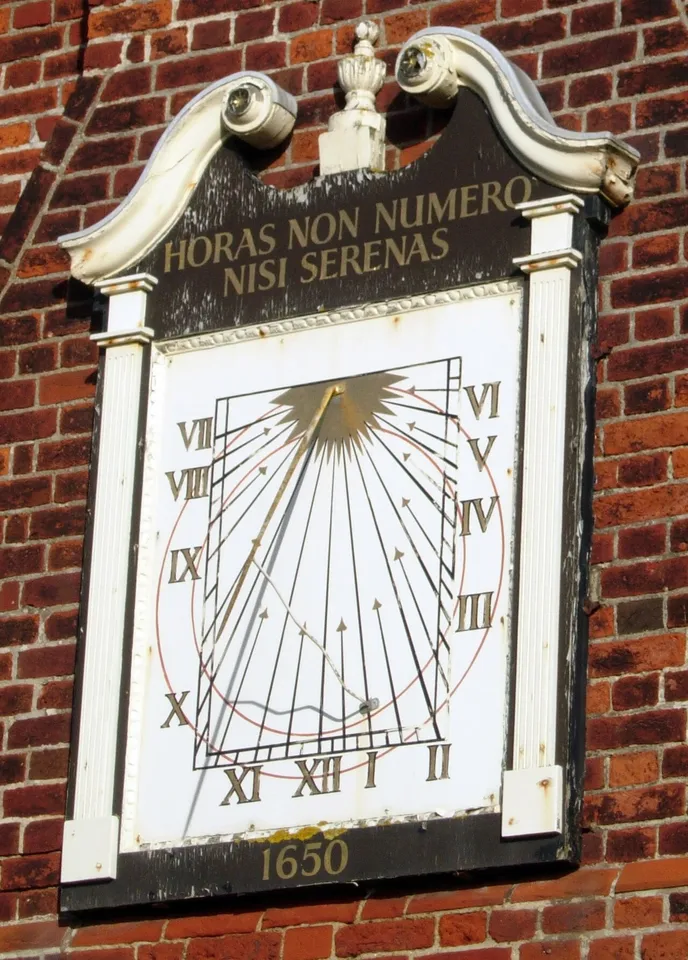
A sundial on Moot Hall in Aldeburgh, England, used here as a measurement-discussion illustration.
How can students make a useful observation log?
Choose a safe, familiar observing place and use a clock whose display you can read easily. Do not travel to an isolated roof, road edge or unfamiliar place merely to complete a sunrise activity. You can practise the record-keeping method using published data when direct observation is unsuitable.
Create the log before the observation. Include columns for the date, place, source's predicted event, what you observed and anything that limited the view. Leave room for uncertainty rather than forcing every observation to look exact.
For example, “view blocked by the neighbouring building” is useful evidence. “Could not identify the edge clearly” is a valid result. Neither needs to be replaced with a guessed minute simply to make the table look complete.
After several entries, separate comparison from explanation. You may notice that your recorded times differ, but the log alone may not identify why. State what the record shows and what extra information would be needed to explain it. That distinction is a transferable science skill.
What can a sundial teach about clocks?
A sundial makes an interesting discussion object because it invites a different question from a phone display: what is this instrument representing, and how should its reading be interpreted? The photograph in this guide shows a sundial on Moot Hall in Aldeburgh, England. It is a historical illustration, not a local sunrise instrument or a live Pakistan time service.
Use the image to practise asking questions before trusting a measurement. What labels can you see? Where is the instrument installed? What instructions would a visitor need? Which details cannot be established from a photograph alone?
You do not need to pretend the image gives every answer. A strong classroom response distinguishes visible evidence from information requiring further research. That habit is equally useful when reading a digital timetable with an impressive interface.
How can sunrise data become a programming exercise?
Begin with a small dataset rather than attempting an astronomical calculator immediately. Suppose a fictional practice table contains 06:20, 06:22 and 06:25. Label it as invented data. Convert each entry to minutes after midnight: 380, 382 and 385. The consecutive differences are two minutes and three minutes.
The important learning step is explaining the transformation. Six hours contain 360 minutes, so adding the remaining twenty gives 380. Subtracting values in a consistent unit is easier than subtracting strings such as “06:20”.
Add validation before calculating. A minute field of 74 should be rejected rather than treated as a normal clock entry. An empty cell should be marked missing, not converted silently to midnight. These small decisions make a practice program more dependable.
When you later use real observations, preserve their source and date. A successful subtraction does not establish that the original sunrise data was correct. Our Python lessons can help you practise variables and conversions before extending the exercise to a larger table.
Is sunrise the same as a prayer-time entry?
Do not substitute a generic sunrise guide for a religious timetable. Check the entry's exact label and the authority responsible for the schedule you follow. This article explains how to read astronomical information; it does not issue a ruling or calculate a local prayer timetable.
If two schedules appear inconsistent, compare their location, date and stated method, then ask the responsible local authority for clarification. A cropped image circulated in a group should not be treated as an explanation of the method behind it.
What should you remember before sharing a sunrise time?
Share the place, full date, event label and source with the number. Avoid presenting an illustrative classroom calculation as a real local prediction. If you are sharing a photograph, distinguish where it was taken from the location discussed in the caption.
For a study activity, a clear question and a repeatable method matter more than an elaborate chart. You can use the November calendar guide to organize observations, then keep the actual measurements in a separate dated log. The calendar plans the work; it does not supply the sunrise times.
Sources
Source 1: rise, set and twilight definitions
Source 2: solar calculation details and maintenance notice
Checked 1 November 2026. Clock examples in this article are fictional teaching data, not calculated sunrise predictions.
Image credits: cover: Nick Harris, source, CC BY 2.5. Resized and converted to WebP. inline: Wilson44691, source, Public domain. Resized and converted to WebP.
Result dates, fees and eligibility must be checked against the issuing authority's current notice. Report a correction with the article URL and original source.