
Taylor Fritz: Indian Wells, the 2024 US Open Final and First-Strike Tennis
Explore Taylor Fritz’s Indian Wells title and 2024 US Open final. Learn first-strike tennis, return statistics and weighted percentage calculations.
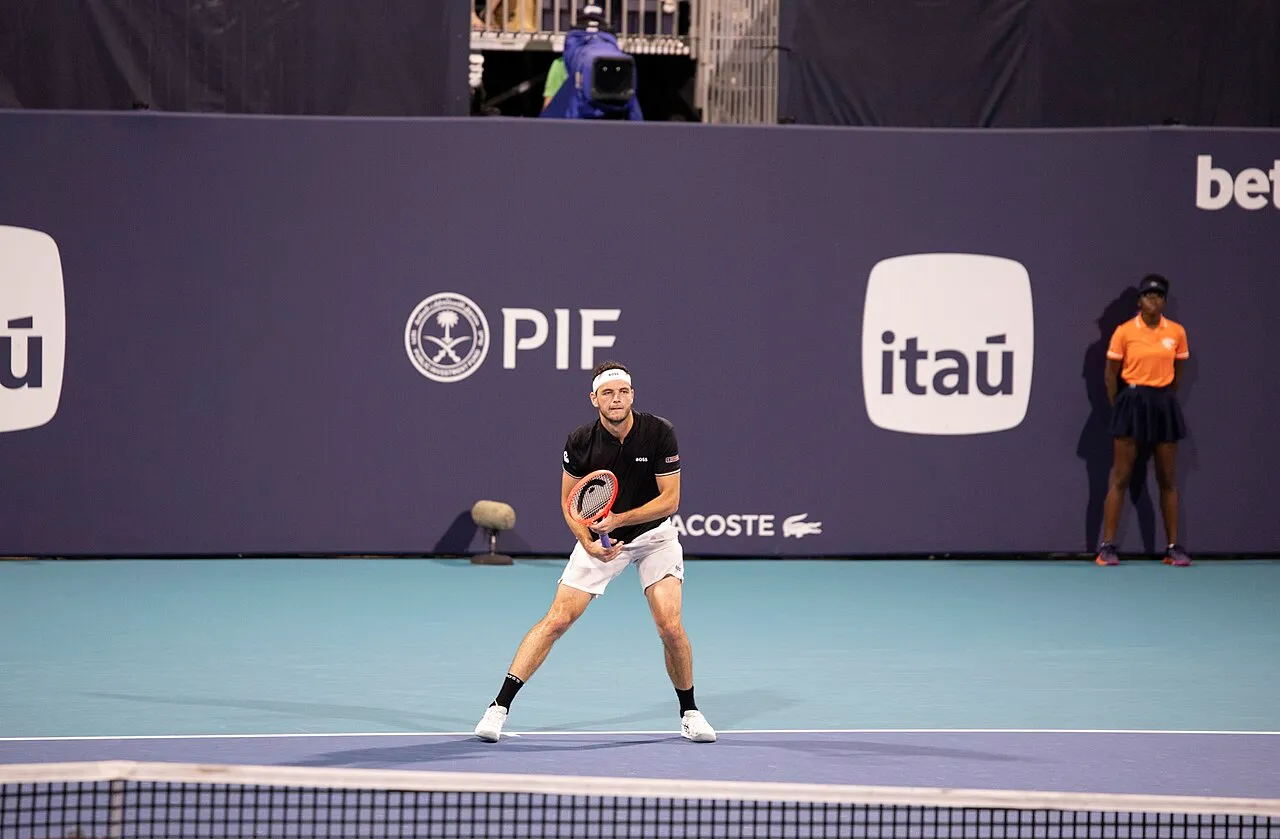
Taylor Fritz's career offers a clear distinction between a breakthrough title and a breakthrough major final. He won Indian Wells in 2022 and reached the US Open men's singles final in 2024. Those events belong to different competition categories and ended with different outcomes. Understanding the distinction is the first step toward reading his career accurately.
There is also a useful tennis lesson behind the milestones. A player trying to control the early part of a rally needs more than a powerful groundstroke. Serve quality, return depth, preparation and recovery combine to create the opportunity. This guide explains those connections without claiming to reproduce private coaching instructions or presenting old results as live news.
Who is Taylor Fritz?
Taylor Fritz is an American professional tennis player whose established milestones include the 2022 Indian Wells singles title and the 2024 US Open final. ATP's biography records the Indian Wells victory over Rafael Nadal. The US Open's official 2024 final report records Jannik Sinner's victory over Fritz. A finalist is not necessarily the tournament champion.
Keep the tournament category visible
Indian Wells is an ATP Masters 1000 tournament, while the US Open is one of the four major events. Winning one category should not be relabelled as winning the other. Both achievements can be significant without being identical. A career table should include event, year, category and finish rather than only an unlabelled list of impressive locations.
A familiar name is not a live result
When Fritz appears in a trend list, the query may concern a current match, an older final or general player information. This article provides the career and learning context. It does not infer a new score from the trend itself. Match reporting requires the actual event and date, not simply evidence that many people searched for the name.
Why was Indian Wells 2022 important?
Fritz defeated Nadal in the 2022 Indian Wells final. ATP's biography identifies him as the first American men's champion at the event since Andre Agassi in 2001. That is a tournament-specific historical comparison. It is not a statement that no American man won any tennis title during the years between those Indian Wells victories.
A named event gives a record meaning
Records often become misleading when a shortened headline drops the event name. First American champion since a particular year needs the question champion of what? Preserving Indian Wells in the sentence tells readers exactly what is being counted. It also avoids confusing singles with doubles or a tour event with a national team competition.
One title is evidence of that tournament
A title run demonstrates successful performance through a particular draw. It does not establish that the winner will beat the same opponent in every later meeting. Surfaces, preparation and competitive circumstances can change. Appreciate the historical result while keeping prediction separate from reporting. A documented achievement does not need an invented guarantee to make it interesting.
What happened at the 2024 US Open?
Fritz reached his first major singles final at the 2024 US Open, where Sinner won the championship. ATP's biography places Fritz's run in the context of American men's major-final appearances, while the tournament's own report establishes the final outcome. Use those dated records rather than a photograph or abbreviated social caption to decide who won.
Reaching the final and winning the final differ
The semi-final decides who advances to the championship match. Winning that earlier round does not award the tournament title. A player can celebrate reaching a first final and later finish runner-up. This sequence helps explain why an emotional post can be entirely genuine while a reader who mistakes it for a title announcement reaches the wrong conclusion.
A career milestone can survive a final defeat
Losing the championship match does not erase the matches that earned the place there. A profile can explain both the progress and the result without describing defeat as victory. That balanced language is more informative for young readers than treating every tournament as either complete triumph or complete failure. Development contains meaningful stages between those extremes.
What is first-strike tennis?
First-strike tennis concerns gaining influence early in a point, often through the serve, return or next groundstroke. It does not require every rally to end immediately. The aim can be to create a manageable advantage that survives into later shots. Whether the attempt succeeds depends on contact quality, court position and the opponent's response.
Start with the arriving ball
A player cannot choose a shot independently of the ball being received. A deep, fast reply can make an intended attack unrealistic. A shorter ball may allow an earlier contact and more options. Watching the incoming trajectory helps explain why the same player sometimes drives aggressively and sometimes uses a safer neutralising response.
Control and speed are separate qualities
A hard shot that lands short may give an opponent a comfortable attack. A controlled deep ball can restrict options even if it travels more slowly. Pace matters, but it must be considered with depth, height and direction. This is a useful corrective to watching only the racket swing or the speed display beside a broadcast replay.
The first attack should create a next position
After striking an attacking ball, the player still needs to prepare for a reply. Remaining in an unsuitable position can waste the advantage. Observe the recovery step and the space the opponent can use. A point is a connected sequence, so evaluating one shot without what follows can produce an incomplete explanation of success or failure.
How does a strong return change the server's plans?
A return that lands deep can prevent the server from stepping comfortably into the next shot. A well-placed return can also move the server away from an intended target. The receiver does not need to hit a clean winner to influence the point. Measuring only return winners would overlook many useful beginnings to neutral or attacking rallies.
Return position is a tactical choice
Standing closer can reduce the server's time after contact, but it also reduces the receiver's preparation interval. Standing deeper can help control some serves while creating different coverage problems. Neither location is universally best. Study the serve type and resulting return rather than treating the receiver's distance from the baseline as a complete explanation.
First-serve and second-serve samples should differ
A match summary may provide separate points-won figures for returns against first and second serves. The separation matters because the situations can present different speed, spin and risk conditions. Combining them into one unlabelled percentage can hide what changed. Keep the categories visible when comparing Fritz with another player or comparing two matches.
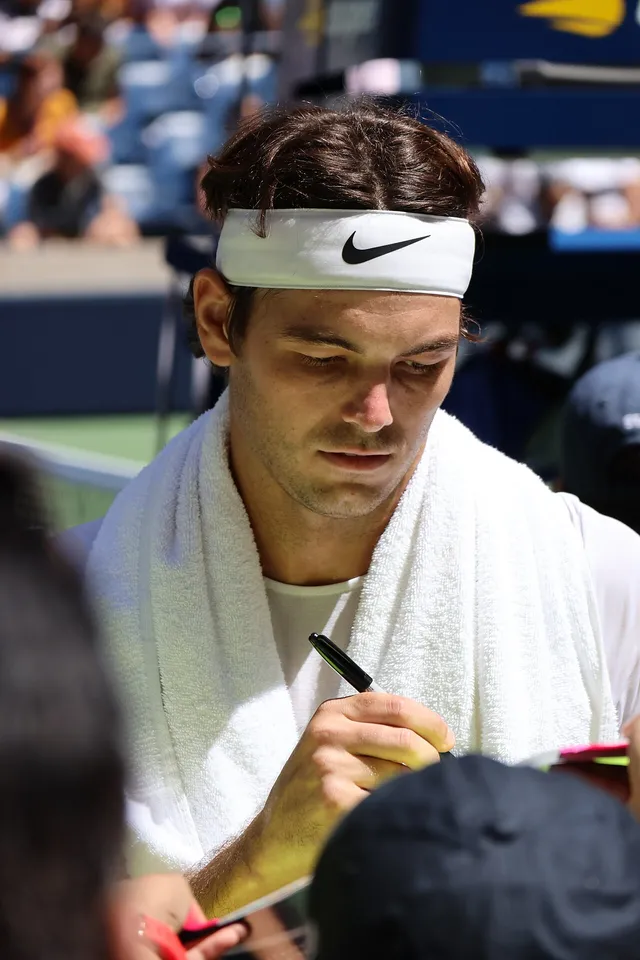
Taylor Fritz after practice at the 2023 US Open; the photograph predates his 2024 final.
How can you calculate a useful percentage?
In a fictional sample, a receiver wins 16 of 40 points against first serves. The rate is 40 percent. If the receiver wins 12 of 20 against second serves, that rate is 60 percent. The combined return rate is 28 divided by 60, about 46.7 percent. It is not the simple average of 40 and 60.
Why an unweighted average can mislead
The two categories contain different numbers of points. Averaging their percentages equally would give the smaller category the same weight as the larger one. Adding the raw wins and opportunities before dividing preserves the actual sample. This is a general mathematics lesson that applies to exam results, survey responses and sports statistics as well as tennis.
Rounding should follow the calculation
Keep enough precision while calculating, then round the displayed result consistently. Rounding every intermediate value can create small differences in the final answer. More decimal places do not automatically make a conclusion more reliable, especially with a small sample. A clear fraction and sensible rounding usually communicate more than a long string of digits.
What makes a forehand pattern worth studying?
A forehand pattern is a repeated sequence of positions and targets, not simply a collection of forehand winners. It might involve a serve creating a particular return, followed by a ball directed into space. To identify the pattern, note where the ball came from and where the opponent was, rather than watching the finishing swing alone.
Recognise the cost of running around a backhand
Moving to play a forehand from a backhand-side position can open attacking possibilities, but it can also leave space elsewhere. The decision depends on time and recovery options. Do not assume that using a preferred stroke is always worth the movement cost. The court position after contact is part of the evaluation, not an unrelated detail.
Margin is part of an attacking choice
A target slightly inside the sideline can preserve pressure while reducing the risk of missing. A shot does not need to land on a line to be effective. For students, this is a valuable reasoning principle: the most dramatic-looking option is not always the option with the strongest balance between expected benefit and controllable risk.
How should you compare two tournament runs?
Begin with the event category, surface, format and opponents. A title and a final at another event are different kinds of evidence. The draw and conditions can also vary. Avoid declaring a player better or worse from a single round label without asking what happened within each run and what question the comparison is intended to answer.
Rankings need a release date
A current ranking, a career high and a year-end ranking are separate records. A result may influence a later update without producing the same position immediately. Use the official dated table for a ranking claim. This article deliberately focuses on established milestones rather than copying a number that could become stale while the explanation remains useful.
Head-to-head results need a defined sample
A record against another player may combine different surfaces and seasons. It can provide background without determining the next match. If you use a subset, state why it is relevant and how many meetings it includes. Choosing only favourable results while hiding the selection rule makes an analysis less credible even if each selected result is correct.
A classroom project using fictional tennis data
Create a table with first serves faced, points won against them, second serves faced and points won against those. Calculate each rate and the combined rate. Then change the sample sizes while keeping the individual percentages constant. The exercise shows how the overall figure can move even though neither category's percentage changes.
Add validation before a chart
Reject negative counts and values where points won exceed points played. Handle an empty sample without dividing by zero. Display the raw counts beside the graph so the viewer can inspect the evidence. Good visual design cannot rescue an invalid denominator. The calculation should be trustworthy before the presentation is made more attractive.
Connect the exercise to a real record carefully
The programming courses can help students implement the calculator, while the class resources support the mathematics. When replacing fictional data with real figures, add the event, match date and official source. A simple tool becomes more useful when it makes uncertainty and scope visible instead of presenting every output as a universal measure of ability.
Questions about Taylor Fritz
Did Fritz win the 2024 US Open?
No. He reached the men's singles final and finished runner-up to Jannik Sinner. The 2022 Indian Wells title is a different achievement. Keeping the two events separate gives an accurate account of both the trophy and the major-final breakthrough. A profile should not combine their headlines into a title claim that the official result does not support.
Does first-strike tennis mean avoiding long rallies?
No. It describes an intention to influence the point early, but the opponent can neutralise the first attack. The player then needs to continue solving the rally. Studying the transition from serve or return into the exchange is more useful than assuming every longer point represents a failure of the original tactical idea.
Sources
- ATP Tour: Taylor Fritz biography and career milestones
- US Open: the official 2024 men's singles final report
Image credits: cover: Vbrunophotog, source, CC BY-SA 4.0. Resized and converted to WebP. inline: Hameltion, source, CC BY-SA 4.0. Resized and converted to WebP.
Found an error or an outdated detail? Report a correction with the article URL and original source.