
Titan Shares: Jewellery, Watches, Store Growth, Inventory and Results
Understand Titan shares through jewellery, watches, store growth, inventory and financial results. Separate gold prices, sales value and physical volume.

Titan share-price searches concern Titan Company Limited, whose business extends beyond watches into jewellery, eyewear and other disclosed categories. A gold-price quotation, the selling price of a watch and an equity quote describe different transactions. Understanding those differences helps readers interpret the company's retail and financial announcements.
Titan's official annual-report library and results announcements are the starting sources. This guide explains jewellery sales, product mix, store expansion, inventory, margins and reporting scope. It does not publish an invented current share price or recommend buying jewellery or shares. Numerical examples are hypothetical learning exercises and should not be mistaken for actual Titan prices, charges or forecasts.
Identify the company rather than one product
A familiar product brand can help a customer recognise a shop, but company analysis needs the full reporting entity. A jewellery outlet and a watch brand may contribute differently to the same group's results. The report identifies the actual businesses and boundaries.
When comparing a share quote with earnings, use the matching company and period. Do not treat a retail product's ticket price as the price of company ownership. Equally, a photograph of one store cannot establish the performance of every location or business category.
| Measure | What it answers |
|---|---|
| Retail selling price | Cost of a particular product under its terms |
| Store count | Defined locations at a reference date |
| Sales volume | Quantity under the disclosed measure |
| Business income | Financial activity for the stated scope |
| Share price | Market quote for the identified security |
Jewellery, watches and eyewear have different drivers
Titan's disclosed business categories serve different customer needs and use different operating measures. A movement in jewellery income cannot automatically explain a watch-category margin. Reading each business separately helps locate the source of a group-level change.
Consider a fictional retailer with jewellery revenue of 80 and watch revenue of 20. If jewellery grows while watches remain unchanged, the total rises, but it would be inaccurate to say every category expanded. The group headline and the category explanation answer different questions.
Actual segment definitions may not match a simple product list. Use the annual report's presentation and reconciliation. A brand familiar to consumers should not become an invented financial segment merely because it is easy to recognise in a headline.
Jewellery value and physical quantity can move differently
Jewellery sales value can be affected by the value of the metal, product design, mix and quantity. A rise in currency revenue does not establish the same increase in grams or units sold. The actual operating measure should come from the company's disclosure.
For a fictional example, ten items sold at 100 each create 1,000 of sales. Selling nine items at 120 creates 1,080. Currency sales rise while the item count falls. The example demonstrates a relationship, not a claim about Titan's actual customer purchases.
The correct question is what the report identifies as the driver. If it discusses value growth without providing a physical quantity, do not manufacture a volume estimate from an unrelated gold quotation. Leave the missing measure visible rather than presenting an unsupported calculation.
Gold price is not the complete retail price
A jewellery transaction can involve product characteristics, making-related charges and other applicable components under the actual terms. The underlying metal quotation is therefore not automatically the final retail price. A company share quote is a further separate measure.
In an invented invoice, a metal component of 80 and a stated service component of 20 create 100 before any remaining specified items. The illustration explains why the components should be identified. It is not an actual Titan invoice or a statement of applicable taxes.
For a purchase, use the provider's current product and invoice details. For company analysis, use the financial disclosures. Mixing a consumer's metal-price calculation with a company-wide margin is not a shortcut; it joins two different questions without the necessary information.
Product mix can change margin
Retail categories can contain products with different prices, costs and customer demand. A shift in mix can affect the financial result even if total customer traffic is similar. The report's explanation is needed to identify the actual change.
Imagine a fictional business selling two product groups with different gross margins. If the lower-margin category becomes a larger share of sales, the combined margin can fall even while revenue grows. No product has to suffer a price cut for that arithmetic to occur.
Do not assign actual product margins without a legitimate disclosure. The example teaches why mix matters. A useful article distinguishes a general mechanism from the specific evidence required to explain Titan's quarterly or annual result.
Store openings and mature-store performance differ
A new location expands a retail network, but it may operate for only part of a reporting period. Existing locations may have different customer bases, sizes and product assortments. Store count is therefore not a direct substitute for revenue or comparable growth.
An invented retailer opens five shops on the last day of a quarter. The closing store count rises, but those shops have not produced a full quarter's sales. Using the new closing count as the number operating throughout the quarter would misstate the comparison.
Read the actual definitions for store additions and comparable business measures. If the report does not provide a mature-store statistic, do not create one by dividing total revenue by a closing store count and labelling the result as an official productivity measure.
A store's location does not establish ownership or scope
A retail network can use different operating arrangements. The specific relationship between a location and the reporting company should be established from legitimate company information. A sign or brand name alone does not explain how every transaction enters the accounts.
For a fictional network, company-operated locations and partner-operated outlets may be presented differently under the relevant arrangements. Counting them together without their definitions can be useful for one network measure and unsuitable for another financial calculation.
For Titan's real reporting, preserve the company's categories. Do not infer a franchise or ownership structure from a photograph. The practical habit is to identify what a store-count measure includes before using it to explain revenue, capital expenditure or employee costs.
Inventory is important in a high-value retail business
Retail inventory connects product availability with cash committed before sale. Its currency value can change because of quantity, cost, mix and other accounting factors. A higher inventory balance does not by itself prove either unsold excess or successful expansion.
In a fictional exercise, the same ten items valued at a different unit cost produce a different inventory total. That is not identical to holding more physical items. The accounting note and actual operating record are needed to explain a real balance change.
Read inventory alongside sales, payables and cash flow. A business can increase reported sales while also committing cash to stocking additional locations. The financial explanation should preserve both movements rather than use one to deny the existence of the other.
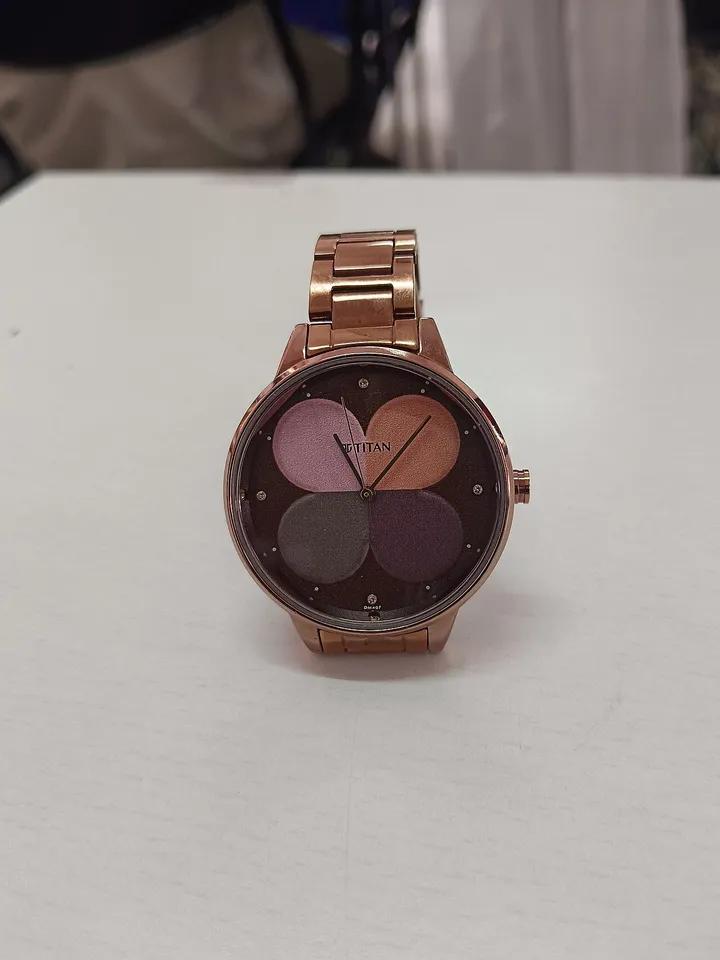
A Titan wristwatch, shown as product context rather than a newly announced model or a current retail-price quotation.
Inventory turnover needs a consistent basis
An inventory-turnover calculation depends on the chosen numerator, average inventory and period. Different definitions can produce different ratios. The method should remain visible so that a comparison does not confuse sales-based and cost-based calculations.
Suppose a fictional cost-of-sales figure is 120 and average inventory is 30. A simple cost-based turnover is four times for the exercise. Replacing the average with a closing balance of 20 would produce six, but it would change the calculation's basis.
For an actual report, use the disclosed measure or state a clearly defined independent calculation. A ratio without its method should not be used to claim that Titan's stock is moving faster or slower than a competitor's differently measured inventory.
Watches involve value, volume and category mix
Watch-business revenue can change with the number of units, realised selling value and product mix. A category trend and a particular model's popularity do not establish the same thing. The report's actual measures are the evidence for business performance.
For an invented example, 100 watches at an average of ten produce 1,000. Selling 90 at an average of 12 produces 1,080. Sales value rises despite fewer units. Calling that a ten-percent volume increase would be wrong.
The same care applies to broad labels such as premium products or connected devices. Use the company's defined categories and dated figures. A product launch establishes that a launch was announced, not how many units were sold or what profit they generated.
International expansion changes comparison boundaries
New markets and acquisitions can alter the scope of a group's financial results. A business included for part of one year and a longer period in another can affect reported growth independently of changes at existing stores. The acquisition and consolidation dates matter.
Titan's FY2026 results announcement discusses the inclusion of Damas in the period's context. Readers should retain the relevant timing and exclusions when interpreting the reported international figures. The announcement should not be reduced to a generic claim that every location performed identically.
A fictional acquisition completed late in a year contributes a different length of trading history from a mature operation included throughout. Identify that boundary before treating the group increase as like-for-like growth. The actual statements and notes provide the applicable treatment.
Currency translation can affect international comparisons
Sales measured in a local currency and their translated reporting-currency value can move differently. That does not necessarily mean customer activity changed by the same amount. The company may explain relevant currency effects using its stated reporting method.
For a fictional overseas store, local revenue stays at 100 while the conversion rate changes from two to 1.9 reporting units per local unit. The translated amount changes from 200 to 190. The example isolates currency, not an actual Titan market result.
Use the actual report when evaluating a real period. Do not apply today's exchange rate to an entire historical year's transactions without explaining the assumption. A useful comparison keeps operational changes separate from translation effects where the evidence allows it.
Operating profit is different from final earnings
Business income, operating profit, profit before tax and profit after tax represent different stages of the financial result. Company-defined measures and exclusions also need their labels. A strong sales headline does not independently establish the final earnings movement.
In a fictional business, revenue is 200, product cost is 140 and operating expenses are 40. The resulting operating remainder of 20 still differs from final profit once the remaining stated items are considered. The calculation is intentionally simplified.
For Titan, follow the reported measure and scope rather than substituting one convenient headline for another. A category operating margin and the consolidated after-tax margin cannot be compared as if they were the same calculation.
Cash flow adds the timing of receipts and spending
Profit can be recognised in a different period from related cash movements. Inventory purchases, supplier terms, store investment and customer-related balances can affect the cash picture. Their actual treatment belongs in the statements rather than assumptions based on retail footfall.
An invented retailer earns 30 but commits another 15 to inventory and ten to new equipment during the period. Its cash story differs from simply placing 30 in the bank. The actual bridge may contain other items, so the exercise should remain a learning model.
Read the cash-flow statement with the income statement. A sales increase and investment-related cash spending can coexist. Neither should be ignored just because the other is more convenient for a positive or negative narrative about the company.
Build a retail-results notebook
Create sections for jewellery, watches, eyewear and other categories according to the report's definitions. Record the period, scope, value measure, physical measure if available and source. Keep store additions separate from existing-store performance and acquisitions separate from comparable operations.
Then explain one change at a time. Was it volume, selling value, mix, additional locations, currency or reporting scope? If the source does not establish a cause, preserve the uncertainty instead of attributing every movement to gold prices or festive demand.
Use class resources to practise averages and percentage changes. Learners in programming courses can build a simple retail dashboard that labels each input as a count, currency amount, rate or period, preventing unlike quantities from being combined silently.
Questions about Titan shares
Is Titan only a watch company?
Its disclosed business covers several categories, including jewellery, watches and eyewear. Use the current annual report for the actual scope and financial presentation. A well-known product does not necessarily represent the largest or only contributor to a company's reported result.
Does higher gold value prove stronger physical jewellery sales?
No. Currency value, item count and physical quantity are different measures. Prices and product mix can change sales value without the same change in quantity. Read the actual operating disclosure rather than deriving a volume claim from a metal-price headline.
Do more stores guarantee higher profit?
No. Opening dates, costs, size, productivity and operating arrangements matter. A closing network count does not describe a full period of sales at mature locations. Use the report's definitions and financial results before drawing a conclusion about the effect of expansion.
Does the article provide a current share or jewellery price?
No. Obtain an identified, timestamped quote for the equity and the actual provider's current terms for a product. The calculations here are fictional teaching examples. They explain relationships and do not replace an official market feed, invoice or product disclosure.
Sources
- Titan official annual-report library
- Titan FY2026 results and business-category context
- Titan official historical earnings presentation: category definitions
Image credits: cover: Moochika, source, CC BY-SA 4.0. Resized and converted to WebP. inline: Darakshanehaluddin, source, CC0. Resized and converted to WebP.
Found an error or an outdated detail? Report a correction with the article URL and original source.