
Tucker Carlson: Career, TCN, Books and How to Read an Interview
Understand Tucker Carlson’s media career, the 2023 Fox departure, TCN and his books, with a guide to context, subtitles and checking interview claims.

Tucker Carlson is an American political commentator, interviewer and author whose earlier television work included Fox News, CNN and MSNBC. His present online publishing operation is Tucker Carlson Network, commonly shortened to TCN. Fox News announced that the network and Carlson had parted ways on 24 April 2023. An old Fox clip therefore needs its original date rather than a caption suggesting he is still presenting that programme there.
For readers in Pakistan, a search for his name can lead to a full interview, a short subtitled excerpt, a book or a political argument about something a guest said. Those are different kinds of material. This profile explains the public career, the current viewing routes and a practical way to evaluate an interview without assuming that either the host's reputation or a viral caption proves a claim true.
Tucker Carlson's public work
Carlson is best understood as a commentator and interviewer with a career across several media formats. Hachette's author biography records his earlier work on CNN's Crossfire and MSNBC's Tucker, his connection with The Daily Caller and his writing for magazines and newspapers. Those credits help explain the background of a recognisable television figure.
The biography is also a useful example of a source that can preserve historical wording. A publisher page connected with an older book may describe an earlier role without functioning as a current employment directory. The dated Fox announcement supplies a clear boundary for the end of his relationship with that network.
His present site organises material into interviews, monologues, speeches and documentaries. Those labels describe different viewing experiences. An interview contains another person's answers; a monologue gives the presenter more direct control of the argument; a documentary combines selected material into an edited narrative. A reader benefits from recognising the form before evaluating the content.
What Fox News confirmed in April 2023
Fox's announcement on 24 April 2023 said that Fox News Media and Carlson had agreed to part ways. It also identified the preceding Friday's programme as his last. That is a dated primary announcement, rather than an inference drawn from an absent episode or a third-party social account.
The short statement should not be expanded into a detailed private explanation that it does not contain. It establishes the separation. It does not, by itself, establish every internal conversation, contractual provision or personal motive that later commentary may discuss.
For someone finding an archived segment, this distinction prevents a simple chronological mistake. A video recorded when Carlson worked at Fox remains a real historical clip. Reposting it years later does not make it a new Fox broadcast, and a fresh upload date does not change the date when the original conversation took place.
What Tucker Carlson Network publishes
TCN's site presents a catalogue of Carlson's online work with routes for watching and listening. Its own navigation separates The Tucker Carlson Show, interviews, monologues, speeches and documentary titles. The site also links to podcast platforms, providing an audio route distinct from watching through the main website.
Use the creator's own catalogue to establish an episode's title, publication date and original presentation. It is a primary source for what the programme published. It is not independent verification of every historical, scientific, political or financial assertion made by a host or guest.
That distinction lets readers use the original source without surrendering judgement. The original conversation is the right place to establish what somebody actually said. The relevant document, dataset, official record or qualified research is then the place to examine whether the underlying claim is supported.
Interviews, monologues and documentaries need different reading
In an interview, listen for the boundary between a question and an answer. A host may introduce a claim in a question, challenge a guest or simply invite a longer explanation. Agreement should not be inferred from every nod, and a guest's answer should not be rewritten as a statement by the interviewer.
A monologue usually provides a more continuous argument from the presenter. Notice the sequence of evidence, examples and conclusions. A powerful example may illustrate an issue without establishing how common it is across a whole population. The size of the conclusion should be compared with the size of the supporting evidence.
A documentary introduces another layer: editorial selection. It can combine interviews, archive footage, music, captions and narration. Each element has a source and a function. A dramatic transition is part of presentation; it is not another independent witness confirming the argument.
Why short clips can change the meaning
A short excerpt can be accurate and still omit information that matters. A reply may refer to a qualification in the previous question, or a strong statement may be followed immediately by a correction. Watching a little before and after the shared passage often resolves uncertainty that a caption leaves open.
Captions also introduce a second author. The person uploading an excerpt chooses a headline, translation and start point. Those choices may come from the original publisher, a supporter, a critic or an unrelated account seeking attention. Their interpretation should not silently replace the speaker's words.
Before sharing an especially surprising statement, find the corresponding passage in the complete programme. Record its date and timestamp. That makes a discussion more useful: other people can inspect the same material instead of debating two differently edited versions of a conversation.
Translation matters for Pakistani viewers
An Urdu subtitle can help a viewer follow fast English speech, but it can also simplify a distinction that matters. Expressions of possibility, probability and certainty should not all become the same confident statement. Similarly, a guest describing what someone alleged is not necessarily endorsing the allegation.
When a claim is important, compare the subtitle with the original audio and any official transcript available. Pay particular attention to words such as may, reportedly, alleged and confirmed. Removing those qualifiers can make a cautious observation sound like an established fact.
A translation should also preserve who is speaking. A caption placed over a reaction shot can confuse the guest's words with the host's response. If the source remains unclear, link to the longer passage rather than making an emphatic claim based solely on an unattributed translated image.
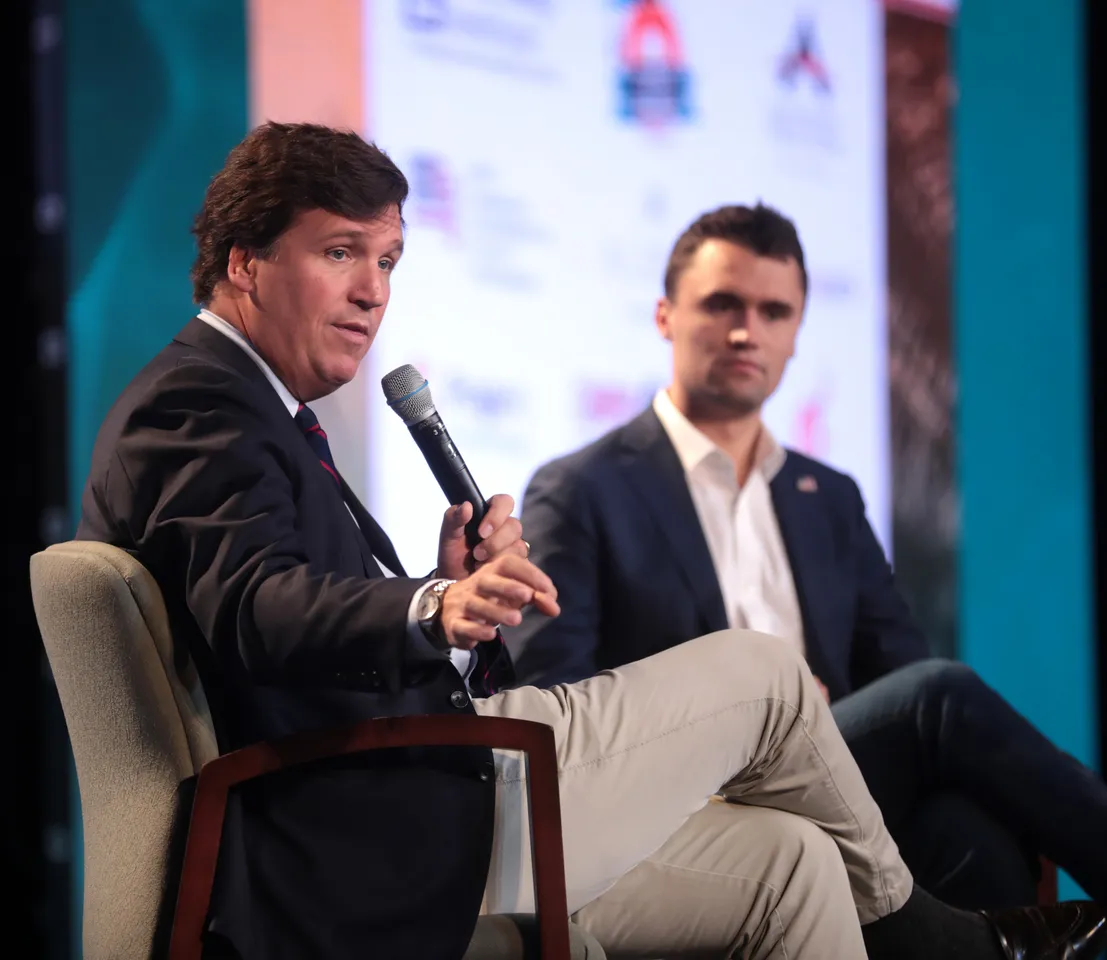
Historical 2018 appearance, not evidence of a new interview or the present status of either participant.
His books are another part of the public record
Hachette lists Politicians, Partisans, and Parasites under Carlson's work. Simon & Schuster publishes Ship of Fools, whose subtitle presents an argument about American elites. These are authored works with their own publication context, not transcripts of every programme produced later.
The publisher's description is useful for identifying the book and its advertised subject. Promotional language on a sales page should be recognised as promotional language, even when the page is the authoritative source for the title, author and edition.
When discussing a passage, identify the book and edition rather than relying on a quotation graphic. A paperback, ebook and audiobook may have different pagination or navigation. A chapter reference and enough surrounding context give another reader a much better chance of finding the same argument without reproducing long copyrighted passages.
A claim is stronger when its evidence can be checked
Treat a programme as the start of an inquiry when it introduces an unfamiliar subject. Identify the specific factual statement rather than the general emotional impression. A claim about a date, a vote, a court decision or a measured change can usually be checked more directly than an assertion that everything has become worse.
Then look for the record that would support that statement. A court filing is different from a final judgement, and a proposal is different from an enacted rule. A survey should identify who was asked and when. A chart should identify the unit and the period it covers.
This approach works whether the claim comes from Carlson, a guest, a critic or another broadcaster. It does not require agreement with a political position. It requires the evidence to answer the same question as the assertion rather than a loosely related question that sounds persuasive beside it.
Guest credentials and guest claims are separate
A guest may have relevant professional experience, personal involvement or access to information. That can make the conversation worth hearing, but it does not automatically establish every statement the guest makes. Experience in one field also does not create unlimited authority across unrelated subjects.
Ask whether the guest is describing something personally observed, interpreting a public record or repeating information received from somebody else. Those are different relationships to evidence. A first-hand account can still have limits, while a well-sourced interpretation can be useful without the speaker having witnessed an event.
The same care applies to criticism. Disliking a guest's politics does not disprove a document, just as admiring a guest does not authenticate one. Read the actual material where possible and keep the person's argument separate from assumptions about personal character.
Watching and listening through the official routes
The network's own site provides its current catalogue and listening links. Start there if you want to distinguish a genuine programme from an impersonating channel or an edited re-upload. A familiar photograph and a similar account name are not enough to establish that an account belongs to the publisher.
Some content and account functions are connected with membership. Review the actual terms shown before purchasing, including renewal, currency and the platform handling the payment. This guide does not promise a particular Pakistan price, discount or catalogue entitlement.
TCN's FAQ describes an account-management route for billing changes and cancellation. It says cancellation takes effect at the end of the current membership term. That is useful context, but the terms attached to the actual purchase remain important, particularly when a subscription is arranged through a third-party app or marketplace rather than directly on the website.
Keep account support separate from social-media replies
Use the official site's account and support links for an account problem. A reply under a viral clip is a poor place to disclose a password, payment reference or personal document. An account pretending to offer urgent help can copy the presenter's name without having any connection with the service.
The network FAQ describes password-reset and account-management email flows. If you request such an email, check the destination and the account action before continuing. An unsolicited message asking for a password should not be treated as legitimate merely because it uses a programme logo.
There is no need to post private billing details publicly to prove that a cancellation request exists. Keep confirmation messages for your own records and use the service's stated support process. This is ordinary account hygiene, not evidence that any named programme has suffered a particular security incident.
How to discuss a controversial interview constructively
Begin with the narrow point you want to examine. Identify the episode, speaker, date and passage. Then separate the original statement from your own interpretation. A discussion becomes much clearer when another person can tell which words are being attributed and which conclusion belongs to the person sharing them.
Avoid treating an entire audience as though it has one motive. People can watch an interview to learn about a guest, evaluate an argument, follow public affairs or disagree with what is said. The fact that a video is popular does not establish why each viewer opened it.
Corrections should be specific too. If a date or figure is wrong, provide the corrected record. If the problem is an omitted qualification, show the surrounding context. Replacing one broad insult with another adds attention without resolving the question that made the interview worth checking in the first place.
Questions about Tucker Carlson
Does Tucker Carlson still host his former Fox programme?
Fox News announced its separation from Carlson on 24 April 2023. His present online publishing operation is TCN. An archived Fox segment can remain available or be shared again, but that does not make it a new episode of his former network programme.
Is the official interview proof that a guest's claim is correct?
The original interview can establish what the guest said and the context in which it was said. Whether the claim is correct requires appropriate evidence beyond the fact of publication. Check the relevant record, research or data rather than treating appearance on a programme as verification.
Why can a publisher biography sound out of date?
A book page may preserve a biography written around an earlier edition or period in the author's career. It remains useful for identifying that work and historical credits. Current roles should be checked against later dated announcements and the present publisher or programme record.
More public-affairs explainers are available in the article library. For separate student learning resources, browse academic classes.
Sources
- Fox News Media's 24 April 2023 announcement, for the dated separation from the network.
- Tucker Carlson Network's own about page, for the publisher's identity and content categories, not independent verification of programme claims.
- TCN FAQ, for the site's stated account-management and cancellation routes. No price or entitlement is guaranteed here.
- Hachette author biography, for historical media credits and Politicians, Partisans, and Parasites. Older role wording is not treated as current employment confirmation.
- Simon & Schuster: Ship of Fools, for book identity and the publisher's description. Promotional claims are not adopted as independently established conclusions.
Image credits: cover: Gage Skidmore from Surprise, AZ, United States of America, source, CC BY-SA 2.0. Resized and converted to WebP. inline: Gage Skidmore from Peoria, AZ, United States of America, source, CC BY-SA 2.0. Resized and converted to WebP.
Found an error or an outdated detail? Report a correction with the article URL and original source.